Current issue
Archive
Manuscripts accepted
About the Journal
Editorial office
Editorial board
Section Editors
Abstracting and indexing
Subscription
Contact
Ethical standards and procedures
Most read articles
Instructions for authors
Article Processing Charge (APC)
Regulations of paying article processing charge (APC)


METABOLIC SYNDROME / RESEARCH PAPER
Serum Preptin as a Potential Biomarker for Metabolic Syndrome and Insulin Resistance
1
Kirsehir Ahi Evran University, Faculty of Medicine, Department of Medical Biochemistry, Turkey
2
Kirsehir Ahi Evran University,Faculty of Medicine, Department of Internal Medicine, Turkey
3
Amasya University,Faculty of Medicine, Department of Physiology, Turkey
4
Kirsehir Ahi Evran University, Faculty of Medicine, Department of Public Health, Turkey
Submission date: 2025-03-07
Final revision date: 2025-08-12
Acceptance date: 2025-08-12
Online publication date: 2025-11-28
Corresponding author
Gamze Turna Saltoglu
Kirsehir Ahi Evran University, Faculty of Medicine, Department of Medical Biochemistry, Kirsehir, Turkey
Kirsehir Ahi Evran University, Faculty of Medicine, Department of Medical Biochemistry, Kirsehir, Turkey
KEYWORDS
TOPICS
ABSTRACT
Introduction:
Metabolic syndrome (MetS) is a complex condition involving obesity, hyperglycemia, dyslipidemia, and hypertension. Preptin, a novel molecule co-secreted with insulin from pancreatic β-cells, has been suggested to play a role in insulin resistance and glucose and lipid metabolism. This study aimed to evaluate the differences in serum preptin levels between healthy controls and MetS patients, and to investigate its relationship with clinical parameters.
Material and methods:
The study included forty MetS patients and forty age- and sex-matched healthy controls. Demographic and clinical data were collected, the serum preptin levels were measured by Enzyme-Linked Immunosorbent Assay (ELISA). The relationships between the serum preptin levels and clinic parameters were assessed.
Results:
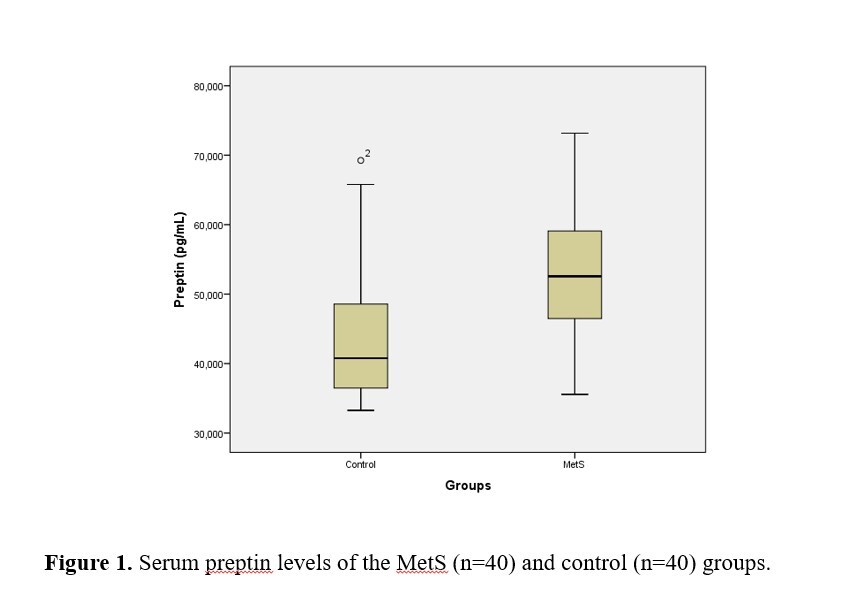
Serum preptin levels were significantly higher in MetS patients compared to the control group (53.77 pg/mL vs. 40.77 pg/mL, p<0.001). MetS patients also had higher triglyceride, cholesterol, low-density lipoprotein cholesterol (LDL-C), fasting glucose, Hemoglobin A1c (HbA1c), insulin, and Homeostatic model assessment of insulin resistance (HOMA-IR) values compared to controls (all p<0.001). A positive correlation was found between serum preptin, insulin (r=0.432, %95 CI:0.07-0.57, p=0.0050), and HOMA-IR (r=0.426, %95 CI:0.08-0.56, p=0.0060) in the MetS group.
Conclusions:
The results indicate that serum preptin levels are significantly elevated in MetS patients. Furthermore, high serum preptin levels were positively correlated with insulin and insulin resistance. These results suggest that preptin may be involved in the insulin resistance pathway via insulin-like growth factor II (IGF-II) modulation. Therefore, further extensive studies are required to fully understand the precise role in MetS and underlying mechanisms of preptin.
Metabolic syndrome (MetS) is a complex condition involving obesity, hyperglycemia, dyslipidemia, and hypertension. Preptin, a novel molecule co-secreted with insulin from pancreatic β-cells, has been suggested to play a role in insulin resistance and glucose and lipid metabolism. This study aimed to evaluate the differences in serum preptin levels between healthy controls and MetS patients, and to investigate its relationship with clinical parameters.
Material and methods:
The study included forty MetS patients and forty age- and sex-matched healthy controls. Demographic and clinical data were collected, the serum preptin levels were measured by Enzyme-Linked Immunosorbent Assay (ELISA). The relationships between the serum preptin levels and clinic parameters were assessed.
Results:
Serum preptin levels were significantly higher in MetS patients compared to the control group (53.77 pg/mL vs. 40.77 pg/mL, p<0.001). MetS patients also had higher triglyceride, cholesterol, low-density lipoprotein cholesterol (LDL-C), fasting glucose, Hemoglobin A1c (HbA1c), insulin, and Homeostatic model assessment of insulin resistance (HOMA-IR) values compared to controls (all p<0.001). A positive correlation was found between serum preptin, insulin (r=0.432, %95 CI:0.07-0.57, p=0.0050), and HOMA-IR (r=0.426, %95 CI:0.08-0.56, p=0.0060) in the MetS group.
Conclusions:
The results indicate that serum preptin levels are significantly elevated in MetS patients. Furthermore, high serum preptin levels were positively correlated with insulin and insulin resistance. These results suggest that preptin may be involved in the insulin resistance pathway via insulin-like growth factor II (IGF-II) modulation. Therefore, further extensive studies are required to fully understand the precise role in MetS and underlying mechanisms of preptin.
REFERENCES (24)
1.
Alberti KG, Eckel RH, Grundy SM, et al. International Diabetes Federation Task Force on Epidemiology and Prevention, Hational Heart, Lung, and Blood Institute, American Heart Association, World Heart Federation, International Atherosclerosis Society, & International Association for the Study of Obesity (2009). Harmonizing the metabolic syndrome: a joint interim statement of the International Diabetes Federation Task Force on Epidemiology and Prevention; National Heart, Lung, and Blood Institute; American Heart Association; World Heart Federation; International Atherosclerosis Society; and International Association for the Study of Obesity. Circulation, 120(16), 1640–1645.
2.
Kanwar P, Kowdley K V. The Metabolic Syndrome and Its Influence on Nonalcoholic Steatohepatitis. Clin Liver Dis 2016;20(2):225–243.
3.
Grundy SM. Metabolic Syndrome Pandemic. Arterioscler Thromb Vasc Biol 2008;28(4):629–36.
4.
National Cholesterol Education Program (NCEP) Expert Panel on Detection, Evaluation, and Treatment of High Blood Cholesterol in Adults (Adult Treatment Panel III). Third Report of the National Cholesterol Education Program (NCEP) Expert Panel on Detection, Evaluation, and Treatment of High Blood Cholesterol in Adults (Adult Treatment Panel III) final report. Circulation 2002;106:3143–3421.
5.
Alberti KG, Zimmet P, Shaw J for IDF Epidemiology Task Force Consensus Group. The metabolic syndrome-a new worldwide definition. The Lancet 2005;366:1059-1062.
6.
Alberti KG, Zimmet P, Shaw J. Metabolic syndrome--a new world-wide definition. A Consensus Statement from the International Diabetes Federation. Diabet Med 2006;23(5):469-480.
7.
Buchanan CM, Phillips AR, Cooper GJ. Preptin derived from proinsulin-like growth factor II (proIGF-II) is secreted from pancreatic islet beta-cells and enhances insulin secretion. Biochem J 2001;360: 431-439.
8.
Cheng KC, Li YX, Asakawa A, et al. Characterization of preptin-induced insulin secretion in pancreatic beta-cells. J Endocrinol 2012;215(1):43-49.
9.
Yang G, Li L, Chen W, Liu H, Boden G, Li K. Circulating preptin levels in normal, impaired glucose tolerance, and type 2 diabetic subjects. Ann Med 2009;41(1):52-56.
10.
Kalayci M, Halifeoglu I, Kalayci H, Ugur K, Yilmaz M. Plasma preptin levels in patients with type 2 diabetes mellitus. Int J Med Biochem 2019;2(1):1-5.
11.
Wang R, Xue A, Zheng W, et al. Elevated serum preptin concentrations in patients with diabetic nephropathy. J Investig Med 2019;67(7):1048–1052.
12.
Celik O, Celik N, Hascalik S, Sahin I, Aydin S, Ozerol E. An appraisal of serum preptin levels in PCOS. Fertil Steril 2011;95(1):314–316.
13.
Li B, Li Y, Zhang T, et al. Preptin is a new predictor of coronary artery calcification. Clin Chim Acta 2018;485:133–138.
14.
Li N, Zheng YB, Han J, et al. Lower circulating preptin levels in male patients with osteoporosis are correlated with bone mineral density and bone formation. BMC Musculoskelet Disord 2013;14:49.
16.
Dobrowolski P, Prejbisz A, Kuryłowicz A, et al. Metabolic syndrome – a new definition and management guidelines. A joint position paper by the Polish Society of Hypertension, Polish Society for the Treatment of Obesity, Polish Lipid Association, Polish Association for Study of Liver, Polish Society of Family Medicine, Polish Society of Lifestyle Medicine, Division of Prevention and Epidemiology Polish Cardiac Society, “Club 30” Polish Cardiac Society, and Division of Metabolic and Bariatric Surgery Society of Polish Surgeons. Archives of Medical Science. 2022;18(5):1133-1156.
17.
Grundy SM. Metabolic syndrome: a multiplex cardiovascular risk factor. J Clin Endocrinol Metab 2007;92(2):399-404.
18.
Buchanan CM, Peng Z, Cefre A, Sarojini V. Preptin analogues: chemical synthesis, secondary structure and biological studies. Chem Biol Drug Des 2013;82:429–437.
19.
Rahimi GRM, Bijeh N, Rashidlamir A. Effects of exercise training on serum preptin, undercarboxylated osteocalcin and high molecular weight adiponectin in adults with metabolic syndrome. Exp Physiol 2019;105(3):449–459.
20.
Rija FF, Musa MIS, Hamad HT. Some Biochemical Parameters and Level of Preptin in Newly Diagnosed Type 2 Diabetic Women Patients in Tikrit City. Journal of Chemical Health Risks 2022;12(2):179-182.
21.
Ozkan Y, Timurkan ES, Aydin S, et al. Acylated and desacylated ghrelin, preptin, leptin, and nesfatin-1 peptide changes related to the body mass index. Int J Endocrinol 2013;2013:236085.
22.
Yoldemir SA, Altun Ö . The Relationship Between Insulin Resistance and Serum Preptin Level. Ankara Med J 2019;4:708-715.
23.
Bu Z, Kuok K, Meng J, Wang R, Xu B. The relationship between polycystic ovary syndrome, glucose tolerance status and serum preptin level. Reprod Biol Endocrinol 2012;10:10.
24.
Mierzwicka A, Kuliczkowska-Plaksej J, Kolackov, K Bolanowski M. Preptin in Women With Polycystic Ovary Syndrome. Gynecol Endocrinol 2018;34(6):470–475.
| eISSN: | 1896-9151 |
| ISSN: | 1734-1922 |

We process personal data collected when visiting the website. The function of obtaining information about users and their behavior is carried out by voluntarily entered information in forms and saving cookies in end devices. Data, including cookies, are used to provide services, improve the user experience and to analyze the traffic in accordance with the Privacy policy. Data are also collected and processed by Google Analytics tool (more).
You can change cookies settings in your browser. Restricted use of cookies in the browser configuration may affect some functionalities of the website.
You can change cookies settings in your browser. Restricted use of cookies in the browser configuration may affect some functionalities of the website.