Current issue
Archive
Manuscripts accepted
About the Journal
Editorial office
Editorial board
Section Editors
Abstracting and indexing
Subscription
Contact
Ethical standards and procedures
Most read articles
Instructions for authors
Article Processing Charge (APC)
Regulations of paying article processing charge (APC)


SEXUOLOGY / STATE OF THE ART PAPER
Headaches, hormones, and transgender individuals: current evidence and knowledge gaps
1
Department of Neurology, Faculty of Medicine and Dentistry, Medical University of Warsaw, Poland
2
Doctoral School, Medical University of Warsaw, Poland
3
Department of Neurology, Medical University of Lublin, Poland
4
Department of Otorhinolaryngology and Oncological Laryngology, Faculty of Medical Sciences in Zabrze, Medical University of Silesia in Katowice, Poland
5
Department of Pharmacokinetics and Therapeutic Drug Monitoring, Pomeranian Medical University, Szczecin, Poland
6
Department of Psychiatry, Bielanski Hospital, Warsaw, Poland
Submission date: 2026-04-10
Final revision date: 2026-05-03
Acceptance date: 2026-06-18
Online publication date: 2026-09-05
Corresponding author
Olga Grodzka
Department of Neurology Faculty of Medicine and Dentistry Medical University of Warsaw 80 Cegłowska St 01-809 Warsaw, Poland
Department of Neurology Faculty of Medicine and Dentistry Medical University of Warsaw 80 Cegłowska St 01-809 Warsaw, Poland
KEYWORDS
gender diverse individualsgender diverse populationprimary headache disorderstransgender individuals
TOPICS
ABSTRACT
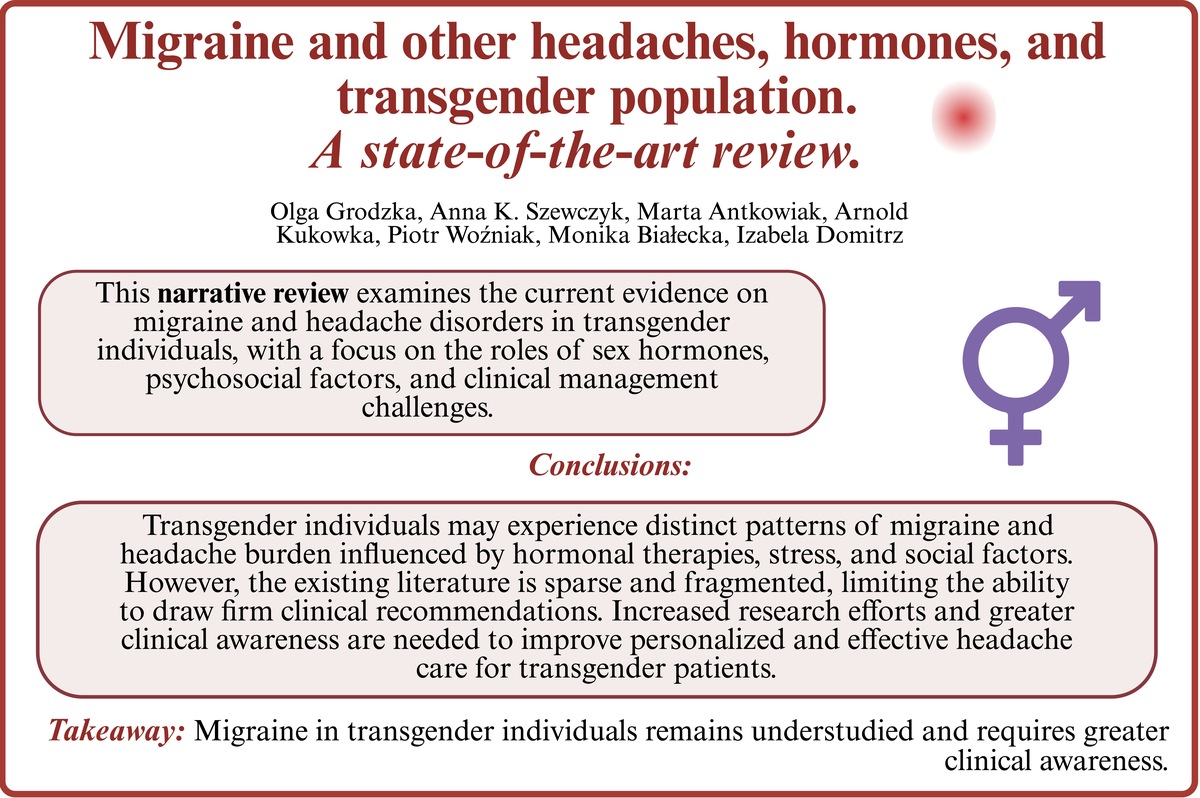
Migraine is a prevalent primary headache disorder affecting 14–17% of the global population and is strongly influenced by sex hormones. However, its characteristics in transgender individuals remain poorly understood and insufficiently studied. This review synthesizes evidence from 126 publications across neurology, otorhinolaryngology, pharmacology, and psychiatry to explore potential relationships between migraine and transgender health. Findings suggest that sex-related differences in migraine extend beyond epidemiology to clinical presentation, severity, and management, and may manifest uniquely in transgender patients. Factors such as gender-affirming hormone therapy, psychosocial stress, internal conflict, minority stress, and societal stigma may contribute to an increased headache burden. Additionally, barriers to healthcare access and limited provider knowledge may further complicate diagnosis and treatment. Despite these insights, data remain limited and fragmented. Greater awareness, interdisciplinary collaboration, and further research are needed to improve understanding and to develop more personalized, inclusive, and effective approaches to migraine management in transgender populations.
REFERENCES (139)
1.
Headache Classification Committee of the International Headache Society (IHS). The International Classification of Headache Disorders, 3rd edition. Cephalalgia 2018; 38: 1-211.
2.
Stovner LJ, Hagen K, Linde M, Steiner TJ. The global prevalence of headache: an update, with analysis of the influences of methodological factors on prevalence estimates. J Headache Pain 2022; 23: 34.
3.
Agosti R. Migraine burden of disease: from the patient’s experience to a socio-economic view. Headache 2018; 58 Suppl. 1: 17-32.
4.
Drescher J, Cohen-Kettenis P, Winter S. Minding the body: situating gender identity diagnoses in the ICD-11. Int Rev Psychiatry 2012; 24: 568-77.
5.
Cohen-Kettenis PT, Pfäfflin F. The DSM diagnostic criteria for gender identity disorder in adolescents and adults. Arch Sex Behav 2010; 39: 499-513.
6.
Poteat T, Davis AM, Gonzalez A. Standards of care for transgender and gender diverse people. JAMA 2023; 329: 1872-4.
7.
Coleman E, Radix AE, Bouman WP, et al. Standards of care for the health of transgender and gender diverse people, version 8. Int J Transgend Health 2022; 23 (Suppl. 1): S1-s259.
8.
Balthazart J. Minireview: hormones and human sexual orientation. Endocrinology 2011; 152: 2937-47.
9.
Bailey JM, Vasey PL, Diamond LM, Breedlove SM, Vilain E, Epprecht M. Sexual orientation, controversy, and science. Psychol Sci Public Interest 2016; 17: 45-101.
10.
Fisher AD, Ristori J, Morelli G, Maggi M. The molecular mechanisms of sexual orientation and gender identity. Mol Cell Endocrinol 2018; 467: 3-13.
11.
Hranilovich JA, Kaiser EA, Pace A, Barber M, Ziplow J. Headache in transgender and gender-diverse patients: a narrative review. Headache 2021; 61: 1040-50.
12.
Winter S, Diamond M, Green J, et al. Transgender people: health at the margins of society. Lancet 2016; 388: 390-400.
13.
Pace A, Barber M, Ziplow J, Hranilovich JA, Kaiser EA. Gender minority stress, psychiatric comorbidities, and the experience of migraine in transgender and gender-diverse individuals: a narrative review. Curr Pain Headache Rep 2021; 25: 82.
14.
Godley F, 3rd, Meitzen J, Nahman-Averbuch H, et al. How sex hormones affect migraine: an interdisciplinary preclinical research panel review. J Pers Med 2024; 14: 184.
15.
Gulati M, Dursun E, Vincent K, Watt FE. The influence of sex hormones on musculoskeletal pain and osteoarthritis. Lancet Rheumatol 2023; 5: e225-e38.
16.
Fitzek MP, Boucherie DM, de Vries T, et al. Migraine in men. J Headache Pain 2025; 26: 3.
17.
van Lohuizen R, Paungarttner J, Lampl C, MaassenVanDenBrink A, Al-Hassany L. Considerations for hormonal therapy in migraine patients: a critical review of current practice. Expert Rev Neurother 2023; 24: 1-21.
18.
Spooner MF, Robichaud P, Carrier JC, Marchand S. Endogenous pain modulation during the formalin test in estrogen receptor beta knockout mice. Neuroscience 2007; 150: 675-80.
19.
Athnaiel O, Cantillo S, Paredes S, Knezevic NN. The role of sex hormones in pain-related conditions. Int J Mol Sci 2023; 24: 1866.
20.
Reddy N, Desai MN, Schoenbrunner A, Schneeberger S, Janis JE. The complex relationship between estrogen and migraines: a scoping review. Syst Rev 2021; 10: 72.
21.
MacGregor EA, Frith A, Ellis J, Aspinall L, Hackshaw A. Incidence of migraine relative to menstrual cycle phases of rising and falling estrogen. Neurology 2006; 67: 2154-8.
22.
Raffaelli B, Storch E, Overeem LH, et al. Sex hormones and calcitonin gene-related peptide in women with migraine: a cross-sectional, matched cohort study. Neurology 2023; 100: e1825-e35.
23.
Kudo C, Harriott AM, Moskowitz MA, Waeber C, Ayata C. Estrogen modulation of cortical spreading depression. J Headache Pain 2023; 24: 62.
24.
Stincic TL, Grachev P, Bosch MA, Rønnekleiv OK, Kelly MJ. Estradiol drives the anorexigenic activity of proopiomelanocortin neurons in female mice. eNeuro. 2018; 5: ENEURO.0103-18.2018.
25.
Lacroix-Fralish ML, Tawfik VL, Nutile-McMenemy N, DeLeo JA. Progesterone mediates gonadal hormone differences in tactile and thermal hypersensitivity following L5 nerve root ligation in female rats. Neuroscience 2006; 138: 601-8.
26.
Kim MJ, Shin HJ, Won KA, et al. Progesterone produces antinociceptive and neuroprotective effects in rats with microinjected lysophosphatidic acid in the trigeminal nerve root. Mol Pain 2012; 8: 16.
27.
Carvalho B, Granot M, Sultan P, Wilson H, Landau R. A longitudinal study to evaluate pregnancy-induced endogenous analgesia and pain modulation. Reg Anesth Pain Med 2016; 41: 175-80.
28.
Chuang SH, Reddy DS. 3-Methyl-neurosteroid analogs are preferential positive allosteric modulators and direct activators of extrasynaptic -subunit -aminobutyric acid type a receptors in the hippocampus dentate gyrus subfield. J Pharmacol Exp Ther 2018; 365: 583-601.
29.
Vincent K, Stagg CJ, Warnaby CE, Moore J, Kennedy S, Tracey I. “Luteal analgesia”: progesterone dissociates pain intensity and unpleasantness by influencing emotion regulation networks. Front Endocrinol (Lausanne) 2018; 9: 413.
30.
Krause DN, Warfvinge K, Haanes KA, Edvinsson L. Hormonal influences in migraine – interactions of oestrogen, oxytocin and CGRP. Nat Rev Neurol 2021; 17: 621-33.
31.
Hornung RS, Benton WL, Tongkhuya S, Uphouse L, Kramer PR, Averitt DL. Progesterone and allopregnanolone rapidly attenuate estrogen-associated mechanical allodynia in rats with persistent temporomandibular joint inflammation. Front Integr Neurosci 2020; 14: 26.
32.
Gupta S, McCarson KE, Welch KM, Berman NE. Mechanisms of pain modulation by sex hormones in migraine. Headache 2011; 51: 905-22.
33.
Al-Hassany L, van Drie RWA, Boucherie DM, MaassenVanDenBrink A. Unraveling the paradox: cardiovascular risk profiling in migraine- a correspondence. J Headache Pain 2025; 26: 113.
34.
Somerville BW. The influence of progesterone and estradiol upon migraine. Headache 1972; 12: 93-102.
35.
Aloisi AM, Ceccarelli I, Fiorenzani P. Gonadectomy affects hormonal and behavioral responses to repetitive nociceptive stimulation in male rats. Ann N Y Acad Sci 2003; 1007: 232-7.
36.
Ceccarelli I, Scaramuzzino A, Massafra C, Aloisi AM. The behavioral and neuronal effects induced by repetitive nociceptive stimulation are affected by gonadal hormones in male rats. Pain 2003; 104: 35-47.
37.
Lashkari M, Noori A, Oveisi S, Kheirkhah M. Association of serum testosterone and dehydroepiandrosterone sulfate with rheumatoid arthritis: a case control study. Electron Physician 2018; 10: 6500-5.
38.
Pikwer M, Giwercman A, Bergström U, Nilsson J, Jacobsson LT, Turesson C. Association between testosterone levels and risk of future rheumatoid arthritis in men: a population-based case-control study. Ann Rheum Dis 2014; 73: 573-9.
39.
White HD, Brown LA, Gyurik RJ, Manganiello PD, Robinson TD, Hallock LS, et al. Treatment of pain in fibromyalgia patients with testosterone gel: Pharmacokinetics and clinical response. Int Immunopharmacol 2015; 27: 249-56.
40.
Verhagen IE, Brandt RB, Kruitbosch CMA, MaassenVanDenBrink A, Fronczek R, Terwindt GM. Clinical symptoms of androgen deficiency in men with migraine or cluster headache: a cross-sectional cohort study. J Headache Pain 2021; 22: 125.
41.
Mattsson P. Serum levels of androgens and migraine in postmenopausal women. Clin Sci (Lond) 2002; 103: 487-91.
42.
Kobus M, Sitek A, Antoszewski B, Rożniecki J, Pełka J, Żądzińska E. Prenatal oestrogen-testosterone balance as a risk factor of migraine in adults. J Headache Pain 2021; 22: 119.
43.
Glaser R, Dimitrakakis C, Trimble N, Martin V. Testosterone pellet implants and migraine headaches: a pilot study. Maturitas 2012; 71: 385-8.
44.
Shields LBE, Seifert T, Shelton BJ, Plato BM. Testosterone levels in men with chronic migraine. Neurol Int 2019; 11: 8079.
45.
Li W, Diao X, Chen C, Li C, Zhang Y, Li Y. Changes in hormones of the hypothalamic-pituitary-gonadal axis in migraine patients. J Clin Neurosci 2018; 50: 165-71.
46.
van Oosterhout WPJ, Schoonman GG, van Zwet EW, et al. Female sex hormones in men with migraine. Neurology 2018; 91: e374-e81.
47.
Dourson AJ, Darken RS, Baranski TJ, Gereau RW, Ross WT, Nahman-Averbuch H. The role of androgens in migraine pathophysiology. Neurobiol Pain 2024; 16: 100171.
48.
Avona A, Mason BN, Burgos-Vega C, et al. Meningeal CGRP-prolactin interaction evokes female-specific migraine behavior. Ann Neurol 2021; 89: 1129-44.
49.
Parashar R, Bhalla P, Rai NK, Pakhare A, Babbar R. Migraine: is it related to hormonal disturbances or stress? Int J Womens Health 2014; 6: 921-5.
50.
Guldiken S, Guldiken B, Demir M, et al. Soluble CD40 ligand and prolactin levels in migraine patients during interictal period. J Headache Pain 2011; 12: 355-60.
51.
Masoud SA, Fakharian E. Serum prolactin and migraine. Ann Saudi Med 2005; 25: 489-91.
52.
Alia S, Ali RS, Nafiseh E, Ehsan K. Comparison the serum level of prolactin among patients with chronic and episodic migraine. J Neurol Res 2013; 3: 68-72.
53.
Hartman N, Voron SC, Hershman JM. Resolution of migraine following bromocriptine treatment of a prolactinoma (pituitary microadenoma). Headache 1995; 35: 430-1.
54.
Cavestro C, Rosatello A, Marino MP, Micca G, Asteggiano G. High prolactin levels as a worsening factor for migraine. J Headache Pain 2006; 7: 83-9.
55.
Maddahi A, Edvinsson L, Warfvinge K. Expression of vasopressin and its receptors in migraine-related regions in CNS and the trigeminal system: influence of sex. J Headache Pain 2022; 23: 152.
56.
Buschmann J, Leppla-Wollsiffer G, Nemeth N, Nelson K, Kirsten R. Migraine patients show increased platelet vasopressin receptors. Headache 1996; 36: 586-8.
57.
Bahadoram M, Mahmoudian-Sani M-R, Keikhaei B, Alikhani K, Bahadoram S. The antimigraine action of arginine-vasopressin: a theoretical basis. Future Neurology 2020; 15. DOI: 10.2217/fnl-2020-0017.
58.
Tzabazis A, Kori S, Mechanic J, et al. Oxytocin and migraine headache. Headache 2017; 57 Suppl. 2: 64-75.
59.
Szewczyk AK, Ulutas S, Aktürk T, et al. Prolactin and oxytocin: potential targets for migraine treatment. J Headache Pain 2023; 24: 31.
60.
Phillips WJ, Ostrovsky O, Galli RL, Dickey S. Relief of acute migraine headache with intravenous oxytocin: report of two cases. J Pain Palliat Care Pharmacother 2006; 20: 25-8.
61.
Wang YL, Yuan Y, Yang J, et al. The interaction between the oxytocin and pain modulation in headache patients. Neuropeptides 2013; 47: 93-7.
62.
Warfvinge K, Krause DN, Maddahi A, et al. Oxytocin as a regulatory neuropeptide in the trigeminovascular system: Localization, expression and function of oxytocin and oxytocin receptors. Cephalalgia 2020; 40: 1283-95.
63.
Özge A, Peres MFP, Burstein R. Pediatric migraine care: bridging gaps, overcoming barriers, and advancing solutions. Eur J Pediatr 2025; 184: 362.
64.
Lu G, Xiao S, Wang Y, et al. Global epidemiology and burden of headache disorders in children and adolescents from 1990 to 2021. Headache 2025; 65: 1170-9.
65.
Fonseca E, Torres-Ferrús M, Gallardo VJ, Macaya A, Pozo-Rosich P. Impact of puberty in pediatric migraine: a pilot prospective study. J Clin Neurol 2020; 16: 416-22.
66.
Eidlitz-Markus T, Zeharia A. Symptoms and clinical parameters of pediatric and adolescent migraine, by gender - a retrospective cohort study. J Headache Pain 2017; 18: 80.
67.
Maleki N, Bernstein C, Napadow V, Field A. Migraine and puberty: potential susceptible brain sites. Semin Pediatr Neurol 2016; 23: 53-9.
68.
Khan A, Liu S, Tao F. Current trends in pediatric migraine: clinical insights and therapeutic strategies. Brain Sci 2025; 15: 280.
69.
Maleki N, Kurth T, Field AE. Age at menarche and risk of developing migraine or non-migraine headaches by young adulthood: a prospective cohort study. Cephalalgia 2017; 37: 1257-63.
70.
Greene K, Irwin SL, Gelfand AA. Pediatric migraine: an update. Neurol Clin 2019; 37: 815-33.
71.
Martinez CI, Liktor-Busa E, Largent-Milnes TM. Molecular mechanisms of hormones implicated in migraine and the translational implication for transgender patients. Front Pain Res (Lausanne) 2023; 4: 1117842.
72.
Peterlin BL, Gupta S, Ward TN, Macgregor A. Sex matters: evaluating sex and gender in migraine and headache research. Headache 2011; 51: 839-42.
73.
Al-Hassany L, Haas J, Piccininni M, Kurth T, Maassen Van Den Brink A, Rohmann JL. Giving researchers a headache – sex and gender differences in migraine. Front Neurol 2020; 11: 549038.
74.
Allena M, De Icco R, Sances G, et al. Gender differences in the clinical presentation of cluster headache: a role for sexual hormones? Front Neurol 2019; 10: 1220.
75.
Global, regional, and national burden of migraine and tension-type headache, 1990-2016: a systematic analysis for the Global Burden of Disease Study 2016. Lancet Neurol 2018; 17: 954-76.
76.
Simmasalam R, Zuniga MC, Hinson HE. Neurological health in sexual and gender minority individuals. Semin Neurol 2024; 44: 193-204.
77.
Heslin KC. Explaining disparities in severe headache and migraine among sexual minority adults in the United States, 2013-2018. J Nerv Ment Dis 2020; 208: 876-83.
78.
Lane IA, Zempsky WT. Capturing the experiences of sexual and gender minorities with migraine headache. Headache 2023; 63: 971-4.
79.
Eitel KB, Hodax JK. Evaluation and medical care of intersex and gender diverse youth. Pediatr Radiol 2024; 54:1352-62.
80.
Nagata JM, Ganson KT, Tabler J, Blashill AJ, Murray SB. Disparities across sexual orientation in migraine among US adults. JAMA Neurol 2020; 78: 117-8.
81.
Rosendale N, Guterman EL, Obedin-Maliver J, et al. Migraine, migraine disability, trauma, and discrimination in sexual and gender minority individuals. Neurology 2022; 99: e1549-e59.
82.
Volpe SG, Ahmad J, Patel RA, Rosendale N. Neurological care for LGBT+ people. Nat Rev Neurol 2024; 20: 288-97.
83.
Nilles C, Williams JVA, Patten S, Pringsheim T, Orr SL. Association between peer victimization, gender diversity, mental health, and recurrent headaches in adolescents: a Canadian population-based study. Neurology 2023; 101: e1654-e64.
84.
Savic I, Garcia-Falgueras A, Swaab DF. Sexual differentiation of the human brain in relation to gender identity and sexual orientation. Prog Brain Res 2010; 186: 41-62.
85.
Hines M, Constantinescu M, Spencer D. Early androgen exposure and human gender development. Biol Sex Differ 2015; 6: 3.
86.
Roselli CE. Neurobiology of gender identity and sexual orientation. J Neuroendocrinol 2018; 30: e12562.
87.
Zhou JN, Hofman MA, Gooren LJ, Swaab DF. A sex difference in the human brain and its relation to transsexuality. Nature 1995; 378: 68-70.
88.
Garcia-Falgueras A, Swaab DF. A sex difference in the hypothalamic uncinate nucleus: relationship to gender identity. Brain 2008; 131 (Pt 12): 3132-46.
89.
Simon L, Kozák LR, Simon V, et al. Regional grey matter structure differences between transsexuals and healthy controls – a voxel based morphometry study. PLoS One 2013; 8: e83947.
90.
Hoekzema E, Schagen SE, Kreukels BP, et al. Regional volumes and spatial volumetric distribution of gray matter in the gender dysphoric brain. Psychoneuroendocrinology 2015; 55: 59-71.
91.
Kranz GS, Hahn A, Kaufmann U, et al. White matter microstructure in transsexuals and controls investigated by diffusion tensor imaging. J Neurosci 2014; 34: 15466-75.
92.
Taziaux M, Staphorsius AS, Ghatei MA, Bloom SR, Swaab DF, Bakker J. Kisspeptin expression in the human infundibular nucleus in relation to sex, gender identity, and sexual orientation. J Clin Endocrinol Metab 2016; 101: 2380-9.
93.
Taziaux M, Swaab DF, Bakker J. Sex differences in the neurokinin B system in the human infundibular nucleus. J Clin Endocrinol Metab 2012; 97: E2210-20.
94.
Burke SM, Kreukels BP, Cohen-Kettenis PT, Veltman DJ, Klink DT, Bakker J. Male-typical visuospatial functioning in gynephilic girls with gender dysphoria – organizational and activational effects of testosterone. J Psychiatry Neurosci 2016; 41: 395-404.
95.
Berglund H, Lindström P, Dhejne-Helmy C, Savic I. Male-to-female transsexuals show sex-atypical hypothalamus activation when smelling odorous steroids. Cereb Cortex 2008; 18: 1900-8.
96.
Yalinay Dikmen P, Ertas M, Kosak S, et al. Primary headaches among gender dysphoric female-to-male individuals: a cross-sectional survey on gender transition experience. Headache 2021; 61: 1194-206.
97.
White Hughto JM, Reisner SL, Pachankis JE. Transgender stigma and health: a critical review of stigma determinants, mechanisms, and interventions. Soc Sci Med 2015; 147: 222-31.
98.
Badaeva A, Maiolino L, Danilov A, et al. Neurogasobiology of migraine: carbon monoxide, hydrogen sulfide, and nitric oxide as emerging pathophysiological trinacrium relevant to nociception regulation. Open Med (Wars) 2025; 20: 20251201.
99.
Hoskin KL, Bulmer DC, Goadsby PJ. Fos expression in the trigeminocervical complex of the cat after stimulation of the superior sagittal sinus is reduced by L-NAME. Neurosci Lett 1999; 266: 173-6.
100.
Valenti S, Fazzuoli L, Giusti M. Circulating nitric oxide levels increase after anti-androgen treatment in male-to-female transsexuals. J Endocrinol Invest 2003; 26: 522-6.
101.
Pringsheim T, Gooren L. Migraine prevalence in male to female transsexuals on hormone therapy. Neurology 2004; 63: 593-4.
102.
Aloisi AM, Bachiocco V, Costantino A, et al. Cross-sex hormone administration changes pain in transsexual women and men. Pain 2007; 132 Suppl. 1: S60-s7.
103.
MacGregor EA. Oestrogen and attacks of migraine with and without aura. Lancet Neurol 2004; 3: 354-61.
104.
Ahmad SR, Rosendale N. Sex and gender considerations in episodic migraine. Curr Pain Headache Rep 2022; 26: 505-16.
105.
Todd CM, Yu A, Lay C, Lagman-Bartolome AM. Effect of testosterone therapy on migraine frequency and disability in two transgender patients: a case report. BMJ Case Rep 2023; 16: e251895.
106.
Trovão Diniz E, Rocha Leite JB, Ribeiro Coutinho Madruga C, Maia Arca V, Macedo Cavalcanti Albuquerque JA, Sampaio Rocha-Filho PA. Headache in transgender men using gender-affirming hormone therapy: a case-control study. Headache 2025: 65:1449-56.
107.
Hranilovich JA, Millington K. Headache prevalence in transgender and gender diverse youth: a single-center case-control study. Headache 2023; 63: 517-22.
108.
Peper JS, Brouwer RM, Schnack HG, et al. Sex steroids and brain structure in pubertal boys and girls. Psychoneuroendocrinology 2009; 34: 332-42.
109.
Koolschijn PC, Peper JS, Crone EA. The influence of sex steroids on structural brain maturation in adolescence. PLoS One 2014; 9: e83929.
110.
Roberts CM, Klein DA, Adirim TA, Schvey NA, Hisle-Gorman E. Continuation of gender-affirming hormones among transgender adolescents and adults. J Clin Endocrinol Metab 2022; 107: e3937-e43.
111.
Bockting WO, Miner MH, Swinburne Romine RE, Hamilton A, Coleman E. Stigma, mental health, and resilience in an online sample of the US transgender population. Am J Public Health 2013; 103: 943-51.
112.
Holroyd KA, Stensland M, Lipchik GL, Hill KR, O’Don-nell FS, Cordingley G. Psychosocial correlates and impact of chronic tension-type headaches. Headache 2000; 40: 3-16.
113.
Steiner J. Psychic Retreats: Pathological Organizations in Psychotic, Neurotic and Borderline Patients. Routledge, London 2003.
114.
Tabernacki T, Gilbert D, Rhodes S, et al. The burden of chronic pain in transgender and gender diverse populations: evidence from a large US clinical database. Eur J Pain 2025; 29: e4725.
115.
Fillingim RB, King CD, Ribeiro-Dasilva MC, Rahim-Williams B, Riley JL, 3rd. Sex, gender, and pain: a review of recent clinical and experimental findings. J Pain 2009; 10: 447-85.
116.
Tsang A, Von Korff M, Lee S, et al. Common chronic pain conditions in developed and developing countries: gender and age differences and comorbidity with depression-anxiety disorders. J Pain 2008; 9: 883-91.
117.
Bimpong K, Thomson K, McNamara CL, et al. The gender pain gap: gender inequalities in pain across 19 European countries. Scand J Public Health 2022; 50: 287-94.
119.
Martin V, Wernke S, Mandell K, et al. Medical oophorectomy with and without estrogen add-back therapy in the prevention of migraine headache. Headache 2003; 43: 309-21.
121.
Vetvik KG, MacGregor EA. Sex differences in the epidemiology, clinical features, and pathophysiology of migraine. Lancet Neurol 2017; 16: 76-87.
122.
Epstein MT, Hockaday JM, Hockaday TD. Migraine and reporoductive hormones throughout the menstrual cycle. Lancet 1975; 1: 543-8.
123.
Vincent K, Warnaby C, Stagg CJ, Moore J, Kennedy S, Tracey I. Brain imaging reveals that engagement of descending inhibitory pain pathways in healthy women in a low endogenous estradiol state varies with testosterone. Pain 2013; 154: 515-24.
124.
Moehlig RC. Methyl testosterone for migraine of women; report of sixty cases. J Mich State Med Soc 1955; 54: 577-9.
125.
Keogh E. Sex and gender differences in pain: past, present, and future. Pain 2022; 163 (Suppl. 1): S108-s16.
126.
Craft RM, Mogil JS, Aloisi AM. Sex differences in pain and analgesia: the role of gonadal hormones. Eur J Pain 2004; 8: 397-411.
127.
Institute of Medicine (US) Committee on Lesbian, Gay, Bisexual, and Transgender Health Issues and Research Gaps and Opportunities. The Health of Lesbian, Gay, Bisexual, and Transgender People: Building a Foundation for Better Understanding. National Academies Press (US), Washington (DC) 2011.
128.
Ólason M, Andrason RH, Jónsdóttir IH, Kristbergsdóttir H, Jensen MP. Cognitive behavioral therapy for depression and anxiety in an interdisciplinary rehabilitation program for chronic pain: a randomized controlled trial with a 3-year follow-up. Int J Behav Med 2018; 25: 55-66.
129.
Verma S, Gallagher RM. The psychopharmacologic treatment of depression and anxiety in the context of chronic pain. Curr Pain Headache Rep 2002; 6: 30-9.
130.
Songer D. Psychotherapeutic approaches in the treatment of pain. Psychiatry (Edgmont) 2005; 2: 19-24.
131.
Hajek A, König HH, Buczak-Stec E, Blessmann M, Grupp K. Prevalence and determinants of depressive and anxiety symptoms among transgender people: results of a survey. Healthcare (Basel) 2023; 11: 705.
132.
De La Rosa JS, Brady BR, Ibrahim MM, et al. Co-occurrence of chronic pain and anxiety/depression symptoms in U.S. adults: prevalence, functional impacts, and opportunities. Pain 2024; 165: 666-73.
133.
Martinez CI, Liktor-Busa E, Largent-Milnes TM. Problems in management of medication overuse headache in transgender and gender non-conforming populations. Front Neurol 2024; 15: 1320791.
134.
Weitzer D. How to provide effective pain management to LGBTQ individuals. Pract Pain Manag 2019; 19.
135.
Tordoff DM, Wanta JW, Collin A, Stepney C, Inwards-Breland DJ, Ahrens K. Mental health outcomes in transgender and nonbinary youths receiving gender-affirming care. JAMA Netw Open 2022; 5: e220978-e.
136.
Hughto JM, Restar AJ, Wolfe HL, et al. Opioid pain medication misuse, concomitant substance misuse, and the unmet behavioral health treatment needs of transgender and gender diverse adults. Drug Alcohol Depend 2021; 222: 108674.
137.
Gordon AR, Krieger N, Okechukwu CA, et al. Decrements in health-related quality of life associated with gender nonconformity among U.S. adolescents and young adults. Qual Life Res 2017; 26: 2129-38.
138.
Abd-Elsayed A, Heyer AM, Schatman ME. Disparities in the treatment of the LGBTQ population in chronic pain management. J Pain Res 2021; 14: 3623-5.
139.
Anger JT, Case LK, Baranowski AP, et al. Pain mechanisms in the transgender individual: a review. Front Pain Res (Lausanne) 2024; 5: 1241015.
| eISSN: | 1896-9151 |
| ISSN: | 1734-1922 |

We process personal data collected when visiting the website. The function of obtaining information about users and their behavior is carried out by voluntarily entered information in forms and saving cookies in end devices. Data, including cookies, are used to provide services, improve the user experience and to analyze the traffic in accordance with the Privacy policy. Data are also collected and processed by Google Analytics tool (more).
You can change cookies settings in your browser. Restricted use of cookies in the browser configuration may affect some functionalities of the website.
You can change cookies settings in your browser. Restricted use of cookies in the browser configuration may affect some functionalities of the website.