Current issue
Archive
Manuscripts accepted
About the Journal
Editorial office
Editorial board
Section Editors
Abstracting and indexing
Subscription
Contact
Ethical standards and procedures
Most read articles
Instructions for authors
Article Processing Charge (APC)
Regulations of paying article processing charge (APC)


NEUROLOGY / RESEARCH PAPER
Radiomics-based models versus traditional imaging characteristics in the diagnostic grading of gliomas: A comparative study
1
The Second Affiliated Hospital of Hainan Medical College, China
Submission date: 2024-12-25
Final revision date: 2025-10-13
Acceptance date: 2025-11-09
Online publication date: 2026-04-03
KEYWORDS
TOPICS
ABSTRACT
Introduction:
Gliomas were highly aggressive primary brain tumors that require precise grading for effective treatment planning. Current grading relies on histopathological analysis, which can be invasive and subjective. Radiomics,a non-invasive approach that extracts quantitative features from medical images,may offer enhanced diagnostic accuracy.
Material and methods:
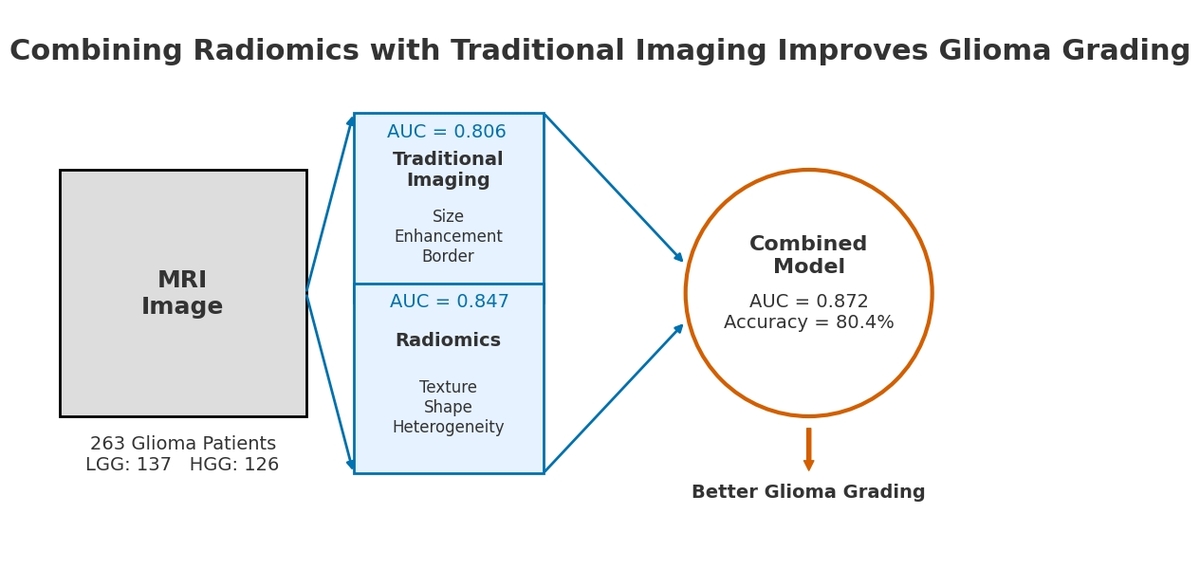
This retrospective study analyzed 263 glioma patients from January 2021 to December 2023. Patients were categorized into low-grade glioma (LGG) and high-grade glioma (HGG) groups based on WHO classifications. MRI images were used to extract radiomic features,compared to traditional imaging characteristics. PyRadiomics facilitated extraction of features such as tumor sphericity and GLCM contrast.Logistic regression with 10-fold cross-validation assessed the diagnostic accuracy,with Receiver Operating Characteristic (ROC) curve analysis and the DeLong test (Bonferroni-adjusted) used to compare the predictive performance of the models.
Results:
Significant differences were observed in radiomics features between LGG and HGG groups, including tumor sphericity and GLCM contrast,with higher heterogeneity in HGG.The radiomics-based model achieved a bootstrap-corrected area under the curve (AUC) of 0.847 (95% CI: 0.80-0.89), sensitivity of 82.0%, and specificity of 38.7%.Traditional imaging characteristics alone demonstrated an AUC of 0.806 (95% CI: 0.76-0.85), with sensitivity and specificity at 80.0% and 35.4%, respectively. The combined model of radiomics and traditional imaging provided an enhanced AUC of 0.872 (95% CI: 0.83-0.91), with improved accuracy (80.4%), sensitivity (84.0%), and specificity (44.8%).
Conclusions:
Radiomics-based models significantly enhance the diagnostic grading of gliomas compared to traditional imaging alone by capturing subtle tumor heterogeneity and complexity. The integration of radiomics and traditional imaging offers superior diagnostic performance, potentially guiding more accurate treatment strategies.
Gliomas were highly aggressive primary brain tumors that require precise grading for effective treatment planning. Current grading relies on histopathological analysis, which can be invasive and subjective. Radiomics,a non-invasive approach that extracts quantitative features from medical images,may offer enhanced diagnostic accuracy.
Material and methods:
This retrospective study analyzed 263 glioma patients from January 2021 to December 2023. Patients were categorized into low-grade glioma (LGG) and high-grade glioma (HGG) groups based on WHO classifications. MRI images were used to extract radiomic features,compared to traditional imaging characteristics. PyRadiomics facilitated extraction of features such as tumor sphericity and GLCM contrast.Logistic regression with 10-fold cross-validation assessed the diagnostic accuracy,with Receiver Operating Characteristic (ROC) curve analysis and the DeLong test (Bonferroni-adjusted) used to compare the predictive performance of the models.
Results:
Significant differences were observed in radiomics features between LGG and HGG groups, including tumor sphericity and GLCM contrast,with higher heterogeneity in HGG.The radiomics-based model achieved a bootstrap-corrected area under the curve (AUC) of 0.847 (95% CI: 0.80-0.89), sensitivity of 82.0%, and specificity of 38.7%.Traditional imaging characteristics alone demonstrated an AUC of 0.806 (95% CI: 0.76-0.85), with sensitivity and specificity at 80.0% and 35.4%, respectively. The combined model of radiomics and traditional imaging provided an enhanced AUC of 0.872 (95% CI: 0.83-0.91), with improved accuracy (80.4%), sensitivity (84.0%), and specificity (44.8%).
Conclusions:
Radiomics-based models significantly enhance the diagnostic grading of gliomas compared to traditional imaging alone by capturing subtle tumor heterogeneity and complexity. The integration of radiomics and traditional imaging offers superior diagnostic performance, potentially guiding more accurate treatment strategies.
Share
RELATED ARTICLE
| eISSN: | 1896-9151 |
| ISSN: | 1734-1922 |

We process personal data collected when visiting the website. The function of obtaining information about users and their behavior is carried out by voluntarily entered information in forms and saving cookies in end devices. Data, including cookies, are used to provide services, improve the user experience and to analyze the traffic in accordance with the Privacy policy. Data are also collected and processed by Google Analytics tool (more).
You can change cookies settings in your browser. Restricted use of cookies in the browser configuration may affect some functionalities of the website.
You can change cookies settings in your browser. Restricted use of cookies in the browser configuration may affect some functionalities of the website.
