Introduction
Cryptorchidism is the absence of one or both testes from the scrotum. It is the most common congenital anomaly of the male gonads, affecting 1.0–4.6% of full-term and 1.1–45% of preterm neonates. Although the majority of testes descend spontaneously within the first months of life, nearly 1.0% of all full-term male infants still have undescended testes (UDT) at 6 months of age, necessitating surgical intervention [1]. Cryptorchidism in most cases occurs without comorbidities and is considered an occasional birth defect. Various factors that can cause the disease are taken into account, among which special attention is paid to hormonal factors, genetic factors, maternal health and environmental factors. At present, the combination of all these elements is primarily considered [2, 3]. Furthermore, cryptorchidism is commonly observed in several dysmorphic syndromes, some neuromuscular disorders and also in some inherited metabolic diseases. Despite extensive research establishing an unequivocal basis of the disease, the probable causes are multi-component factors, making cryptorchidism a disease of complex etiology [4, 5].
Bilateral UDT increases the risk of being infertile six-fold compared with unilateral UDT or with the general healthy male population. Approximately 10% of infertile men have a history of cryptorchidism and orchidopexy. The significance of this problem has been noted, but until now, the exact causes and development of this defect at the molecular level have not been fully elucidated [1].
The latest studies indicated that one factor amplifying the occurrence of cryptorchidism is the absence of the metalloproteinase ADAMTS16 (a Disintegrin And Metalloproteinase with ThromboSpondin motifs16) [6]. In vivo studies have already highlighted the importance of matrix metalloproteinases (MMPs), which modulate intra- and extracellular pathways and networks by proteolytic processing of various biomolecules. Due to their activity they are functionally implicated in the regulation of various physiological (such as embryogenesis, apoptosis, cell migration, growth and remodeling of connective tissue and wound healing) [7]; and in pathological processes (inflammation, neoplasm, autoimmune and neurological diseases or atherosclerosis) [8–13]. Therefore, metalloproteinase activity is tightly controlled by epigenetic, transcriptional, and post-transcriptional gene expression regulation, post-translational modifications (PTMs), proteolytic activation, and interactions with specific endogenous inhibitors (tissue inhibitors of metalloproteinases – TIMPs) [14]. Apart from TIMPs, various unspecific inhibiting factors have been found such as α2-macroglobulin, β-amyloid precursor protein and heparin [15].
ADAMTS forms a family of 19 proteins which display diverse, tissue-dependent roles. Mostly they play an important role in inter-cellular interactions, adhesion, cell fusion and exfoliation of proteins from the cell surface. In the exfoliation process, many of the integral membrane proteins are released and form soluble, physiologically active proteins, modulating the surrounding environment [16]. They take part in processes such as extracellular matrix turnover, melanoblast development, interdigital web regression, blood coagulation, ovulation, etc. [14, 17–19].
Human genetic studies have revealed potential associations of the activity/presence of ADAMTS and different malfunctions, inter alia disorders and birth defects resulting from Adamts2, Adamts3, Adamts10, Adamts13, Adamts17, Adamts20, Adamtsl2 and Adamtsl4 mutations [14].
Recently also ADAMTS16 was described as an important factor inter alia in morphogenesis, with special emphasis on its role in rat testis development [6]. However, until now there are no data regarding the role of ADAMTS16 in testicular descent in humans.
Therefore, the aim of this study was to evaluate Adamts16 expression in patients with diagnosed cryptorchidism. Also considering the hypothesis described above and the possible modifying effect conferred by polymorphisms, the objective of this study was to evaluate the frequency of the polymorphisms rs16875319, rs16875054, rs16875122, and rs58353460 in the Adamts16 gene in patients with UDT, and to correlate the frequency of the different polymorphisms with the incidence of cryptorchidism.
Material and methods
Material
The study group consisted of 158 unrelated boys (mean age: 4.1 ±2.04 years) who underwent surgery due to unilateral UDT. The reference group consisted of 123 age-related subjects (mean age: 4.1 ±2.41 years) who had no cryptorchidism and underwent surgery for other reasons, mainly due to inguinal hernia. All patients were operated on in the Department of Pediatric Surgery and Urology, Medical University of Lodz, between January 2017 and June 2019.
Experimental material, i.e. DNA, was isolated from peripheral blood samples obtained from patients of both the study and the reference group before surgery.
Tissue samples from 42 patients with UDT (mean age: 4.07 ±2.96 years) were obtained from the cremaster muscle, gubernaculum and hernial sac (126 samples) during orchidopexy. The inclusion criterion was diagnosed cryptorchidism and exclusion criteria were inherited arterial hypertension, and esophageal squamous cell carcinoma in the past family history.
Tissue samples from 21 control individuals (mean age: 4.13 ±2.86 years) were obtained from the cremaster muscle and hernial sac (42 samples). The samples were collected in the Department of Clinical Chemistry and Biochemistry, Medical University of Lodz.
The study was approved by the Bioethics Committee of the Medical University of Lodz (No. RNN/162/09/KE of 17.02.2009 with modification KE/256/18 of 13.03.2018 and RNN/102/17/KE of 11.04.2017).
Methods
Genomic DNA was isolated from blood samples using the QIAamp DNA Blood Mini Kit for isolation of high-molecular-weight DNA (Qiagen, Chatsworth, CA, USA).
The reaction was set up according to the TaqMan technology manual. In general, 100 ng of genomic DNA, TaqMan Genotyping Master Mix (Applied Biosystems), and TaqMan probes (catalog no. 4351379; SNP IDs: rs16875319, rs16875054, rs16875122, and rs58353460) were mixed and subjected to PCR reaction performed in CFX96 Touch Real-Time PCR (Bio-Rad) under the following conditions: 95°C for 10 min for polymerase activation, followed by 50 cycles including 95°C for 15 s and 60°C for 1 min.
Total RNA extraction and quantitative real-time polymerase chain reaction (PCR)
Total RNA was extracted with the RNAqueous Total RNA Isolation Kit from collected tissue and reverse transcribed into cDNA using a RevertAid First Strand cDNA Synthesis Kit according to the manufacturer’s protocol. We used 100 ng of RNA and performed 40 repetitions.
Quantitative real-time PCR was performed using an CFX96 Touch Real-Time PCR (Bio-Rad). The reaction mix (12 µl) contained 0.2 nmol of forward and reverse primer, cDNA template, water and SYBR Green PCR Master Mix. Reactions were incubated at 95°C for 10 min, followed by 40 cycles of 95°C for 15 s and 56°C for 1 min. The following gene-specific primers were used: Adamts16 f: ACGTACTGTACAAGAGATCC, r: ATGTATTTCTTGCGTCTTCC. Gene expression levels were normalized to the level of Gapdh using the following primers: f: ACAGTTGCCATGTAGACC and r: TTGAGCACAGGGTACTTTA.
Statistical analysis
The number of obtained genotypes was compared with the expected value under the Hardy-Weinberg law. The significance of differences between allele frequencies and genotypes for individual groups was assessed using the χ2 test. The risk of occurrence of the event was assessed by means of multivariate regression analysis (odds ratio – OR) with an appropriate confidence interval (95% confidence interval – 95% CI.
The significance of differences in Adamts16 expression in controls and patients with cryptorchidism was assessed by Mann-Whitney U test. The criterion for statistical significance was set at p < 0.05.
Results
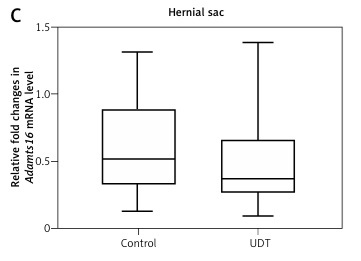
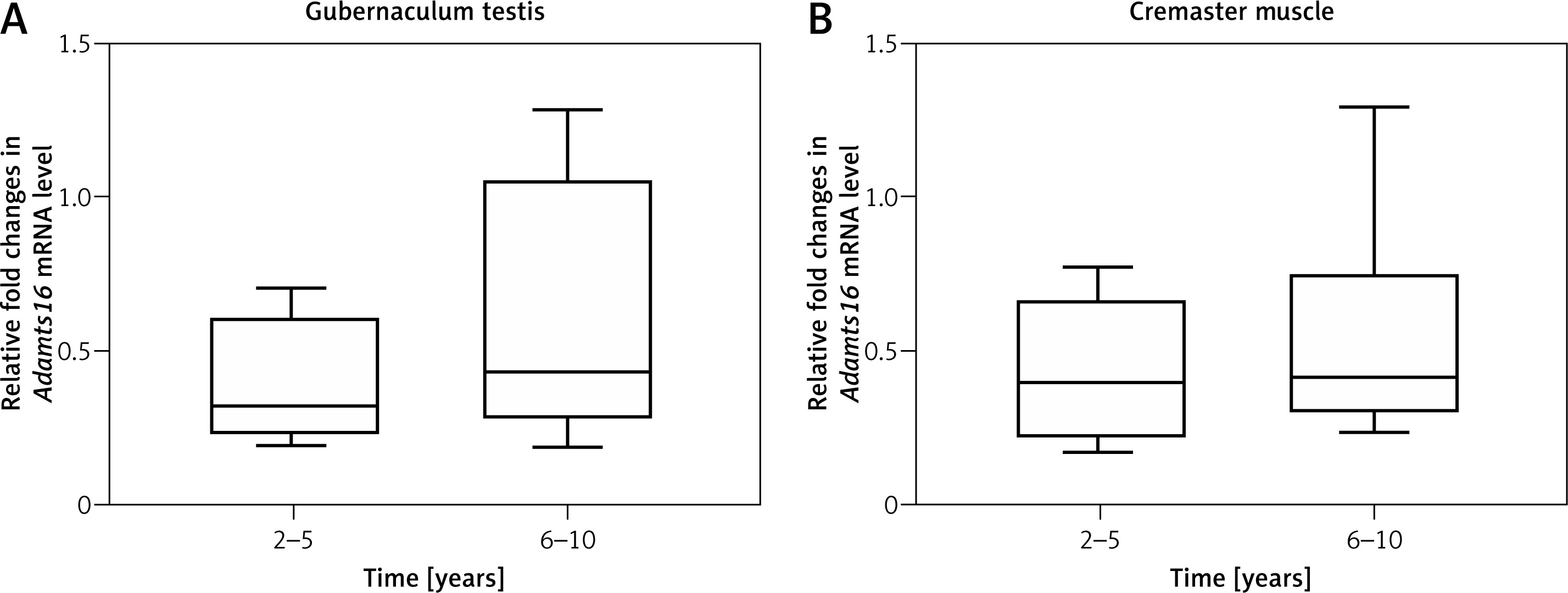
As the latest studies on animal model indicated that Adamts16 is a critical gene required for the normal functioning of the genitourinary system, we decided to evaluate Adamts16 expression in patients diagnosed with cryptorchidism in three types of paratesticular tissues: cremaster muscle, gubernaculum testis, and hernial sac. The obtained results indicate that the level of Adamts16 mRNA in both cremaster muscle and gubernaculum testis in patients with cryptorchidism is lower in comparison to the controls (Figures 1 A–C). The most statistically considerable differences (the lowest expression) were observed in gubernaculum. As most control samples were obtained from the hernial sac, we also determined the level of Adamts16 mRNA in this tissue. The expression of Adamts16 was insignificantly lower in the hernial sac in patients with cryptorchidism in comparison to the controls (Figure 1 C). Taking into consideration the age of examined patients, the observed expression of Adamts16 was significantly higher in older boys (Figures 2 A, B).
Figure 1
Expression of Adamts16 in gubernaculum testis (A), cremaster muscle (B), and hernial sac (C) of controls and patients with UDT, as determined by real-time PCR. Expression in gubernaculum was compared to expression in hernial sac of controls
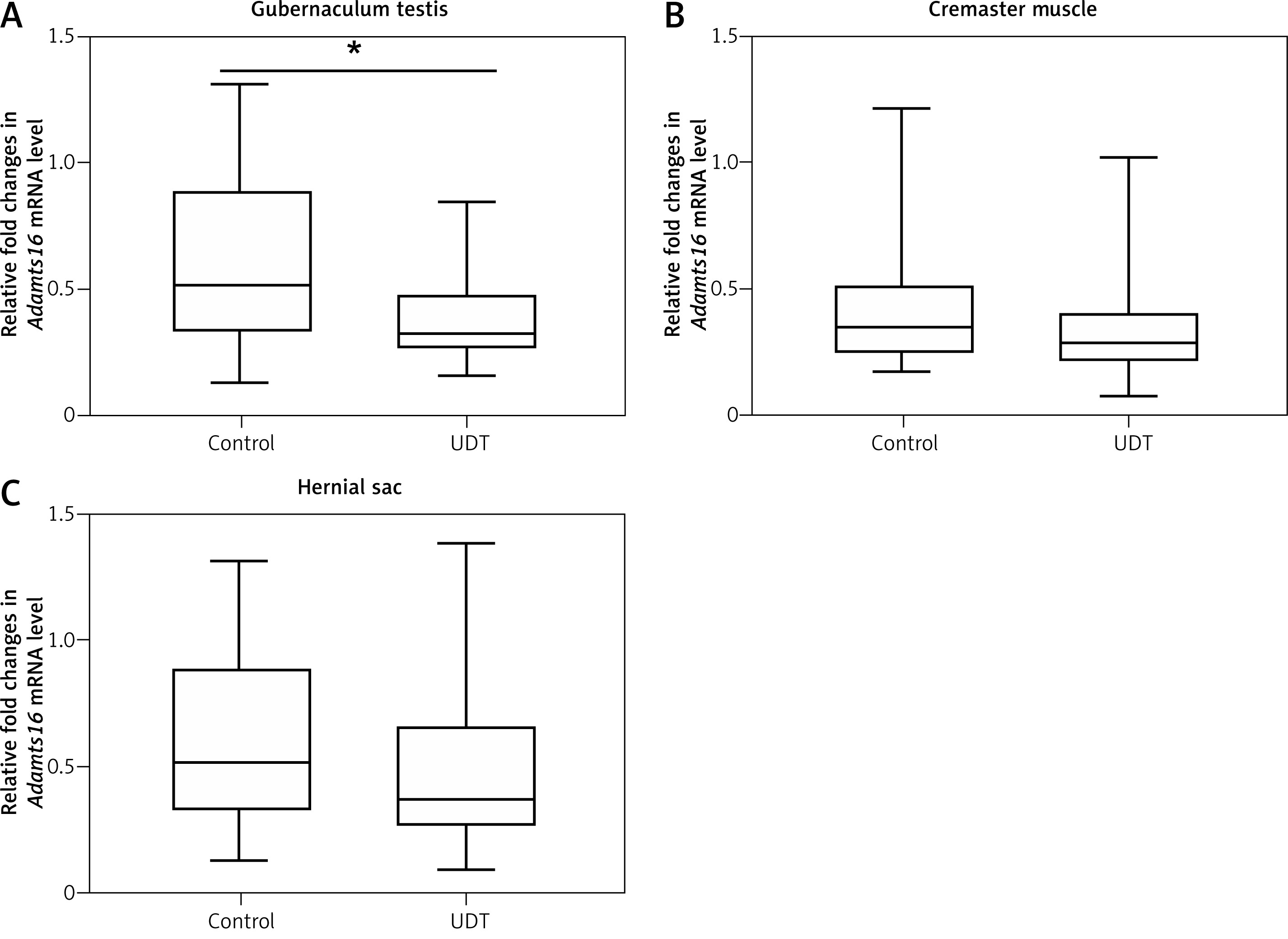
Figure 2
Expression of Adamts16 in gubernaculum testis (A), cremaster muscle (B) in patients with cryptorchidism, as determined by real-time PCR. Expression in hernia sac was not shown due to statistical insignificance
These studies suggested that deficiency of mRNA Adamts16 might be linked with occurrence of cryptorchidism. For that reason, in the next stage of our research we evaluated the influence of the presence of selected polymorphisms within the tested gene on the incidence of cryptorchidism.
Table I presents an analysis of the distribution of rs16875054 A/G polymorphism variants of the Adamts16 gene and its correlation with the modulation of the risk of cryptorchidism. The Hardy-Weinberg (HW) χ2 analysis revealed that in the study group (χ2 = 96.21; p < 0.05) and in the control group (χ2 = 30.27; p < 0.05) genotype distribution of Adamts16 (rs16875054) gene polymorphism is not in the Hardy-Weinberg equilibrium. The frequencies of A and G alleles were respectively 13% and 87% in the study group and 6% and 94% in the control group, whereas the genotype distribution was 84% for GG, 5% for A/G and 11% for AA for cryptorchidism patients and 91% for GG, 6% for A/G and 3% for AA for the controls. The obtained results indicate a relationship between the A/A genotype as well as the A allele and the incidence of cryptorchidism. According to the calculated odds ratio, the homozygous A/A variant (OR = 3.4831, 95% CI: 1.1384–10.6566) as well as the A allele (OR = 2.2993, 95% CI: 1.2426–4.2544) are associated with more frequent occurrence of cryptorchidism.
Table I
Distribution of genotypes, allele frequencies, and analysis of the odds ratio (OR) for rs16875054 A/G polymorphism of Adamts16 gene in UDT patients and controls
Table II presents an analysis of the distribution of rs16875319 G/T polymorphism variants of the Adamts16 gene and its correlation with the modulation of the risk of cryptorchidism. Genotype distribution of Adamts16 (rs16875319) polymorphism showed no deviation from the Hardy-Weinberg equilibrium in the study group (χ2 = 2.61; p = 0.106) or in the control group (χ2 = 0.073; p = 0.787). The frequencies of T and G alleles were 82% and 18% in the examined group of patients and 83% and 17% in the control group, respectively, while the genotype distribution was 66% for TT, 33% for G/T and 1% for GG for patients with cryptorchidism and 69% for TT, 28% for G/T and 3% for GG for the controls. The final analysis did not show a significant association of polymorphism with the risk of cryptorchidism.
Table II
Distribution of genotypes, allele frequencies, and analysis of the odds ratio (OR) for rs16875319 G/T polymorphism of Adamts16 gene in UDT patients and controls
Tables III and IV show the results of the distribution of rs16875122 G/T and rs58353460 A/G polymorphisms of the Adamts16 gene and their influence and correlation with cryptorchidism occurrence. Despite the conducted genotyping, in both cases correlation with the modulation of the risk of cryptorchidism was not observed. These data confirmed lack of any interdependence of rs16875122 G/T and rs58353460 A/G polymorphisms of the Adamts16 gene with cryptorchidism presence in the Caucasian population.
Table III
Distribution of genotypes, allele frequencies, and analysis of the odds ratio (OR) for rs16875122 G/T polymorphism of Adamts16 gene in UDT patients and controls
| Genotype/allele | Patients (n = 158) | Freq. | Controls (n = 121) | Freq. | OR | P-value |
|---|---|---|---|---|---|---|
| T/T | 0 | 0.0 | 0 | 0.0 | – | – |
| G/T | 0 | 0.0 | 0 | 0.0 | – | – |
| GG | 158 | 1.0 | 121 | 1.0 | Ref. | – |
| T | 0 | 0 | 0 | 1.0 | – | – |
| G | 316 | 1.0 | 242 | 1.0 | Ref. | – |
Table IV
Distribution of genotypes, allele frequencies, and analysis of the odds ratio (OR) for rs58353460 A/G polymorphism of Adamts16 gene in UDT patients and controls
| Genotype/allele | Patients (n = 158) | Freq. | Controls (n = 123) | Freq. | OR | P-value |
|---|---|---|---|---|---|---|
| G/G | 1 | 0.006 | 0 | 0.0 | – | – |
| A/G | 0 | 0.0 | 0 | 0.0 | – | – |
| A/A | 157 | 0.994 | 123 | 1.0 | Ref. | – |
| G | 2 | 0.006 | 0 | 0.0 | – | – |
| A | 314 | 0.994 | 246 | 1.0 | Ref. | – |
Discussion
Metalloproteinases have commanded huge attention due to their role in a variety of normal and pathological conditions. Recent findings indicate that members of the ADAMTS family (a Disintegrin And Metalloproteinase with ThromboSpondin motifs) are also critically involved in morphogenesis [16]. Most of the ADAMTS proteases remodel extracellular matrix, or shed various proteins such as cytokines, adhesion ligands, growth factors, and their receptors [20].
Studies in recent years have indicated the physiological importance of ADAMTS in a variety of organ systems. However, there are still some ADAMTS members whose mechanisms and regulatory impact are still not fully elucidated.
One poorly characterized example, lacking knowledge of substrates and the molecular pathways in which it participates, is ADAMTS16. Still it was reported that its expression is essential in rodent fetal lung and kidneys, adult brain, and most recently, in rodent gonadal development [6, 21, 22]. Additionally, ADAMTS16 is linked with urgency urinary incontinence in women [23], functional impairment in schizophrenia [24] and hypertension (rats) [25].
In order to verify whether AdamtsS16 is implicated in testis descent, we performed RT-qPCR to analyze its expression in patients with diagnosed cryptorchidism. The obtained data indicate that patients with undescended testis have significantly lower expression of Adamts16 (Figure 1). The biggest changes were observed in the gubernaculum, which remains the key structure for testicular descent in humans. After birth, the gubernaculum undergoes extensive remodeling of the extracellular matrix (ECM), which is achieved by a tight balance of metalloproteinases and their inhibitors [26]. Also, studies on animal models showed that ECM remodeling by matrix metalloproteinases around/in the gubernaculum is necessary for its migration through the inguinal fat [27], with special emphasis on metalloproteinase MT1-MMP and MMP2, which play an important role in spermatogenesis [27, 28].
Our data are also in line with data obtained by Abdul-Majeed et al., who observed that lack of Adamts16 is responsible for the occurrence of cryptorchidism and subsequent infertility in homozygous Adamts16 mutant male rats [6]. More-over, previous studies conducted by Zhao et al. indicate that disturbance in Adamts20 expression in dog gubernaculum is linked with cryptorchidism occurrence [29]. Further, Dun et al. described Adamts10 as being expressed during the later stages of mouse spermatogenesis and suggested it to be an important factor during fertilization [30].
In our opinion, the more frequent decreased level of Adamts16 expression in patients with cryptorchidism clearly indicates the indirect function of the ADAMTS16 protein in the process of testicular descent. The direct link remains unclear; however, considering the wide range of interactions of ADAMTS16 with other metzincin family proteins and a number of growth factors, cytokines and signaling molecules processed by ADAMTS16, we postulate that the reduced expression level might affect the extracellular matrix remodeling and/or the mesenchymal cell migration. Consequently, it may lead to the disruption of gubernaculum elongation and to aberrant testicular descent.
Particular attention should be paid to the differences in expression found in our studies in patients depending on the age group. Previously mentioned studies highlight ADAMTS16 involvement in cryptorchidism and confirm data obtained from animal models. However, since ADAMTS16 is an important factor in morphogenesis [31], our discovery of the dependence of expression on age suggests that critical changes in ADAMTS16 activity and expression occur during prenatal development and shortly after birth. Additionally, taking into account further differences between age groups, not only in infants but also in children, we postulate that the level of expression depends on the hormonal balance of the organism and changes with mutation. Our findings are in line with one of the theories presented in the introduction to this article, which searches for the sources of cryptorchidism in hormonal disorders of the body or the interaction of these disorders with other environmental and genetic factors.
Since severe deficiency of the mRNA Adamts16 leads to a testis defect, we also investigated whether selected polymorphisms rs16875319, rs16875054, rs16875122, and rs58353460 in the Adamts16 gene correlate with occurrence of cryptorchidism.
Comparison of the genotype and allele frequencies for rs16875054 is shown in Table I. It shows that the A/A genotype and A allele may be responsible for increased risk of cryptorchidism. According to data shown in Table II, there is no evidence that rs16875319 polymorphisms in the Adamts16 gene is related to cryptorchidism. Despite the fact that our results show that rs16875319 and rs16875054 polymorphisms in the Adamts16 gene are not a major determinant to develop cryptorchidism in the Caucasian population, it cannot be excluded in other populations. Our results also confirmed that rs16875122 and rs58353460 polymorphisms do not occur in the Caucasian population (Tables III and IV). So far, many polymorphisms have been identified in the Adamts16 gene, but no research has been conducted on their modulation of the risk of cryptorchidism in the human model. Although most of the polymorphisms we studied did not show any relation to cryptorchidism, the results obtained for rs16875054 indicate that differences in structure may translate into effectiveness of action and, consequently, lead to the underlying cause of the disease. Probably the mechanism behind this process is very complex and involves more than one polymorphism, intergenic interactions, and interactions of the protein with other cellular factors. Therefore, in our opinion, further research in this field is necessary to better understand the role of the influence of Adamsts16 polymorphisms on the level of its activity and, consequently, on the potential impact on cryptorchidism development.
There is a long list of putative risk factors associated with cryptorchidism. The present study extends this list with a disturbance in Adamts16 expression.
Taking into consideration the above-mentioned points, it seems especially interesting to focus future research on ADAMTS16 involvement in cryptorchidism development.