Current issue
Archive
Manuscripts accepted
About the Journal
Editorial office
Editorial board
Section Editors
Abstracting and indexing
Subscription
Contact
Ethical standards and procedures
Most read articles
Instructions for authors
Article Processing Charge (APC)
Regulations of paying article processing charge (APC)


RARE DISEASES / CLINICAL RESEARCH
A rare variant in the IL22RA2 gene is associated with unexplained recurrent pregnancy loss in Han Chinese women
1
Department of Traditional Chinese Medicine, Jiangxi Maternal and Child Health Hospital, Nanchang, China
2
Jiangxi Women’s and Children’s Medical Center, Nanchang, , China
3
Central Lab, Jiangxi Maternal and Child Health Hospital, Nanchang, China
4
Central Lab, Jiangxi Women’s and Children’s Medical Center, Nanchang, China
5
Department of Experiment Lab, Jiangxi Maternal and Child Health Hospital, Nanchang, China
Submission date: 2020-05-12
Final revision date: 2020-07-15
Acceptance date: 2020-08-03
Online publication date: 2021-04-18
Publication date: 2026-08-28
Corresponding author
Arch Med Sci 2026;22(4):2205-2210
KEYWORDS
TOPICS
ABSTRACT
Introduction:
Recurrent pregnancy loss (RPL) occurs in ~1–2% of reproductive women. Previous studies have suggested that altered expression and polymorphisms of interleukin-related genes may be involved in RPL. The aim of this study was to explore the potential presence of interleukin-22 receptor subunit a2 (IL22RA2) mutations in Han Chinese women with unexplained recurrent pregnancy loss (URPL).
Material and methods:
A total of 328 Han Chinese women with URPL were analyzed for potential mutations in the IL22RA2 gene by sequencing all of the exons. Additionally, 615 Han Chinese control women without miscarriage history were analyzed. Evolutionary conservation and in silico analyses were performed to predict the potential pathogenicity of IL22RA2 mutations.
Results:
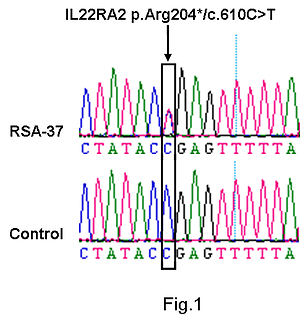
A rare variant, p.Arg204* (c.610C>T), was identified in 4 out of 328 women with URPL. In contrast, this rare variant was absent in 615 Han Chinese control women without miscarriage history and had a significantly higher mutation frequency when compared with 10,588 Chinese control women from The China Metabolic Analytics Project (ChinaMAP), 4245 East Asians, or 60051 individuals across the world from the Exome Aggregation Consortium (ExAC) database. Evolutionary conservation analysis indicated that this rare variant was highly conserved from human to zebrafish, and in silico analysis suggested that it may be pathogenic.
Conclusions:
An enrichment of a potentially pathogenic rare variant in the IL22RA2 gene was observed in URPL patients for the first time, suggesting that this rare variant may be associated with the development of URPL. However, further functional assays should be performed to confirm the potential role of this rare variant in URPL.
Recurrent pregnancy loss (RPL) occurs in ~1–2% of reproductive women. Previous studies have suggested that altered expression and polymorphisms of interleukin-related genes may be involved in RPL. The aim of this study was to explore the potential presence of interleukin-22 receptor subunit a2 (IL22RA2) mutations in Han Chinese women with unexplained recurrent pregnancy loss (URPL).
Material and methods:
A total of 328 Han Chinese women with URPL were analyzed for potential mutations in the IL22RA2 gene by sequencing all of the exons. Additionally, 615 Han Chinese control women without miscarriage history were analyzed. Evolutionary conservation and in silico analyses were performed to predict the potential pathogenicity of IL22RA2 mutations.
Results:
A rare variant, p.Arg204* (c.610C>T), was identified in 4 out of 328 women with URPL. In contrast, this rare variant was absent in 615 Han Chinese control women without miscarriage history and had a significantly higher mutation frequency when compared with 10,588 Chinese control women from The China Metabolic Analytics Project (ChinaMAP), 4245 East Asians, or 60051 individuals across the world from the Exome Aggregation Consortium (ExAC) database. Evolutionary conservation analysis indicated that this rare variant was highly conserved from human to zebrafish, and in silico analysis suggested that it may be pathogenic.
Conclusions:
An enrichment of a potentially pathogenic rare variant in the IL22RA2 gene was observed in URPL patients for the first time, suggesting that this rare variant may be associated with the development of URPL. However, further functional assays should be performed to confirm the potential role of this rare variant in URPL.
REFERENCES (29)
1.
Arias-Sosa LA, Acosta ID, Lucena-Quevedo E, Moreno-Ortiz H, Esteban-Pérez C, Forero-Castro M. Genetic and epigenetic variations associated with idiopathic recurrent pregnancy loss. J Assist Reprod Genet 2018; 35: 355-66.
2.
Xu Y, Ban Y, Ran L, et al. Relationship between unexplained recurrent pregnancy loss and 5,10-methylenetetrahydrofolate reductase polymorphisms. Fertil Steril 2019; 111: 597-603.
3.
Stephenson MD, McQueen D, Winter M, Kliman HJ. Luteal start vaginal micronized progesterone improves pregnancy success in women with recurrent pregnancy loss. Fertil Steril 2017; 107: 684-90.
4.
Sharif K, Sharif Y, Watad A, et al. Vitamin D, autoimmunity and recurrent pregnancy loss: more than an association. Am J Reprod Immunol 2018; 80: e12991.
5.
Gonçalves DR, Braga A, Braga J, Marinho A. Recurrent pregnancy loss and vitamin D: a review of the literature. Am J Reprod Immunol 2018; 80: e13022.
6.
Hachem EH, Crepaux V, May-Panloup P, Descamps P, Legendre G, Bouet PE. Recurrent pregnancy loss: current perspectives. Int J Womens Health 2017; 9: 331-45.
7.
Sun Y, Chen M, Mao B, Cheng X, Zhang X, Xu C. Association between vascular endothelial growth factor polymorphism and recurrent pregnancy loss: a systematic review and meta-analysis. Eur J Obstet Gynecol Reprod Biol 2017; 211: 169-76.
8.
Krieg S, Westphal L. Immune function and recurrent pregnancy loss. Semin Reprod Med 2015; 33: 305-12.
9.
Gu Y, Wang JM, Zhang ZF, et al. The association between polymorphisms of genes related to inflammation and recurrent pregnancy loss. Gynecol Endocrinol 2018; 34: 349-52.
10.
Quintero-Ronderos P, Mercier E, Fukuda M, et al. Novel genes and mutations in patients affected by recurrent pregnancy loss. PLoS One 2017; 12: e0186149.
11.
Faas MM, de Vos P. Uterine NK cells and macrophages in pregnancy. Placenta 2017; 56: 44-52.
12.
Xiong S, Sharkey AM, Kennedy PR, et al. Maternal uterine NK cell-activating receptor KIR2DS1 enhances placentation. J Clin Invest 2013; 123: 4264-72.
13.
Zhang J, Dunk CE, Lye SJ. Sphingosine signalling regulates decidual NK cell angiogenic phenotype and trophoblast migration. Hum Reprod 2013; 28: 3026-37.
14.
Robertson SA, Care AS, Moldenhauer LM. Regulatory T cells in embryo implantation and the immune response to pregnancy. J Clin Invest 2018; 128: 4224-35.
15.
Comba C, Bastu E, Dural O, et al. Role of inflammatory mediators in patients with recurrent pregnancy loss. Fertil Steril 2015; 104: 1467-74.
16.
Enninga EAL, Harrington SM, Creedon DJ, et al. Immune checkpoint molecules soluble program death ligand 1 and galectin-9 are increased in pregnancy. Am J Reprod Immunol 2018; 79: e12795.
17.
Kim JO, Lee WS, Lee BE, et al. Interleukin-1beta -511T>C genetic variant contributes to recurrent pregnancy loss risk and peripheral natural killer cell proportion. Fertil Steril 2014; 102: 206-12.
18.
Jang HG, Choi Y, Kim JO, et al. Polymorphisms in tumor necrosis factor-alpha (-863C>A, -857C>T and +488G>A) are associated with idiopathic recurrent pregnancy loss in Korean women. Hum Immunol 2016; 77: 506-11.
19.
Zidan HE, Rezk NA, Alnemr AA, Moniem MI. Interleukin-17 and leptin genes polymorphisms and their levels in relation to recurrent pregnancy loss in Egyptian females. Immunogenetics 2015; 67: 665-73.
20.
Chen H, Yang X, Du J, Lu M. Interleukin-18 gene polymorphisms and risk of recurrent pregnancy loss: a systematic review and meta-analysis. J Obstet Gynaecol Res 2015; 41: 1506-13.
21.
Bohiltea CL, E Radoi V. Interleukin-6 and interleukin-10 gene polymorphisms and recurrent pregnancy loss in Romanian population. Iran J Reprod Med 2014; 12: 617-22.
22.
Nasiri M, Rasti Z. CTLA-4 and IL-6 gene polymorphisms: risk factors for recurrent pregnancy loss. Hum Immunol 2016; 77: 1271-4.
23.
Dambaeva S, Schneiderman S, Jaiswal MK, et al. Interleukin 22 prevents lipopolysaccharide- induced preterm labor in mice. Biol Reprod 2018; 98: 299-308.
24.
Wang Y, Xu B, Li MQ, Li DJ, Jin LP. IL-22 secreted by decidual stromal cells and NK cells promotes the survival of human trophoblasts. Int J Clin Exp Pathol 2013; 6: 1781-90.
25.
O’Hern Perfetto C, Fan X, Dahl S, et al. Expression of interleukin-22 in decidua of patients with early pregnancy and unexplained recurrent pregnancy loss. J Assist Reprod Genet 2015; 32: 977-84.
26.
Kamoi M, Fukui A, Kwak-Kim J, et al. NK22 cells in the uterine mid-secretory endometrium and peripheral blood of women with recurrent pregnancy loss and unexplained infertility. Am J Reprod Immunol 2015; 73: 557-67.
27.
Logiodice F, Lombardelli L, Kullolli O, et al. Decidual interleukin-22-producing CD4+ T cells (Th17/Th0/IL-22+ and Th17/Th2/IL-22+, Th2/IL-22+, Th0/IL-22+), which also produce IL-4, are involved in the success of pregnancy. Int J Mol Sci 2019; 20L pii: E428.
28.
Schwarz JM, Cooper DN, Schuelke M, Seelow D. MutationTaster2: mutation prediction for the deep-sequencing age. Nat Methods 2014; 11: 361-2.
29.
Choi Y, Chan AP. PROVEAN web server: a tool to predict the functional effect of amino acid substitutions and indels. Bioinformatics 2015; 31: 2745-47.
| eISSN: | 1896-9151 |
| ISSN: | 1734-1922 |

We process personal data collected when visiting the website. The function of obtaining information about users and their behavior is carried out by voluntarily entered information in forms and saving cookies in end devices. Data, including cookies, are used to provide services, improve the user experience and to analyze the traffic in accordance with the Privacy policy. Data are also collected and processed by Google Analytics tool (more).
You can change cookies settings in your browser. Restricted use of cookies in the browser configuration may affect some functionalities of the website.
You can change cookies settings in your browser. Restricted use of cookies in the browser configuration may affect some functionalities of the website.