
Stroke ranks as the third leading cause of mortality and the fourth leading cause of disability-adjusted life years worldwide, with approximately 11.9 million new cases in 2021 alone [1]. China bears a particularly heavy burden because of its large population and rapid population ageing. Although comprehensive early risk assessment may help prevent stroke, some cases occur without established modifiable risk factors, pointing to additional biological pathways, including chronic physiological dysregulation [2].
Allostatic load (AL) – the cumulative “wear and tear” produced by repeated activation of the hypothalamic-pituitary-adrenal axis, the sympathetic nervous system, and pro-inflammatory pathways – has been proposed as an integrative biomarker of chronic stress, offering predictive value beyond individual risk factors [3, 4]. AL has been linked to stroke-related mortality in Western cohorts [5], but its role in predicting incident stroke among Asian populations remains largely unexamined, and no study has quantitatively evaluated whether smoking and drinking modify this association.
To address this gap, the China Health and Retirement Longitudinal Study (CHARLS) was analysed to examine the longitudinal association between AL and incident stroke among adults aged 45 years and older, with particular attention to nonlinearity and effect modification by smoking and drinking status.
Methods
Study population
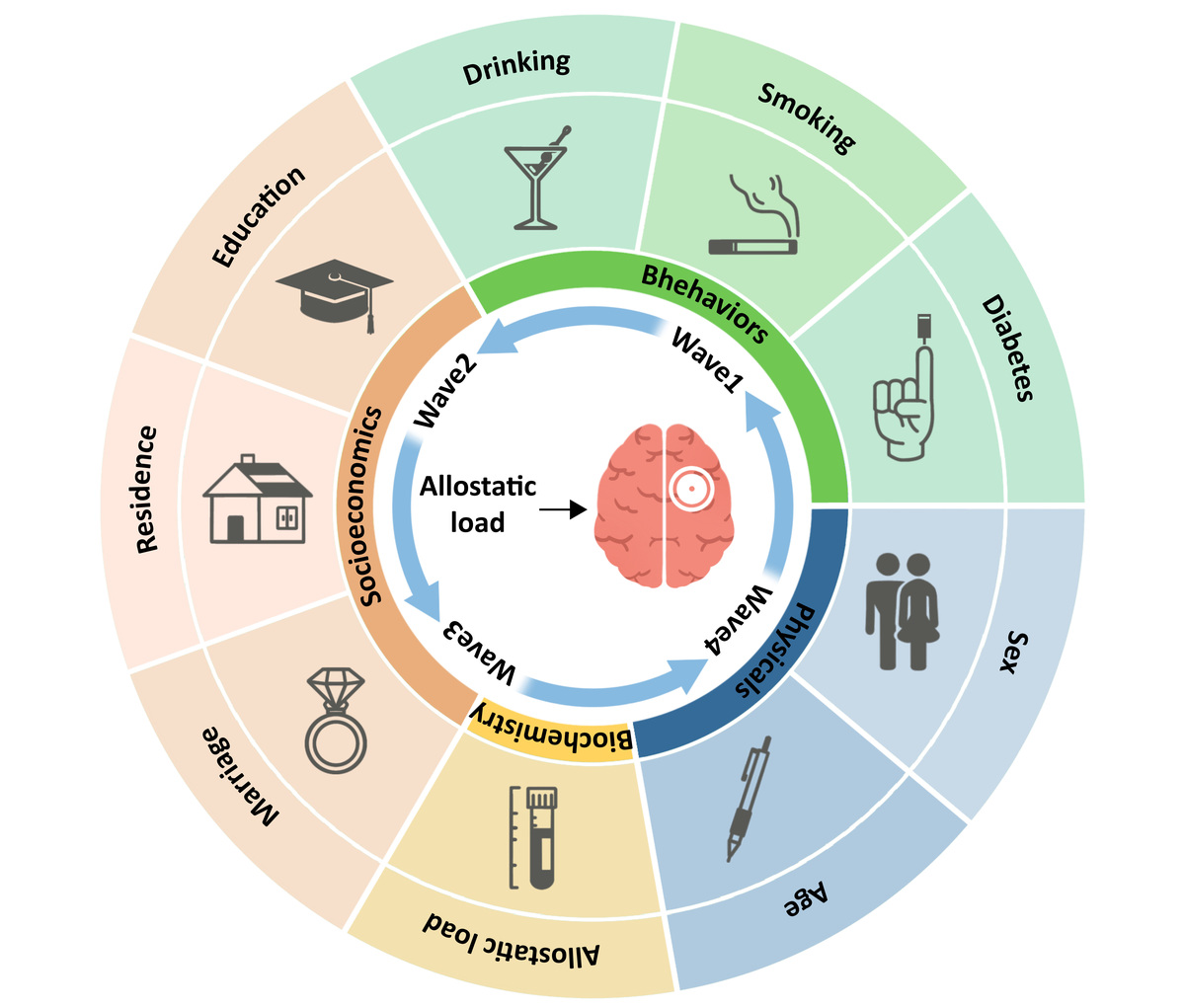
CHARLS is a nationally representative cohort of Chinese adults aged 45 years and older, established in 2011 with follow-up waves in 2013, 2015, and 2018 [6]. Of 17,705 participants at baseline, 4617 were included after excluding those aged under 45 years, missing AL data, with baseline stroke, or lost to follow-up across all subsequent waves (Supplementary Figure S1).
Exposure and outcome
AL was derived from 14 biomarkers spanning cardiovascular, metabolic, and neuroendocrine systems, each dichotomised against an at-risk cut-off point and summed into a score of 0–14 [7]; participants were further grouped into quartiles. Incident stroke was ascertained from self-reported physician diagnosis during waves 2–4.
Covariates
Demographic (age, gender, marital status, education, residence), behavioural (smoking, drinking), and health-status (diabetes) covariates were collected by standardised interview.
Statistical analysis
Baseline characteristics between participants with and without incident stroke were compared using Welch’s two-sample t-test for continuous variables and Pearson’s χ2 test for categorical variables. Logistic regression was used to estimate odds ratios (ORs) across three models: unadjusted and further adjusted for age, gender, marital status, education, residence, smoking, drinking, and diabetes. Subgroup analyses, interaction tests, and restricted cubic spline (RCS) models were used to evaluate potential effect modification by smoking and drinking status. All statistical analyses were conducted using R software (version 4.2.0). A two-sided p-value < 0.05 was considered statistically significant.
Results
Among 4617 participants, 379 (8.21%) developed incident stroke during follow-up (Supplementary Table SI). Compared with non-stroke participants, those who developed stroke were significantly older, had a higher prevalence of diabetes, and showed higher allostatic load scores (all p < 0.05). No significant differences were observed in gender, residence, education level, smoking status, or drinking status between the two groups (all p > 0.05).
Association between AL and incident stroke
Higher AL was significantly associated with elevated stroke risk in both the unadjusted model (OR = 1.19, 95% CI: 1.13–1.26, per unit increase) and after full adjustment (OR = 1.16, 95% CI: 1.09–1.23) (Table I). Quartile analysis showed a graded dose-response pattern: compared with Q1, stroke risk increased progressively across Q2 (adjusted OR = 1.58, 95% CI: 0.97–2.59, p = 0.068), Q3 (adjusted OR = 1.65, 95% CI: 1.01–2.69, p = 0.045), and Q4 (adjusted OR = 2.41, 95% CI: 1.52–3.81, p < 0.001), with a significant linear trend (p for trend < 0.001).
Table I
Association between AL and incident stroke
Subgroup and interaction analyses
The positive association between AL and incident stroke was consistent across both smoking and drinking status strata (Table II). Among non-smokers and smokers, higher AL was significantly associated with increased stroke risk (OR = 1.17, 95% CI: 1.08–1.26 and OR = 1.24, 95% CI: 1.14–1.35, respectively; both p < 0.001), with no significant interaction (p for interaction = 0.293). Similarly, no significant interaction was observed by drinking status (p for interaction = 0.874), with comparable risk estimates among non-drinkers (OR = 1.19, 95% CI: 1.10–1.28) and drinkers (OR = 1.20, 95% CI: 1.10–1.31).
Dose-response analyses
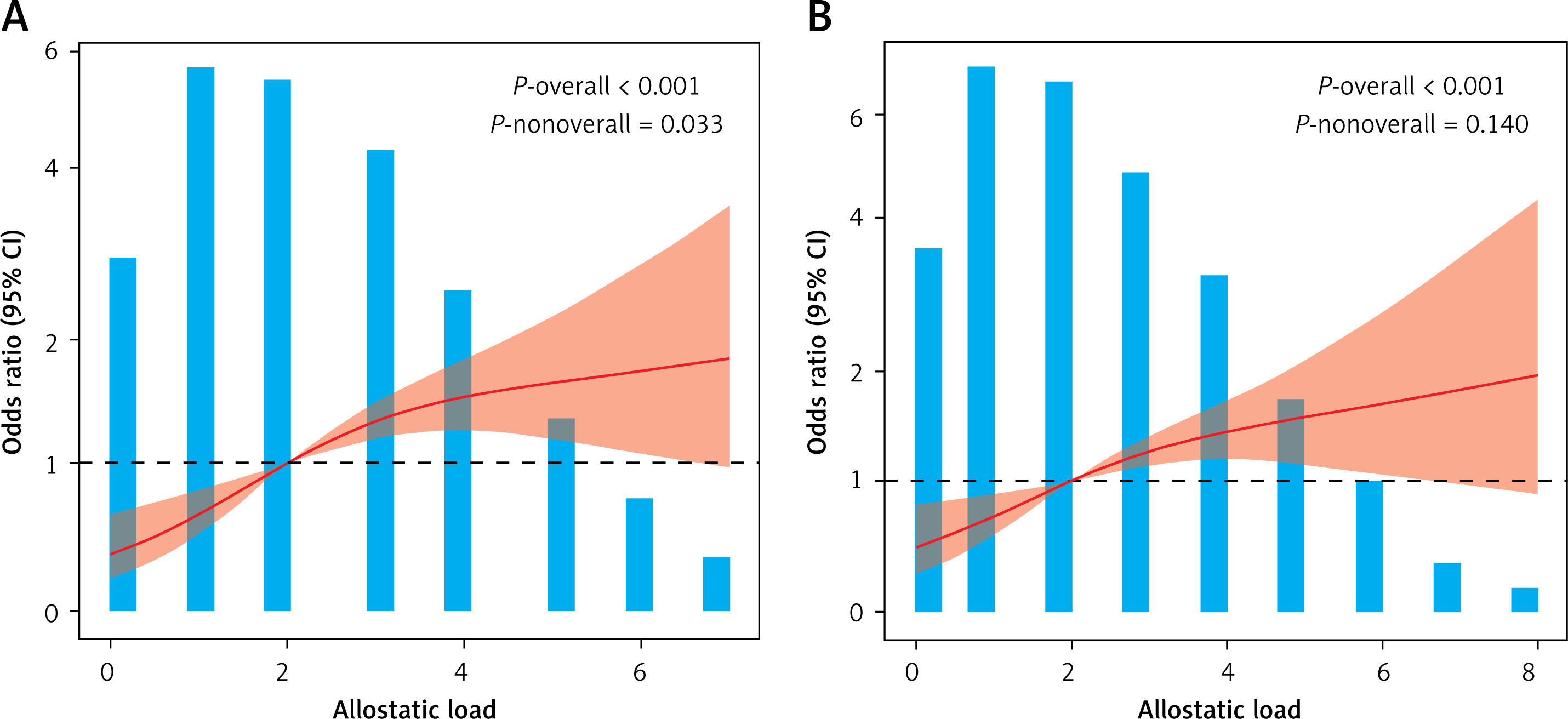
Among smokers, RCS analysis revealed a significant nonlinear association between AL and incident stroke (p for nonlinearity = 0.033). In contrast, among drinkers, the association between AL and incident stroke was approximately linear (p for nonlinearity = 0.140), with the odds ratio increasing steadily across the range of AL without a distinct inflection point (Figure 1).
Discussion
In this nationally representative cohort of Chinese adults aged 45 years and older, higher AL was independently associated with incident stroke, with a graded dose-response relationship that remained consistent across smoking and drinking status (both p for interaction > 0.05). These findings extend prior evidence linking AL to stroke-related mortality in Western populations and represent, to date, the first study to test whether this association holds consistently across smoking and drinking status in an Asian cohort.
Mechanistically, AL reflects dysregulation across cardiovascular, metabolic, immune, and neuroendocrine systems arising from sustained activation of stress mediators such as cortisol, catecholamines, and cytokines [3, 8], producing endothelial dysfunction, dyslipidaemia, and low-grade inflammation that favour atherogenesis and vascular injury. Among smokers, concurrent oxidative stress and endothelial injury may interact synergistically with AL-related dysregulation, so that even modest AL elevations signal disproportionate risk before the association attenuates once substantial vascular damage has occurred [9]. Among drinkers, the absence of a threshold suggests a more uniform, dose-independent contribution of alcohol-related pathways to vascular risk.
The consistency of the association across smoking and drinking strata, together with the absence of a significant interaction for either behaviour, supports the role of AL as a complementary, integrative marker of cumulative physiological burden rather than a factor whose effect depends on these behaviours [10].
Several limitations warrant mention. The observational design precludes causal inference, and stroke was ascertained by self-report; self-reported stroke has been shown to generate risk estimates comparable to medically verified diagnoses [11], so residual misclassification would likely bias associations toward the null rather than inflate them. AL was measured at a single time point, precluding assessment of dynamic change, and stroke subtypes could not be distinguished. Finally, as CHARLS enrolled only Chinese adults, these findings may not generalise to populations with different demographic or risk profiles.
In conclusion, higher AL was independently associated with incident stroke among middle-aged and older Chinese adults, with a graded dose-response relationship that remained consistent across smoking and drinking status. These findings support incorporating AL into stroke-risk assessment in community and primary care settings. Prospective studies with repeated AL measurements and confirmed stroke subtyping are warranted.