
In recent years, there has been rapid development in digital tools within healthcare, and artificial intelligence (AI) has the potential to assist healthcare professionals in their daily practice. The scientific literature increasingly indicates that AI can contribute to improving the efficiency of healthcare systems [1, 2], yet its application also involves ethical, legal and professional changes, as well as public acceptance. Key issues include responsibility for AI-supported decisions, the security and confidentiality of patient data, the transparency of algorithms, and the impact on relationships between healthcare staff and patients. The level of trust that healthcare professionals place in such solutions is particularly important, as it largely determines their willingness to implement them in clinical practice [3, 4]. It is therefore particularly important to understand the views of current and future healthcare professionals, an area which, however, has not been sufficiently researched.
The aim of this study was to assess the level of knowledge, experience and attitudes towards artificial intelligence among doctors, other healthcare professionals and medical students, and to identify factors influencing the perception of this technology.
Methods
A cross-sectional, anonymous survey was conducted among 150 respondents representing the medical community (doctors, other healthcare professionals, and medical students). Participants completed the questionnaire electronically (via social media or a QR code) or on paper, distributed in hospitals. The inclusion criteria were practising a medical profession or studying a medical degree, and completing the questionnaire in full.
A proprietary questionnaire was used, comprising sections on demographic data, knowledge and experience regarding AI, attitudes towards AI, concerns and ethical issues, and vision of the future of AI in medicine. The questionnaire contained both closed-ended questions (nominal five-point scales and a Likert scale) and open-ended questions. Statistical analysis was performed using PQStat software (version 1.8.6.126) with non-parametric tests (Mann–Whitney U, Kruskal–Wallis), assuming a significance level of p < 0.05. Detailed information on how the study was conducted, along with the questionnaire in Polish, is included as Supplementary Material S1 and S2.
Results
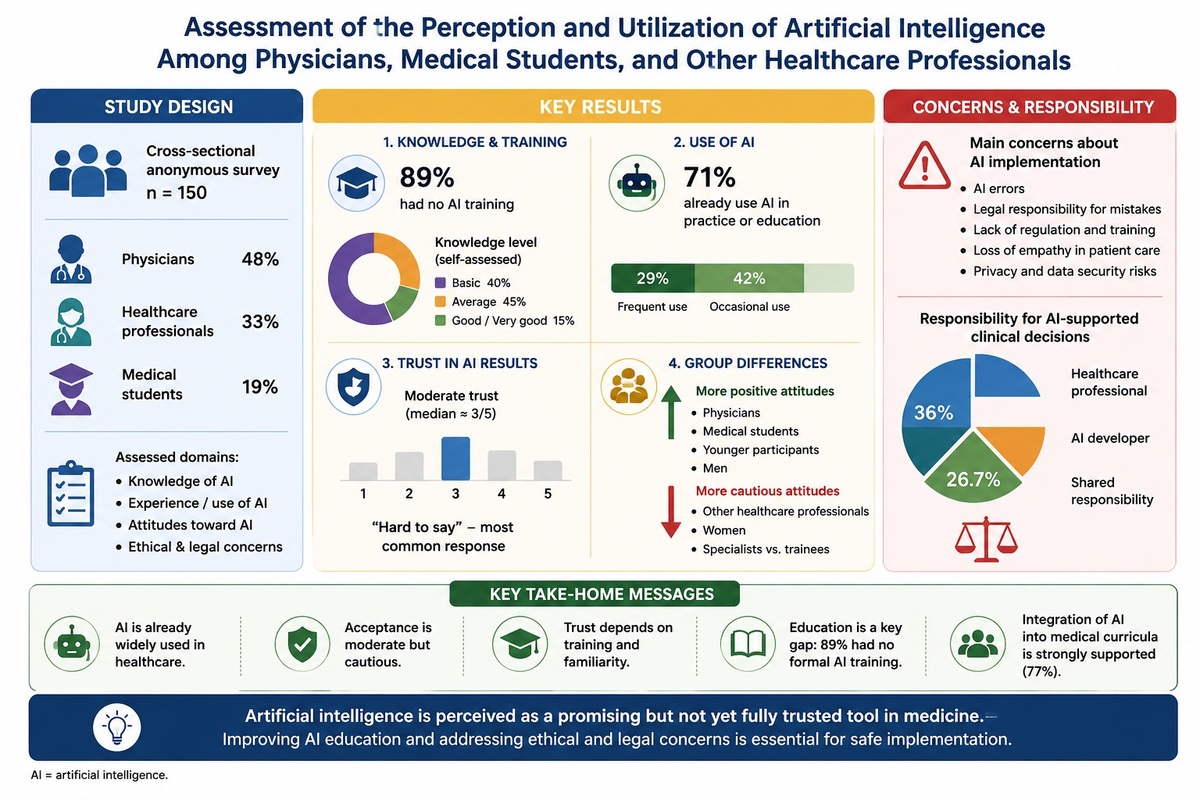
The study group consisted of doctors (N = 72, 48%) other healthcare professionals (N = 50, 33%), and students (N = 28, 19%). The participants’ ages ranged from 19 to 65 (median 33). Respondents most often rated their knowledge of AI as average (45%) or basic (40%); only a small proportion reported good or very good knowledge of the subject (Figure 1).
Figure 1
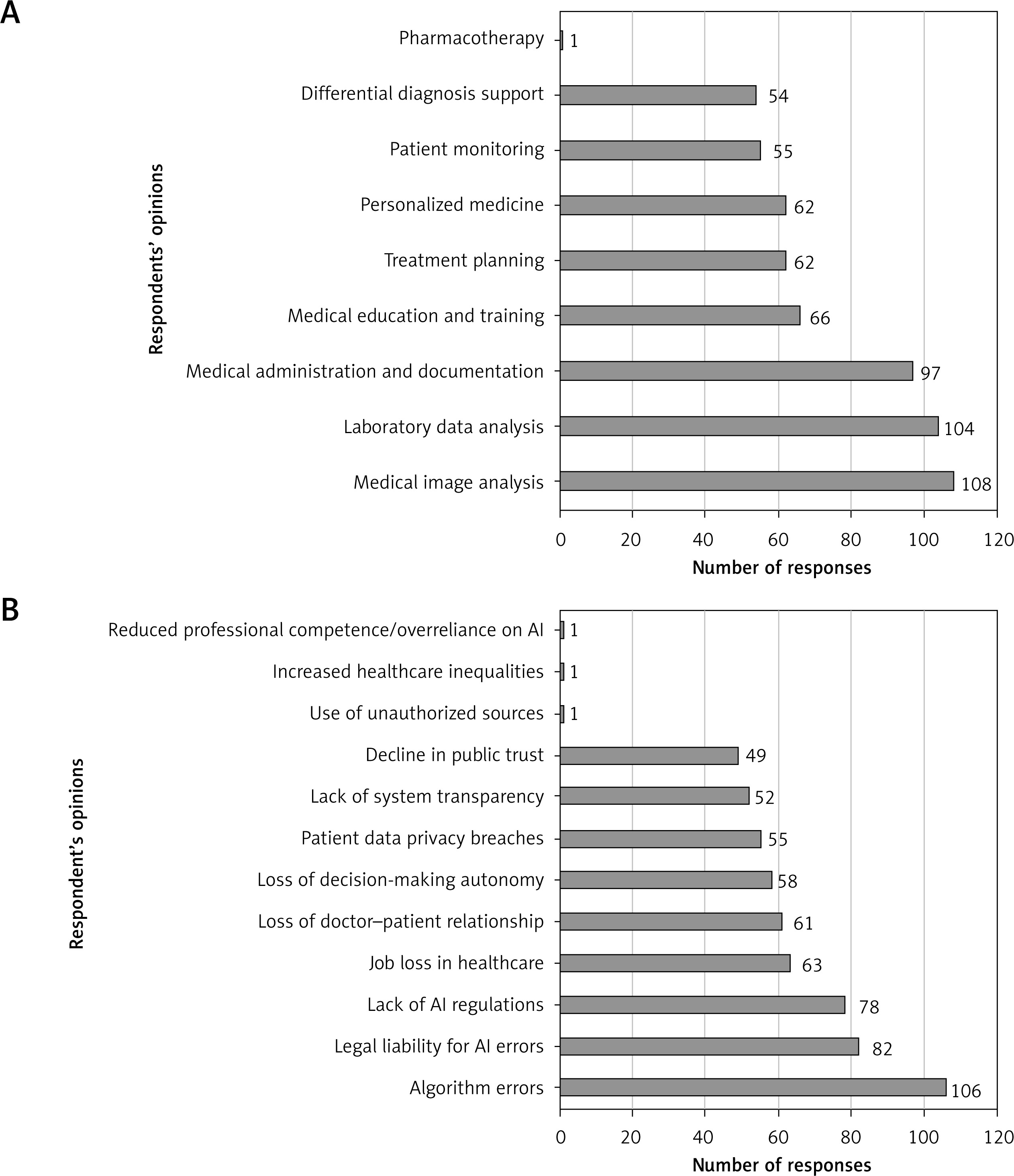
A – Potential applications of artificial intelligence in medical practice. B – Concerns regarding the implementation of AI in medicine
As many as 89% of participants (N = 134) had not taken part in any training or courses related to AI in medicine. The most frequently cited source of knowledge about AI was the internet and other media, whilst academic education and structured training were mentioned only sporadically.
Despite this, the vast majority of respondents admitted to using AI in clinical practice or in the educational process. 42% (N = 63) indicated occasional use of this tool, and 29% (N = 44) indicated frequent use. The most frequently cited areas of potential use for AI in clinical practice were, in order: medical image analysis, analysis of laboratory test results, administration and medical documentation, and education and training. AI was also perceived as a tool capable of contributing to the development of personalised medicine and improving diagnostic accuracy.
An analysis of differences between professional groups revealed varying attitudes towards AI.
Physicians and medical students rated AI’s potential to reduce staff workload (physicians vs other healthcare professionals p = 0.000612; medical students vs. other healthcare professionals p = 0.006615; physicians Me = 4; Q1 = 3, Q3 = 5; medical students Me = 4; Q1 = 4, Q3 = 5; other healthcare professionals Me = 3; Q1 = 3, Q3 = 4) and impact the future of the medical profession higher than others (physicians vs. other healthcare professionals p = 0.000098; medical students vs other healthcare professionals p = 0.008614; physicians Me = 4, Q1 = 4, Q3 = 4; medical students Me = 4; Q1 = 3.25, Q3 = 4; other healthcare professionals Me = 3; Q1 = 3, Q3 = 4) while also expressing greater trust in the tools’ safety (physicians vs. other healthcare professionals p = 0.029266; medical students vs other healthcare professionals p = 0.010869; physicians Me = 3; Q1 = 3, Q3 = 4; medical students Me = 4; Q1 = 3, Q3 = 4; other healthcare professionals Me = 3; Q1 = 3, Q3 = 3). Other healthcare professionals, however, took a more cautious approach, more likely to express the opinion that AI will not replace human empathy (physicians vs. other healthcare professionals p = 0.021586; physicians Me = 4; Q1 = 1.75, Q3 = 5; other healthcare professionals Me = 5; Q1 = 3.25, Q3 = 5) and may exacerbate inequalities in access to healthcare (physicians vs other healthcare professionals p = 0.006787; physicians Me = 2; Q1 = 2, Q3 = 3; other healthcare professionals Me = 3; Q1 = 2, Q3 = 3).
Gender-based differences in responses were also observed. In most analyses, men showed greater trust in AI, highlighting the potential to enhance patient safety (p = 0.000781), improve the quality of care (p = 0.004655), and relieve staff of routine tasks (p = 0.003006). They were more likely than women to believe that the development of AI in medicine is inevitable and necessary (p = 0.020337), showed greater support for incorporating AI into medical curricula (p = 0.009892), and rated the impact of AI on the future of the medical profession more positively (p = 0.000615). Women remained more sceptical, as they more often responded that empathy can never be replaced by AI (p = 0.001219).
When it came to the professional status of doctors, junior doctors rated the potential of AI to improve the quality of medical care higher than specialists did (p = 0.009134). Interns and junior doctors rated the potential of AI to reduce the workload of staff significantly higher than specialists did (p = 0.009728). Interestingly, interns were more likely than specialists to agree with the statement that AI will never replace human empathy (p = 0.012144).
Place of work (teaching hospital/district hospital/regional hospital/primary healthcare) had no significant impact on attitudes toward AI in medicine.
Participation in training on artificial intelligence translated into greater trust in the results it generates (p = 0.0116), although it did not significantly influence most of the other variables analysed.
Age also influenced attitudes towards AI, with younger respondents being more open to its implementation than older ones. This may be due to their better familiarity with digital technologies and greater exposure to innovations during their education.
The most frequently reported concerns among responders about implementing AI in healthcare were algorithmic errors, legal liability for AI mistakes, and insufficient legal regulations and training for healthcare professionals. Concerns also included the loss of the patient-doctor relationship, loss of autonomy in decision-making, violations of patient data privacy, lack of transparency in system operation, and a decline in public trust in healthcare professionals.
Regarding responsibility for AI-supported clinical decisions, the largest proportion of participants (36%) indicated that responsibility should rest with the healthcare professional; slightly fewer indicated responsibility for the algorithm creator (27.3%) or shared responsibility (26.7%).
In terms of trust in artificial intelligence as a safe and reliable tool in medicine, just over half of the respondents answered “hard to say”, one third claimed that they tended to trust it, and the remaining participants expressed distrust.
When asked about the future of AI in healthcare, respondents most frequently predicted its gradual implementation over the next 5–10 years. The greatest potential for development was attributed to areas such as medical imaging, clinical data analysis and healthcare system management.
The vast majority (77%) of respondents were in favour of incorporating AI into medical school curricula. Most respondents assessed the impact of AI on the future of medical professions as generally positive, with about one third holding a neutral view and a small proportion expressing negative views.
Discussion
This cross-sectional survey revealed that only 10.67% of respondents had formal AI education, with moderate self-assessed AI knowledge (median = 3). Although 89% had received no AI training, most considered AI integration into medical curricula essential and viewed AI expansion in healthcare as inevitable. Respondents rated AI’s potential to improve care quality highly, yet reported only moderate trust in AI-generated outputs (median = 3), with concerns regarding errors and legal liability.
Significant differences emerged across professional groups: physicians and medical students demonstrated more favourable attitudes toward AI than other healthcare professionals, with trainees and residents expressing greater optimism than specialists. Gender-related differences were also observed: men reported greater optimism, whereas women emphasized caution.
The pattern of high perceived usefulness coupled with moderate trust is consistent with international findings [5, 6]. Recent work on large language model dependence further suggests that AI adoption should be considered not only in terms of usefulness, but also in relation to users’ trust, reliance, and responsible use boundaries [7]. Inter-professional and gender-based attitudinal differences align with prior research demonstrating that familiarity with AI correlates with more positive attitudes [8, 9], and that women exhibit higher AI anxiety and greater emphasis on ethical considerations [10].
However, the high proportion of respondents lacking AI training may partly reflect the absence of systematic AI education in Polish medical curricula, limiting direct generalizability. Given the cross-sectional, non-probability sampling design, all observed associations should be regarded as exploratory hypotheses requiring confirmation through longitudinal and randomly sampled studies.
These findings suggest that systematic integration of AI competencies into medical education warrants consideration [11]. Recent advances in research therapeutics further indicate that digital technologies are increasingly being integrated into medical diagnostics and treatment [12], reinforcing the need for healthcare professionals to develop adequate digital and AI-related competencies [13]. Building trust requires rigorous clinical validation, transparent reporting according to SPIRIT-AI and CONSORT-AI guidelines [14, 15], and adherence to the EU AI Act and Medical Device Regulation frameworks. These implications remain tentative and require further empirical verification.
In conclusion, these results suggest that artificial intelligence may play an increasingly important role in the future of medicine. Further research is needed to deepen knowledge, build trust, and ensure responsible implementation of these tools in clinical practice.