Current issue
Archive
Manuscripts accepted
About the Journal
Editorial office
Editorial board
Section Editors
Abstracting and indexing
Subscription
Contact
Ethical standards and procedures
Most read articles
Instructions for authors
Article Processing Charge (APC)
Regulations of paying article processing charge (APC)


PUBLIC HEALTH / CLINICAL RESEARCH
Association of spiritual coping skills with psychological resilience and health beliefs of mothers of children with special needs
1
Department of Public Health Nursing, Faculty of Health Sciences, Toros University, Mersin, Turkey
2
Department of Child Care and Youth Services, Child Development Program, Vocational School of Health Services, Toros University, Mersin, Turkey
Submission date: 2024-11-02
Final revision date: 2025-02-26
Acceptance date: 2025-03-05
Online publication date: 2025-05-18
Corresponding author
Neslihan Özcanarslan
Department of Nursing Faculty of Health Sciences Toros University Mersin, Turkey Phone: +905336671604
Department of Nursing Faculty of Health Sciences Toros University Mersin, Turkey Phone: +905336671604
KEYWORDS
TOPICS
ABSTRACT
Introduction:
Mothers of children with special needs face various responsibilities and challenges in daily life. They not only manage their children’s care and needs but also strive to maintain their own psychological resilience. This study aimed to explore the mediating role of spiritual coping skills in the psychological resilience and health beliefs of these mothers.
Material and methods:
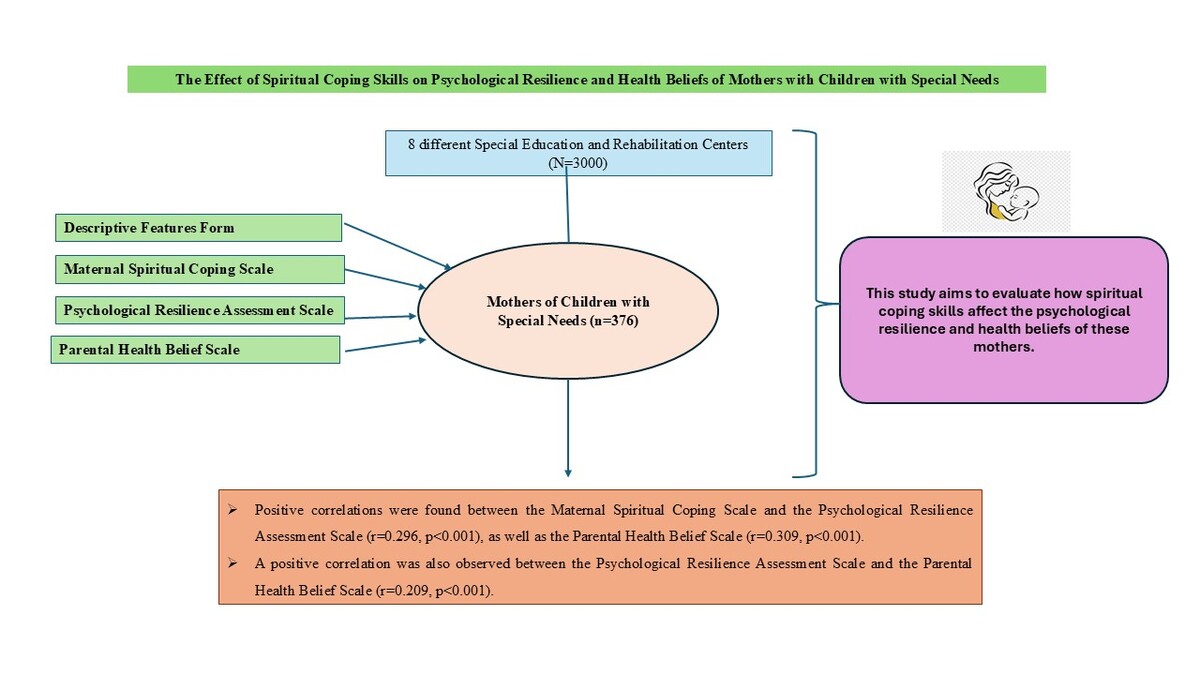
A cross-sectional descriptive design was used, following STROBE reporting guidelines. The study involved 3000 mothers from eight special education and rehabilitation centers, with 376 mothers selected through proportional stratified random sampling. Data were collected using the ‘Descriptive Characteristics Form,’ ‘Maternal Spiritual Coping Scale,’ ‘Psychological Resilience Assessment Scale,’ and ‘Parental Health Belief Scale.’ Descriptive analyses were conducted for demographic data and parameter results, while regression analysis was used to assess relationships between variables, and correlation coefficients were calculated. Data were analyzed using a specialized statistical program.
Results:
Positive correlations were found between the Maternal Spiritual Coping Scale and the Psychological Resilience Assessment Scale (r = 0.296, p < 0.001), as well as the Parental Health Belief Scale (r = 0.309, p < 0.001). A positive correlation was also observed between the Psychological Resilience Assessment Scale and the Parental Health Belief Scale (r = 0.209, p < 0.001).
Conclusions:
The study found that mothers’ spiritual coping strategies were associated with their psychological health and their attitudes towards their children’s health problems.
Mothers of children with special needs face various responsibilities and challenges in daily life. They not only manage their children’s care and needs but also strive to maintain their own psychological resilience. This study aimed to explore the mediating role of spiritual coping skills in the psychological resilience and health beliefs of these mothers.
Material and methods:
A cross-sectional descriptive design was used, following STROBE reporting guidelines. The study involved 3000 mothers from eight special education and rehabilitation centers, with 376 mothers selected through proportional stratified random sampling. Data were collected using the ‘Descriptive Characteristics Form,’ ‘Maternal Spiritual Coping Scale,’ ‘Psychological Resilience Assessment Scale,’ and ‘Parental Health Belief Scale.’ Descriptive analyses were conducted for demographic data and parameter results, while regression analysis was used to assess relationships between variables, and correlation coefficients were calculated. Data were analyzed using a specialized statistical program.
Results:
Positive correlations were found between the Maternal Spiritual Coping Scale and the Psychological Resilience Assessment Scale (r = 0.296, p < 0.001), as well as the Parental Health Belief Scale (r = 0.309, p < 0.001). A positive correlation was also observed between the Psychological Resilience Assessment Scale and the Parental Health Belief Scale (r = 0.209, p < 0.001).
Conclusions:
The study found that mothers’ spiritual coping strategies were associated with their psychological health and their attitudes towards their children’s health problems.
REFERENCES (37)
1.
Jones J, Passey J. Family adaptation, coping and resources: parents of children with developmental disabilities and behaviour problems. J Dev Disabil 2004; 11: 31-46.
2.
Koyuncu M, Gümüş H, Bolat EY. Investigation of recreation area participation barriers of families with special needs. Int J Disabil Sports Health Sci 2024; 7: 556-63.
3.
Asa GA, Fauk NK, Ward PR, Hawke K, Crutzen R, Mwanri L. Psychological, sociocultural and economic coping strategies of mothers or female caregivers of children with a disability in Belu district, Indonesia. PloS One 2021; 16: e0251274.
4.
Yilmaz G. Spiritual orientation, meaning in life, life satisfaction, and well-being in mothers with disabled children. J Relig Health 2019; 58: 2251-62.
5.
Białek K, Sadowski M, Adamczyk-Gruszka O, Młodawski J, Świercz G. Level of basic hope and symptoms of anxiety and depression in women after miscarriage. Arch Med Sci 2024; 20: 332-8.
6.
Adams D, Rose J, Jackson N, Karakatsani E, Oliver C. Coping strategies in mothers of children with intellectual disabilities showing multiple forms of challenging behaviour: associations with maternal mental health. Behav Cogn Psychother 2018; 46: 257-75.
7.
Karaca A, Konuk Şener D. Spirituality as a coping method for mothers of children with developmental disabilities. Int J Dev Disabil 2021; 67: 112-20.
8.
Aslan G, Kant E, Gül Can F. Investigation of the relationship between spiritual coping styles and hope levels in mothers with disabled children in Turkey. J Relig Health 2023; 62: 3347-63.
9.
Koenig HG. Religion and Mental Health: Research and Clinical Applications. Academic Press, Cambridge 2018.
10.
Lucchetti G, Góes LG, Amaral SG, et al. Spirituality, religiosity and the mental health consequences of social isolation during COVID-19 pandemic. Int J Soc Psychiatry 2021; 67: 672-9.
11.
McCullough ME, Willoughby BL. Religion, self-regulation, and self-control: associations, explanations, and implications. Psychol Bull 2009; 135: 69-93.
12.
Feudtner C, Walter JK, Faerber JA, et al. Good-parent beliefs of parents of seriously ill children. JAMA Pediatr 2015; 169: 39-47.
13.
Gözüm S, Çapık C. Sağlık davranışlarının geliştirilmesinde bir rehber: sağlık inanç modeli. DEUHFED 2014; 7: 230-7.
14.
Elsobkey FA. Mothers’ health education based on health belief model to promote health of preterm infant related to sudden infant death syndrome. Am J Nurs 2018; 6: 164-73.
15.
Sekaran U, Bougie R. Research Methods for Business: a Skill Building Approach. John Wiley and Sons, Hoboken 2016.
16.
Yaman KG, Şanver-Gürsoy H, Canel AN, Eksi H. Maternal spiritual coping scale: development and validation. Spiritual Psychology and Counseling 2018; 3: 9-21.
17.
Türkkan T, Bülbül K, Odacı H. Psikolojik sağlamlığı değerlendirme ölçeği: Türkçe versiyonuna ilişkin ilk psikometrik bulgular. Yükseköğretim ve Bilim Dergisi 2022; 12: 255-63.
18.
Sunmaz D, Günsel B. Ebeveyn sağlık inanç ölçeğinin Türkiye’deki geçerlilik ve güvenirlik çalışması. Dokuz Eylül Üniversitesi Sağlık Bilimleri Enstitüsü 2003.
19.
Amen MM, Clarke VP. The influence of mothers’health beliefs on use of preventive child health care services and mothers’ perception of children’s health status. Issues Compr Pediatr Nurs 2001; 24: 153-63.
20.
Manor-Binyamini I. Mothers of children with developmental disorders in the Bedouin community in Israel: family functioning, caregiver burden, and coping abilities. J Autism Dev Disord 2011; 41: 610-7.
21.
Cauda-Laufer N. Raising a child with a disability: coping mechanisms and support needs. PCOM Psychology Dissertations 2017.
22.
Papp LM, Goeke-Morey MC, Cummings EM. Mothers’ and fathers’ psychological symptoms and marital functioning: examination of direct and interactive links with child adjustment. J Child Fam Stud 2004; 13: 469-82.
23.
Lickenbrock DM, Ekas NV, Whitman TL. Feeling good, feeling bad: influences of maternal perceptions of the child and marital adjustment on well-being in mothers of children with an autism spectrum disorder. J Autism Dev Disord 2011; 41: 848-58.
24.
Lloyd CM, Rosman E. Exploring mental health outcomes for low-income mothers of children with special needs: implications for policy and practice. Infants Young Child 2005; 18: 186-99.
25.
Nota A, Chikwanha TM, January J, Dangarembizi N. Factors contributing to defaulting scheduled therapy sessions by caregivers of children with congenital disabilities. Malawi Med J 2015; 27: 25-8.
26.
Yeniyapı A, Tokur Kegin M. Anaokulu Çocuklarının Annelerinin Ev Kazalarına Yönelik Aldıkları Güvenlik Önlemleri ile Sağlık İnancı Arasındaki İlişki: Kesitsel ve Korelasyonel Çalışma. Turkiye Klinikleri J Nurs Sci 2023; 15: 97-107.
27.
Park HJ, Chung GH. A multifaceted model of changes and adaptation among Korean mothers of children with disabilities. J Child Fam Stud 2015; 24: 915-29.
28.
Demirci A, Kartal M. The prevalence of developmental delay among children aged 3-60 months in Izmir, Turkey. Child Care Health Dev 2016; 42: 213-9.
29.
Shevell M, Majnemer A, Platt RW, Webster R, Birnbaum R. Developmental and functional outcomes at school age of preschool children with global developmental delay. J Child Neurol 2005; 20: 648-54.
30.
Scherzer AL, Chhagan M, Kauchali S, Susser E. Global perspective on early diagnosis and intervention for children with developmental delays and disabilities. Dev Med Child Neurol 2012; 54: 1079-84.
31.
Olusanya BO, et al. Disabilities in early childhood: a global health perspective. Children 2023; 10: 155.
32.
Yu S. The influence of mothers’ educational level on children’s comprehensive quality. J Educ Humanit Soc Sci 2023; 8: 1264-72.
33.
Banu B, Khanom K. Effects of education level of father and mother on perceptions of breastfeeding. J Enam Med Coll 2012; 2: 67-73.
34.
Bhuiya A, Streatfield K. Mothers’ education and survival of female children in a rural area of Bangladesh. Popul Stud 1991; 45: 253-64.
35.
Das Gupta M. Death clustering, mothers’ education and the determinants of child mortality in rural Punjab, India. Popul Stud 1990; 44: 489-505.
36.
Giannakou K, Kyprianidou M, Hadjikou A, et al. Knowledge of mothers regarding children’s vaccinations in Greece: an online cross-sectional study. BMC Public Health 2021; 21: 2119.
37.
Shalaby H, Obaid RA, Alharthi RH, et al. Health education role in promoting mothers’ beliefs, knowledge and practice of exclusive breastfeeding among King Fahd Armed Forces Hospital population. Int J Community Med Public Health 2019; 6: 1853.
| eISSN: | 1896-9151 |
| ISSN: | 1734-1922 |

We process personal data collected when visiting the website. The function of obtaining information about users and their behavior is carried out by voluntarily entered information in forms and saving cookies in end devices. Data, including cookies, are used to provide services, improve the user experience and to analyze the traffic in accordance with the Privacy policy. Data are also collected and processed by Google Analytics tool (more).
You can change cookies settings in your browser. Restricted use of cookies in the browser configuration may affect some functionalities of the website.
You can change cookies settings in your browser. Restricted use of cookies in the browser configuration may affect some functionalities of the website.