Current issue
Archive
Manuscripts accepted
About the Journal
Editorial office
Editorial board
Section Editors
Abstracting and indexing
Subscription
Contact
Ethical standards and procedures
Most read articles
Instructions for authors
Article Processing Charge (APC)
Regulations of paying article processing charge (APC)


NEUROLOGY / CLINICAL RESEARCH
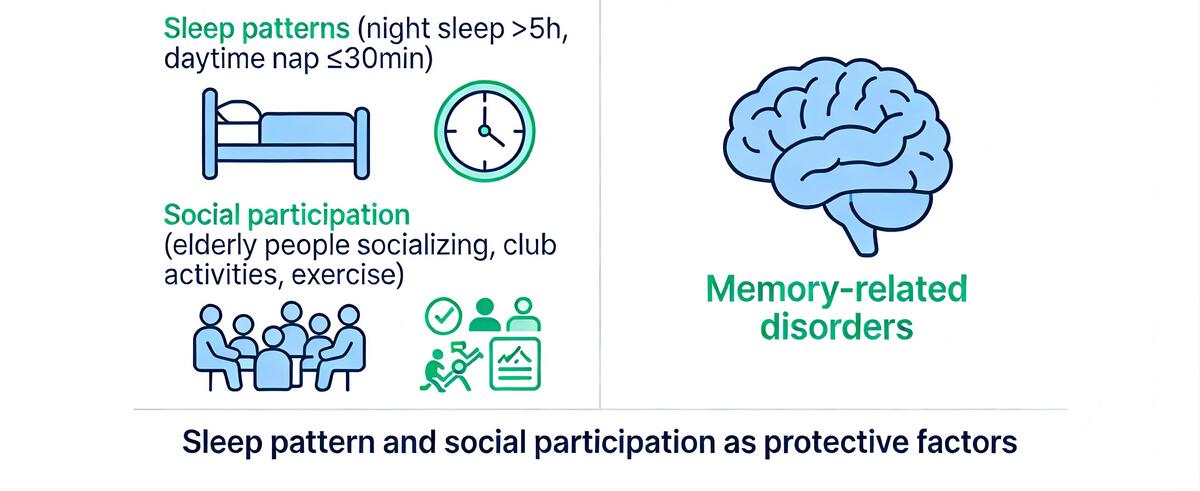
Associations of nocturnal-diurnal sleep patterns and social participation factors with memory-related disorders in middle-aged and older adults
1
Zhaoqing University, China
2
Department of Sports, Exercise and Health Sciences, University of Trás-os-Montes and Alto Douro, Vila Real, Portugal
3
College of Sports Science, Dankook University, Korea (South)
4
Department of Sport and Exercise Sciences, Kunsan National University, Korea (South)
5
Faculty of Education, City University of Macau, China
6
Department of Rehabilitation Medicine, Shenzhen Hospital, Southern Medical University, China
Submission date: 2025-12-08
Final revision date: 2026-02-10
Acceptance date: 2026-03-03
Online publication date: 2026-06-04
KEYWORDS
CHARLSmiddle-aged and older adultsnighttime sleep durationsocial participationmemory-related disorders
TOPICS
ABSTRACT
Introduction:
The aim of the study was to investigate whether there is an association between nocturnal-daytime sleep patterns as well as social participation and memory-related categories of diseases in the middle-aged and older population in China.
Material and methods:
This study was based on data from the China Health and Retirement Longitudinal Study (CHARLS), and a total of 19,023 study participants who met the inclusion and exclusion criteria were included in the 2018 analysis. Logistic regression models were used to explore the relationship between different night-time-daytime sleep patterns, social participation, and memory-related categories of disorders step by step with adjustments for different covariates, and the odds ratios (ORs) and 95% confidence intervals (95% Cl) were obtained.
Results:
Logistic regression models with sequential adjustment for potential confounders identified nighttime sleep duration > 5 h combined with daytime sleep duration ≤ 30 min, participation in sports, and participation in social or other club activities as factors associated with lower odds of memory-related diseases. Stratified analyses found that among males, people living in rural areas, and married people, the group with > 5 h of nighttime sleep and ≤ 30 min of daytime sleep was associated with lower odds of memory-related disorders. Among women, people living in urban areas, and married people, social participation was associated with lower odds of memory-related diseases.
Conclusions:
Nighttime sleep time > 5 h, daytime sleep time ≤ 30 min group, and social participation are associated with lower odds of memory-related disorders in older adults.
REFERENCES (37)
1.
Ware C, Dautricourt S, Gonneaud J, Chételat G. Does second language learning promote neuroplasticity in aging? A systematic review of cognitive and neuroimaging studies. Front Aging Neurosci 2021; 13: 706672.
2.
Laganiere J, Kells AP, Lai JT, et al. An engineered zinc finger protein activator of the endogenous glial cell line-derived neurotrophic factor gene provides functional neuroprotection in a rat model of Parkinson’s disease. J Neurosci 2010; 30: 16469-74.
3.
Baik D, Yu YM, Jung SY, Kang HY. Prevalence and patterns of the concurrent use of anticholinergics for the motor symptoms of Parkinson’s disease and acetylcholinesterase inhibitors in Parkinson’s disease patients with dementia: a cross-sectional study using Korea National Health Insurance claims data. BMC Geriatr 2022; 22: 609.
4.
Li J, McPhillips MV, Deng Z, Fan F, Spira A. Daytime napping and cognitive health in older adults: a systematic review. J Gerontol A Biol Sci Med Sci 2023; 78: 1853-60.
5.
Ellenbogen JM, Hulbert JC, Stickgold R, Dinges DF, Thompson-Schill SL. Interfering with theories of sleep and memory: sleep, declarative memory, and associative interference. Curr Biol 2006; 16: 1290-4.
6.
Ju YE, McLeland JS, Toedebusch CD, et al. Sleep quality and preclinical Alzheimer disease. JAMA Neurol 2013; 70: 587-93.
7.
Marmot M, Shipley M, Brunner E, Hemingway H. Relative contribution of early life and adult socioeconomic factors to adult morbidity in the Whitehall II study. J Epidemiol Community Health 2001; 55: 301-7.
8.
Ouyang Y, Wang K, Zhang T, Peng L, Song G, Luo J. The influence of sports participation on body image, self-efficacy, and self-esteem in college students. Front Psychol 2020; 10: 3039.
9.
Bogaert S, Davis J, Van Rossom S, Vanwanseele B. Impact of gender and feature set on machine-learning-based prediction of lower-limb overuse injuries using a single trunk-mounted accelerometer. Sensors 2022; 22: 2860.
10.
House JS, Robbins C, Metzner HL. The association of social relationships and activities with mortality: prospective evidence from the Tecumseh Community Health Study. Am J Epidemiol 1982; 116: 123-40.
11.
Hsu HC. Does social participation by the elderly reduce mortality and cognitive impairment? Aging Ment Health 2007; 11: 699-707.
12.
Zhao Y, Hu Y, Smith JP, Strauss J, Yang G. Cohort profile: the China Health and Retirement Longitudinal Study (CHARLS). Int J Epidemiol 2014; 43: 61-8.
13.
Wang Y, Jiang G, Hou N, et al. Effects and differences of sleep duration on the risk of new-onset chronic disease conditions in middle-aged and elderly populations. Eur J Intern Med 2023; 107: 73-80.
14.
Yang YB, Zheng YB, Sun J, et al. To nap or not? Evidence from a meta-analysis of cohort studies of habitual daytime napping and health outcomes. Sleep Med Rev 2024; 78: 101989.
15.
Levasseur M, Lussier-Therrien M, Biron ML, et al. Scoping study of definitions of social participation: update and co-construction of an interdisciplinary consensual definition. Age Ageing 2022; 51: afab215.
16.
Ni X, Zhang Y, Zhang W, Wen Y, Wang Y, Wang M. Association between the triglyceride glucose-body mass index and memory-related diseases: a nationwide cohort study. Public Health 2025; 239: 136-41.
17.
Chen C, Wu H, Yang L, et al. Network analysis of chronic disease among middle-aged and older adults in China: a nationwide survey. Front Public Health 2025; 13: 1551034.
18.
Tao H, Chen G, Wu L, Lou H. Synergistic impact of air pollution and artificial light at night on memory disorders: a nationwide cohort analysis. BMC Public Health 2025; 25: 1591.
19.
Zhang Z, Hu C, Cai Y, et al. The evolution of comorbidities in chronic diseases among Chinese middle-aged and elderly people: evidence from the CHARLS (2015-2020). PLoS One 2025; 20: e0329372.
20.
VanderWeele TJ, Ding P. Sensitivity analysis in observational research: introducing the E-value. Ann Intern Med 2017; 167: 268-74.
21.
Hayward MD, Farina MP, Zhang YS, Kim JK, Crimmins EM. The importance of improving educational attainment for dementia prevalence trends from 2000 to 2014, among older non-hispanic black and white Americans. J Gerontol B Psychol Sci Soc Sci 2021; 76: 1870-9.
22.
Phillips AJK, Klerman EB, Butler JP. Modeling the adenosine system as a modulator of cognitive performance and sleep patterns during sleep restriction and recovery. PLoS Comput Biol 2017; 13: e1005759.
23.
Gao L, Yang J, Liu J, Xin T, Liu Y. Activities of daily living and depression in chinese elderly of nursing homes: a mediation analysis. Psychol Res Behav Manag 2023; 16: 29-38.
24.
Franken P, Dijk DJ. Sleep and circadian rhythmicity as entangled processes serving homeostasis. Nat Rev Neurosci 2024; 25: 43-59.
25.
Leong RLF, Lau TY, Dicom AR, et al. Influence of mid-afternoon nap duration and sleep parameters on memory encoding, mood, processing speed, and vigilance. Sleep 2023; 46: zsad025.
26.
Gao C, Zheng X, Cai R, et al. Timing and intraindividual variability of daytime napping and Alzheimer’s disease in older adults. Commun Med 2025; 5: 219.
27.
Ellender CM, Ruehland WR, Duce B, et al. Australasian Sleep Association 2024 guidelines for sleep studies in adults. Sleep 2024; 47: zsae1407.
28.
Colcombe S, Kramer AF. Fitness effects on the cognitive function of older adults: a meta-analytic study. Psychol Sci 2003; 14: 125-30.
29.
Ellwardt L, Aartsen M, Deeg D, Steverink N. Does loneliness mediate the relation between social support and cognitive functioning in later life? Soc Sci Med 2013; 98: 116-24.
30.
Lovato N, Lack L. The effects of napping on cognitive functioning. Progress Brain Res 2010; 185: 155-66.
31.
Leong RLF, Lo JC, Chee MWL. Systematic review and meta-analyses on the effects of afternoon napping on cognition. Sleep Med Rev 2022; 65: 101666.
32.
Dutheil F, Bessonnat B, Pereira B, et al. Napping and cognitive performance during night shifts: a systematic review and meta-analysis. Sleep 2020; 43: zsaa109.
33.
Salisbury DL, Warry W, Fergen J, Cruikshank K, Soderlund PD, Jacklin K. The MN RIDE pilot: feasibility of a synchronous, remotely delivered, aerobic exercise training program for rural-dwelling adults with subjective cognitive decline. Rural Remote Health 2023; 23: 8351.
34.
Gasquoine PG. Effects of physical activity on delayed memory measures in randomized controlled trials with nonclinical older, mild cognitive impairment, and dementia participants. J Clin Exp Neuropsychol 2018; 40: 874-86.
35.
Tsukita K, Sakamaki-Tsukita H, Takahashi R. Long-term effect of regular physical activity and exercise habits in patients with early Parkinson disease. Neurology 2022; 98: e859-71.
36.
Oh DJ, Yang HW, Kim TH, et al. Association of low emotional and tangible support with risk of dementia among adults 60 years and older in South Korea. JAMA Netw Open 2022; 5: e2226260.
37.
Zutter C, Stoltz A. Community gardens and urban agriculture: Healthy environment/healthy citizens. Int J Ment Health Nurs 2023; 32: 1452-61.
| eISSN: | 1896-9151 |
| ISSN: | 1734-1922 |

We process personal data collected when visiting the website. The function of obtaining information about users and their behavior is carried out by voluntarily entered information in forms and saving cookies in end devices. Data, including cookies, are used to provide services, improve the user experience and to analyze the traffic in accordance with the Privacy policy. Data are also collected and processed by Google Analytics tool (more).
You can change cookies settings in your browser. Restricted use of cookies in the browser configuration may affect some functionalities of the website.
You can change cookies settings in your browser. Restricted use of cookies in the browser configuration may affect some functionalities of the website.