Current issue
Archive
Manuscripts accepted
About the Journal
Editorial office
Editorial board
Section Editors
Abstracting and indexing
Subscription
Contact
Ethical standards and procedures
Most read articles
Instructions for authors
Article Processing Charge (APC)
Regulations of paying article processing charge (APC)


CLINICAL RESEARCH
Illness perception, pain coping, and self-compassion: a cross-sectional study of Polish women with endometriosis
1
The John Paul II Catholic University of Lublin, Poland
2
Euro-Medica Child and Adolescent Psychological Clinic, Sieniawa, Poland
These authors had equal contribution to this work
Submission date: 2025-11-10
Final revision date: 2026-01-01
Acceptance date: 2026-01-29
Online publication date: 2026-10-20
Corresponding author
KEYWORDS
TOPICS
ABSTRACT
Introduction:
Endometriosis is a chronic inflammatory gynecological disease, one of whose main symptoms is chronic pain. Generally, negative perceptions of the disease as an obstacle/loss, harm, or threat are linked to poorer adjustment, whereas positive perceptions of illness as a challenge, value, or profit show the opposite pattern. The study aimed to investigate whether pain-coping strategies and self-compassion in women with endometriosis were associated with the perception of their disease in terms of obstacle/loss, threat, harm, value, challenge, and profit.
Material and methods:
The study group consisted of 265 Polish women with a diagnosis of endometriosis. The online survey included three measures: the Self-Compassion Scale (SCS-PL), the Coping Strategies Questionnaire (CSQ), and the Disease-Related Appraisals Scale (DRAS).
Results:
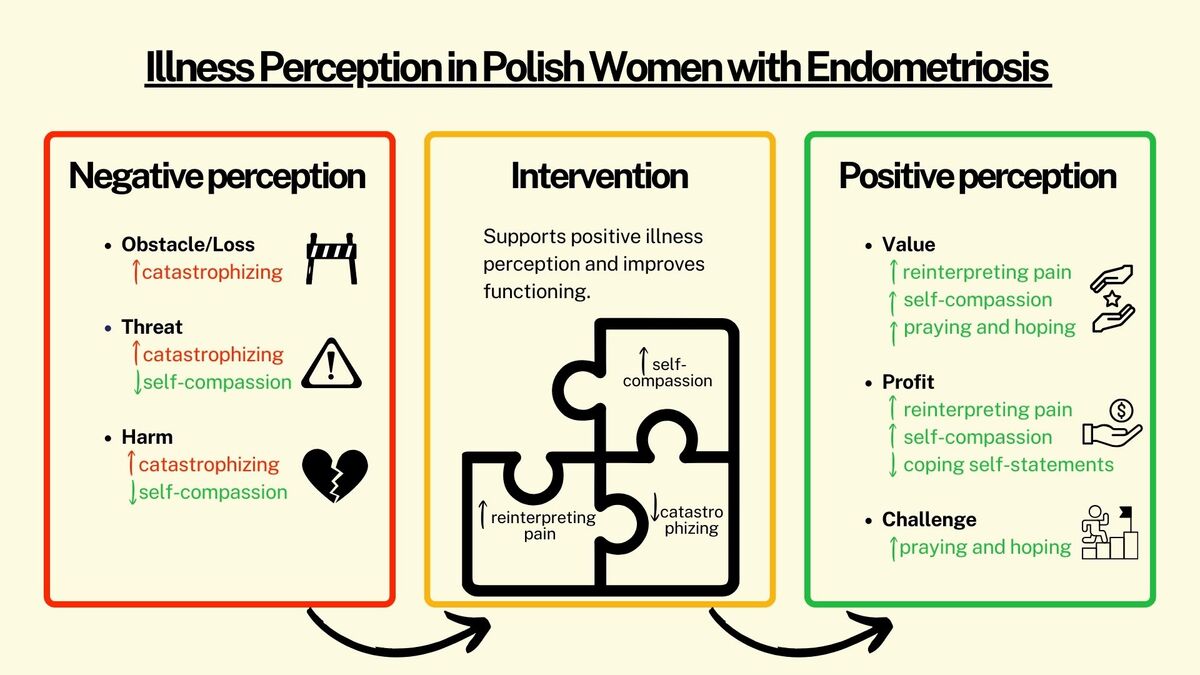
Perceiving illness in negative terms – as an obstacle/loss, threat, or harm – was associated with catastrophizing about pain. Threat and harm categories were also inversely related to self-compassion. Perceptions of endometriosis in terms of value or profit were positively associated with the strategy of reinterpreting pain sensations and by self-compassion. The profit category was also negatively associated with coping self-statements, whereas viewing illness as value or challenge was associated with the praying and hoping strategy.
Conclusions:
Higher self-compassion and greater use of reinterpreting pain sensations were associated with more positive perceptions of endometriosis, whereas catastrophizing was associated with more negative perceptions. These findings may help inform psychological interventions supporting women with endometriosis, although longitudinal or intervention studies are needed to determine whether modifying these factors changes illness perceptions and improves functioning or quality of life.
REFERENCES (54)
1.
Pettersson A, Berterö CM. How women with endometriosis experience health care encounters. Women’s Health Rep 2020; 1: 529-42.
2.
Young K, Fisher J, Kirkman M. Women’s experiences of endometriosis: a systematic review and synthesis of qualitative research. J Fam Planning Reprod Health Care 2015; 41: 225-34.
3.
Maulenkul T, Kuandyk A, Makhadiyeva D, et al. Understanding the impact of endometriosis on women’s life: an integrative review of systematic reviews. BMC Women’s Health 2024; 24: 524.
4.
Della Corte L, Di Filippo C, Gabrielli O, et al. The burden of endometriosis on women’s lifespan: a narrative overview on quality of life and psychosocial wellbeing. Int J Environ Res Public Health 2020; 17: 4683.
5.
Facchin F, Barbara G, Saita E, et al. Impact of endometriosis on quality of life and mental health: Pelvic pain makes the difference. J Psychosom Obstet Gynaecol 2015; 36: 135-41.
6.
Kalfas M, Chisari C, Windgassen S. Psychosocial factors associated with pain and health-related quality of life in endometriosis: a systematic review. Eur J Pain 2022; 26: 1827-48.
7.
Li W, Feng H, Ye Q. Relationship between endometriosis and mental health: a systematic review and meta-analysis. Arch Med Sci 2025; 21: 1985-96.
8.
Cole JM, Grogan S, Turley E. “The most lonely condition I can imagine”: psychosocial impacts of endometriosis on women’s identity. Feminism Psychology 2021; 31: 171-91.
9.
Calvi C, Sherman KA, Pham D. Loneliness and perceived social support in endometriosis: the roles of body image disturbance and anticipated stigma. Int J Behav Med 2024; 31: 433-44.
11.
Lipowski Z J. Physical illness, the individual and the coping processes. Psychiatry Med 1970; 1: 91-102.
12.
Barberis N, Cannavò M, Cuzzocrea F, Saladino V, Verrastro V. Illness perceptions and factors of distress as mediators between trait emotional intelligence and quality of life in endometriosis. Psychol Health Med 2023; 28: 1818-30.
13.
Spinoni M, Capano AU, Porpora MG, Grano C. Understanding the psychological factors linking pelvic pain and health-related quality of life in endometriosis: the influence of illness representations and coping strategies. Am J Obstet Gynecol 2025; 233: 54.e1-10.
14.
Moore C, Cogan N, Williams L. Illness perceptions among individuals with endometriosis and their longitudinal associations with psychological distress and pain. J Health Psychol 2025; 30: 4284-97.
15.
Pavlova M, Noel M, Orr SL, et al. Early childhood risk factors for later onset of pediatric chronic pain: a multi-method longitudinal study. BMC Pediatr 2024; 24: 508.
16.
Rosenstiel AK, Keefe FJ. The use of coping strategies in chronic low back pain patients: relationship to patient characteristics and current adjustment. Pain 1983; 17: 33-44.
17.
Leventhal H, Phillips LA, Burns E. The common-sense model of self-regulation (CSM): a dynamic framework for understanding illness self-management. J Behav Med 2016; 39: 935-46.
18.
Petrie KJ, Weinman J. Patients’ perceptions of their illness: the dynamo of volition in health care. Curr Direct Psychol Sci 2012; 21: 60-5.
19.
Woodhouse S, Hebbard G, Knowles SR. Exploring symptom severity, illness perceptions, coping styles, and well-being in gastroparesis patients using the common sense model. Dig Dis Sci 2018; 63: 958-65.
20.
Zhang M, Nie S, Hai Z, Du Y, Jiang M, Cai C. Effects of illness perception and coping style on self-management in peritoneal dialysis patients: a cross-sectional study. Psychol Res Behav Manag 2024; 17: 3381-93.
21.
de Heer EW, Vriezekolk JE, van der Feltz-Cornelis CM. Poor illness perceptions are a risk factor for depressive and anxious symptomatology in fibromyalgia syndrome: a longitudinal cohort study. Front Psychiatry 2017; 8: 217.
22.
Pereira MG, Carvalho C, Costa ECV, Leite Â, Almeida V. Quality of life in chronic pain patients: Illness- and wellness-focused coping as moderators. PsyCh J 2021; 10: 283-94.
23.
Andysz A, Merecz-Kot D. Predictors of illness acceptance in women with endometriosis. Health Psychol Rep 2021; 9: 240-51.
24.
Neff KD. Self-Compassion: an alternative conceptualization of a healthy attitude toward oneself. Self Identity 2003; 2: 85-101.
25.
Wren AA, Somers TJ, Wright MA, et al. Self-compassion in patients with persistent musculoskeletal pain: relationship of self-compassion to adjustment to persistent pain. J Pain Symptom Manag 2012; 43: 759-70.
26.
Sirois F, Rowse G. The role of self-compassion in chronic illness care. J Clin Outcomes Manag 2016; 23: 521-7.
27.
Germer CK, Neff KD. Self-compassion in clinical practice. J Clin Psychol 2013; 69: 856-67.
28.
Nasika IN, Wiart C, Bonvarlet AS, Guillaume J, Yavchitz A, Tereno S. Attachment patterns, self-compassion, and coping strategies in patients with chronic pain. Pain Rep 2023; 8: e1087.
29.
Roomaney R, Kagee A. Coping strategies employed by women with endometriosis in a public health-care setting. J Health Psychol 2016; 21: 2259-68.
30.
Sirois FM, Molnar DS, Hirsch JK. Self-compassion, stress, and coping in the context of chronic illness. Self Identity 2015; 14: 334.
31.
Mistretta EG, Davis MC. Meta-analysis of self-compassion interventions for pain and psychological symptoms among adults with chronic illness. Mindfulness 2022; 13: 267-84.
32.
Orozco-Gómez ÁM, Villamil-Munévar V, Mateus LM, Morales-Cruz C, Osorio-Noriega R. Pain characteristics, coping strategies and its relation with the quality of life in patients with chronic pain diseases. Salud Soc 2016; 7: 240-52.
33.
Yuan Y, Schreiber K, Flowers KM, et al. The relationship between emotion regulation and pain catastrophizing in patients with chronic pain. Pain Med 2024; 25: 468-77.
34.
Neff KD. Self-compassion: theory, method, research, and intervention. Ann Rev Psychol 2023; 74: 193-218.
35.
Kocur D, Flakus M, Fopka-Kowalczyk M. Skala Współczucia dla Samego Siebie (SCS-PL) [Self-Compassion Scale – Polish version (SCS-PL)]. Przegl Badań Eduk 2022; 37: 1-46.
36.
Juczyński Z. Narzędzia pomiaru w promocji i psychologii zdrowia [Measurement Tools in Health Promotion and Psychology]. Pracownia Testów Psychologicznych Polskiego Towarzystwa Psychologicznego 2001.
37.
Janowski K, Steuden S, Kuryłowicz J, Nieśpiałowska-Steuden M. The Disease-Related Appraisals Scale: a tool to measure subjective perception of the disease situation. Biopsych Aspects Health Dis 2009; 1: 108-25.
38.
George D, Mallery M. SPSS for Windows step by step: a simple guide and reference (17.0 update). Pearson 2010.
39.
Tabachnick BG, Fidell LS. Using Multivariate Statistics (5th ed.). Allyn and Bacon 2007.
40.
González-Echevarría AM, Rosario E, Acevedo S, Flores I. Impact of coping strategies on quality of life of adolescents and young women with endometriosis. J Psychosom Obstet Gynecol 2019; 40: 138-45.
41.
Zarbo C, Brugnera A, Frigerio L, et al. Behavioral, cognitive, and emotional coping strategies of women with endometriosis: a critical narrative review. Arch Women’s Ment Health 2018; 21: 1-13.
42.
Vlaeyen JWS, Linton SJ. Fear-avoidance model of chronic musculoskeletal pain: 12 years on. Pain 2012; 153: 1144-7.
43.
Espuig A, Pons-Vinent M, Carbajo E, Lacomba-Trejo L. The impact of pain, threat perception and emotional distress on suicide risk in individuals with colorectal cancer. Nurs Rep 2024; 14: 2629-39.
44.
Vlaeyen JWS, Crombez G, Linton SJ. The fear-avoidance model of pain. Pain 2016; 157: 1588-9.
45.
Rogers AH, Farris SG. A meta-analysis of the associations of elements of the fear-avoidance model of chronic pain with negative affect, depression, anxiety, pain-related disability and pain intensity. Eur J Pain 2022; 26: 1611-35.
46.
Neff KD, Germer CK. A pilot study and randomized controlled trial of the mindful self-compassion program. J Clin Psychol 2013; 69: 28-44.
47.
Facchin F, Grosso F, Saita E, Vercellini P, Pagnini F. Can self-compassion and mindfulness predict psychological wellbeing in individuals with endometriosis? Findings from an online survey. BMC Womens Health 2025; 25: 310.
48.
Van Niekerk L, Johnstone L, Matthewson M. Predictors of self-compassion in endometriosis: the role of psychological health and endometriosis symptom burden. Hum Reprod 2022; 37: 264-73.
49.
McCracken LM, Vowles KE. Acceptance and commitment therapy and mindfulness for chronic pain: model, process, and progress. Am Psychol 2014; 69: 178-87.
50.
Scott W, McCracken LM. Psychological flexibility, acceptance and commitment therapy, and chronic pain. Curr Opin Psychol 2015; 2: 91-6.
51.
Jors K, Büssing A, Hvidt NC, Baumann K. Personal prayer in patients dealing with chronic illness: a review of the research literature. Evid Based Complement Alternat Med 2015; 2015: 927973.
52.
Ehde DM, Dillworth TM, Turner JA. Cognitive-behavioral therapy for individuals with chronic pain: efficacy, innovations, and directions for research. Am Psychol 2014; 69: 153-66.
53.
Sturgeon JA. Psychological therapies for the management of chronic pain. Psychol Res Behav Manag 2014; 7: 115-24.
54.
Fang QY, Campbell N, Mooney SS, Holdsworth-Carson SJ, Tyson K. Evidence for the role of multidisciplinary team care in people with pelvic pain and endometriosis: a systematic review. Austral N Zeal J Obstet Gynaecol 2024; 64: 181-92.
Share
RELATED ARTICLE
| eISSN: | 1896-9151 |
| ISSN: | 1734-1922 |

We process personal data collected when visiting the website. The function of obtaining information about users and their behavior is carried out by voluntarily entered information in forms and saving cookies in end devices. Data, including cookies, are used to provide services, improve the user experience and to analyze the traffic in accordance with the Privacy policy. Data are also collected and processed by Google Analytics tool (more).
You can change cookies settings in your browser. Restricted use of cookies in the browser configuration may affect some functionalities of the website.
You can change cookies settings in your browser. Restricted use of cookies in the browser configuration may affect some functionalities of the website.