Current issue
Archive
Manuscripts accepted
About the Journal
Editorial office
Editorial board
Section Editors
Abstracting and indexing
Subscription
Contact
Ethical standards and procedures
Most read articles
Instructions for authors
Article Processing Charge (APC)
Regulations of paying article processing charge (APC)


GENERAL SURGERY / RESEARCH PAPER
Combined CRS-HIPEC for Peritoneal Malignancies: A 10-Year Single-Center Experience
1
Lower Silesian Center of Oncology, Pulmonology and Hematology, Poland
2
Hirszfeld Institute of Immunology & Experimental Therapy; Polish Academy of Sciences, Laboratory of Immunopathology, Department of Experimental Therapy, Poland
3
Wroclaw University of Science and
Technology, Faculty of Medicine, Poland
Submission date: 2025-04-04
Final revision date: 2025-07-23
Acceptance date: 2025-10-03
Online publication date: 2026-02-15
Corresponding author
Michał Kazanowski
Lower Silesian Center of Oncology, Pulmonology and Hematology, pl Hirszfelda 12, Wrocław, Poland
Lower Silesian Center of Oncology, Pulmonology and Hematology, pl Hirszfelda 12, Wrocław, Poland
KEYWORDS
Hyperthermic Intraperitoneal ChemotherapySurvival AnalysisPeritoneal CarcinomatosisCytoreductive SurgeryPeritoneal Neoplasms
TOPICS
ABSTRACT
Introduction:
Peritoneal surface malignancies (PSMs) are challenging to treat due to their locoregional nature and poor response to systemic therapies. Cytoreductive surgery (CRS) combined with hyperthermic intraperitoneal chemotherapy (HIPEC) has emerged as a promising treatment for selected patients, though long-term, real-world data remain limited. Aim of the study: To analyze clinical outcomes, survival patterns, and prognostic factors in a large cohort of patients undergoing CRS-HIPEC over a 10-year period at a national referral center.
Material and methods:
This retrospective study included 292 adult patients who underwent 319 CRS-HIPEC procedures between 2015 and 2024. Primary endpoints included overall survival (OS) and postoperative outcomes. Data were stratified by tumor type, Peritoneal Cancer Index (PCI), and Completeness of Cytoreduction (CC-score).
Results:
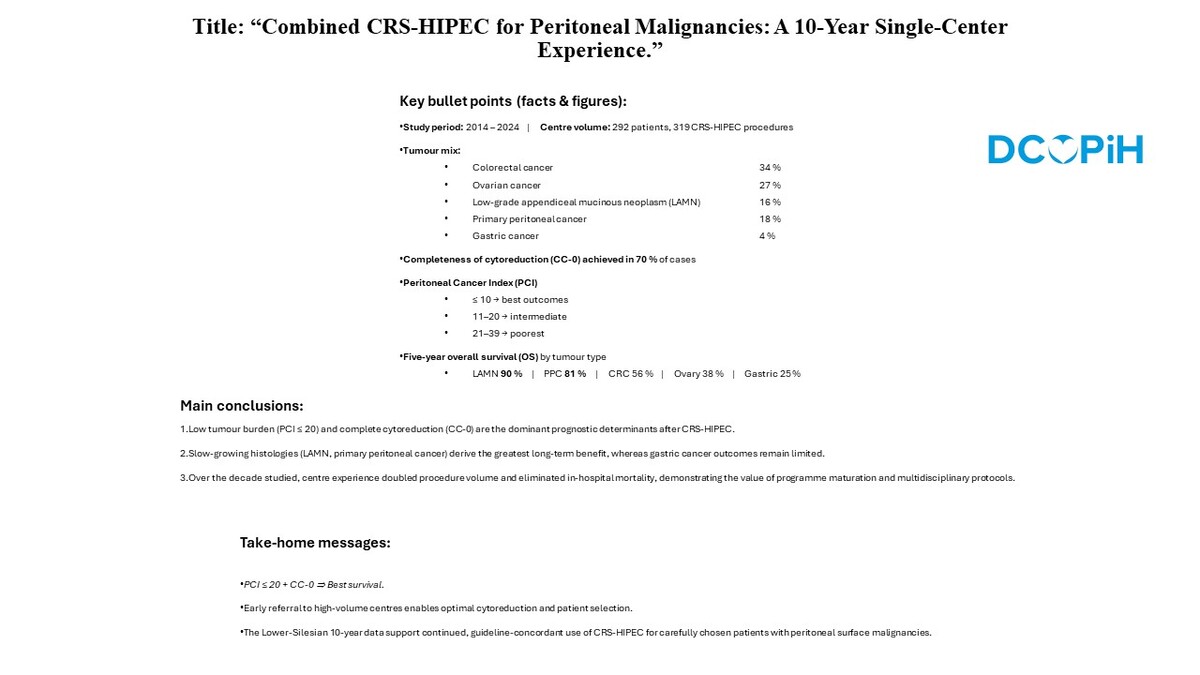
The most common indications were colorectal cancer (34.5%), ovarian cancer (27.0%), low-grade appendiceal mucinous neoplasm (LAMN) (16.1%), primary peritoneal cancer (17.7%), and gastric cancer (3.7%). Complete cytoreduction (CC-0) was achieved in 69.9% of cases. Five-year survival rates were highest in LAMN (90.4%) and primary peritoneal cancer (80.7%), and lowest in gastric cancer (25.0%). Lower PCI (<20) and CC-0 resection were strongly associated with improved survival. Postoperative morbidity declined over time, with no in-hospital mortality since 2022.
Conclusions:
CRS-HIPEC offers substantial long-term survival benefits in selected patients with PSMs. Tumor biology, PCI, and completeness of cytoreduction are key prognostic factors. Our findings support expanding access to HIPEC in well-selected cases, particularly in tumors with peritoneal-confined dissemination.
Peritoneal surface malignancies (PSMs) are challenging to treat due to their locoregional nature and poor response to systemic therapies. Cytoreductive surgery (CRS) combined with hyperthermic intraperitoneal chemotherapy (HIPEC) has emerged as a promising treatment for selected patients, though long-term, real-world data remain limited. Aim of the study: To analyze clinical outcomes, survival patterns, and prognostic factors in a large cohort of patients undergoing CRS-HIPEC over a 10-year period at a national referral center.
Material and methods:
This retrospective study included 292 adult patients who underwent 319 CRS-HIPEC procedures between 2015 and 2024. Primary endpoints included overall survival (OS) and postoperative outcomes. Data were stratified by tumor type, Peritoneal Cancer Index (PCI), and Completeness of Cytoreduction (CC-score).
Results:
The most common indications were colorectal cancer (34.5%), ovarian cancer (27.0%), low-grade appendiceal mucinous neoplasm (LAMN) (16.1%), primary peritoneal cancer (17.7%), and gastric cancer (3.7%). Complete cytoreduction (CC-0) was achieved in 69.9% of cases. Five-year survival rates were highest in LAMN (90.4%) and primary peritoneal cancer (80.7%), and lowest in gastric cancer (25.0%). Lower PCI (<20) and CC-0 resection were strongly associated with improved survival. Postoperative morbidity declined over time, with no in-hospital mortality since 2022.
Conclusions:
CRS-HIPEC offers substantial long-term survival benefits in selected patients with PSMs. Tumor biology, PCI, and completeness of cytoreduction are key prognostic factors. Our findings support expanding access to HIPEC in well-selected cases, particularly in tumors with peritoneal-confined dissemination.
| eISSN: | 1896-9151 |
| ISSN: | 1734-1922 |

We process personal data collected when visiting the website. The function of obtaining information about users and their behavior is carried out by voluntarily entered information in forms and saving cookies in end devices. Data, including cookies, are used to provide services, improve the user experience and to analyze the traffic in accordance with the Privacy policy. Data are also collected and processed by Google Analytics tool (more).
You can change cookies settings in your browser. Restricted use of cookies in the browser configuration may affect some functionalities of the website.
You can change cookies settings in your browser. Restricted use of cookies in the browser configuration may affect some functionalities of the website.