
Modern life has made sitting the default posture of work, transport, and leisure. In contrast with the pre-industrial world, in which subsistence itself required repeated bouts of muscular effort, contemporary societies are organized to spare exertion. Automation has displaced manual labor and most professional tasks are performed at a desk and through the screen. Household appliances have compressed domestic work, cars and dependable public transport have replaced walking and cycling, and television, computers, and smartphones occupy increasing portions of discretionary time. At the same time, many urban environments remain poorly equipped with safe, walkable routes and accessible green spaces. The result is not merely a cultural preference for convenience, but a structural drift towards immobility. Together, these forces contribute to the global burden of obesity, type 2 diabetes, cardiovascular disease, chronic kidney disease, and metabolic liver disease.
Under physiological conditions, adipose tissue is the principal safe reservoir for surplus lipids. When this storage capacity is exceeded, fatty substrates are redirected to ectopic sites, including the liver, where they promote organ dysfunction, insulin resistance, and adverse systemic metabolic sequelae. The terminology used to describe this condition has evolved substantially. What was once termed nonalcoholic fatty liver disease (NAFLD), and later metabolic dysfunction-associated fatty liver disease (MAFLD), is now increasingly recognized as metabolic dysfunction-associated steatotic liver disease (MASLD) [1]. This change is more than semantic: MASLD is a systemic disorder with hepatic consequences, cirrhosis, liver failure, and hepatocellular carcinoma, and extrahepatic outcomes, including atherosclerotic cardiovascular disease, chronic kidney disease, and non-hepatic cancers. Across these domains, the severity of liver fibrosis functions as a powerful barometer of systemic risk [2–5].
The scale of the problem is formidable. MASLD affects about 38% of adults and 7–14% of children and adolescents worldwide, while its more rapidly progressive inflammatory variant, metabolic dysfunction-associated steatohepatitis (MASH), imposes a substantial clinical, economic, and quality-of-life burden that is projected to increase across most regions of the world [6].
Sex and gender, genetic susceptibility, cardiometabolic milieu, diet, sleep, medications, and environmental exposures all shape the onset and progression of MASLD, but lifestyle remains central. A consistent body of evidence indicates that physical activity and structured exercise protect against steatotic liver disease. Against this background, a recent publication in this journal [7] adds timely evidence from the National Health and Nutrition Examination Survey (NHANES). In 7,705 adults assessed by transient elastography and questionnaire-derived measures of sedentary behavior and physical activity, sedentary time showed a graded association with MAFLD. Risk became apparent beyond 5 h/day and increased further with each additional hour of sitting. Although men had higher prevalence rates of MAFLD, fibrosis, and cirrhosis, the association between sedentary time and MAFLD did not differ significantly by sex. These data support a pragmatic public health message: limiting sedentary time to less than 5 h daily should be considered alongside, rather than subordinate to, recommendations for moderate-to-vigorous physical activity, with targets tailored to age and individual fitness. They also expose a gap in current guidance, which defines desirable exercise targets far more clearly than it defines tolerable sedentary exposure. A complementary NHANES-based cross-sectional analysis found a graded association between sitting time and insulin resistance in US adults, independent of smoking status and physical activity. However, this association was substantially attenuated after adjustment for body mass index and disappeared after accounting for waist circumference, suggesting that abdominal adiposity largely mediates the metabolic harm of prolonged sitting [8].
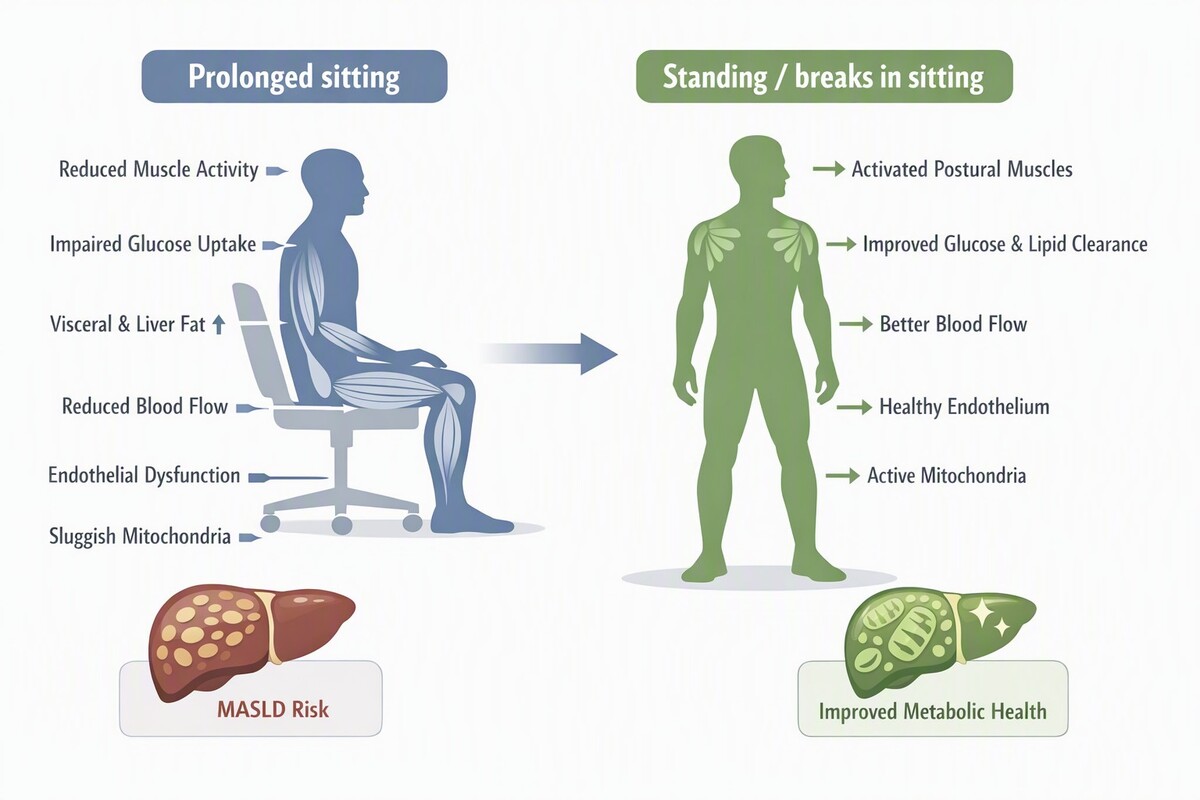
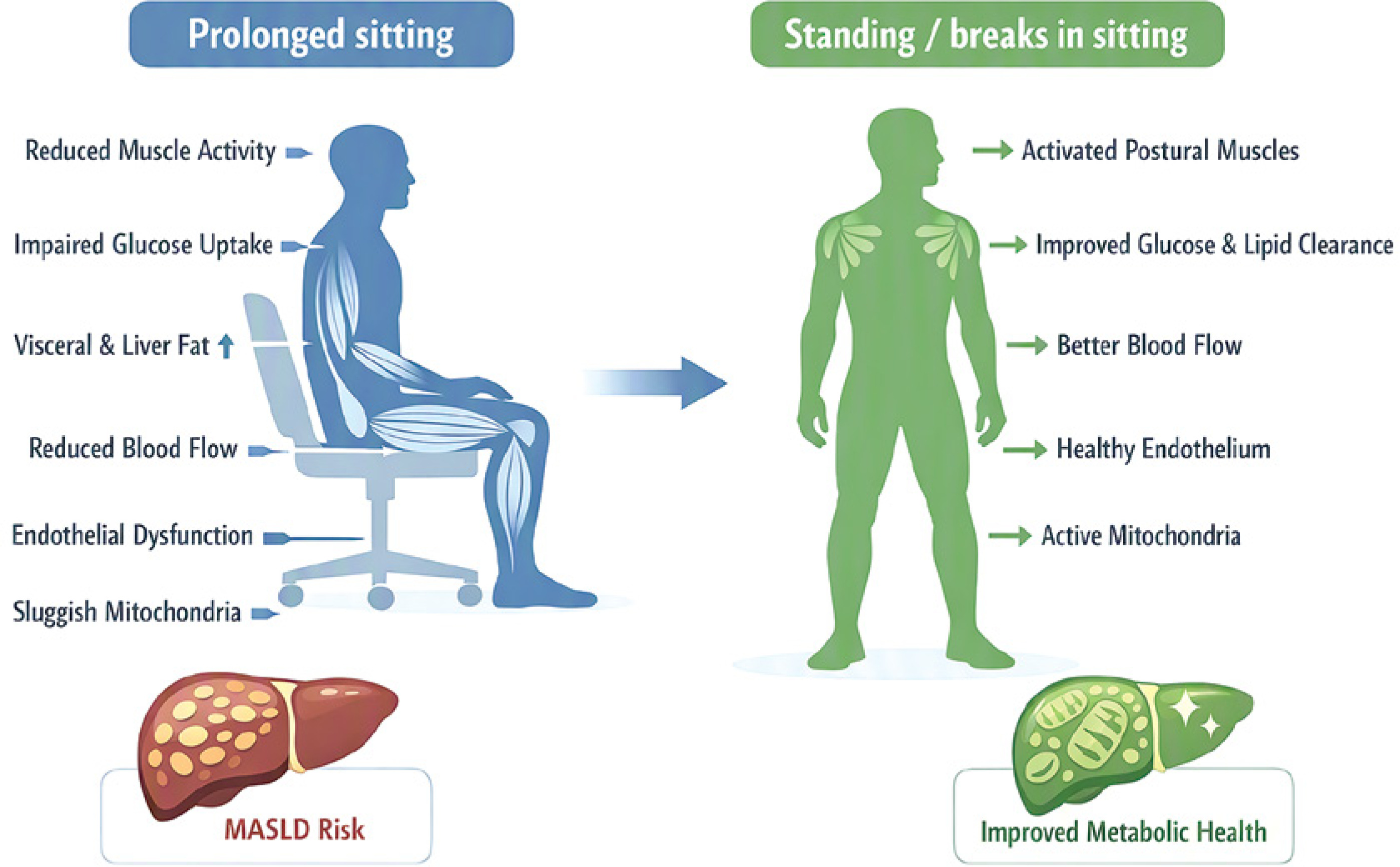
Figure 1 sets out the biological pathways through which sedentary behavior may drive metabolic dysfunction and MASLD and illustrates how breaking up prolonged sitting could attenuate these risks.
Figure 1
The transition from sedentary behavior to standing improves metabolic function. Sedentary behavior is proposed to promote metabolic dysfunction-associated steatotic liver disease through a convergent network of metabolic, vascular and bioenergetic perturbations. Prolonged sitting reduces contractile activity in large lower-limb skeletal muscles, favoring insulin resistance, visceral adiposity and adverse lipid handling, while limiting insulin-independent glucose disposal, lipoprotein lipase activity and mitochondrial substrate oxidation. By contrast, replacing extended sitting with standing re-engages postural muscle activity, increases glucose uptake, improves triglyceride and fatty-acid clearance, relieves lipotoxic interference with insulin signaling, enhances lower-limb blood flow and endothelial nitric oxide bioavailability, and supports mitochondrial pyruvate flux and metabolic flexibility. These mechanisms provide biological plausibility for the association between sedentary time, abdominal adiposity and MASLD risk, and indicate that interrupting sitting may complement structured exercise as a practical strategy to improve systemic metabolic health
Mechanistic plausibility strengthens clinical signals. Seminal tracer studies showed that most hepatic fatty acids are derived from the circulating non-esterified fatty acid pool [9], implying that strategies to reduce adipose-tissue fatty acid flux remain central to prevention and treatment. Visceral adiposity is particularly injurious because fatty acids released from intra-abdominal fat can reach the liver directly through the portal circulation. This pattern of fat distribution is more common in men and in postmenopausal women, and it probably contributes to sexual differences in MASLD [9]. In this respect, the study by Yang and Li [7] is noteworthy: no significant sex difference was observed in the association between sedentary behavior and MAFLD (p for interaction = 0.0974), yet men had higher prevalence rates of MAFLD, liver fibrosis, and cirrhosis than women. This apparent dissociation should be interpreted cautiously. Prospective studies are needed, particularly because previous work suggests that hepatic complications may be more frequent in men, whereas extrahepatic outcomes – including cardiovascular disease and non-hepatic cancers – may be more prevalent in women [5, 10]. In addition, comparative studies have shown that the MASLD definition is more comprehensive, whereas the MAFLD definition more selectively identifies individuals at risk of more progressive disease [1].
In conclusion, the systemic nature of MASLD demands systemic prevention. The study by Yang and Li [7] reinforces a simple but clinically consequential message: health is shaped not only by how much purposeful exercise people perform, but also by how long they remain seated. Reducing sedentary time, interrupting prolonged sitting, and designing homes, workplaces, and cities that make movement easier should be considered core components of metabolic and liver-health strategies. Yet the scale of this challenge also makes clear that individual commitment, although necessary, is not sufficient. People cannot be expected to overcome, by willpower alone, environments that require prolonged desk work, reward screen-based leisure, discourage active commuting, and make convenience the default architecture of daily life. Durable prevention will therefore require a collective reappraisal of how societies organize work, leisure, and transport. Employers can normalize standing meetings, active breaks, flexible schedules and workstations that encourage postural variation. Schools and communities can protect time and space for outdoor activity, urban planners can prioritize safe pavements, cycling routes, green areas and accessible public transport, and policymakers can frame mobility as a determinant of metabolic health rather than merely a matter of personal preference. The goal is not to moralize sitting or judge individuals, but to redesign ordinary routines so that movement becomes easy, safe and socially expected. Standing more often is not a substitute for exercise; it is an essential first step towards restoring movement to daily life.