Introduction
Metabolic dysfunction-associated fatty liver disease (MAFLD), formerly known as non-alcoholic fatty liver disease, now represents a growing challenge in clinical hepatology, a trend that closely parallels the rising rates of obesity, diabetes, and metabolic syndrome (MetS) [1–6]. Over the past three decades, MAFLD has been the sole liver disease with a rising prevalence in the US, currently affecting approximately 30% of adults, and projections indicate that over 50% of adults may be affected by MAFLD by 2040 if current trends persist [5–7]. Furthermore, MAFLD is recognized as a potentially progressive condition leading to non-alcoholic steatohepatitis (NASH), liver fibrosis (LF), hepatocellular carcinoma (HCC), and culminating in liver transplantation, and is also strongly associated with mortality from all causes and cardiovascular disease (CVD) among US adults [6, 8, 9]. There is increasing awareness of the need to address MAFLD as a critical global public health concern due to its substantial economic burden and detrimental effects on health [5, 8, 10]. Despite the lack of approved pharmacotherapy for first-line treatment, lifestyle interventions – such as enhancing physical activity (PA) and reducing sedentary behavior (SB) – remain the cornerstone of MAFLD prevention and management [1, 2, 7, 11–13].
SB encompasses all waking activities involving minimal energy expenditure (≤ 1.5 METs) involving maintenance of a seated, reclining, or lying posture [13, 14]. During the post-pandemic period, SB has become increasingly pervasive in modern living [15]. Notably, approximately 36% of the examined US population was identified as sedentary, with an additional 48% exhibiting low levels of PA [16]. Furthermore, an expanding body of epidemiological research suggests that sedentary lifestyles have contributed to adverse health outcomes, including obesity, diabetes, insulin resistance (IR), MetS, CVD, cancer, and mortality, independent of PA [14, 17–19]. Many of these conditions are critical factors in the pathogenesis and progression of MAFLD. Specifically, IR is a central component of MetS and serves as the strongest predictor of MAFLD development [20]. Consequently, SB has become a major public health challenge driven by its widespread occurrence and associated healthcare costs [16, 21].
The 2018 Physical Activity Guidelines for Americans first addressed the risks associated with SB in adults; similarly, the World Health Organization guidelines on PA and SB explicitly recommend that all populations and age groups reduce sedentary time, although neither provides a specific quantitative guideline for SB [12, 14, 22–24]. In recent years, the rise in sedentary behavior has been a likely contributing factor to the accelerated development of MAFLD [25]. Furthermore, evidence indicates that SB is an independent predictor of MAFLD, with a 20% increased risk associated with SB [7, 11, 17, 18, 26]. Data from recent research support a dose-response correlation of SB with MAFLD incidence; however, none have identified a definitive threshold effect [7, 10, 21, 24]. Unfortunately, the existing body of evidence regarding a potential dose-response association between SB and MAFLD remains limited and inconsistent.
Therefore, to delineate the specific dose-response association and potential threshold linking SB to MAFLD, we conducted an analysis of the nationally representative National Health and Nutrition Examination Survey (NHANES) cohort within a cross-sectional design.
Material and methods
Study sample
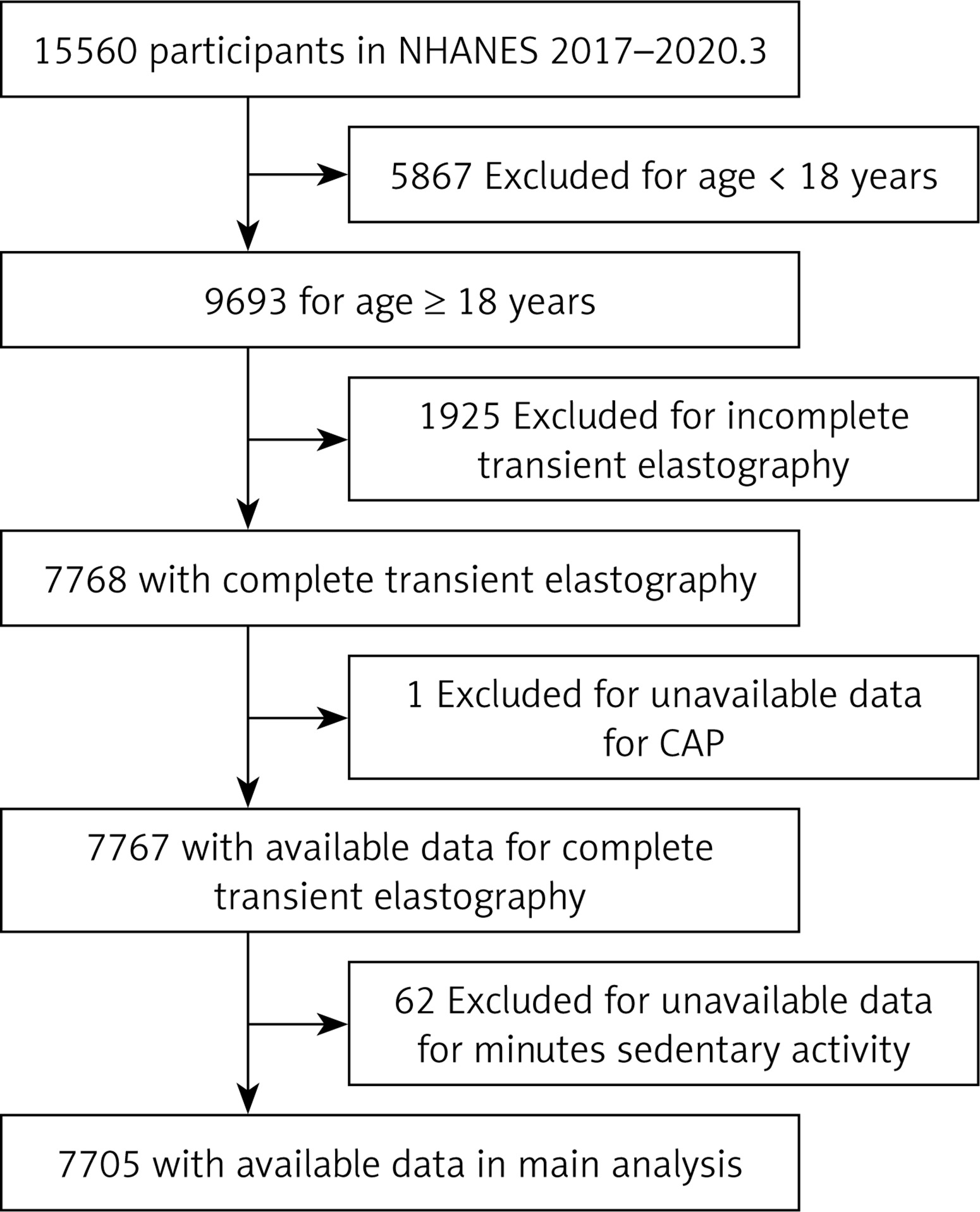
This study was based on data sourced from the pre-pandemic survey cycles of NHANES (2017 to March 2020), with a specific focus on liver ultrasound transient elastography (TE) tests. Detailed characterization of NHANES has been reported elsewhere [5, 7, 26–28]. Out of 15,560 participants, 7,705 adults with complete TE, sedentary activity, and covariate data were included. Exclusions were as follows: participants under 18 (N = 5,867), incomplete TE data (N = 1,925), missing CAP or LSM data (N = 1), and missing sedentary activity data (N = 62). The participant inclusion process is detailed in Figure 1. This study used de-identified, publicly available data from NHANES. The original NHANES investigation was carried out under the approval of the NCHS Ethics Review Board, with informed consent obtained from all participants. Accordingly, this analysis did not require additional ethical approval.
Primary exposure
The study population of adults (≥ 18 years) was administered the NHANES 2017–2020 physical activity survey, modeled after the Global Physical Activity Questionnaire. Detailed information is available at https://wwwn.cdc.gov/Nchs/Data/Nhanes/Public/2017/DataFiles/P_PAQ.htm. The questionnaire assessed SB, such as sitting while watching TV, working, using computers, and driving, excluding sleep. It was validated for US adults, showing reliable test-retest results [15]. A total of 9,610 participants completed the questionnaire, while 83 did not. Participants were divided into SB quartiles with the following ranges: < 3, 3–5, 5–8, and ≥ 8 h of sedentary time daily.
Outcomes
With a noninvasive technique having demonstrated reliability for steatosis and fibrosis assessment, hepatic steatosis and stiffness were measured via transient elastography (FibroScan 502 V2 Touch; M/XL probes) [1, 12, 17]. Participants aged 12 and older, excluding those who were pregnant, unable to lie down, or had electronic implants/lesions at the examination site, were eligible. The study included only those with complete examinations (fasting ≥ 3 h, ≥ 10 valid readings, and an IQR for stiffness measurements of < 30%). The diagnostic criteria were as follows: hepatic steatosis corresponded to CAP ≥ 263 dB/m; clinically significant fibrosis and cirrhosis were identified by LSM cutoff values of ≥ 6.3 kPa and ≥ 12.5 kPa, respectively [29, 30]. Furthermore, MAFLD was defined by hepatic steatosis co-occurring with at least one of the following: overweight/obesity, type 2 diabetes, or ≥ 2 metabolic abnormalities, as detailed in the international expert consensus statement [1].
Covariates
Covariates were chosen in accordance with established confounders in the literature and clinical relevance. The demographic covariates were age, sex, race/ethnicity, the poverty-income ratio, and educational level. Moreover, alcohol intake was classified according to NIAAA guidelines [31], and smoking status was defined by serum cotinine concentrations as low (< 0.015 ng/ml), intermediate (0.015–3 ng/ml), or high (≥ 3 ng/ml) [32]. Triglyceride levels were stratified in accordance with the NCEP ATP III criteria [33]. Furthermore, physical activity levels were categorized with reference to established guidelines [23].
Statistical analysis
All analyses were conducted in accordance with the NHANES complex sampling design, with survey weights applied to ensure national representativeness. Continuous measures are expressed as mean ± SD and evaluated with linear regression, whereas categorical measures are presented as percentages (95% CI) and examined with the χ2 test. The association of SB with MAFLD was examined using multivariable logistic regression. In line with the MAFLD framework, we did not use its diagnostic metabolic criteria as covariates in our main analysis to avoid over-adjustment, following established methods [34]. Additionally, to characterize and quantify the dose-risk pattern in the association of SB with MAFLD, analyses using restricted cubic splines (knot locations: 5th, 35th, 65th, 95th percentiles) and piecewise regression were performed.
Data were analyzed using R (v4.5.1), EmpowerStats (v4.2), and STATA (v16.0), and statistical significance was defined as a two-sided p-value < 0.05.
Results
Participant characteristics
The cohort included 7,705 participants, comprising 49.7% men, with a mean age of 47.17 years. The distribution of baseline attributes across sedentary time quartiles is summarized in Supplementary Table SI. Given the particular interest in our findings regarding the predominance of MAFLD, data were further stratified by MAFLD status (Supplementary Table SII). Additionally, analysis stratified by sex (Supplementary Table SIII) revealed an increased prevalence of MAFLD, LF, and LC in men.
Associations between sedentary behavior and MAFLD
Individuals with a higher level of SB had higher odds of MAFLD. As shown in Table I, significant positive associations between prolonged SB and MAFLD were observed for quartiles Q2 to Q4, which persisted across all models [fully adjusted: OR = 1.508 (95% CI: 1.220–1.865) for Q2; OR = 1.511 (95% CI: 1.214–1.879) for Q3; OR = 2.042 (95% CI: 1.637–2.548) for Q4]. Compared to the reference group (Q1: < 3 h/day), the Q2-Q4 groups had 50.8%, 51.1%, and 104.2% higher odds, respectively. In sex-stratified analyses (Supplementary Table SIV), men had significantly higher odds in Q2-Q4 [fully adjusted: OR = 1.455 (95% CI: 1.080–1.959) for Q2; OR = 1.702 (95% CI: 1.237–2.340) for Q3; OR = 2.436 (95% CI: 1.753–3.384) for Q4], while women had significantly higher odds in Q2 and Q4 [fully adjusted: OR = 1.462 (95% CI: 1.072–1.992) for Q2; OR = 1.516 (95% CI: 1.102–2.084) for Q4]. However, no significant interaction was observed between sedentary time and sex (p = 0.0974 for interaction).
Table I
Association between sedentary time and metabolic dysfunction-associated fatty liver disease (MAFLD) among US adults (n = 7,705), National Health and Nutrition Examination Survey (NHANES) 2017–2020. Detailed legend: Model 1: Non-adjusted model; Model 2 adjusted for: sex; age; race; Model 3 adjusted for: sex; age; race; physical activity level; HBV infection; HCV infection; daily alcohol drinking status; serum cotinine levels; education; poverty income ratio
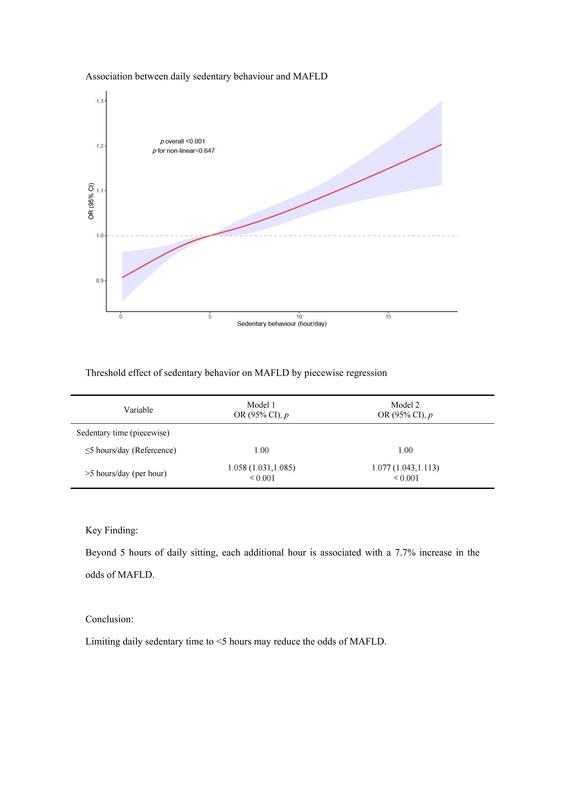
Moreover, as shown in Figure 2, the RCS analysis confirmed that SB has a dose-response association with MAFLD, revealing a linear association with a threshold at 5 h/day (p for non-linear = 0.647, p overall < 0.001). In subgroup analyses stratified by BMI, diabetes, and hypertension, participants with obesity, diabetes, or hypertension had a markedly higher odds of MAFLD (Supplementary Figure S1). Furthermore, piecewise regression analysis was performed to quantify this relationship (Tables II).
Figure 2
Dose-response relationship between sedentary time and metabolic dysfunction-associated fatty liver disease (MAFLD) risk. Detailed legend: odds ratios (ORs) and p-values were estimated with adjustment for: sex; age; race; physical activity level; HBV infection; HCV infection; daily alcohol drinking status; serum cotinine levels; education; poverty income ratio
95% CI – 95% confidence interval.
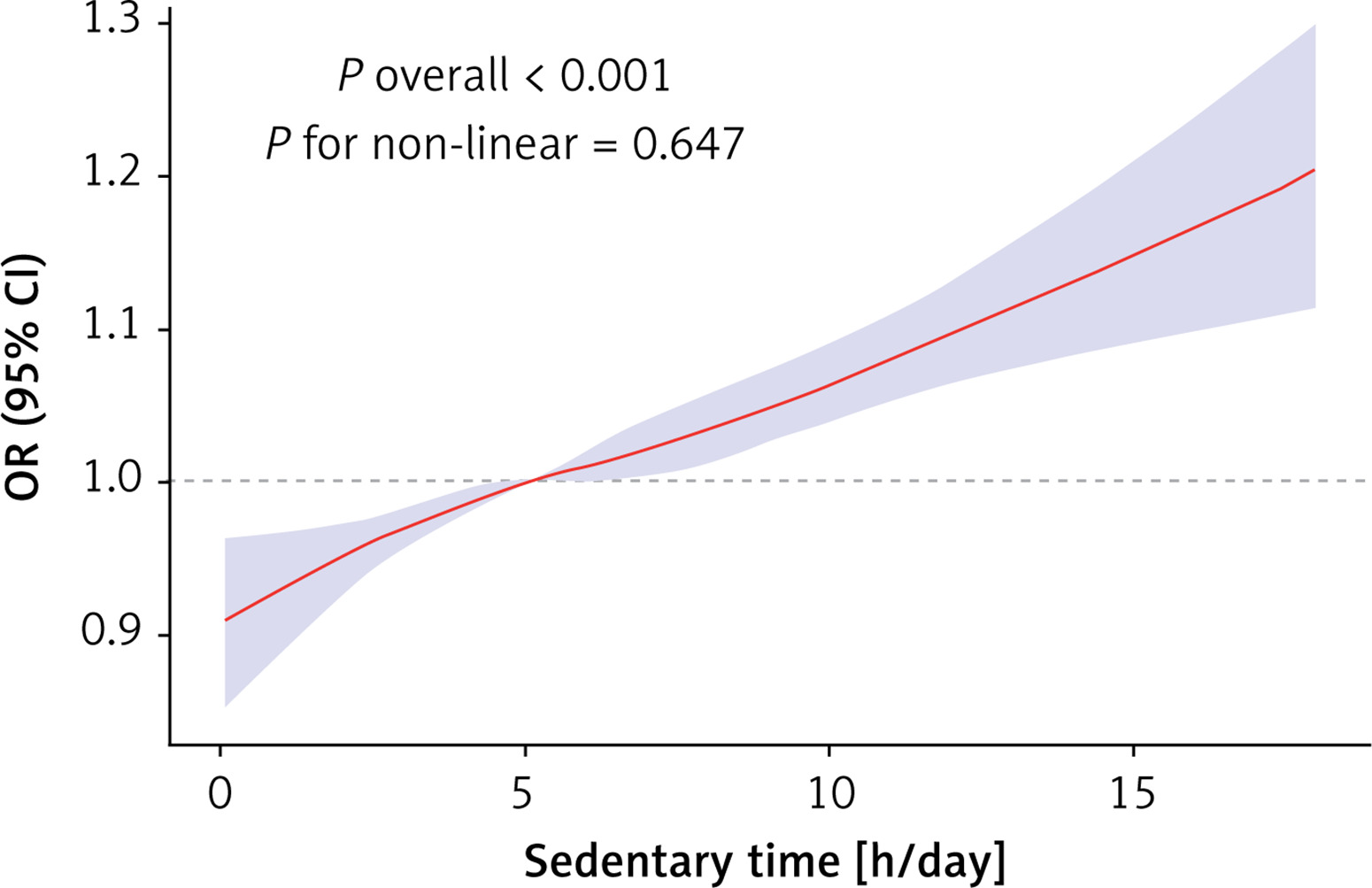
Table II
Threshold effect of sedentary behavior on metabolic dysfunction-associated fatty liver disease (MAFLD) by piecewise regression, NHANES 2017–2020 (n = 7,705). Model 1: Non-adjusted model; Model 2 adjusted for: sex; age; race; physical activity level; HBV infection; HCV infection; daily alcohol drinking status; serum cotinine levels; education; poverty income ratio
| Sedentary time (piecewise) | Model 1 OR (95% CI), p | Model 2 OR (95% CI), p |
|---|---|---|
| ≤ 5 h/day (Reference) | 1.00 | 1.00 |
| > 5 h/day (per hour) | 1.058 (1.031, 1.085) < 0.001 | 1.077 (1.043, 1.113) < 0.001 |
Discussion
Based on data from the nationally representative NHANES cohort, our analysis established a linear dose-response association between SB and MAFLD. Specifically, our investigation provides initial evidence for a dose-response relationship: sedentary time demonstrated a threshold effect at 5 h daily, significantly elevating MAFLD odds. Each additional hour was associated with a 7.7% increase in the odds – findings that remained consistent following comprehensive covariate adjustment and multiple sensitivity analyses.
Given its population-wide frequency and numerous adverse health effects, SB has garnered significant academic interest. A large prospective UK study of 360,047 adults demonstrated linear dose-response relationships between SB and 14 non-communicable diseases, including chronic liver disease, and indicated that exceeding 6 h of daily sedentary time increases this risk – a threshold consistent with our findings [21]. Several other studies have reported a significant linear dose-response association linking total and prolonged sedentary time to MAFLD, although no specific threshold was established [7, 10, 13, 26, 27]. However, a prospective study of 338,087 UK Biobank participants revealed a nonlinear association of SB with MAFLD [24]. This divergence likely stems from varying definitions of sedentary time or population heterogeneity. Nevertheless, other lines of evidence consistently identify SB as an independent predictor of MAFLD.
Furthermore, evidence suggests that more than 8 h per day of sedentary time is associated with an elevated risk of MAFLD, with two studies reporting a 1.15% (95% CI: 1.14–1.50%) increase in hepatic fat content for each additional daily hour of sedentariness [7, 35, 36]. However, some findings advocate for more stringent recommendations regarding sedentary time limits [18, 24, 37]. This is particularly concerning given that US adults now average 6 h of daily sedentary time [15]. Such inactivity substantially elevates the risk of diabetes, CVD, and MAFLD, among other adverse outcomes, making the promotion of less sedentary lifestyles an urgent public health priority.
Specifically, our research indicates that for an equivalent sedentary exposure, hypertensive individuals have higher odds of MAFLD, suggesting that hypertension acts as a risk factor in sedentary populations. Given that SB is an established cardiovascular risk factor and MAFLD increases cardiovascular risk by over 60% [38], these factors may form a detrimental cycle. This pattern is pronounced among diabetic or obese individuals, where MAFLD prevalence reaches 65% and 75%, respectively [39]. The incidence of MAFLD is rising in parallel with the diabetes and obesity epidemics [6], and these conditions are key drivers of MAFLD progression [40]. Excessive and prolonged SB initiates a series of detrimental effects, including IR, vascular dysfunction, metabolic alterations in substrate utilization and muscle fiber type, increased central and ectopic fat accumulation (such as in the liver), decreased muscle mass and strength, dyslipidemia, and inflammation [41, 42]. These effects collectively drive the onset and progression of metabolic disorders, diabetes, and obesity. Consequently, reducing sedentary time is particularly crucial for individuals with common metabolic diseases, as it offers dual benefits for managing primary diseases and improving fatty liver conditions.
Interestingly, no significant sex difference was observed in the association between sedentary behavior and MAFLD (p for interaction = 0.0974). However, men exhibited a higher prevalence of MAFLD, liver fibrosis, and cirrhosis than women. Underlying this disparity are pronounced sex-based divergences in fat distribution: women typically accumulate fat in peripheral regions such as the hips and thighs, whereas men show a greater tendency toward developing visceral obesity, which has a more direct association with MetS and MAFLD [17]. Moreover, sex hormones significantly influence the development or resolution of MetS by modulating key processes such as fat distribution, body weight, and the homeostasis of TG and fatty acids. Estradiol has been shown to confer protection against MetS, while testosterone is associated with an elevated risk [43–45]. The protective effect of estrogen against liver fat accumulation, as opposed to the risk potentially increased by testosterone, may account for the heightened susceptibility to MAFLD in women following the decline in estrogen levels during menopause [25]. Concurrently, the prevalence of MAFLD among women is projected to rise at a faster rate than in men by 2040 [6], a trend attributable to global population aging, which is increasing the proportion of postmenopausal women and consequently leading to a loss of the protective benefits of endogenous estrogen. While MAFLD was more prevalent in men, affected women exhibited comparable NASH risk and elevated risk for progressive fibrosis, particularly after age 50 [46]. Notably, NASH is now the foremost cause of liver transplantation in females [47], suggesting that they may encounter a disproportionately higher risk of adverse liver-related outcomes over time. However, subsequent studies are required to substantiate these findings.
There are some limitations in this analysis. First, the cross-sectional design precludes causal inference, a limitation inherent to the NHANES database. Second, the reliance on self-reported sedentary time rather than accelerometer data is a limitation; however, the sedentary behavior questionnaire has demonstrated acceptable reliability and validity in previous research, and the observed secular trends are unlikely to be significantly affected by measurement error. Third, the absence of a biopsy for histological validation is a limitation, although it is uncommon in large epidemiological studies due to the invasive nature of the procedure. Moreover, given its broadest accessibility and thoroughly validated bedside method, transient elastography represents the logical first choice for assessment. Fourth, despite our adjustment for multiple confounders, residual or unmeasured confounding, such as sex hormone use (including the specific route of administration for hormone replacement therapy) and dietary habits, cannot be entirely ruled out and may affect the robustness of our findings. Fifth, due to missing data, baseline characteristics may have differed between excluded and included participants, potentially introducing selection bias and limiting the generalizability of our findings.
In conclusion, our analysis revealed that sedentary time exceeding 5 h/day was an independent determinant of MAFLD, irrespective of physical activity levels. Furthermore, each additional hour of daily sedentary behavior beyond this threshold conferred a 7.7% rise in MAFLD risk. Future research should examine the relationship between SB and MAFLD across diverse subpopulations to provide evidence for quantitative guidelines on sitting time.