Current issue
Archive
Manuscripts accepted
About the Journal
Editorial office
Editorial board
Section Editors
Abstracting and indexing
Subscription
Contact
Ethical standards and procedures
Most read articles
Instructions for authors
Article Processing Charge (APC)
Regulations of paying article processing charge (APC)


ORTHOPEDICS AND TRAUMATOLOGY / CLINICAL RESEARCH
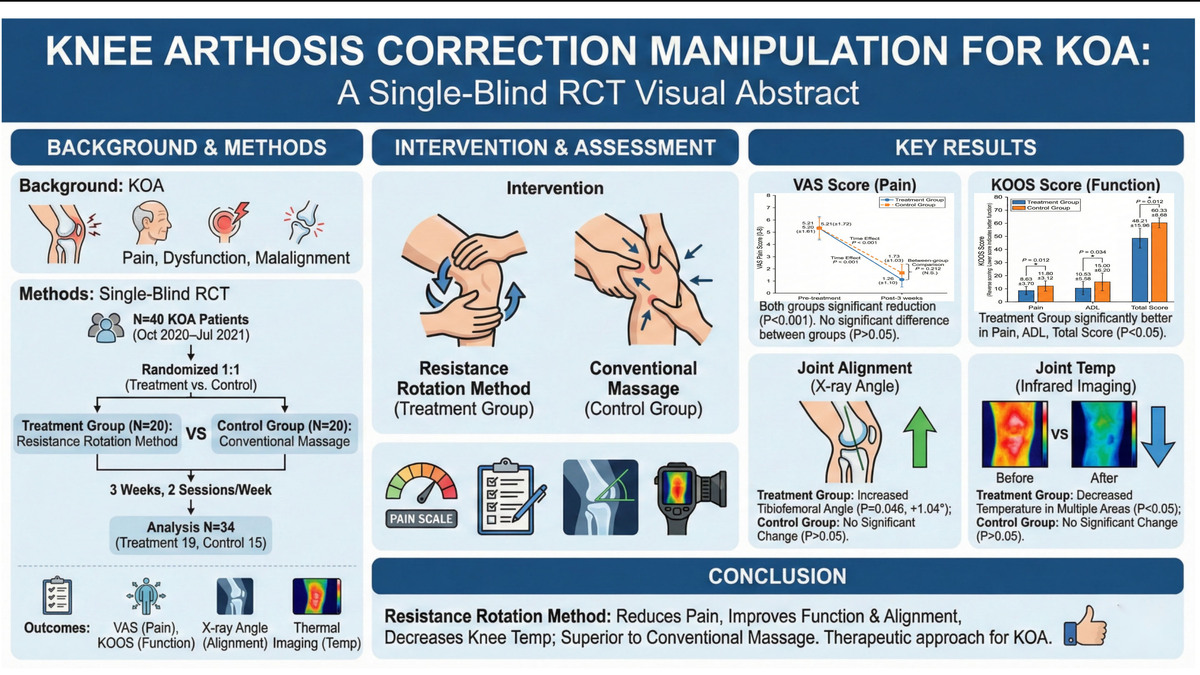
Effect of resistance rotational correction manipulation for the knee joint on knee alignment and joint temperature in patients with knee osteoarthritis: a randomized controlled trial
1
College of Acupuncture, Moxibustion and Tuina, Shandong University of Traditional Chinese Medicine, Jinan, Shandong, China
2
Department of Massage, Affiliated Hospital of Shandong University of Traditional Chinese Medicine, Jinan, Shandong, China
3
Center for Prevention and Treatment of Affiliated Hospital of Shandong University of Traditional Chinese Medicine, Jinan, Shandong, China
4
Department of Tuina, Shandong First Medical University Affiliated Provincial Hospital, Jinan, Shandong, China
5
Shuguang Hospital Affiliated to Shanghai University of Traditional Chinese Medicine, Huangpu, Shanghai, China
Submission date: 2025-11-05
Final revision date: 2026-01-28
Acceptance date: 2026-03-06
Online publication date: 2026-06-04
Corresponding author
Huadong Li
Department of Massage Affiliated Hospital Shandong University of Traditional Chinese Medicine, Jinan Shandong, China
Department of Massage Affiliated Hospital Shandong University of Traditional Chinese Medicine, Jinan Shandong, China
KEYWORDS
fasciahelical force linejoint force lineknee osteoarthritisknee temperatureresistance rotational correction manipulation for the knee jointTuina
TOPICS
ABSTRACT
Introduction:
Knee osteoarthritis (KOA) is a common chronic degenerative disease in middle-aged and elderly people, characterized by joint pain, functional impairment, and abnormal joint alignment. Knee joint resistance rotation therapy, a traditional Chinese medicine massage technique, has been reported to have clinical benefits, but research on its effects and mechanisms in regulating joint alignment and knee temperature is limited. The aim of the study was to observe the effects of knee joint resistance rotation therapy compared with conventional massage on pain, function, joint alignment, and joint temperature in patients with KOA, and to explore its clinical effects and possible mechanisms of action.
Material and methods:
A single-blind, randomized controlled trial was conducted, including 40 patients with knee osteoarthritis (KOA) who visited the outpatient department of the Affiliated Hospital of Shandong University of Traditional Chinese Medicine from October 2020 to July 2021. They were randomly divided into a treatment group (resisted knee rotation) and a control group (routine massage), with 20 patients in each group. Both groups received treatment twice a week for a total of 3 weeks. Pain intensity was assessed using the Visual Analogue Scale (VAS) before and after treatment, joint function was assessed using the Knee Injury and Osteoarthritis Outcome Score (KOOS), joint alignment was assessed by measuring the angle between the tibial articular surface and the long axis of the femur using X-ray, and temperature changes in different areas of the knee joint were detected using infrared thermography.
Results:
Ultimately, 34 patients (19 in the treatment group and 15 in the control group) completed the study (6 dropped out, dropout rate 15%). After treatment, VAS scores in both groups were significantly lower than before treatment (treatment group: 5.21 ±1.72 vs. 1.26 ±1.10, p < 0.001; control group: 5.20 ±1.61 vs. 1.73 ±1.03, p < 0.001), but the difference between the groups was not statistically significant (MD = –0.47, 95% CI: –1.22 to 0.28, p = 0.212). Both groups showed significant improvements in KOOS scores across dimensions such as pain, symptoms, and activities of daily living compared to pre-treatment levels (p < 0.05). Furthermore, the treatment group had lower reported scores than the control group for pain (8.63 ±3.70 vs. 11.80 ±3.12, MD = –3.17, 95% CI: –6.02 to –0.32, p = 0.012), activities of daily living (10.53 ±5.58 vs. 15.00 ±6.20, MD = –7.47, 95% CI: –12.56 to –0.38, p = 0.034), and total score (48.21 ±15.96 vs. 60.33 ±8.68, MD = –12.12, 95% CI: –22.01 to –2.23, p = 0.012). After treatment, the angle between the tibial articular surface and the long axis of the femur increased significantly from baseline in the treatment group compared to before treatment (98.10 ±2.56 vs. 99.78 ±2.45, p = 0.046), while there was no statistically significant difference in the control group (p > 0.05). After treatment, the temperature in multiple areas of the anterior and posterior knee joint was significantly lower in the treatment group compared to before treatment (p < 0.05), while there was no statistically significant difference in temperature in the control group (p > 0.05).
Conclusions:
Knee joint resistance rotation therapy may improve pain, joint function, joint alignment, and knee temperature in patients with knee arthritis (KOA). Although some KOOS outcomes favored this therapy over conventional massage, the between-group difference in VAS scores was not statistically significant.
REFERENCES (36)
1.
Amarasinghe P, Wadugodapitiya S, Weerasekara I. Biomechanical and clinical relationships between lower back pain and knee osteoarthritis: a systematic review. Syst Rev 2023; 12: 28.
2.
Chen X, Tang H, Lin J, Zeng R. Temporal trends in the disease burden of osteoarthritis from 1990 to 2019, and projections until 2030. PLoS One 2023; 18: e0288561.
3.
Hawker GA, King LK. The burden of osteoarthritis in older adults. Clin Geriatr Med 2022; 38: 181-92.
4.
Belluzzi E, Olivotto E, Toso G, et al. Conditioned media from human osteoarthritic synovium induces inflammation in a synoviocyte cell line. Connect Tissue Res 2019; 60: 136-45.
5.
Biz C, Maso G, Gambato M, et al. Challenging surgical treatment of displaced articular tibial plateau fractures: do early knee radiographic features have a predictive value of the mid-term clinical functional outcomes? Orthop Surg 2019; 11: 1149-62.
7.
Jang S, Lee K, Ju JH. Recent updates of diagnosis, pathophysiology, and treatment on osteoarthritis of the knee. Int J Mol Sci 2021; 22: 2619.
8.
Zhang Y, Zhang D, Liao X, et al. Novel insights into the role of ferroptosis in temporomandibular joint osteoarthritis and knee osteoarthritis. Int J Med Sci 2025; 22: 2119-31.
9.
Li GZ, Ji RJ, Xu CP, Yang LJ, Moreira P. On patient quality of life: impacts of knee osteoarthritis on pain, anxiety, depression, fatigue and sleep disorders. Nurs Open 2025; 12: e70264.
10.
Neelaraju H, Gangaiah M, Mittal P. Surgical healing beyond the scalpel: exploring the impact of depressive symptoms on functional recovery in total knee arthroplasty patients. J Orthop Surg Res 2023; 18: 833.
11.
Chinese Rheumatology Association. Guidelines of osteoarthritis diagnosis and treatment. Chin J Rheumatol 2010; 6: 416-9.
12.
Alshewaier SA, Sikkandar MY, Almakrami AAA, et al. Investigation of customized total knee implant with articular cartilage under loading conditions using finite element analysis. PLoS One 2025; 20: e0311210.
13.
Jacobs E, Stroobant L, Witvrouw E, et al. Sustained benefits of blood flow restriction therapy in knee osteoarthritis rehabilitation: 1-year follow-up of a randomised controlled trial. Br J Sports Med 2025; 59: 1481-9.
14.
Wang T, Liu H, Zhao W, et al. Predicting knee osteoarthritis progression using neural network with longitudinal MRI radiomics, and biochemical biomarkers: a modeling study. PLoS Med 2025; 22: e1004665.
15.
Hernández-Valencia CG, Torre-Morales CM, Ortiz-Huidobro RI, et al. Intra-articular injectable poly (gallic acid) and hyaluronic acid reduce inflammation and oxidative stress for the treatment of osteoarthritis. Int J Biol Macromol 2025; 322: 146502.
16.
O’Brien MS, McDougall JJ. Age and frailty as risk factors for the development of osteoarthritis. Mech Ageing Dev 2019; 180: 21-8.
17.
Appleton CT. Osteoarthritis year in review 2017: biology. Osteoarthritis Cartilage 2018; 26: 296-303.
18.
Krakowski P, Rejniak A, Sobczyk J, Karpiński R. Cartilage integrity: a review of mechanical and frictional properties and repair approaches in osteoarthritis. Healthcare 2024; 12: 1648.
19.
Zhou J, Zhao F, Chen C, et al. Influencing factors of flexion contracture among patients with knee osteoarthritis: a multi-center retrospective cross-sectional study. Sci Rep 2025; 15: 32144.
20.
Zhang H, Ma J, Tian A, et al. Analysis of cartilage loading and injury correlation in knee varus deformity. Medicine 2024; 103: e38065.
21.
Tsokanos A, Livieratou E, Billis E, et al. The efficacy of manual therapy in patients with knee osteoarthritis: a systematic review. Medicina 2021; 57: 696.
22.
Li B, Yang Z, Li Y, Zhang J, Li C, Lv N. Exploration beyond osteoarthritis: the association and mechanism of its related comorbidities. Front Endocrinol 2024; 15: 1352671.
23.
Ishibashi K, Sasaki E, Sasaki S, Kimura Y, Yamamoto Y, Ishibashi Y. Medial stabilizing technique preserves anatomical joint line and increases range of motion compared with the gap-balancing technique in navigated total knee arthroplasty. Knee 2020; 27: 558-64.
24.
Zhou X, Liu G, Han B, Li H, Zhang L, Liu X. Different prevention and treatment strategies for knee osteoarthritis (KOA) with various lower limb exoskeletons – a comprehensive review. Robotica 2021; 39: 1345-67.
25.
Mahmoudian A, Van Assche D, Herzog W, Luyten FP. Towards secondary prevention of early knee osteoarthritis. RMD Open 2018; 4: e000468.
26.
Hunter CW, Deer TR, Jones MR, et al. Consensus guidelines on interventional therapies for knee pain (STEP guidelines) from the American Society of Pain and Neuroscience. J Pain Res 2022; 15: 2683-745.
27.
Siviero P, Marseglia A, Biz C, et al. Quality of life outcomes in patients undergoing knee replacement surgery: longitudinal findings from the QPro-Gin study. BMC Musculoskelet Disord 2020; 21: 436.
28.
Beaudart C, Lengelé L, Leclercq V, et al. Symptomatic efficacy of pharmacological treatments for knee osteoarthritis: a systematic review and a network meta-analysis with a 6-month time horizon. Drugs 2020; 80: 1947-59.
29.
Khury F, Oltmanns M, Unseld T, Fuchs M, Reichel H, Faschingbauer M. Which knee phenotypes exhibit the strongest correlation with cartilage degeneration? Clin Orthop Relat Res 2024; 482: 500-10.
30.
Zeng CY, Zhang ZR, Tang ZM, et al. Benefits and mechanisms of exercise training for knee osteoarthritis. Front Physiol 2021; 12: 794062.
31.
Furmanek MP, Stomka KJ, Sobiesiak A, et al. The effects of cryotherapy on knee joint position sense and force production sense in healthy individuals. J Human Kinetics 2018; 61: 39-51.
32.
Courtney CA, Steffen AD, Fernández-de-las-Peñas C, et al. Joint mobilization enhances mechanisms of conditioned pain modulation in individuals with osteoarthritis of the knee. J Orthop Sports Phys Ther 2016; 46: 168-76.
33.
Park S, Min S, Park SH, et al. Influence of isometric exercise combined with electromyostimulation on inflammatory cytokine levels, muscle strength, and knee joint function in elderly women with early knee osteoarthritis. Front Physiol 2021; 12: 688260.
34.
Yan HL, Huo JT, Zhou WC, et al. Application and mechanism of tissue flossing in sports and rehabilitation. Chin J Tissue Engineering Res 2024; 28: 464-71.
35.
Assar S, Gandomi F, Mozafari M, et al. The effect of Total resistance exercise vs. aquatic training on self-reported knee instability, pain, and stiffness in women with knee osteoarthritis: a randomized controlled trial. BMC Sports Sci Med Rehabil 2020; 12: 27.
36.
Lu Y, Chen J, Zhang XL. Low-intensity resistance exercise based on myofascial chains alters the lower-limb tension and improves health status in female individuals with knee osteoarthritis. J Sport Rehabil 2023; 32: 818-26.
| eISSN: | 1896-9151 |
| ISSN: | 1734-1922 |

We process personal data collected when visiting the website. The function of obtaining information about users and their behavior is carried out by voluntarily entered information in forms and saving cookies in end devices. Data, including cookies, are used to provide services, improve the user experience and to analyze the traffic in accordance with the Privacy policy. Data are also collected and processed by Google Analytics tool (more).
You can change cookies settings in your browser. Restricted use of cookies in the browser configuration may affect some functionalities of the website.
You can change cookies settings in your browser. Restricted use of cookies in the browser configuration may affect some functionalities of the website.