Current issue
Archive
Manuscripts accepted
About the Journal
Editorial office
Editorial board
Section Editors
Abstracting and indexing
Subscription
Contact
Ethical standards and procedures
Most read articles
Instructions for authors
Article Processing Charge (APC)
Regulations of paying article processing charge (APC)


DIABETOLOGY / RESEARCH PAPER
Hemoglobin glycation index as a screening tool for aging acceleration and cardiovascular disease: a population-based study
1
Xijing hospital, The Fourth Military Medical University, China
These authors had equal contribution to this work
Submission date: 2026-02-24
Final revision date: 2026-04-30
Acceptance date: 2026-05-24
Online publication date: 2026-07-25
KEYWORDS
DiabetesCardiovascular diseaseBiological AgingHemoglobin glycation indexAging accelerationPhenotypic age acceleration
TOPICS
ABSTRACT
Introduction:
Diabetes promotes aging and contributes to the progression of cardiovascular disease (CVD). Hemoglobin glycation index (HGI) serves as an indicator linking blood glucose to CVD, but the role of aging remains unclear. This study aimed to investigate the association between the HGI and CVD, and to evaluate whether accelerated aging mediates this relationship.
Material and methods:
We conducted a cross-sectional analysis from the NHANES 1999-2010. HGI was used to assess interindividual glycemic variability, and phenotypic age acceleration (PAA) was employed to estimate biological aging. Relationships were studied using multivariable linear and logistic regression, LASSO regression, and mediation analysis. Patients with type 2 diabetes admitted to Xijing Hospital were enrolled to validate the efficacy of HGI.
Results:
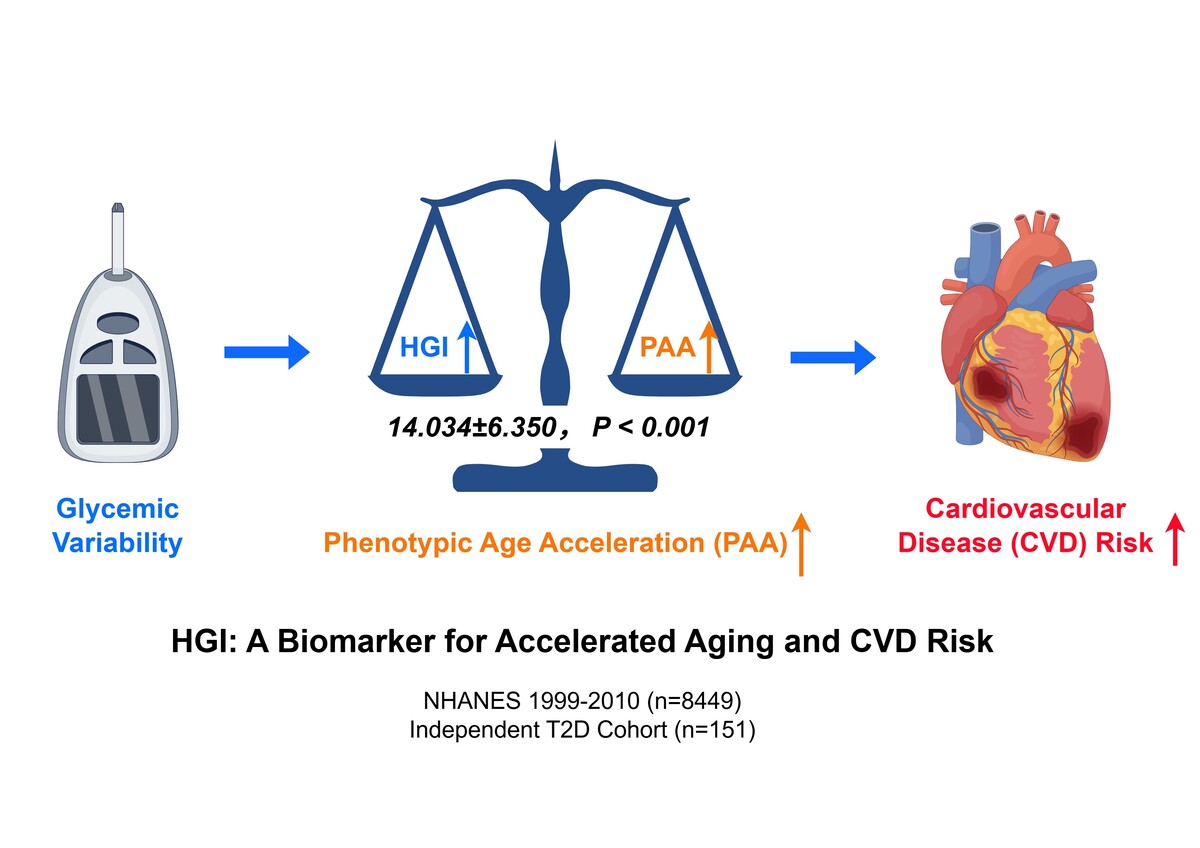
Analysis of 8,449 NHANES adults (median age 45 years; 48% male) revealed that 8.2% had CVD. Individuals with a positive HGI had a significantly higher risk of CVD, independent of age, sex, PAA, lipid levels, and renal function. A positive HGI was also positively associated with PAA (β= 14.034, P < 0.001). Mediation analysis showed PAA significantly mediated 23.8% (95% CI: 17.1%–29.0%, P < 0.001) of the relationship between HGI and CVD. In the validation cohort, positive HGI inversely correlated with cardiac function parameters, including left atrial strain during contraction phase (LASct) and left ventricular global longitudinal strain (LVGLS).
Conclusions:
The HGI is a strong and clinically accessible biomarker for both accelerated biological aging and increased cardiovascular risk, especially in individuals with dysglycemia.
Diabetes promotes aging and contributes to the progression of cardiovascular disease (CVD). Hemoglobin glycation index (HGI) serves as an indicator linking blood glucose to CVD, but the role of aging remains unclear. This study aimed to investigate the association between the HGI and CVD, and to evaluate whether accelerated aging mediates this relationship.
Material and methods:
We conducted a cross-sectional analysis from the NHANES 1999-2010. HGI was used to assess interindividual glycemic variability, and phenotypic age acceleration (PAA) was employed to estimate biological aging. Relationships were studied using multivariable linear and logistic regression, LASSO regression, and mediation analysis. Patients with type 2 diabetes admitted to Xijing Hospital were enrolled to validate the efficacy of HGI.
Results:
Analysis of 8,449 NHANES adults (median age 45 years; 48% male) revealed that 8.2% had CVD. Individuals with a positive HGI had a significantly higher risk of CVD, independent of age, sex, PAA, lipid levels, and renal function. A positive HGI was also positively associated with PAA (β= 14.034, P < 0.001). Mediation analysis showed PAA significantly mediated 23.8% (95% CI: 17.1%–29.0%, P < 0.001) of the relationship between HGI and CVD. In the validation cohort, positive HGI inversely correlated with cardiac function parameters, including left atrial strain during contraction phase (LASct) and left ventricular global longitudinal strain (LVGLS).
Conclusions:
The HGI is a strong and clinically accessible biomarker for both accelerated biological aging and increased cardiovascular risk, especially in individuals with dysglycemia.
REFERENCES (18)
1.
Marx N, Federici M, Schütt K, et al (2023) 2023 ESC Guidelines for the management of cardiovascular disease in patients with diabetes. Eur Heart J 44:4043–4140. https://doi.org/10.1093/eurhea....
2.
Cahn A, Wiviott SD, Mosenzon O, et al (2022) Association of Baseline HbA1c With Cardiovascular and Renal Outcomes: Analyses From DECLARE-TIMI 58. Diabetes Care 45:938–946. https://doi.org/10.2337/dc21-1....
3.
Nayak AU, Singh BM, Dunmore SJ (2019) Potential Clinical Error Arising From Use of HbA1c in Diabetes: Effects of the Glycation Gap. Endocr Rev 40:988–999. https://doi.org/10.1210/er.201....
4.
Ahn CH, Min SH, Lee D-H, et al (2017) Hemoglobin Glycation Index Is Associated With Cardiovascular Diseases in People With Impaired Glucose Metabolism. J Clin Endocrinol Metab 102:2905–2913. https://doi.org/10.1210/jc.201....
5.
Xin S, Zhao X, Ding J, Zhang X (2023) Association between hemoglobin glycation index and diabetic kidney disease in type 2 diabetes mellitus in China: A cross- sectional inpatient study. Front Endocrinol 14:1108061. https://doi.org/10.3389/fendo.....
6.
Banach M, Fronczek M, Goc A, et al (2025) Telomere length across the spectrum of metabolic health: an analysis from the LIPIDOGEN2015 study. Arch Med Sci AMS 21:1213–1221. https://doi.org/10.5114/aoms/1....
7.
Chen L, Yin X, Zhao Y, et al (2022) Biological ageing and the risks of all-cause and cause-specific mortality among people with diabetes: a prospective cohort study. J Epidemiol Community Health 76:771–778. https://doi.org/10.1136/jech-2....
8.
L L, L B, F M, et al (2022) Inflammation, Aging, and Cardiovascular Disease: JACC Review Topic of the Week. J Am Coll Cardiol 79:. https://doi.org/10.1016/j.jacc....
9.
American Diabetes Association (2020) 2. Classification and Diagnosis of Diabetes: Standards of Medical Care in Diabetes-2020. Diabetes Care 43:S14–S31. https://doi.org/10.2337/dc20-S....
10.
Levine ME, Lu AT, Quach A, et al (2018) An epigenetic biomarker of aging for lifespan and healthspan. Aging 10:573–591. https://doi.org/10.18632/aging....
11.
Cohen RM, Franco RS, Khera PK, et al (2008) Red cell life span heterogeneity in hematologically normal people is sufficient to alter HbA1c. Blood 112:4284–4291. https://doi.org/10.1182/blood-....
12.
Khera PK, Joiner CH, Carruthers A, et al (2008) Evidence for interindividual heterogeneity in the glucose gradient across the human red blood cell membrane and its relationship to hemoglobin glycation. Diabetes 57:2445–2452. https://doi.org/10.2337/db07-1....
13.
Chia CW, Egan JM, Ferrucci L (2018) Age-related Changes in Glucose Metabolism, Hyperglycemia, and Cardiovascular Risk. Circ Res 123:886. https://doi.org/10.1161/CIRCRE....
14.
R D, Q F, Y S, Q L (2022) Epigenetic clock: A promising biomarker and practical tool in aging. Ageing Res Rev 81:. https://doi.org/10.1016/j.arr.....
15.
Liu Z, Kuo P-L, Horvath S, et al (2018) A new aging measure captures morbidity and mortality risk across diverse subpopulations from NHANES IV: A cohort study. PLoS Med 15:e1002718. https://doi.org/10.1371/journa....
16.
Fb D, Pj D, G N, et al (1985) The effect of in vivo glucose administration on human erythrocyte Ca2+-ATPase activity and on enzyme responsiveness in vitro to thyroid hormone and calmodulin. Diabetes 34:. https://doi.org/10.2337/diab.3....
17.
Rabini RA, Petruzzi E, Staffolani R, et al (1997) Diabetes mellitus and subjects’ ageing: a study on the ATP content and ATP-related enzyme activities in human erythrocytes. Eur J Clin Invest 27:327–332. https://doi.org/10.1046/j.1365....
18.
Banach M, Fogacci F, Atanasov AG, et al (2025) A 360° perspective on cardiovascular prevention: the International Lipid Expert Panel SiMple tIps for the heaLthy hEart (ILEP-SMILE). Arch Med Sci AMS 21:711–718. https://doi.org/10.5114/aoms/2....
| eISSN: | 1896-9151 |
| ISSN: | 1734-1922 |

We process personal data collected when visiting the website. The function of obtaining information about users and their behavior is carried out by voluntarily entered information in forms and saving cookies in end devices. Data, including cookies, are used to provide services, improve the user experience and to analyze the traffic in accordance with the Privacy policy. Data are also collected and processed by Google Analytics tool (more).
You can change cookies settings in your browser. Restricted use of cookies in the browser configuration may affect some functionalities of the website.
You can change cookies settings in your browser. Restricted use of cookies in the browser configuration may affect some functionalities of the website.