Current issue
Archive
Manuscripts accepted
About the Journal
Editorial office
Editorial board
Section Editors
Abstracting and indexing
Subscription
Contact
Ethical standards and procedures
Most read articles
Instructions for authors
Article Processing Charge (APC)
Regulations of paying article processing charge (APC)


CLINICAL RESEARCH
Socioeconomic inequalities in major behavioral cancer risk factors in Poland: evidence from a nationally representative health survey
1
Center for Oncological Biomarker Analysis and Molecular Epidemiology, Department of Pathology, Maria Sklodowska-Curie National Research Institute of Oncology, Warsaw, Poland
2
Cancer Epidemiology and Primary Prevention Department, Maria Sklodowska-Curie National Research Institute of Oncology, Warsaw, Poland
Submission date: 2026-04-10
Final revision date: 2026-05-24
Acceptance date: 2026-07-09
Online publication date: 2026-08-10
Corresponding author
Paweł Koczkodaj
Maria Sklodowska-Curie National Research Institute of Oncology Wawelska Str 15 02-034 Warsaw, Poland
Maria Sklodowska-Curie National Research Institute of Oncology Wawelska Str 15 02-034 Warsaw, Poland
KEYWORDS
TOPICS
ABSTRACT
Introduction:
Cancer remains a major public health burden in Poland, with a substantial proportion of cases attributable to modifiable behavioral risk factors such as smoking, obesity, and physical inactivity. These factors are socially patterned, contributing to health inequalities across socioeconomic groups. The study aimed to quantify socioeconomic gradients in key behavioral cancer risk factors in Poland.
Material and methods:
A cross-sectional analysis was conducted using data from the Polish wave of the European Health Interview Survey (EHIS) 2019, covering a nationally representative sample of individuals aged ≥ 15 years. Educational attainment was used as an indicator of socioeconomic status (SES; high, middle, low). Prevalence of smoking, obesity (body mass index ≥ 30 kg/m²), and lack of recreational physical activity were estimated across educational groups. Socioeconomic gradients were assessed using prevalence ratios (PRs), and the estimated number of individuals exposed to each risk factor was calculated using national population estimates.
Results:
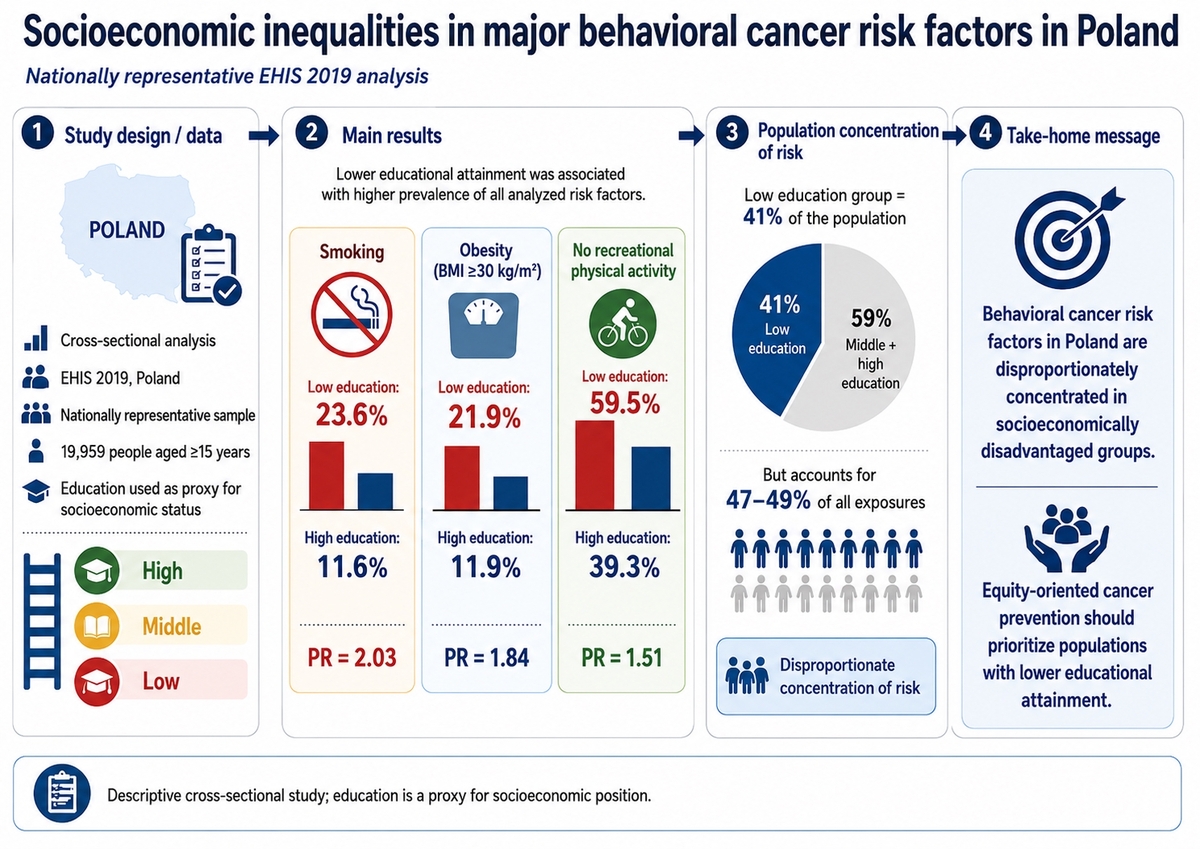
Clear socioeconomic gradients were observed for all analyzed risk factors. Individuals with low education had higher prevalence of smoking (23.6% vs. 11.6%, PR = 2.03), obesity (21.9% vs. 11.9%; PR = 1.84), and physical inactivity (59.5% vs. 39.3%; PR = 1.51) compared to those with high education. The low-education group (41% of the population) accounted for ~47–49% of all exposures, indicating a disproportionate concentration of behavioral cancer risk. Reducing these inequalities could substantially decrease the population burden of risk factors.
Conclusions:
Behavioral cancer risk factors in Poland are unequally distributed and disproportionately concentrated among socioeconomically disadvantaged groups. Addressing these inequalities through targeted, equity-oriented prevention strategies may help reduce the future cancer burden.
Cancer remains a major public health burden in Poland, with a substantial proportion of cases attributable to modifiable behavioral risk factors such as smoking, obesity, and physical inactivity. These factors are socially patterned, contributing to health inequalities across socioeconomic groups. The study aimed to quantify socioeconomic gradients in key behavioral cancer risk factors in Poland.
Material and methods:
A cross-sectional analysis was conducted using data from the Polish wave of the European Health Interview Survey (EHIS) 2019, covering a nationally representative sample of individuals aged ≥ 15 years. Educational attainment was used as an indicator of socioeconomic status (SES; high, middle, low). Prevalence of smoking, obesity (body mass index ≥ 30 kg/m²), and lack of recreational physical activity were estimated across educational groups. Socioeconomic gradients were assessed using prevalence ratios (PRs), and the estimated number of individuals exposed to each risk factor was calculated using national population estimates.
Results:
Clear socioeconomic gradients were observed for all analyzed risk factors. Individuals with low education had higher prevalence of smoking (23.6% vs. 11.6%, PR = 2.03), obesity (21.9% vs. 11.9%; PR = 1.84), and physical inactivity (59.5% vs. 39.3%; PR = 1.51) compared to those with high education. The low-education group (41% of the population) accounted for ~47–49% of all exposures, indicating a disproportionate concentration of behavioral cancer risk. Reducing these inequalities could substantially decrease the population burden of risk factors.
Conclusions:
Behavioral cancer risk factors in Poland are unequally distributed and disproportionately concentrated among socioeconomically disadvantaged groups. Addressing these inequalities through targeted, equity-oriented prevention strategies may help reduce the future cancer burden.
REFERENCES (17)
1.
Didkowska JA, Wojciechowska U, Irzyk M, et al. Nowotwory złośliwe w Polsce w 2023 roku [Cancer in Poland in 2023]. Polish National Cancer Registry, Maria Skłodowska-Curie National Research Institute of Oncology, Warsaw 2025. Available from: https://onkologia.org.pl/pliki.... Accessed: 20.03.2026.
2.
OECD/European Commission. EU Country Cancer Profile: Poland 2025. OECD Publishing, Paris 2025. Available from: https://doi.org/10.1787/fc2a5e.... Accessed: 20.03.2026.
3.
Mańczuk M, Sulkowska U, Łobaszewski J, et al. Time trends in tobacco-attributable cancer mortality in Poland – direct estimation method. Nowotwory J Oncol 2017; 67: 227-35.
4.
Koczkodaj P, Michałek IM. Declining tobacco control awareness and support among Polish adolescents: Trends from the Global Youth Tobacco Survey 2003-2022. Tob Prev Cessat 2025; 11. DOI: https://doi.org/10.18332/tpc/2....
5.
Feliu A, Barrera B, Boland V, Drury A, Hâncean MG, Geantă M, et al. Exploring individual and contextual determinants of cancer prevention behaviour change in the European Union: a qualitative study to inform implementation of the European Code Against Cancer. Lancet Reg Health Eur 2026; 64: 101633.
6.
Statistics Poland (GUS). Health status of population in Poland in 2019. Statistics Poland, Warsaw 2021. Available from: https://stat.gov.pl/obszary-te.... Accessed: 09.03.2026.
7.
Statistics Poland (GUS). Population – socio-economic situation of the country. Statistics Poland, Warsaw 2026. Available from: https://ssgk.stat.gov.pl/Ludno.... Accessed: 09.03.2026.
8.
Hiscock R, Bauld L, Amos A, Fidler JA, Munafò M. Socioeconomic status and smoking: a review. Ann NY Acad Sci 2012; 1248: 107-23.
9.
Garrett BE, Martell BN, Caraballo RS, King BA. Socioeconomic differences in cigarette smoking among sociodemographic groups. Prev Chronic Dis 2019; 16: E74.
10.
Vandevijvere S, De Pauw R, Djojosoeparto S, et al. Upstream determinants of overweight and obesity in Europe. Curr Obes Rep 2023; 12: 417-28.
11.
Autret K, Bekelman TA. Socioeconomic status and obesity. J Endocr Soc 2024; 8: bvae176.
12.
Beenackers MA, Kamphuis CB, Giskes K, et al. Socioeconomic inequalities in occupational, leisure-time, and transport related physical activity among European adults: a systematic review. Int J Behav Nutr Phys Act 2012; 9: 116.
13.
Stringhini S, Carmeli C, Jokela M, et al. Socioeconomic status and the 25 × 25 risk factors as determinants of premature mortality: a multicohort study and meta-analysis of 1·7 million men and women. Lancet 2017; 389: 1229-37.
14.
Probst C, Kilian C, Sanchez S, Lange S, Rehm J. The role of alcohol use and drinking patterns in socioeconomic inequalities in mortality: a systematic review. Lancet Public Health 2020; 5: e324-32.
15.
Lewer D, Meier P, Beard E, Boniface S, Kaner E. Unravelling the alcohol harm paradox: a population-based study of social gradients across very heavy drinking thresholds. BMC Public Health 2016; 16: 599.
16.
Unanue-Arza S, Solís-Ibinagagoitia M, Díaz-Seoane M, et al. Inequalities and risk factors related to non-participation in colorectal cancer screening programmes: a systematic review. Eur J Public Health 2021; 31: 346-355.
17.
Damiani G, Federico B, Basso D, et al. Socioeconomic disparities in the uptake of breast and cervical cancer screening in Italy: a cross sectional study. BMC Public Health 2012; 12: 99.
Share
RELATED ARTICLE
| eISSN: | 1896-9151 |
| ISSN: | 1734-1922 |

We process personal data collected when visiting the website. The function of obtaining information about users and their behavior is carried out by voluntarily entered information in forms and saving cookies in end devices. Data, including cookies, are used to provide services, improve the user experience and to analyze the traffic in accordance with the Privacy policy. Data are also collected and processed by Google Analytics tool (more).
You can change cookies settings in your browser. Restricted use of cookies in the browser configuration may affect some functionalities of the website.
You can change cookies settings in your browser. Restricted use of cookies in the browser configuration may affect some functionalities of the website.