Current issue
Archive
Manuscripts accepted
About the Journal
Editorial office
Editorial board
Section Editors
Abstracting and indexing
Subscription
Contact
Ethical standards and procedures
Most read articles
Instructions for authors
Article Processing Charge (APC)
Regulations of paying article processing charge (APC)


ONCOLOGY / RESEARCH PAPER
Identification and analysis of immunological characteristics of prognostic feature for osteosarcoma based on costimulatory molecule-related genes
1
Lishui people’s hospital, China
Submission date: 2026-01-08
Acceptance date: 2026-02-15
Online publication date: 2026-05-01
KEYWORDS
TOPICS
ABSTRACT
Introduction:
Osteosarcoma (OSA) is a primary malignant bone tumor with poor prognosis. Costimulatory molecule-related genes (CMRGs) are crucial for T cell-mediated antitumor immunity, yet their prognostic and therapeutic value in OSA remains unclear.
Material and methods:
Non-negative matrix factorization (NMF) clustering was used to define CMRG-based subtypes. Prognostic signature genes were selected using univariate Cox, LASSO, and multivariate regression analyses. The predictive performance of the model was assessed using ROC curves, calibration plots, and decision curve analysis (DCA). Immune infiltration and immune checkpoint differences were evaluated via ssGSEA. Drug sensitivity was predicted using CellMiner, and gene expression was validated by qRT-PCR in OSA cells.
Results:
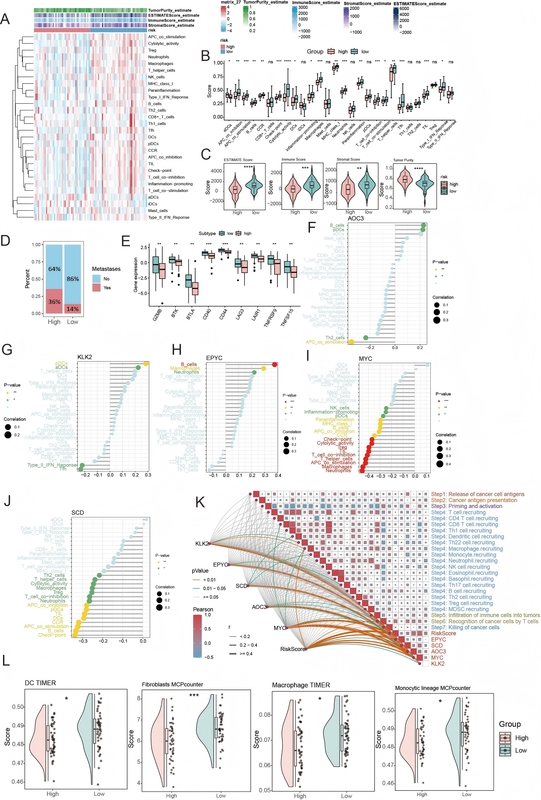
This study selected five characteristic genes related to the prognosis of OSA and constructed a prognostic model. The evaluation results indicate that the model has favorable predictive performance, with calibration curves and DCA confirming that the predicted survival probabilities aligned with the actual survival probabilities of patients. Furthermore, the response results for immunotherapy revealed that patients with lower risk scores had more favorable immune responses and lower rates of disease metastasis. Notably, DMAPT, Obatoclax, 8-Chloro-adenosine, and Palbociclib showed a significant positive correlation with MYC. Additionally, qRT-PCR results indicated that EPYC, SCD1, and AOC3 were significantly overexpressed in OSA cells.
Conclusions:
This study is the first to integrate CMRG-based subtyping, risk modeling, immune profiling, and experimental validation in OSA. The identified biomarkers may guide personalized treatment and improve survival prediction in OSA patients.
Osteosarcoma (OSA) is a primary malignant bone tumor with poor prognosis. Costimulatory molecule-related genes (CMRGs) are crucial for T cell-mediated antitumor immunity, yet their prognostic and therapeutic value in OSA remains unclear.
Material and methods:
Non-negative matrix factorization (NMF) clustering was used to define CMRG-based subtypes. Prognostic signature genes were selected using univariate Cox, LASSO, and multivariate regression analyses. The predictive performance of the model was assessed using ROC curves, calibration plots, and decision curve analysis (DCA). Immune infiltration and immune checkpoint differences were evaluated via ssGSEA. Drug sensitivity was predicted using CellMiner, and gene expression was validated by qRT-PCR in OSA cells.
Results:
This study selected five characteristic genes related to the prognosis of OSA and constructed a prognostic model. The evaluation results indicate that the model has favorable predictive performance, with calibration curves and DCA confirming that the predicted survival probabilities aligned with the actual survival probabilities of patients. Furthermore, the response results for immunotherapy revealed that patients with lower risk scores had more favorable immune responses and lower rates of disease metastasis. Notably, DMAPT, Obatoclax, 8-Chloro-adenosine, and Palbociclib showed a significant positive correlation with MYC. Additionally, qRT-PCR results indicated that EPYC, SCD1, and AOC3 were significantly overexpressed in OSA cells.
Conclusions:
This study is the first to integrate CMRG-based subtyping, risk modeling, immune profiling, and experimental validation in OSA. The identified biomarkers may guide personalized treatment and improve survival prediction in OSA patients.
| eISSN: | 1896-9151 |
| ISSN: | 1734-1922 |

We process personal data collected when visiting the website. The function of obtaining information about users and their behavior is carried out by voluntarily entered information in forms and saving cookies in end devices. Data, including cookies, are used to provide services, improve the user experience and to analyze the traffic in accordance with the Privacy policy. Data are also collected and processed by Google Analytics tool (more).
You can change cookies settings in your browser. Restricted use of cookies in the browser configuration may affect some functionalities of the website.
You can change cookies settings in your browser. Restricted use of cookies in the browser configuration may affect some functionalities of the website.