
Life expectancy is not merely an actuarial abstraction; it is a clinically consequential estimate that helps physicians translate population-level mortality data into individualized decisions at the bedside. For the practicing physician, prognosis informs cancer screening, preventive pharmacotherapy, perioperative decision-making, chronic disease targets, medication review, advance care planning, and the appropriate timing of palliative approaches. Life tables, typically, provide age- and sex-specific survival estimates that describe mortality at the population level, but these estimates must be interpreted alongside the patient’s comorbidity, functional reserve, frailty, cognition, and goals of care [1]. Used thoughtfully, life expectancy reports support evidence-based and patient-centered medicine by shifting the clinical question from “Can this intervention be offered?” to “Is this intervention likely to help this patient within the time horizon that matters to them?”
This distinction begins with a central challenge: chronological age is an imprecise proxy for prognosis. Although mortality risk rises with age, heterogeneity among older adults increases substantially over the life course [2]. Heterogeneity in mortality risk assessment refers to the variation in an individual’s likelihood of death compared to others of the same age and biological sex. Accounting for this variance ensures that life expectancy reports transition from broad population averages to accurate, hyper-personalized lifespan projections [3]. Two patients of the same age may differ markedly in gait speed, activities of daily living, cognition, social supports, disease burden, nutritional status, and recent illness trajectory. Prognostic indices for older adults, therefore, typically incorporate functional measures and comorbid conditions rather than age alone [4]. Recognizing this heterogeneity is clinically important because age-based decisions risk both undertreatment of robust older adults and overtreatment of frail patients whose life expectancy is limited by competing risks. Key methodologies and algorithms are critical. Actuaries, insurance underwriters, and geriatricians use specific statistical and mathematical models to calculate and characterize mortality risks across heterogeneous populations [5]: Cox proportional hazards model: A widely used survival model that measures the effect of multiple risk factors (e.g., medical conditions or lifestyle behaviors) on the hazard of an event, such as death, over time.
Multivariable risk algorithms (e.g., MPoRT): Algorithms such as the Multivariable Mortality Risk Tool estimate the reduction in life expectancy associated with specific unhealthy behaviors (such as smoking or poor diet). The MPoRT or Mortality Population Risk Tool is a multivariable predictive algorithm that provides an estimate of an individual’s 5-year risk of all-cause mortality and life expectancy.
Mixture models: Approaches that partition a heterogeneous population into a series of more homogeneous groups, allowing reports to estimate the probability of survival for distinct health profiles.
Once prognosis is understood as individualized rather than age-based, the concept of “time to benefit” provides a useful academic framework for applying life expectancy to clinical care. Time to benefit refers to the interval between the initiation of an intervention and the point at which meaningful benefit is expected to accrue. This principle has been emphasized in geriatric prescribing, cancer screening, and preventive medicine, where harms often occur early while benefits may require years to emerge [6].
Cancer screening illustrates the point particularly clearly. Screening may reduce disease-specific mortality in selected populations, but the benefit is delayed and must be balanced against false-positive results, incidental findings, invasive follow-up, overdiagnosis, misclassification resulting from changes in disease classifications, anxiety, and complications arising from invasive procedures or unnecessary treatment. Walter and Covinsky’s framework for individualized cancer screening in older adults emphasized that patients with limited life expectancy, particularly those expected to live fewer than 5 years, are unlikely to derive survival benefit from many cancer screening programs [7]. More recent summaries similarly recommend individualized decisions that consider comorbidity, functional status, remaining life expectancy, perceived quality of life, and patient goals, rather than rigid age cutoffs alone [8, 9].
These screening and prevention decisions depend on the quality of the underlying prognostic estimate. Estimating life expectancy and reporting it should therefore combine several forms of evidence. Population life tables establish a baseline expectation, while validated prognostic instruments can refine estimates using variables such as hospitalization history, the interval between admission and discharge, smoking and/or vaping status, body mass index, dietary status, use of recreational drugs, functional impairment, cognitive limitations, and chronic disease. The ePrognosis platform, developed by geriatric researchers at the University of California, San Francisco, aggregates validated prognostic tools and includes instruments estimating mortality and disability risk in community-dwelling older adults [10]. A systematic review of prognostic indices identified multiple validated models for older adults across community, nursing home, and hospital settings, and emphasized that these tools vary in generalizability, discrimination, and calibration [4].
Clinical judgment remains essential, but it should be disciplined by awareness of its limitations. Physicians often overestimate survival, particularly in advanced illness, and prognosis may change rapidly after acute hospitalization, functional decline, seizures, delirium, weight loss, or treatment failure. The “surprise question” – “Would I be surprised if my patient will die within the next year?” – is a simple prompt intended to identify patients who may benefit from advance care planning or palliative support. However, recent systematic review evidence suggests that the surprise question has only modest accuracy, with substantial heterogeneity across settings, small communities, and large populations; it should probably be used as a trigger for reflection rather than as a stand-alone prognostic test [11].
Because these estimates are probabilistic, the next clinical task is, of course, communication. For the practicing physician, prognosis should rarely be communicated as a single deterministic number. A more accurate and humane approach is to present prognosis as a range, explicitly acknowledge uncertainty, and connect the estimate to the decision at hand. For example, a physician might say, “People with your health conditions can live a determinate number of years, but your recent hospitalizations and weight loss suggest that time may be shorter than we had hoped. That matters because this specific test or theranostic approach is unlikely to help for several years, while the burdens could occur now.” This framing preserves honesty without false precision and links prognosis to ranges, values, trade-offs, and practical choices. It represents a patient-centered approach, which we consider personalized medicine [12, 13].
Communication about life expectancy also requires ethical sensitivity. Patients differ in how much prognostic information they want, when they want it, and who should be involved. A respectful conversation begins with permission: “Would it be helpful to talk about what we might expect over time?” The physician should then assess the patient’s understanding, his/her education, provide information in plain language, check and verify comprehension in a quiet environment, and invite questions to stimulate discussion. Prognostic disclosure should never extinguish hope; rather, it can broaden hope from cure alone to include comfort, independence, time at home, preparation, reconciliation, or the achievement of specific personal milestones. A holistic approach to patient prognosis delivery integrates physical, emotional, psychological, and social dimensions into a single narrative. It moves beyond merely reciting life expectancy or statistical data to honor patient values, preserve the human dignity, and establish a framework for ongoing quality-of-life support [14, 15].
When prognosis is communicated clearly, it becomes a safeguard against both overtreatment and undertreatment [16, 17]. A limited prognosis should not lead to therapeutic nihilism. Many interventions have short time horizons and can improve symptoms, function, or dignity: analgesia, diuresis, transfusion in selected circumstances, treatment of reversible causes of suffering, deprescribing of burdensome medications, home supports, mobility aids, and timely palliative care. Conversely, a patient of advanced age who remains functionally independent and has few competing illnesses may reasonably benefit from surgery, rehabilitation, vaccination, preventive therapy, or selected screening. The ethical issue is therefore not age itself, but proportionality between expected benefit, expected burden, and the patient’s priorities. A meaningful dialogue between a patient and his/her physician is fundamental to clinical care, facilitating the interpretation of intricate medical data, alleviating anxieties, and ensuring the alignment of treatment objectives.
The practical value of this proportional approach becomes apparent in common clinical scenarios. An 82-year-old patient with advanced chronic obstructive pulmonary disease, recurrent hospitalizations, and dependence in basic activities of daily living is unlikely to benefit from initiating colorectal cancer screening, but may benefit substantially from inhaler optimization, pulmonary rehabilitation if feasible, treatment of anxiety related to dyspnea, home oxygen assessment, and advanced care planning. By contrast, a healthy 78-year-old who walks daily, lives independently, and has few or no comorbidities may reasonably continue selected preventive interventions after a discussion of expected benefit, burden, and personal preference [18, 19].
Medication decisions provide another practical example. In a robust older adult with a prior myocardial infarction and good functional status, continuation of a statin, a prescription drug able to lower low-density lipoproteins (LDL) in the blood, may be appropriate because the patient has a meaningful chance of living long enough to benefit from secondary prevention. In a patient with metastatic cancer, progressive cachexia, and a prognosis measured in months, the same medication may offer little realistic benefit while adding pill burden, adverse effects, and monitoring complexity. Similar reasoning applies to tight glycemic control. For most adults with diabetes, the target A1c goal is 7.0% or less. This target generally corresponds to an estimated average blood glucose (eAG) of 154 mg/dl (8.6 mmol/l). Maintaining this level is proven to significantly reduce the risk of long-term diabetes complications [20]. An A1c target that is appropriate for a middle-aged patient with decades of expected survival may be unnecessarily hazardous in a frail older adult at high risk of hypoglycemia, falls, and cognitive impairment.
Procedural and surgical decisions also require explicit attention to prognosis. A patient with severe aortic stenosis, preserved cognition, independent function, and a reasonable expected survival may benefit from valve intervention if the procedure is likely to improve symptoms and function. Conversely, an older patient with advanced dementia, severe frailty, recurrent aspiration pneumonia, and poor mobility may experience little durable benefit from an invasive procedure, even if the procedure is technically feasible. In such cases, life expectancy estimation helps clinicians distinguish between interventions that may restore function and those that may merely prolong a burdensome clinical trajectory.
Hospital medicine offers further examples. In a patient admitted with decompensated heart failure, the immediate priority may be diuresis, symptom relief, medication reconciliation, and discharge planning; however, repeated admissions, declining renal function, hypotension limiting guideline-directed therapy, and progressive functional loss should also prompt a broader prognostic conversation. Similarly, in advanced dementia, the development of dysphagia, pressure injuries, recurrent infections, and weight loss often signals a limited prognosis. Recognizing these patterns allows the physician to introduce goals-of-care discussions earlier, avoid nonbeneficial transfers, and support families in making decisions that emphasize comfort and dignity.
These examples underscore that life expectancy should not be used reflexively to deny care. Rather, it should be used to match the intensity and purpose of care to the patient’s likely future. For some patients, the appropriate clinical response is prevention and rehabilitation; for others, it is symptom control, deprescribing, caregiver support, and palliative care. The best medical decision is therefore not the most technologically aggressive option, but the option most likely to produce a meaningful outcome within the patient’s expected lifespan [18, 19, 21].
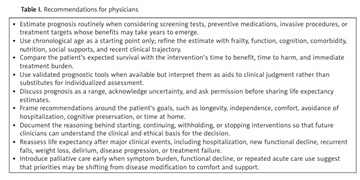
Taken together, these examples can be used to develop a practical framework for clinicians. First, establish a baseline estimate using age- and sex-specific life tables, while recognizing that these data describe populations rather than individuals [1]. Second, refine the estimate using comorbidity, frailty, functional status, cognition, nutritional status, and recent clinical trajectory. Third, compare the patient’s prognosis with the time to benefit and time to harm of the proposed intervention [6]. Fourth, discuss uncertainty and elicit values: what outcomes would the patient consider worthwhile, and what burdens would they prefer to avoid? Fifth, document the reasoning and revisit the estimate as clinical circumstances evolve. Prognosis should be treated as a dynamic clinical assessment rather than a one-time label (Table I).
Table I
Recommendations for physicians
The qualifications of the assessor or expert are paramount. An expert asked to estimate life expectancy should be able to move fluently between individual clinical facts and population-level evidence. Both certification in family medicine and a Master of Public Health (Family medicine is a medical specialty, certified by the CFPC [College of Family Physicians of Canada] in Canada. The Master of Public Health or MPH is a graduate academic degree awarded by a university can be valuable qualifications for assessing life expectancy and preparing a life expectancy report for a lawyer or the court, in addition to other physicians or insurance companies.
The four tenets of family medicine are essential and remain critical in 2026 and beyond [18, 21, 22]. The family doctor is a proficient medical practitioner. Family practitioners exhibit proficiency in the patient-centered therapeutic approach; they incorporate a thoughtful, adept, and suitable investigation for illness. They demonstrate understanding of patients’ experiences with illness, particularly their thoughts, emotions, and expectations, as well as the effects of illness on their lives. Family practitioners leverage their knowledge of human development and familial and societal structures to formulate a holistic strategy for the care of patients and their families. They are skilled at collaborating with patients to establish a mutual understanding of issues, treatment objectives, and the respective responsibilities of both physician and patient in the management process. They excel in delivering information to patients in a way that honors their independence and enables them to assume control of their health care and make choices that serve their best interests. Their methodology for health care relies on the most credible scientific evidence accessible. Family medicine is a discipline rooted in community engagement. Community-based family practice is profoundly shaped by local conditions. As a community member, the family physician may respond to individuals’ evolving needs, swiftly adapt to new situations, and use appropriate resources to meet patients’ needs. Family practitioners perceive themselves as integral components of a communal network of healthcare professionals and possess expertise in cooperating as either team members or leaders. They utilize referrals to professionals and community resources with discernment. The rapport between patient and physician is fundamental to the function of the family doctor. Family practitioners possess an understanding and appreciation of the human experience, particularly the essence of suffering and patients’ reactions to illness. They possess an understanding of their capabilities and constraints and acknowledge when their individual challenges hinder proficient care [18, 21, 22].
Family medicine’s core competencies – such as person-centered care and the biopsychosocial approach – shift life expectancy estimates from purely statistical actuarial numbers to dynamic, highly individualized clinical metrics by integrating biology with a patient’s life context [19, 23]. The biopsychosocial approach integrates biological data with psychological and social contexts. Family physicians weigh how emotional climate, socioeconomic stressors, and trauma impact disease progression and overall longevity [24]. Person-centered care shifts the focus from simply managing a disease to understanding the patient’s individual goals, personal values, and quality-of-life definitions. This prevents unnecessary interventions when they do not align with what matters most to the patient, even in low-resource settings [25, 26]. Comprehensive care encompasses preventive care, chronic disease management, and mental health support across all life stages [23, 27]. Providers evaluate how multiple comorbidities interact to appropriately time treatments and gauge long-term prognoses. RESPECT, as a risk communication tool, was designed for community-dwelling older adults who need care (e.g., from nurses or personal support workers) to live at home and to support earlier identification of their palliative care needs [28]. RESPECT is openly accessible through ProjectBigLife.ca, and its implementation and acceptability as an openly accessible online tool for communicating the risk of death to community-dwelling older adults have been previously evaluated. The ePrognosis tool only modestly overestimates mortality rate in older breast cancer patients enrolled in two cooperative group studies. This tool, which estimates non-cancer mortality risk based on readily available clinical information, may inform adjuvant therapy decisions, but should be validated in non-clinical trial populations [29–31].
Similarly, an MPH provides formal training in epidemiology, biostatistics, demography, health policy, social determinants of health, and critical appraisal – disciplines directly relevant to interpreting life tables, survival curves, prognostic indices, competing risks, and uncertainty. MPH training can therefore strengthen the assessor’s ability to evaluate whether a mortality estimate is methodologically sound, clinically applicable, and appropriately contextualized for the patient or population under consideration [32–37]. While clinical experience remains indispensable, advanced public health training adds a structured analytic framework that is particularly valuable when life expectancy opinions are used in complex clinical, administrative, occupational, insurance, or medicolegal settings, preparing life expectancy reports for plaintiff lawyers or courts.
Six Sigma certification can further strengthen the credibility and reliability of the assessor or expert, particularly when life expectancy opinions are used in complex systems or medicolegal settings. Six Sigma emphasizes structured problem-solving, reduction of unwarranted variation, process measurement, root cause analysis, and sustained quality control through frameworks such as DMAIC – Define, Measure, Analyze, Improve, and Control [38, 39]. In the context of life expectancy assessment, this training is relevant because prognostic opinions often depend on the quality of data sources, the consistency of assumptions, the transparency of the methodology, and the reproducibility of reasoning. Lean Six Sigma has also been widely applied in healthcare to improve process reliability, patient flow, safety, and operational performance, although the evidence base varies across settings and study designs [40]. For an assessor, Six Sigma certification signals familiarity with disciplined analytic methods that can help identify bias, reduce avoidable error, standardize review processes, and communicate uncertainty more systematically. It should not replace clinical expertise or epidemiologic training, but it can complement them by adding a quality-improvement framework focused on measurement, variation, and defensible process control.
Rather than treating life expectancy scores as fixed, rigid directives, physicians should use these scores to contextualize and translate population-level data into personalized, actionable health plans [41, 42]. Life expectancy should function as a bridge between epidemiology and bedside medicine. It helps the physician integrate actuarial data, prognostic instruments, clinical judgment, patient trajectory, and personal goals into a coherent recommendation. Its greatest value lies not in predicting the exact timing of death, but in clarifying which interventions are likely to provide meaningful benefit, which are more likely to impose burden, and how care can be aligned with the patient’s remaining time, values, and priorities.
In conclusion, life expectancy is a practical instrument of clinical judgment, not a verdict on the worth of a life. Its proper use requires epidemiologic literacy, not only familiarity, but also dexterity with diagnostic and prognostic tools, attention to frailty and function, and skillful communication under uncertainty. When integrated into shared decision-making, life expectancy helps physicians recommend care that is evidence-informed, proportionate, patient-individualized, and aligned with the patient’s goals. The practicing physician should therefore regard prognosis not as a peripheral consideration, but as a core element of ethical and tailored medical care.