Current issue
Archive
Manuscripts accepted
About the Journal
Editorial office
Editorial board
Section Editors
Abstracting and indexing
Subscription
Contact
Ethical standards and procedures
Most read articles
Instructions for authors
Article Processing Charge (APC)
Regulations of paying article processing charge (APC)


NEPHROLOGY / CLINICAL RESEARCH
Risk prediction for death and end-stage renal disease does not align with observed outcomes in older patients with advanced chronic kidney disease: a Romanian center experience
1
University of Medicine and Pharmacy “Gr. T. Popa” Iasi, Romania, “Dr. C. I. Parhon” Hospital, Iasi, Romania
Submission date: 2020-08-18
Final revision date: 2020-10-20
Acceptance date: 2020-10-22
Online publication date: 2021-03-21
Corresponding author
Apetrii Mugurel
University of Medicine and Pharmacy “Gr. T. Popa” Nephology, Dialysis and Transplant “Dr. C. I. Parhon” Hospital Iasi, Romania
University of Medicine and Pharmacy “Gr. T. Popa” Nephology, Dialysis and Transplant “Dr. C. I. Parhon” Hospital Iasi, Romania
KEYWORDS
TOPICS
ABSTRACT
Introduction:
In 2016, the European Renal Best Practice (ERBP) group published a guideline on the management of older adults with advanced chronic kidney disease (CKD). Two risk scores were highlighted: the Bansal score for mortality, and the Kidney Failure Risk Equation (KFRE) for estimating progression to end-stage kidney disease (ESRD). Our group, as part of the ERBP team, aimed to apply these risk prediction tools in a cohort of older adults with eGFR < 45 ml/min/1.73 m2.
Material and methods:
This retrospective study included adults aged ≥ 65 years with CKD stage 3b-4, evaluated at a Romanian Outpatient Nephrology Department between October 2016 and October 2018. The Bansal score was calculated for all subjects and the KFRE was then used in the low mortality risk group. Outcomes were death or the initiation of dialysis. These outcomes were used to compare the difference between the estimated trajectory and the observed clinical course of patients. Patients were followed up until September 2019.
Results:
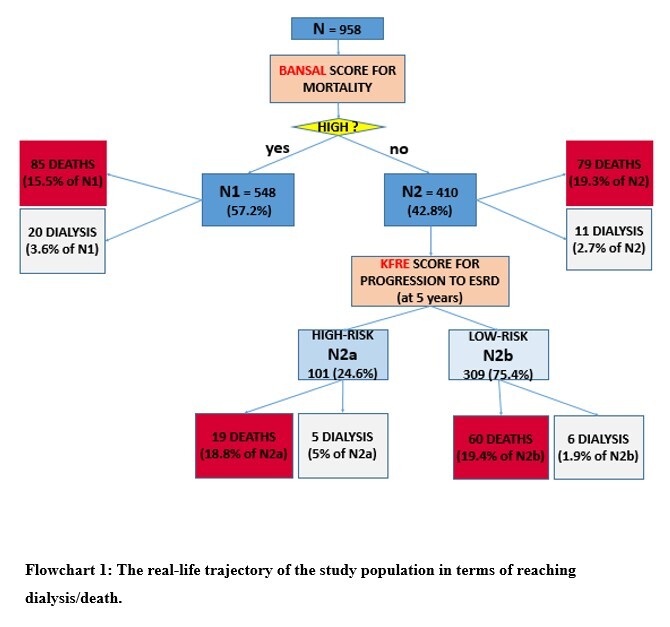
From the total population (N = 958 patients), more than half (N1 = 548, 57.2%) had a high mortality risk. In the remaining group with low mortality risk (N2 = 410, 42.8%), 75.4% had a low risk of progression to ESRD. Observed events consisted of 164 deaths and 31 dialysis initiations. We found similar death rates in the two groups (high versus low predicted mortality risk). There was no difference in the rate of dialysis initiation between subjects with a high or low predicted risk of progression to ESRD.
Conclusions:
Risk prognostication for death and ESRD did not correspond to the observed clinical course of our older patients with advanced CKD.
REFERENCES (22)
1.
Hill NR, Fatoba ST, Oke JL, et al. Global prevalence of chronic kidney disease – a systematic review and meta-analysis. PLoS One 2016; 11: e0158765.
3.
Zandecki L, Janion M, Sadowski M, et al. Associations of changes in patient characteristics and management with decrease in mortality rates of men and women with ST-elevation myocardial infarction – a propensity score-matched analysis. Arch Med Sci 2020; 16: 772-80.
4.
Li Y, Meng X, Zhou C, Zhou X. Pregnancy-associated plasma protein A as a predictor of all-cause mortality and cardiovascular events in patients with chronic kidney disease: a meta-analysis of prospective studies. Arch Med Sci 2020; 16: 8-15.
5.
Wilhelm-Leen ER, Hall YN, Tamura MK, Chertow GM. Frailty and chronic kidney disease: the Third National Health and Nutrition Evaluation Survey. Am J Med 2009; 122: 664-71.e2.
6.
Nixon AC, Bampouras TM, Pendleton N, Woywodt A, Mitra S, Dhaygude A. Frailty and chronic kidney disease: current evidence and continuing uncertainties. Clin Kidney J 2018; 11: 236-45.
7.
Lee SJ, Son H, Shin SK. Influence of frailty on health-related quality of life in pre-dialysis patients with chronic kidney disease in Korea: a cross-sectional study. Health Qual Life Outcomes 2015; 13: 70.
8.
Piątek Ł, Wilczek K, Kurzawski J, et al. Gender-related disparities in the treatment and outcomes in patients with non-ST-segment elevation myocardial infarction: results from the Polish Registry of Acute Coronary Syndromes (PL-ACS) in the years 2012-2014. Arch Med Sci 2020; 16: 781-8.
9.
O’Hare AM, Choi AI, Bertenthal, et al. Age affects outcomes in chronic kidney disease. J Am Soc Nephrol 2007; 18: 2758-65.
10.
Farrington K, Covic A, Nistor I, et al. Clinical Practice Guideline on management of older patients with chronic kidney disease stage 3b or higher (eGFR<45 mL/min/1.73 m2): a summary document from the European Renal Best Practice Group. Nephrol Dial Transplant 2017; 32: 9-16.
11.
Tangri N, Stevens LA, Griffith J, et al. A predictive model for progression of chronic kidney disease to kidney failure. JAMA 2011; 305: 1553-9.
12.
Bansal N, Katz R, De Boer IH, et al. Development and validation of a model to predict 5-year risk of death without ESRD among older adults with CKD. Clin J Am Soc Nephrol 2015; 10: 363-71.
13.
Levey AS, Stevens LA. Estimating GFR using the CKD Epidemiology Collaboration (CKD-EPI) creatinine equation: more accurate GFR estimates, lower CKD prevalence estimates, and better risk predictions. Am J Kidney Dis 2010; 55: 622-7.
14.
Harris TB, Visser M, Everhart J, et al. Waist circumference and sagittal diameter reflect total body fat better than visceral fat in older men and women. The Health, Aging and Body Composition Study. Ann N Y Acad Sci 2000; 904: 462-73.
15.
Tangri N, Grams ME, Levey A, et al. Multinational assessment of accuracy of equations for predicting risk of kidney failure: a meta-analysis. JAMA 2016; 315: 164-74.
16.
Ramer SJ, McCall NN, Robinson-Cohen C, et al. Health outcome priorities of older adults with advanced CKD and concordance with their nephrology providers’ perceptions. J Am Soc Nephrol 2018; 29: 2870-8.
17.
Hallan SI, Rifkin DE, Potok OA, et al. Implementing the European Renal Best Practice Guidelines suggests that prediction equations work well to differentiate risk of end-stage renal disease vs. death in older patients with low estimated glomerular filtration rate. Kidney Int 2019; 96: 728-37.
18.
Xiong J, Zhang M, Guo X, et al. Acute kidney injury in critically ill cirrhotic patients with spontaneous bacterial peritonitis: a comparison of KDIGO and ICA criteria. Arch Med Sci 2020; 16: 569-76.
19.
Prakash S, O’Hare AM. Interaction of aging and chronic kidney disease. Semin Nephrol 2009; 29: 497-503.
20.
Ren Q, Shi Q, Ma, et al. Quality of life, symptoms, and sleep quality of elderly with end-stage renal disease receiving conservative management: a systematic review. Health Qual Life Outcomes 2019; 17: 78.
21.
Ladin K, Pandya R, Kannam A, et al. Discussing conservative management with older patients with CKD: an interview study of nephrologists. Am J Kidney Dis 2018; 71: 627-35.
22.
Aguayo GA, Donneau AF, Vaillant MT, et al. Agreement between 35 published frailty scores in the general population. Am J Epidemiol 2017; 186: p. 420-34.
Share
RELATED ARTICLE
| eISSN: | 1896-9151 |
| ISSN: | 1734-1922 |

We process personal data collected when visiting the website. The function of obtaining information about users and their behavior is carried out by voluntarily entered information in forms and saving cookies in end devices. Data, including cookies, are used to provide services, improve the user experience and to analyze the traffic in accordance with the Privacy policy. Data are also collected and processed by Google Analytics tool (more).
You can change cookies settings in your browser. Restricted use of cookies in the browser configuration may affect some functionalities of the website.
You can change cookies settings in your browser. Restricted use of cookies in the browser configuration may affect some functionalities of the website.