Current issue
Archive
Manuscripts accepted
About the Journal
Editorial office
Editorial board
Section Editors
Abstracting and indexing
Subscription
Contact
Ethical standards and procedures
Most read articles
Instructions for authors
Article Processing Charge (APC)
Regulations of paying article processing charge (APC)


CLINICAL RESEARCH
The pan-immune-inflammation value is associated with all-cause and cardiovascular mortality among individuals with diabetes
1
Department of Cardiology, the First People’s Hospital of Xiaoshan District, Xiaoshan Affiliated Hospital of Wenzhou Medical University, Hangzhou, Zhejiang, China
2
Department of Training, Hangzhou Xiaoshan No. 4 Secondary Vocational School, Hangzhou, Zhejiang, China
3
The First People’s Hospital of Xiaoshan District, Xiaoshan Affiliated Hospital of Wenzhou Medical University, Hangzhou, Zhejiang, China
Submission date: 2026-01-11
Final revision date: 2026-04-05
Acceptance date: 2026-04-18
Online publication date: 2026-08-18
Corresponding author
Mei Yu
The First People’s Hospital of Xiaoshan District Xiaoshan Affiliated Hospital of Wenzhou Medical University, Hangzhou 311200, Zhejiang, China
The First People’s Hospital of Xiaoshan District Xiaoshan Affiliated Hospital of Wenzhou Medical University, Hangzhou 311200, Zhejiang, China
KEYWORDS
pan-immune-inflammation valuediabetesmortalityestimated glomerular filtration ratecardiovascular risk
TOPICS
ABSTRACT
Introduction:
Diabetes is a major global health burden, with chronic inflammation playing a central role in its progression and complications. The pan-immune-inflammation value (PIV) is a novel composite biomarker reflecting systemic immune inflammation. However, its prognostic value for mortality in individuals with diabetes remains unclear.
Material and methods:
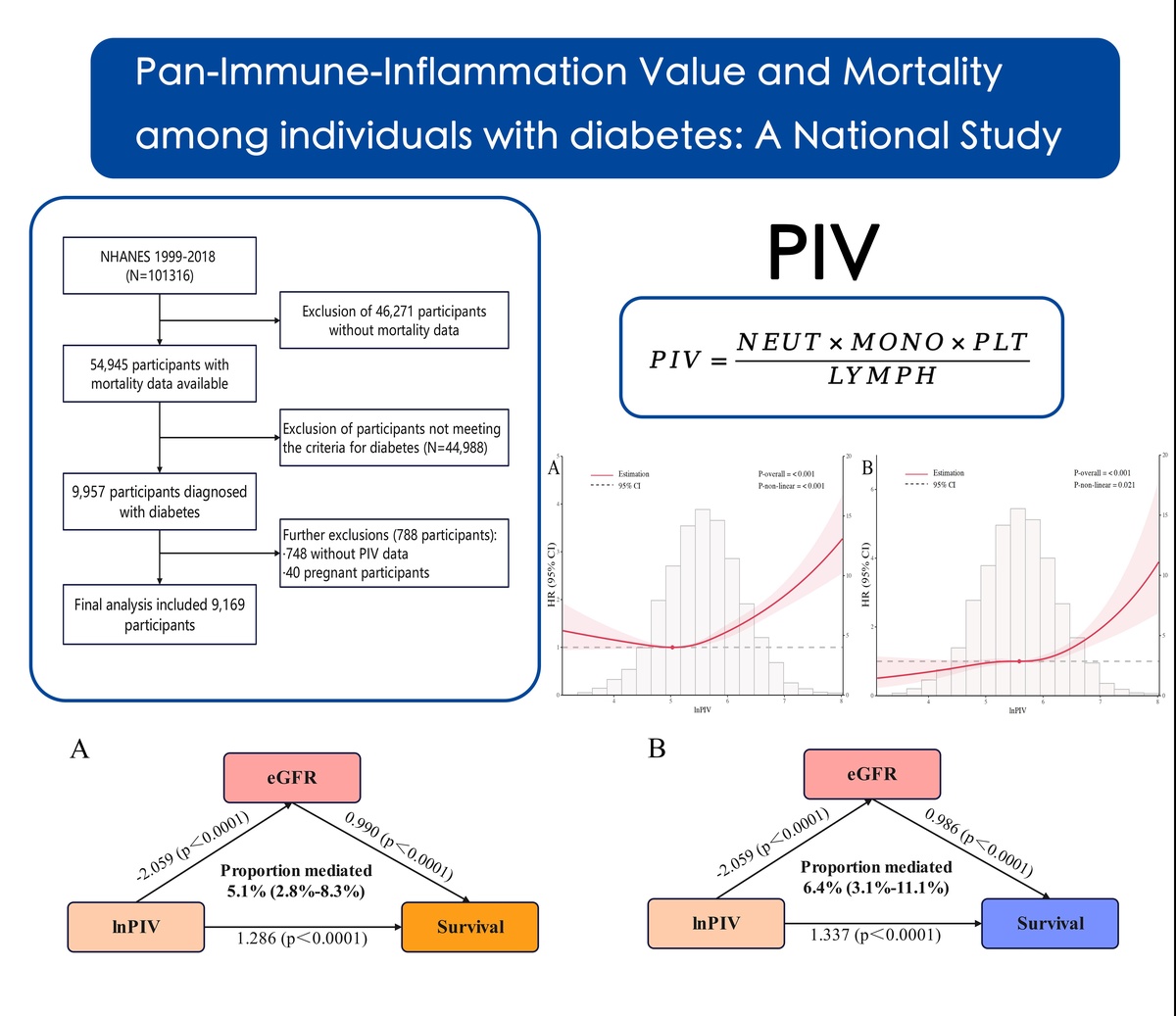
We conducted a retrospective cohort analysis using the nationally representative National Health and Nutrition Examination Survey (NHANES) data, including participants aged ≥ 20 with available PIV data. PIV was calculated using a validated equation and then log-transformed (ln) before analysis. Multivariable Cox regression models were employed to evaluate this association. We further explored the dose-response relationship using restricted cubic splines (RCS) and threshold analysis to identify potential non-linear effects. The robustness of findings was confirmed through subgroup and sensitivity analyses, and the potential mediating role of estimated glomerular filtration rate (eGFR) was investigated.
Results:
During a median follow-up of 94.9 months, 2,549 deaths were recorded, including 727 attributable to cardiovascular diseases. Elevated lnPIV levels were strongly associated with increased all-cause and cardiovascular mortality. Critical thresholds were identified at lnPIV values of 5.056 for all-cause mortality and 5.586 for cardiovascular mortality. These core associations were stable across all subgroup and sensitivity analyses. Furthermore, mediation analysis estimated that eGFR accounted for 5.1% and 6.4% of the lnPIV-associated risk for all-cause and cardiovascular mortality, respectively.
Conclusions:
Pan-immune-inflammation value was found to be independently associated with increased risks of all-cause and cardiovascular mortality in individuals with diabetes, characterized by a nonlinear association and a distinct threshold effect. These findings suggest that PIV could serve as a practical biomarker for risk stratification, potentially identifying patients who may benefit from more intensive management of both inflammation and renal function.
Diabetes is a major global health burden, with chronic inflammation playing a central role in its progression and complications. The pan-immune-inflammation value (PIV) is a novel composite biomarker reflecting systemic immune inflammation. However, its prognostic value for mortality in individuals with diabetes remains unclear.
Material and methods:
We conducted a retrospective cohort analysis using the nationally representative National Health and Nutrition Examination Survey (NHANES) data, including participants aged ≥ 20 with available PIV data. PIV was calculated using a validated equation and then log-transformed (ln) before analysis. Multivariable Cox regression models were employed to evaluate this association. We further explored the dose-response relationship using restricted cubic splines (RCS) and threshold analysis to identify potential non-linear effects. The robustness of findings was confirmed through subgroup and sensitivity analyses, and the potential mediating role of estimated glomerular filtration rate (eGFR) was investigated.
Results:
During a median follow-up of 94.9 months, 2,549 deaths were recorded, including 727 attributable to cardiovascular diseases. Elevated lnPIV levels were strongly associated with increased all-cause and cardiovascular mortality. Critical thresholds were identified at lnPIV values of 5.056 for all-cause mortality and 5.586 for cardiovascular mortality. These core associations were stable across all subgroup and sensitivity analyses. Furthermore, mediation analysis estimated that eGFR accounted for 5.1% and 6.4% of the lnPIV-associated risk for all-cause and cardiovascular mortality, respectively.
Conclusions:
Pan-immune-inflammation value was found to be independently associated with increased risks of all-cause and cardiovascular mortality in individuals with diabetes, characterized by a nonlinear association and a distinct threshold effect. These findings suggest that PIV could serve as a practical biomarker for risk stratification, potentially identifying patients who may benefit from more intensive management of both inflammation and renal function.
REFERENCES (47)
1.
Duncan BB, Magliano DJ, Boyko EJ. IDF diabetes atlas 11th edition 2025: global prevalence and projections for 2050. Nephrol Dial Transplant 2025; 41: 7-9.
2.
GBD 2023 Disease and Injury and Risk Factor Collaborators. Burden of 375 diseases and injuries, risk-attributable burden of 88 risk factors, and healthy life expectancy in 204 countries and territories, including 660 subnational locations, 1990-2023: a systematic analysis for the Global Burden of Disease Study 2023. Lancet 2025; 406: 1873-922.
3.
Xia Y, Xia C, Wu L, Li Z, Li H, Zhang J. Systemic Immune Inflammation Index (SII), System Inflammation Response Index (SIRI) and risk of all-cause mortality and cardiovascular mortality: a 20-year follow-up cohort study of 42,875 US adults. J Clin Med 2023; 12: 1128.
4.
Amezcua-Guerra LM, Brianza-Padilla M, Martínez-García M, Gutiérrez-Esparza G. Establishment of high-altitude reference values for the pan-immune-inflammation value in healthy adults living in Mexico City. Arch Med Res 2026; 57: 103281.
5.
Sethi Y, Padda I, Gosavi S, Singhal S, Moinuddin A. Viewpoint: beyond glycated hemoglobin-the frontier of novel biomarkers in diabetes care. Arch Med Res 2026; 57: 103331.
6.
Shaaban SM, Gaber Z, Semary S, Dewidar AM. Impact of vitamin B12 on outcome of early stage luminal A and B breast cancer, single center experience. Med Pharm J 2023; 2: 17-27.
7.
Winther-Larsen A, Aggerholm-Pedersen N, Sandfeld-Paulsen B. Inflammation-scores as prognostic markers of overall survival in lung cancer: a register-based study of 6,210 Danish lung cancer patients. BMC Cancer 2022; 22: 63.
8.
Kuang T, Qiu Z, Wang K, Zhang L, Dong K, Wang W. Pan-immune inflammation value as a prognostic biomarker for cancer patients treated with immune checkpoint inhibitors. Front Immunol 2024; 15: 1326083.
9.
Fucà G, Guarini V, Antoniotti C, et al. The pan-immune-inflammation value is a new prognostic biomarker in metastatic colorectal cancer: results from a pooled-analysis of the Valentino and TRIBE first-line trials. Br J Cancer 2020; 123: 403-9.
10.
Lin F, Zhang LP, Xie SY, et al. Pan-immune-inflammation value: a new prognostic index in operative breast cancer. Front Oncol 2022; 12: 830138.
11.
Zhao H, Chen X, Zhang W, et al. Pan-immune-inflammation value is associated with the clinical stage of colorectal cancer. Front Surg 2022; 9: 996844.
12.
Shi J, Liu C, Yang N, Qiu C. Pan-immune-inflammation value: a new prognostic index in operative laryngeal and pharyngeal carcinomas. Clin Transl Oncol 2025; 27: 151-9.
13.
Wu B, Zhang C, Lin S, Zhang Y, Ding S, Song W. The relationship between the pan-immune-inflammation value and long-term prognoses in patients with hypertension: National Health and Nutrition Examination Study, 1999-2018. Front Cardiovasc Med 2023; 10: 1099427.
14.
Rohm TV, Meier DT, Olefsky JM, Donath MY. Inflammation in obesity, diabetes, and related disorders. Immunity 2022; 55: 31-55.
15.
He H, Wang H, Chen X, et al. Treatment for type 2 diabetes and diabetic nephropathy by targeting Smad3 signaling. Int J Biol Sci 2024; 20: 200-17.
16.
Yang F, Wang M, Chen Y, Wu J, Li Y. Association of cardio-renal biomarkers and mortality in the U.S.: a prospective cohort study. Cardiovasc Diabetol 2023; 22: 265.
17.
Corti F, Lonardi S, Intini R, et al. The pan-immune-inflammation value in microsatellite instability-high metastatic colorectal cancer patients treated with immune checkpoint inhibitors. Eur J Cancer 2021; 150: 155-67.
18.
Qiu Z, Chen X, Geng T, et al. Associations of serum carotenoids with risk of cardiovascular mortality among individuals with type 2 diabetes: results from NHANES. Diabetes Care 2022; 45: 1453-61.
19.
Tylutka A, Walas Ł, Zembron-Lacny A. Level of IL-6, TNF, and IL-1 and age-related diseases: a systematic review and meta-analysis. Front Immunol 2024; 15: 1330386.
20.
Soták M, Clark M, Suur BE, Börgeson E. Inflammation and resolution in obesity. Nat Rev Endocrinol 2025; 21: 45-61.
21.
Zhang J, Fan X, Xu Y, et al. Association between inflammatory biomarkers and mortality in individuals with type 2 diabetes: NHANES 2005-2018. Diabetes Res Clin Pract 2024; 209: 111575.
22.
Chen X, Li A, Ma Q. Neutrophil-lymphocyte ratio and systemic immune-inflammation index as predictors of cardiovascular risk and mortality in prediabetes and diabetes: a population-based study. Inflammopharmacology 2024; 32: 3213-27.
23.
Şahin AB, Cubukcu E, Ocak B, et al. Low pan-immune-inflammation-value predicts better chemotherapy response and survival in breast cancer patients treated with neoadjuvant chemotherapy. Sci Rep 2021; 11: 14662.
24.
Sahin TK, Akyildiz A, Dogan OT, Kavgaci G, Guven DC, Aksoy S. Prognostic significance of pan-immune-inflammation value in patients with HER2-positive metastatic breast cancer treated with trastuzumab emtansine. Pharmaceuticals 2024; 17: 824.
25.
Ulas A, Avci N, Kos T, et al. Are neutrophil/lymphocyte ratio and platelet/lymphocyte ratio associated with prognosis in patients with HER2-positive early breast cancer receiving adjuvant trastuzumab? J Buon 2015; 20: 714-22.
26.
Akkaya S, Cakmak U. Association between pan-immune-inflammation value and coronary slow flow phenomenon in patients with angiographically normal coronary arteries. Int J Cardiol 2024; 398: 131631.
27.
Şen F, Kurtul A, Bekler Ö. Pan-immune-inflammation value is independently correlated to impaired coronary flow after primary percutaneous coronary intervention in patients with ST-segment elevation myocardial infarction. Am J Cardiol 2024; 211: 153-9.
28.
Ramadan H. Sex hormones and the immune system: a bibliometric analysis. Med Pharm J 2024; 3: 106-18.
29.
An Y, Xu BT, Wan SR, et al. The role of oxidative stress in diabetes mellitus-induced vascular endothelial dysfunction. Cardiovasc Diabetol 2023; 22: 237.
30.
Shah MS, Brownlee M. Molecular and cellular mechanisms of cardiovascular disorders in diabetes. Circ Res 2016; 118: 1808-29.
31.
Johnson J, Jaggers RM, Gopalkrishna S, et al. Oxidative stress in neutrophils: implications for diabetic cardiovascular complications. Antioxid Redox Signal 2022; 36: 652-66.
32.
Li HD, You YK, Shao BY, et al. Roles and crosstalks of macrophages in diabetic nephropathy. Front Immunol 2022; 13: 1015142.
33.
Lin DW, Yang TM, Ho C, Shih YH, Lin CL, Hsu YC. Targeting macrophages: therapeutic approaches in diabetic kidney disease. Int J Mol Sci 2024; 25: 4350.
34.
Guzik TJ, Skiba DS, Touyz RM, Harrison DG. The role of infiltrating immune cells in dysfunctional adipose tissue. Cardiovasc Res 2017; 113: 1009-23.
35.
Ido Y, Carling D, Ruderman N. Hyperglycemia-induced apoptosis in human umbilical vein endothelial cells: inhibition by the AMP-activated protein kinase activation. Diabetes 2002; 51: 159-67.
36.
Vorotnikov AV, Khapchaev AY, Nickashin AV, Shirinsky VP. In vitro modeling of diabetes impact on vascular endothelium: are essentials engaged to tune metabolism? Biomedicines 2022; 10: 3181.
37.
Farag E, Esa Y, Chehade NEH, Sleiman VB, Seif J. Endothelial glycocalyx in perioperative medicine current understanding and future direction. J Clin Anesth 2026; 110: 112154.
38.
Karakasis P, Theofilis P, Patoulias D, Vlachakis PK, Antoniadis AP, Fragakis N. Diabetes-driven atherosclerosis: updated mechanistic insights and novel therapeutic strategies. Int J Mol Sci 2025; 26: 2196.
39.
Xue C, Chen K, Gao Z, et al. Common mechanisms underlying diabetic vascular complications: focus on the interaction of metabolic disorders, immuno-inflammation, and endothelial dysfunction. Cell Commun Signal 2023; 21: 298.
40.
Zoccali C, Agarwal R, Mallamaci F, et al. Inter-organ crosstalk: the kidney’s role in systemic health and disease. J Intern Med 2025; 298: 368-91.
41.
Furman D, Campisi J, Verdin E, et al. Chronic inflammation in the etiology of disease across the life span. Nat Med 2019; 25: 1822-32.
42.
Campillo S, Bohorquez L, Gutiérrez-Calabrés E, et al. Indoxyl sulfate- and P-cresol-induced monocyte adhesion and migration is mediated by integrin-linked kinase-dependent podosome formation. Exp Mol Med 2022; 54: 226-38.
43.
Alicic RZ, Cox EJ, Neumiller JJ, Tuttle KR. Incretin drugs in diabetic kidney disease: biological mechanisms and clinical evidence. Nat Rev Nephrol 2021; 17: 227-44.
44.
Lehrskov LL, Christensen RH. The role of interleukin-6 in glucose homeostasis and lipid metabolism. Semin Immunopathol 2019; 41: 491-9.
45.
Shao Y, Cheng Z, Li X, Chernaya V, Wang H, Yang XF. Immunosuppressive/anti-inflammatory cytokines directly and indirectly inhibit endothelial dysfunction--a novel mechanism for maintaining vascular function. J Hematol Oncol 2014; 7: 80.
46.
Ansari Z, Chaurasia A, Neha, Sharma N, Bachheti RK, Gupta PC. Exploring inflammatory and fibrotic mechanisms driving diabetic nephropathy progression. Cytokine Growth Factor Rev 2025; 84: 120-34.
47.
Ma L, Liu D, Yu Y, Li Z, Wang Q. Immune-mediated renal injury in diabetic kidney disease: from mechanisms to therapy. Front Immunol 2025; 16: 1587806.
Share
RELATED ARTICLE
| eISSN: | 1896-9151 |
| ISSN: | 1734-1922 |

We process personal data collected when visiting the website. The function of obtaining information about users and their behavior is carried out by voluntarily entered information in forms and saving cookies in end devices. Data, including cookies, are used to provide services, improve the user experience and to analyze the traffic in accordance with the Privacy policy. Data are also collected and processed by Google Analytics tool (more).
You can change cookies settings in your browser. Restricted use of cookies in the browser configuration may affect some functionalities of the website.
You can change cookies settings in your browser. Restricted use of cookies in the browser configuration may affect some functionalities of the website.