Collegium Medicum Cardinal Stefan Wyszyński University in Warsaw Bursztynowa 2 04-749 Warsaw, Poland Phone +48 22 47 35 149. E-mail: r.drobot@uksw.edu.pl
With the Conformité Européenne (CE) mark certification of the da Vinci Single-Port (SP) system in January 2024, single-incision robotic urology in Central Europe entered a phase of applied evaluation rather than one of immediate adoption. Although the CE certification permits use within the European Union (EU) and European Economic Area (EEA), clinical uptake hinges on training pathways, capital acquisition, and institutional accreditation [1]. Central European health systems differ in funding, training capacity, and robotic diffusion, so SP adoption is likely to remain uneven in the early phase. We assessed the influences of regulatory authorisation, early clinical evidence, payer decisions, and regional implementation on the first phase of SP robotic urology and evaluated whether standardised pathways can deliver efficiency without compromising outcomes. Although the CE certification encompasses endoscopic abdominopelvic and transoral indications, we focused on emerging adoption for urological applications.
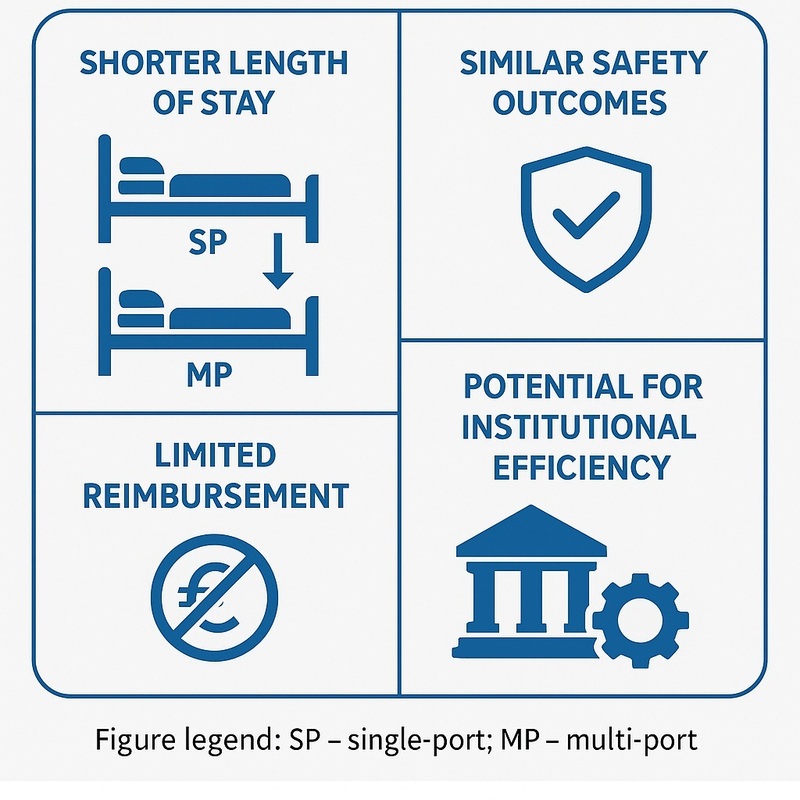
Emerging evidence of clinical feasibility and safety includes a propensity score-matched observational study that compared extraperitoneal SP robot-assisted radical prostatectomy (RARP) with transperitoneal multi-port (MP) RARP and reported similar short-term oncologic outcomes and perioperative safety, with shorter length of stay (LOS; 12.6 h vs. 31.9 h) and earlier catheter removal in SP, as well as comparable early continence [2]. In a single-institution SP transvesical series, a Retzius-sparing extraperitoneal technique achieved early continence and erectile-function recovery while maintaining oncologic quality [3]. These preliminary data, with modest cohorts, short follow-up, nonrandomised design, and potential learning-curve effects, nevertheless support clinical feasibility and outline plausible mechanisms for early functional gains, but the real oncological value will depend on long-term endpoints, concordance between cTNM/rTNM and pTNM staging, and the need for adjuvant or salvage radiotherapy. Beyond continence and catheter timing, the matched analysis reported comparable margins and complications whereas the single-centre series aligned with a Retzius-sparing strategy that preserved anterior support structures.
LOS is a practical operational marker that bridges clinical signals to system efficiency. The European Urology Focus guidance describes same-day or next-day pathways as feasible when supported by selection criteria and standardised perioperative care [4]. Using the 12.6-h versus 31.9-h benchmark from the propensity-matched study, an SP pathway that saved approximately 0.80 days per case would free approximately 161 bed-days per 200 cases annually. This promising signal derives from early single-centre data and warrants multicentre validation across diverse pathways; critically, short stays must not increase unplanned visits or readmissions. Expressed in days, the MP and SP mean are approximately 1.33 and 0.53, respectively, which yield an approximately 0.80-day difference.
With LOS as a cost driver, using payer data for context, a national analysis covering January 2022 through March 2025 (> 31,000 radical prostatectomies) documented rapid uptake of robot-assisted techniques (approximately 62% share) with 30-day safety comparable to laparoscopy [5]. In July 2025, the National Health Fund (NFZ) reduced the L31R tariff for robot-assisted prostatectomy to 17,028 points; at contemporaneous point valuations, this equates to approximately 27,500 PLN per case, nearly 15% below a prior mean of 32,000 PLN [6]. Thus, assuming constant volume and point valuation, a 200-case program could generate approximately 0.9 million PLN lower annual revenue; the actual effects vary with contracting, case-mix, baseline LOS, and the still incompletely described capital, maintenance, and disposable costs of SP versus MP platforms. The tariff decision signals payer expectations whereby efficiency gains and volume, rather than platform choice alone, should underpin value and procurement, thus elevating audited pathway metrics within contracting and budget-impact assessments.
Therefore, SP pathways may support institutional efficiency when delivered in standardised perioperative protocols, for appropriately selected patients, and by teams with SP-specific training. Sub-24-h discharge increases bed availability and reduces variable stay costs, which are material. However, the conversion of the time saved into realised savings depend on local micro-costs, weekend-discharge logistics, and diagnosis-related group rules; accordingly, time saved is not a linear proxy for cost saved. Robust cost-accounting is therefore pivotal. The Agency for Health Technology Assessment and Tariff System (AOTMiT), which conducts tariff recalibration and hospital cost-data collection, is a channel to incorporate LOS-linked metrics into future tariffs or add-ons [7]. Table I summarises value domains and measurement priorities, including LOS, readmissions, and learning-curve metrics.
Table I
Value domains and measurement priorities for single-port (SP) pathways in Central Europe (2024–2025)
[i] AOTMiT – Agency for Health Technology Assessment and Tariff System, CeZ – Centrum e-Zdrowia, DRG – diagnosis-related group, GUS – Statistics Poland, LOS – length of stay, MP – multi-port, NFZ – National Health Fund, PLN – Polish zloty, RARP – robot-assisted radical prostatectomy, SP – single-port.
Beyond institutional metrics, reductions in inpatient days may carry societal implications. In 2024 Poland recorded approximately 290 million sick-leave days, wherein 6.5 million were associated with hospital care [8]. Using Statistics Poland’s average gross wage for the second quarter of 2025 (8748.63 PLN per month), assuming 21 working days, a notional working day equals approximately 417 PLN [9]. If 30% of radical-pros-tatectomy patients are employed and only half of saved bed-days translate into fewer sick-leave days, then, at the centre level, 161 bed-days corresponds to approximately 24 working-days recovered and 10,000 PLN. LOS does not, by itself, determine return-to-work; effects depend on rehabilitation, employer policies, and social-insurance rules, whereby figures are scenario-based. Prospective analyses should explicitly test whether LOS gains translate into shorter sick leave in individual Central European health systems.
The translation of potential efficiencies into practice depends on regional deployment capacity. In September 2025, the first Central-European SP installation was announced at Masaryk Hospital, Ústí nad Labem, Czech Republic; the contract (> €3.4 million) includes training and service support [10], constituting an early step toward operational readiness and enabling shared training, proctoring, and stabilised supply chains – prerequisites for reliable day-case pathways. These regional developments, currently limited largely to Poland and the first Czech centre, complement policy efforts to align reimbursement with efficiency-based care.
As deployment progresses, policy instruments will determine whether efficiency gains are recognised. NFZ analyses indicate that robot-assisted prostatectomy is clinically safe; however, incremental system benefit is evinced through standardised short-stay pathways and audited outcomes [5, 6]. AOTMiT’s cost-accounting provides a mechanism to integrate LOS-linked metrics into tariff design [7]. Providers can contribute by defining explicit criteria for SP program launch (including training and volume thresholds), auditing selection, discharge timing, and 30-/90-day outcomes, and reporting validated cost and resource-use data. These steps tie clinical metrics to accountable, efficiency-based funding across systems.
In conclusion, SP robotic urology in Central Europe is moving from promise to structured evaluation under real-world constraints, but current evidence is confined to early single-centre series. Early single-centre evidence suggests measurable perioperative efficiency – particularly shorter LOS – with maintained short-term safety and acceptable early oncologic surrogates [2–4, 10], but its generalisability remains uncertain. Simultaneously, reimbursement signals in Poland emphasise that efficiency, not platform choice alone, will shape economic viability. Important uncertainties remain: cumulative European SP experience is small; most datasets are single-centre with limited follow-up and potential learning-curve effects; long-term oncologic endpoints (biochemical recurrence, metastasis-free survival, and need for adjuvant or salvage radiotherapy) and health-economic outcomes (including sick leave) have not yet been reported; and tariff parameters are evolving [2–7]. The future is pivotal for prospective multicentre evaluations and audit-linked registries – building on national analyses of urologic oncology care already reported in Central Europe [5] – that integrate clinical outcomes, stage concordance between cTNM/rTNM and pTNM classifications, LOS, readmissions, sick leave, and resource use with real-world NFZ and AOTMiT data to assess sustainability and scalability. This perspective is based solely on publicly available regulatory, clinical, and payer data and is intended to guide evaluation frameworks rather than specific procurement decisions. Transparent reporting will facilitate peer comparison and accelerate safe, scalable implementation across Central Europe.