Current issue
Archive
Manuscripts accepted
About the Journal
Editorial office
Editorial board
Section Editors
Abstracting and indexing
Subscription
Contact
Ethical standards and procedures
Most read articles
Instructions for authors
Article Processing Charge (APC)
Regulations of paying article processing charge (APC)


ONCOLOGY / STATE OF THE ART PAPER
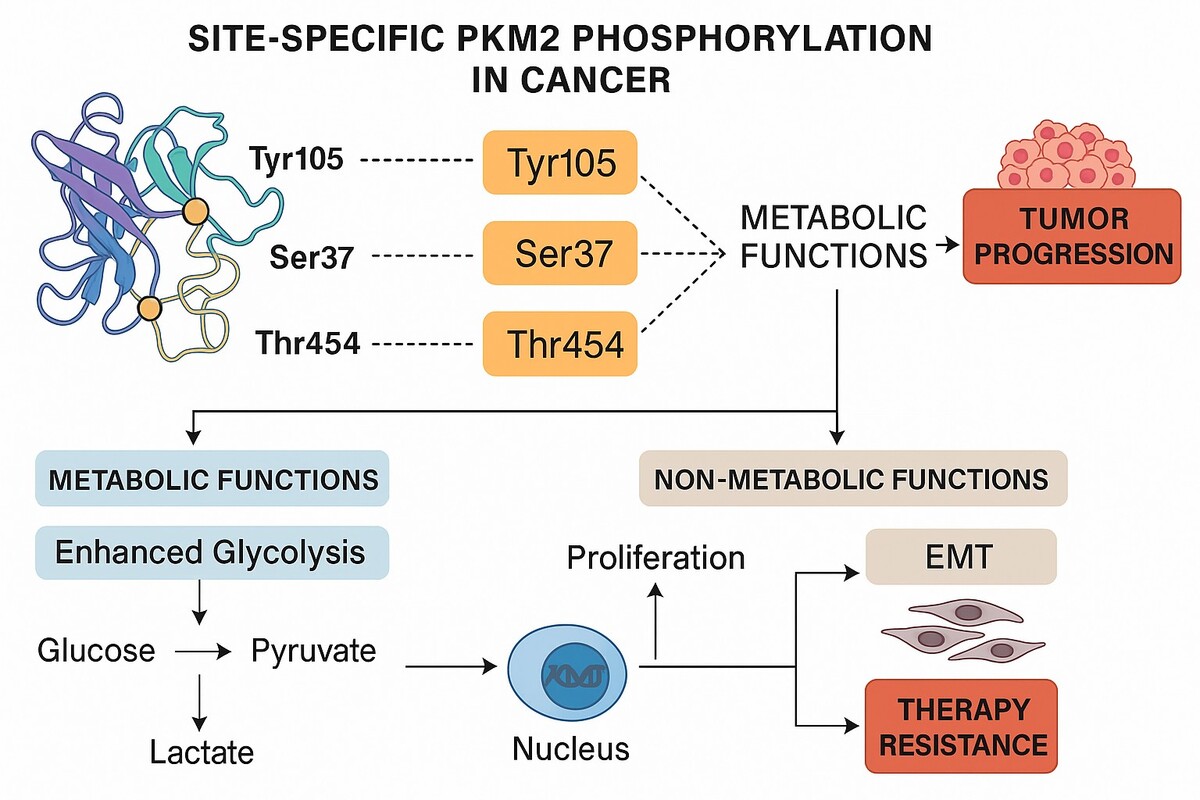
Site-specific PKM2 phosphorylation in cancer: a systematic review of its role in metabolic plasticity and precision therapy

1
Department of Clinical Laboratory Sciences, Faculty of Applied Medical Sciences, Najran University, Najran, Saudi Arabia
Submission date: 2025-10-29
Final revision date: 2026-03-23
Acceptance date: 2026-03-24
Online publication date: 2026-06-04
Corresponding author
Mohammed Merae Alshahrani
Department of Clinical Laboratory Sciences Faculty of Applied Medical Sciences Najran University 1988, Najran, 61441 Saudi Arabia
Department of Clinical Laboratory Sciences Faculty of Applied Medical Sciences Najran University 1988, Najran, 61441 Saudi Arabia
KEYWORDS
pyruvate kinase M2 (PKM2)site-specific phosphorylationcancer metabolismtumor growth and therapy resistancemetabolic plasticityprecision oncology
TOPICS
ABSTRACT
Pyruvate kinase M2 (PKM2), a central enzyme in glycolysis, plays a key role in tumor metabolism and growth. Its activity is tightly regulated through site-specific phosphorylation at residues such as Tyr105, Ser37, and Thr454. These modifications influence metabolic plasticity, tumor progression, and therapy resistance. This systematic review consolidates current evidence on PKM2 phosphorylation in cancer, its metabolic and signaling implications, and potential as a biomarker and therapeutic target in precision oncology. A systematic search of PubMed, Scopus, and Embase was conducted in accordance with the PRISMA 2020 guidelines. Studies investigating site-specific PKM2 phosphorylation and its functional or clinical relevance in cancer were included. Data extraction focused on phosphorylation sites, signaling pathways, metabolic and tumor-related effects, and therapeutic applications. Study quality and bias risk were assessed using standardized tools. Fifty-eight studies met the inclusion criteria. Tyr105, Ser37, and Thr454 were the most frequently reported phosphorylation sites, each significantly influencing PKM2 activity, localization, and oncogenic interactions. Their modification consistently enhanced glycolysis, plasticity, tumor growth, and resistance to therapy across cancers. Site-specific PKM2 phosphorylation regulates metabolism and tumor behavior, underscoring its value as a biomarker and therapeutic target for precision-based cancer management.
REFERENCES (58)
1.
Dong G, Mao Q, Xia W, et al. PKM2 and cancer: the function of PKM2 beyond glycolysis. Oncol Lett 2016; 11: 1980-6.
3.
Prakasam G, Iqbal MA, Bamezai RNK, Mazurek S. Posttranslational modifications of pyruvate kinase M2: tweaks that benefit cancer. Front Oncol 2018; 8: 22.
4.
Yang W, Xia Y, Ji H, et al. Nuclear PKM2 regulates -catenin transactivation upon EGFR activation. Nature 2011; 480: 118-22.
5.
Yang W, Lu Z. Regulation and function of pyruvate kinase M2 in cancer. Cancer Lett 2013; 339: 153-8.
6.
Wang C, Zeng J, Li LJ, et al. Cdc25A inhibits autophagy-mediated ferroptosis by upregulating ErbB2 through PKM2 dephosphorylation in cervical cancer cells. Cell Death Dis 2021; 12: 1055.
7.
Fernandes PM, Kinkead J, McNae I, Michels PAM, Walkinshaw MD. Biochemical and transcript level differences between the three human phosphofructokinases show optimisation of each isoform for specific metabolic niches. Biochem J 2020; 477: 4425-41.
8.
Haddaway NR, Page MJ, Pritchard CC, McGuinness LA. PRISMA2020: An R package and Shiny app for producing PRISMA 2020-compliant flow diagrams, with interactivity for optimised digital transparency and Open. Campbell Syst Rev 2022; 18: e1230.
9.
Voss DM, Kral AJ, Sim GY, et al. PKM splice-switching ASOs induce upregulation of dual-specificity phosphatases and dephosphorylation of ERK1/2 in hepatocellular carcinoma. J Biol Chem 2025; 301: 108345.
10.
Wei J, Lei G, Chen Q, et al. Casticin inhibits proliferation of non-small cell lung cancer cells through regulating reprogramming of glucose metabolism. Phytomedicine 2025; 136: 156278.
11.
Li Q, Ci H, Zhao P, et al. NONO interacts with nuclear PKM2 and directs histone H3 phosphorylation to promote triple-negative breast cancer metastasis. J Exp Clin Cancer Res 2025; 44: 90.
12.
Wang J, Liu L, Gao X, et al. A novel pathway for stemness propagation and chemoresistance in non-small cell lung cancer via phosphorylated PKM2-loaded small extracellular vesicles. Theranostics 2025; 15: 3439-61.
13.
Liu S, Ai Z, Hu Y, et al. Ginseng glucosyl oleanolate suppresses cervical cancer via simultaneous inhibition of glycolysis and oxidative phosphorylation in vivo/vitro. J Agric Food Chem 2025; 73: 18746-62.
14.
Zhan W, Zhang H, She X, et al. BRG1 inhibits glycolysis by promoting SHP1-mediated dephosphorylation of PKM2 in non-small cell lung cancer. Oncogenesis 2025; 14: 32.
15.
Wang Y, Shu H, Qu Y, et al. PKM2 functions as a histidine kinase to phosphorylate PGAM1 and increase glycolysis shunts in cancer. EMBO J 2024; 43: 2368-96.
16.
Olea-Flores M, Sharma T, Verdejo-Torres O, DiBartolomeo I, Thompson PR. Muscle-specific pyruvate kinase isoforms, PKM1 and PKM2, regulate mammalian SWI/SNF proteins and histone 3 phosphorylation during myoblast differentiation. FASEB J 2024; 38: e400784.
17.
Chen X, Jiang C, Chen M, et al. SYK promotes the formation of neutrophil extracellular traps by inducing PKM2 nuclear translocation and promoting STAT3 phosphorylation to exacerbate hepatic ischemia-reperfusion injury and tumor recurrence. Mol Med 2024; 30: 146.
18.
Chen J, Duan S, Wang Y, et al. MYG1 drives glycolysis and colorectal cancer development through nuclear-mitochondrial collaboration. Nat Commun 2024; 15: 4969.
19.
Li C, Deng C, Wang S, et al. A novel role for the ROS-ATM-Chk2 axis mediated metabolic and cell cycle reprogramming in the M1 macrophage polarization. Redox Biol 2024; 70: 103059.
20.
Wang T, Zhang M, Khan M, et al. Cryptotanshinone suppresses ovarian cancer via simultaneous inhibition of glycolysis and oxidative phosphorylation. Biomed Pharmacother 2024; 170: 115956.
21.
Zhou Z, Zheng X, Zhao J, et al. ULK1-dependent phosphorylation of PKM2 antagonizes O-GlcNAcylation and regulates the Warburg effect in breast cancer. Oncogene 2024; 43: 1769-78.
22.
Chen T, Xie S, Cheng J, et al. AKT1 phosphorylation of cytoplasmic ME2 induces a metabolic switch to glycolysis for tumorigenesis. Nat. Commun. 2024; 15: 686.
23.
Tian M, Yeang L, Zhao Z, et al. TIPE drives a cancer stem-like phenotype by promoting glycolysis via PKM2/HIF-1 axis in melanoma. Elife 2024; 13: RP92741.
24.
Peng C, Yang P, Zhang D, et al. KHK-A promotes fructose-dependent colorectal cancer liver metastasis by facilitating the phosphorylation and translocation of PKM2. Acta Pharm Sin B 2024; 14: 2959-76.
25.
Zhang Y, Wu MJ, Lu WC, et al. Metabolic switch regulates lineage plasticity and induces synthetic lethality in triple-negative breast cancer. Cell Metab 2024; 36: 193-208.e8.
26.
Liu J, RTao M, Zhao W, et al. Calcium channel 21 is essential for pancreatic tumor-initiating cells through sequential phosphorylation of PKM2. Cell Mol Gastroenterol Hepatol 2023; 15: 373-92.
27.
Lai X, Liang Y, Zhang H, et al. Protein kinase C epsilon promotes de novo lipogenesis and tumor growth in prostate cancer cells by regulating the phosphorylation and nuclear translocation of PKM2. Exp Cell Res 2023; 422: 113427.
28.
Liang N, Mi L, Li J, et al. Pan-cancer analysis of the oncogenic and prognostic role of PKM2: a potential target for survival and immunotherapy. Biomed Res Int 2023; 2023: 3375109.
29.
Pak JN, Lee HJ, Sim GY, et al. Anti-Warburg effect via generation of ROS and inhibition of PKM2/-catenin mediates apoptosis of lambertianic acid in prostate cancer cells. Phytother Res 2023; 37: 4224-35.
30.
Lee YB, Min JK, Kim JG, et al. Multiple functions of pyruvate kinase M2 in various cell types. J Cell Physiol 2022; 237: 128-48.
31.
Jiang Y, Wang T, Sheng D, et al. Aurora A-mediated pyruvate kinase M2 phosphorylation promotes biosynthesis with glycolytic metabolites and tumor cell cycle progression. J Biol Chem 2022; 298: 102561.
32.
Pu F, Liu J, Jing D, et al. LncCCAT1 interaction protein PKM2 upregulates SREBP2 phosphorylation to promote osteosarcoma tumorigenesis by enhancing the Warburg effect and lipogenesis. Int J Oncol 2022; 60: 44.
33.
Song J, Zheng J, Liu X, et al. A novel protein encoded by ZCRB1-induced circHEATR5B suppresses aerobic glycolysis of GBM through phosphorylation of JMJD5. J Exp Clin Cancer Res 2022; 41: 171.
34.
Wang Y, Shu H, Liu J, et al. EGF promotes PKM2 O-GlcNAcylation by stimulating O-GlcNAc transferase phosphorylation at Y976 and their subsequent association. J Biol Chem 2022; 298: 102340.
35.
Zhang Z, Zheng Y, Chen Y, et al. Gut fungi enhances immunosuppressive function of myeloid-derived suppressor cells by activating PKM2-dependent glycolysis to promote colorectal tumorigenesis. Exp Hematol Oncol 2022; 11: 88.
36.
Cao F, Yang D, Tang F, et al. Girdin promotes tumorigenesis and chemoresistance in lung adenocarcinoma by interacting with PKM2. Cancers 2022; 14: 5688.
37.
Jia Y, Li HY, Wang Y, et al. Crosstalk between hypoxia-sensing ULK1/2 and YAP-driven glycolysis fuels pancreatic ductal adenocarcinoma development. Int J Biol Sci 2021; 17: 2772-94.
38.
Patel MS, Mahmood S, Jung J, Rideout TC. Reprogramming of aerobic glycolysis in non-transformed mouse liver with pyruvate dehydrogenase complex deficiency. Physiol Rep 2021; 9: e14684.
39.
McGuinness LA, Higgins JPT. Risk-of-bias VISualization (robvis): an R package and Shiny web app for visualizing risk-of-bias assessments. Res Synth Methods 2021; 12: 55-61.
40.
Zhou B, Fan Z, He G, et al. SHP2 mutations promote glycolysis and inhibit apoptosis via PKM2/hnRNPK signaling in colorectal cancer. iScience 2024; 27: 110462.
41.
Wang B, Wang B, Ma J, et al. LIN28B induced PCAT5 promotes endometrial cancer progression and glycolysis via IGF2BP3 deubiquitination. Cell Death Dis 2024; 15: 242.
42.
Yang Y, Qin H, Ding M, et al. Small ankyrin 1 (sANK1) promotes docetaxel resistance in castration-resistant prostate cancer cells by enhancing oxidative phosphorylation. FEBS Open Bio 2023; 13: 257-69.
43.
Yang L, Zhang J, Hu C, et al. Nuclear translocation of PKM2 mediates keratinocyte metabolic reprogramming in psoriasis. Exp Dermatol 2023; 32: 1960-70.
44.
Zhao G, Yuan H, Li Q, et al. DDX39B drives colorectal cancer progression by promoting the stability and nuclear translocation of PKM2. Signal Transduct Target Ther 2022; 7: 275.
45.
Li L, Zhu L, Hao B, et al. iNOS-derived nitric oxide promotes glycolysis by inducing pyruvate kinase M2 nuclear translocation in ovarian cancer. Oncotarget 2017; 8: 33047-63.
46.
Mohammad GH, Olde Damink SWM, Malago M, Dhar DK, Pereira SP. Pyruvate kinase M2 and lactate dehydrogenase A are overexpressed in pancreatic cancer and correlate with poor outcome. PLoS One 2016; 11: e0151635.
47.
Hitosugi T, Kang S, Vander Heiden MG, et al. Tyrosine phosphorylation inhibits PKM2 to promote the Warburg effect and tumor growth. Sci Signal 2009; 2: ra73.
48.
Yang W, Zheng Y, Xia Y, et al. ERK1/2-dependent phosphorylation and nuclear translocation of PKM2 promotes the Warburg effect. Nat Cell Biol 2012; 14: 1295-304.
49.
Zhao G, Li WY, Chen D, et al. A novel, selective inhibitor of fibroblast growth factor receptors that shows a potent broad spectrum of antitumor activity in several tumor xenograft models. Mol Cancer Ther 2011; 10:2200-10.
50.
Lee SA, Ho C, Troxler M, Lin CY, Chung SH. Non-metabolic functions of PKM2 contribute to cervical cancer cell proliferation induced by the HPV16 E7 oncoprotein. Viruses 2021; 13: 433.
51.
Liang J, Cao R, Wang X, et al. Mitochondrial PKM2 regulates oxidative stress-induced apoptosis by stabilizing Bcl2. Cell Res 2017; 27: 329-51.
52.
Wang Y, Liu J, Zhang D, et al. O-GlcNAcylation destabilizes the active tetrameric PKM2 to promote the Warburg effect. Proc Natl Acad Sci USA 2017; 114: 13732-7.
53.
Zerdes I, Wallerius M, Sifakis EG, et al. STAT3 activity promotes programmed-death ligand 1 expression and suppresses immune responses in breast cancer. Cancers 2019; 11: 1479.
54.
Zhou Z, Li M, Zhang L, et al. Oncogenic kinase–induced PKM2 tyrosine 105 phosphorylation converts nononcogenic PKM2 to a tumor promoter and induces cancer stem–like cells. Cancer Res 2018; 78: 2248-61.
55.
Yu S, Pei S, Zhang M, et al. PKM2-mediated STAT3 phosphorylation promotes acute liver failure via regulating NLRP3-dependent pyroptosis. Commun Biol 2024; 7: 1694.
56.
Liao HY, Zhang GH, Zheng JX, et al. Pyruvate kinase M2 (PKM2) regulates rheumatoid arthritis by mediating glycolysis reprogramming through the Akt/mTOR pathway. Int J Biochem Cell Biol 2025; 189: 106870.
57.
Toller-Kawahisa JE, Viacava PR, Palsson-McDermott EM, et al. Metabolic reprogramming of macrophages by PKM2 promotes IL-10 production via adenosine. Cell Rep 2025; 44: 115172.
58.
Xie M, Yu Y, Kang R, et al. PKM2-dependent glycolysis promotes NLRP3 and AIM2 inflammasome activation. Nat Commun 2016; 7: 13280.
| eISSN: | 1896-9151 |
| ISSN: | 1734-1922 |

We process personal data collected when visiting the website. The function of obtaining information about users and their behavior is carried out by voluntarily entered information in forms and saving cookies in end devices. Data, including cookies, are used to provide services, improve the user experience and to analyze the traffic in accordance with the Privacy policy. Data are also collected and processed by Google Analytics tool (more).
You can change cookies settings in your browser. Restricted use of cookies in the browser configuration may affect some functionalities of the website.
You can change cookies settings in your browser. Restricted use of cookies in the browser configuration may affect some functionalities of the website.