Current issue
Archive
Manuscripts accepted
About the Journal
Editorial office
Editorial board
Section Editors
Abstracting and indexing
Subscription
Contact
Ethical standards and procedures
Most read articles
Instructions for authors
Article Processing Charge (APC)
Regulations of paying article processing charge (APC)


UROLOGY / RESEARCH PAPER
The Effect of Diagnosis Timing on Prognosis and Survival of Gallbladder Cancer
1
İstanbul Prof. Dr. Cemil Taşçıoğlu City Hospital, Department of General Surgery, İstanbul/ Türkiye, Turkey
Submission date: 2025-03-14
Final revision date: 2025-07-21
Acceptance date: 2025-09-12
Online publication date: 2026-02-08
Corresponding author
Dursun Özgür Karakaş
İstanbul Prof. Dr. Cemil Taşçıoğlu City Hospital, Department of General Surgery, İstanbul/ Türkiye, Kaptanpaşa Mah. Darulaceze Cad. No:27, 34384, İstanbul, Turkey
İstanbul Prof. Dr. Cemil Taşçıoğlu City Hospital, Department of General Surgery, İstanbul/ Türkiye, Kaptanpaşa Mah. Darulaceze Cad. No:27, 34384, İstanbul, Turkey
KEYWORDS
TOPICS
ABSTRACT
Introduction:
Gallbladder cancer (GBC) is an aggressive cancer with a poor prognosis and an often-asymptomatic course. Here, we investigated the effect of GBC diagnosis time on prognosis and survival.
Material and methods:
Sixty-five patients diagnosed with GBC between January 1, 2016, and June 30, 2023, were evaluated for age, gender, laboratory parameters, treatment, diagnosis time, follow-up, survival, and pathological results. Estimated life expectancy and survival rate were calculated, and demographic findings, imaging, pathology, and laboratory results were compared as a function of survival and diagnostic time.
Results:
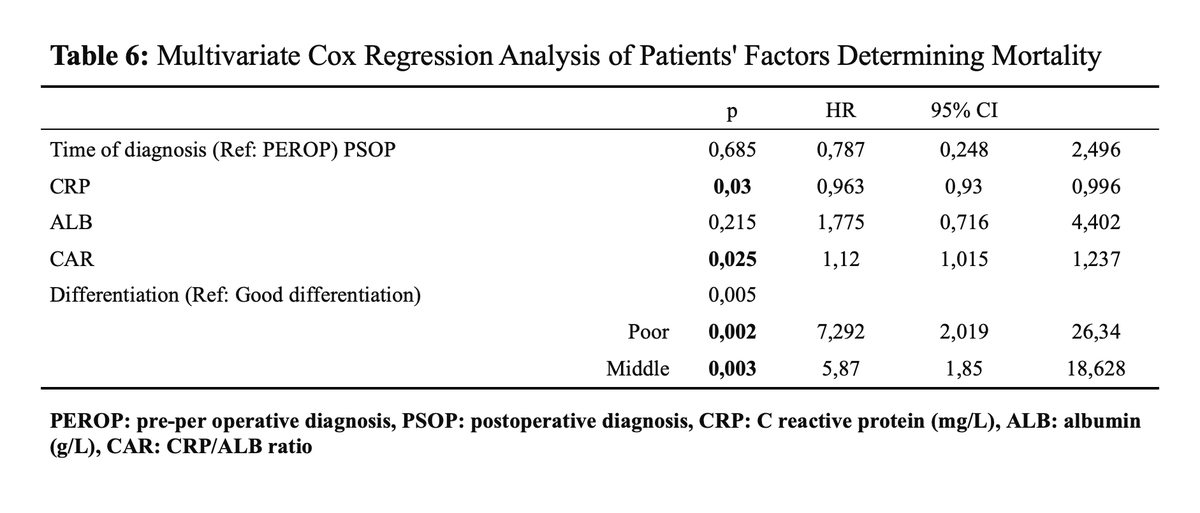
Roughly three quarters of the patients (73.8%) were female; the mean age of the cohort was 65.6±11.9 years (range: 24–93 years). About one third (29.2%) of the patients were diagnosed preoperatively. A statistically significant difference between the groups was detected in terms of priority treatment, tumor differentiation, tumor dimensions, and ALP results. Poor differentiation, high T stage, and high CEA and GGT values were statistically significantly different in the patients who died. Based on univariate analysis, we found that CRP, elevated CAR, low and moderate differentiation, T2, T3, and T4 were all risk factors. On the other hand, elevated ALB was determined to be a protective factor.
Conclusions:
The detection of advanced T stage and poor differentiation affect diagnosis and survival, although the correlations are not statistically significant.
Gallbladder cancer (GBC) is an aggressive cancer with a poor prognosis and an often-asymptomatic course. Here, we investigated the effect of GBC diagnosis time on prognosis and survival.
Material and methods:
Sixty-five patients diagnosed with GBC between January 1, 2016, and June 30, 2023, were evaluated for age, gender, laboratory parameters, treatment, diagnosis time, follow-up, survival, and pathological results. Estimated life expectancy and survival rate were calculated, and demographic findings, imaging, pathology, and laboratory results were compared as a function of survival and diagnostic time.
Results:
Roughly three quarters of the patients (73.8%) were female; the mean age of the cohort was 65.6±11.9 years (range: 24–93 years). About one third (29.2%) of the patients were diagnosed preoperatively. A statistically significant difference between the groups was detected in terms of priority treatment, tumor differentiation, tumor dimensions, and ALP results. Poor differentiation, high T stage, and high CEA and GGT values were statistically significantly different in the patients who died. Based on univariate analysis, we found that CRP, elevated CAR, low and moderate differentiation, T2, T3, and T4 were all risk factors. On the other hand, elevated ALB was determined to be a protective factor.
Conclusions:
The detection of advanced T stage and poor differentiation affect diagnosis and survival, although the correlations are not statistically significant.
Share
RELATED ARTICLE
| eISSN: | 1896-9151 |
| ISSN: | 1734-1922 |

We process personal data collected when visiting the website. The function of obtaining information about users and their behavior is carried out by voluntarily entered information in forms and saving cookies in end devices. Data, including cookies, are used to provide services, improve the user experience and to analyze the traffic in accordance with the Privacy policy. Data are also collected and processed by Google Analytics tool (more).
You can change cookies settings in your browser. Restricted use of cookies in the browser configuration may affect some functionalities of the website.
You can change cookies settings in your browser. Restricted use of cookies in the browser configuration may affect some functionalities of the website.