Current issue
Archive
Manuscripts accepted
About the Journal
Editorial office
Editorial board
Section Editors
Abstracting and indexing
Subscription
Contact
Ethical standards and procedures
Most read articles
Instructions for authors
Article Processing Charge (APC)
Regulations of paying article processing charge (APC)


HEPATOLOGY / RESEARCH PAPER
Metabolic Insights into Non-Alcoholic Fatty Liver Disease: Impact of Gut Microbiota and TCM Constitutions
1
Preventive Treatment Department, Changzhou Traditional Chinese Medicine Hospital Affiliated to Nanjing University of Chinese Medicine, China
2
Department of Science and Education, Wujin Traditional Chinese Medicine Hospital, China
3
Department of Clinical Nutrition, Academy of Health and Rehabilitation, Academy of Acupuncture and Tuina, Nanjing University of Chinese Medicine, China
4
First Clinical Medical College, Nanjing University of Chinese Medicine, China
Submission date: 2025-06-03
Final revision date: 2025-08-02
Acceptance date: 2025-09-12
Online publication date: 2026-02-08
Corresponding author
KEYWORDS
Gut MicrobiotaNon-Alcoholic Fatty Liver DiseaseMetabolic PathwaysPersonalized TreatmentTraditional Chinese Medicine Constitution16S rRNA Sequencing
TOPICS
ABSTRACT
Introduction:
Metabolic dysfunction-associated steatotic liver disease (MASLD) is intricately linked to gut microbiota dysbiosis and is influenced by Traditional Chinese Medicine (TCM) constitution theory. This study explores the fecal microbiota composition in MASLD patients with varied TCM constitutions to unravel the molecular mechanisms underlying the disease.
Material and methods:
In this study, 51 MASLD patients and 46 healthy controls were classified into seven TCM constitution groups based on high-throughput sequencing of fecal samples. Analyses were conducted to compare microbial communities, metabolite profiles, and metabolic pathways among these constitution groups. The relationships between specific microbiota and biochemical indicators were evaluated using LEfSe and Spearman correlation analyses.
Results:
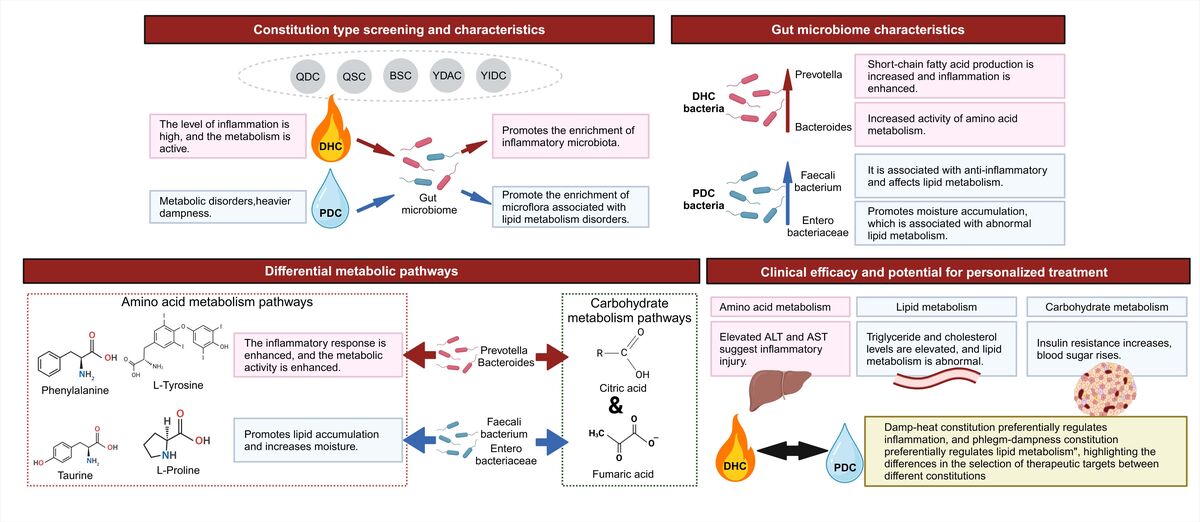
MASLD patients exhibited reduced fecal microbiota diversity compared to healthy controls, with significant variations in microbial structure among TCM constitution groups. The damp-heat constitution (DHC) and phlegm-dampness constitution (PDC) groups displayed enriched populations of specific microbial species, distinct bacterial taxa, and unique metabolite profiles. Multiple significant pathways related to amino acid, fatty acid, and carbohydrate metabolism were identified through metabolic pathway enrichment analysis. Significant correlations were observed between specific microbial taxa and biochemical indicators such as triglycerides, total cholesterol, alanine aminotransferase (ALT), and aspartate aminotransferase (AST).
Conclusions:
This study highlights the close association between alterations in gut microbiota, TCM constitution differences, and MASLD progression. The findings suggest that changes in microbial diversity and metabolite profiles may play a crucial role in MASLD pathogenesis. The identification of constitution-specific microbial variations provides promising targets for personalized interventions and treatment strategies for MASLD.
Metabolic dysfunction-associated steatotic liver disease (MASLD) is intricately linked to gut microbiota dysbiosis and is influenced by Traditional Chinese Medicine (TCM) constitution theory. This study explores the fecal microbiota composition in MASLD patients with varied TCM constitutions to unravel the molecular mechanisms underlying the disease.
Material and methods:
In this study, 51 MASLD patients and 46 healthy controls were classified into seven TCM constitution groups based on high-throughput sequencing of fecal samples. Analyses were conducted to compare microbial communities, metabolite profiles, and metabolic pathways among these constitution groups. The relationships between specific microbiota and biochemical indicators were evaluated using LEfSe and Spearman correlation analyses.
Results:
MASLD patients exhibited reduced fecal microbiota diversity compared to healthy controls, with significant variations in microbial structure among TCM constitution groups. The damp-heat constitution (DHC) and phlegm-dampness constitution (PDC) groups displayed enriched populations of specific microbial species, distinct bacterial taxa, and unique metabolite profiles. Multiple significant pathways related to amino acid, fatty acid, and carbohydrate metabolism were identified through metabolic pathway enrichment analysis. Significant correlations were observed between specific microbial taxa and biochemical indicators such as triglycerides, total cholesterol, alanine aminotransferase (ALT), and aspartate aminotransferase (AST).
Conclusions:
This study highlights the close association between alterations in gut microbiota, TCM constitution differences, and MASLD progression. The findings suggest that changes in microbial diversity and metabolite profiles may play a crucial role in MASLD pathogenesis. The identification of constitution-specific microbial variations provides promising targets for personalized interventions and treatment strategies for MASLD.
| eISSN: | 1896-9151 |
| ISSN: | 1734-1922 |

We process personal data collected when visiting the website. The function of obtaining information about users and their behavior is carried out by voluntarily entered information in forms and saving cookies in end devices. Data, including cookies, are used to provide services, improve the user experience and to analyze the traffic in accordance with the Privacy policy. Data are also collected and processed by Google Analytics tool (more).
You can change cookies settings in your browser. Restricted use of cookies in the browser configuration may affect some functionalities of the website.
You can change cookies settings in your browser. Restricted use of cookies in the browser configuration may affect some functionalities of the website.
