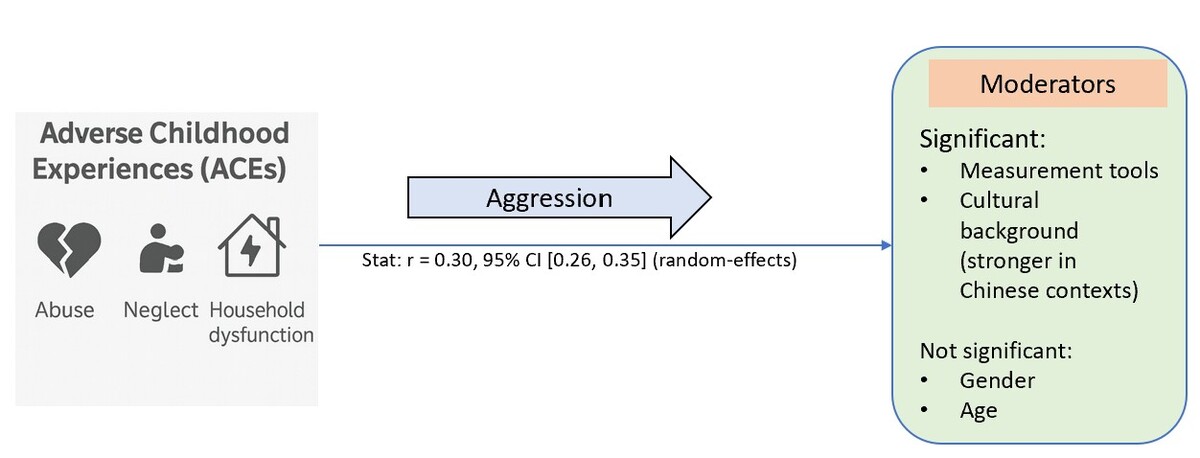
Adverse childhood experiences (ACEs), including abuse, neglect, and dysfunction in the household, are now widely recognized as major influences on mental well-being and behavior throughout life [1]. Research on ACEs, particularly those occurring prior to turning 18, and their adverse consequences is well documented in various research papers [2]. Studies demonstrate that people exposed to them are at increased risk of negative consequences, including aggression [3]. Aggression can manifest itself physically, verbally, or emotionally and is influenced by many different influences, such as family members, personal factors, and environmental conditions [4].
Aggressive behavior is shaped by complex factors. The General Aggression Model suggests that various situations can trigger aggression by altering internal states [5]. ACEs – including physical, emotional, and sexual abuse, neglect, and household dysfunction – are major influences, with studies showing that exposure before the age of 18 increases aggressive behavior [6]. General strain theory further explains that stress and pressure increase the likelihood of aggression [7]. Research links ACEs to higher stress, reduced security and happiness, and stronger associations with violent crime and intimate partner aggression [8].
Recent studies on ACEs and aggressive behavior highlight multiple influencing factors [9]. The impact of ACEs may vary by personal attributes (race, gender, age) and environmental contexts (family functioning, cultural background) [10]. Evidence underscores the need for multidisciplinary efforts to address ACEs and their long-term effects on mental and behavioral health [11]. Research also shows that measurement tools shape findings, as some focus on specific abuses while others include broader dysfunction and neglect, emphasizing the importance of reliable instruments that capture all forms of ACEs.
Though some studies have explored the roles that gender, age, and family interactions play in mitigating the effects of ACEs on aggression [12], no clear agreement has been reached regarding their magnitude and direction of influence. Further, culture’s impact is still not fully appreciated, although evidence indicates it plays a substantial role in shaping how individuals respond to negative situations. This study seeks to fill any gaps by conducting an in-depth review of research concerning ACEs and aggression, paying particular attention to any moderating effects such as age, gender measurement tools, or cultural context. By synthesizing data from numerous studies through meta-analysis we hope to gain more insight into which elements influence this relationship while highlighting areas for additional investigation. Therefore, this study addresses to what extent ACEs influence aggressive behavior, and how these effects are moderated by individual characteristics (age, gender), measurement tools, and cultural context. Thus, this study aims to systematically investigate the relationship between ACEs and aggressive behavior, with a specific focus on understanding how various moderating factors and cultural influences affect this relationship. Notably, primary evidence remains sparse for several regions (e.g., Sub-Saharan Africa, South Asia beyond India, Latin America). We therefore examine cultural moderation and explicitly highlight the need for replication in underrepresented populations.
Drawing on the above theoretical and empirical insights, this study proposes the following hypotheses regarding the direct association between ACEs and aggressive behavior and the moderating roles of gender, age, measurement tools, and cultural background.
H1: There is a significant positive correlation between ACEs and aggressive behavior.
H2: Gender can moderate the relationship between ACEs and aggressive behavior.
H3: Age moderates the relationship between ACEs and aggressive behavior.
H4: ACEs measurement tools play a moderating role in the relationship between ACEs and aggressive behavior.
H5: The cultural background of the study sample moderates the relationship between ACEs and aggressive behavior.
This study contributes to the ACEs–aggression literature in three ways. First, the meta-analysis provides a precise and comprehensive estimate of their relationship, addressing prior inconsistencies. Second, it systematically examines the moderating effects of gender, age, and cultural background, providing new insights. Ultimately, it highlights the importance of cultural influences in guiding more culturally sensitive prevention and intervention strategies.
Research methodology
Literature search and screening
A comprehensive search was conducted in CNKI and Wanfang (Chinese) and in Web of Science, Scopus, ERIC, ProQuest, and Springer (English) using keywords related to ACEs, child trauma, abuse, neglect, and aggression. The search covered the period from January 2013 to December 2023, yielding 1,421 records. Inclusion criteria required peer-reviewed empirical studies reporting correlation coefficients (or convertible statistics) between ACEs and aggression with clear sample sizes. After screening and verification, 24 articles met the criteria (Supplementary Figure S1).
Meta-analysis process
Each study was coded for author, year, sample size, average age (median used if only a range was given), ACEs and aggression measurement tools, and female ratio. When multiple aggression types (e.g., verbal, physical) were reported, they were coded separately.
Effect size
Of the 24 studies, 22 reported correlation coefficients, while two reported standardized regression coefficients; these were converted to correlation coefficients using the formulas r = 0.98β + 0.05 (for β ≥ 0) and r = 0.98β (for β < 0). Final study details are presented in Supplementary Table SI.
Model selection and heterogeneity test
Meta-analysis used fixed- and random-effects models. The fixed-effect model assumes a common true effect size, while the random-effects model accounts for variation across studies.
Publication bias
Publication bias was assessed using funnel plots, Egger’s test, Begg’s test, and p-curve analysis. Funnel plots illustrate effect size against sample size, with symmetry in the upper half suggesting no bias. In Egger’s test, non-significant regression results (p > 0.05) indicate no serious bias. In p-curve analysis, right-skewed p-values (more between 0–0.025 than 0.025–0.05) suggest true effects, while the opposite indicates potential bias (Supplementary Figures S2, S3).
Results
Heterogeneity test
A heterogeneity test was conducted on the study. The results showed that the Q test result was 784.95 (df = 27, p < 0.001), and I2 was 96.56%, indicating high heterogeneity. This indicates that 96.56% of the variation in the relationship between ACEs and aggressive behavior was due to the true effect size (Supplementary Table SII). Therefore, based on the results of the heterogeneity test, it is more appropriate to use the random-effects model in the subsequent analysis.
Main effect test
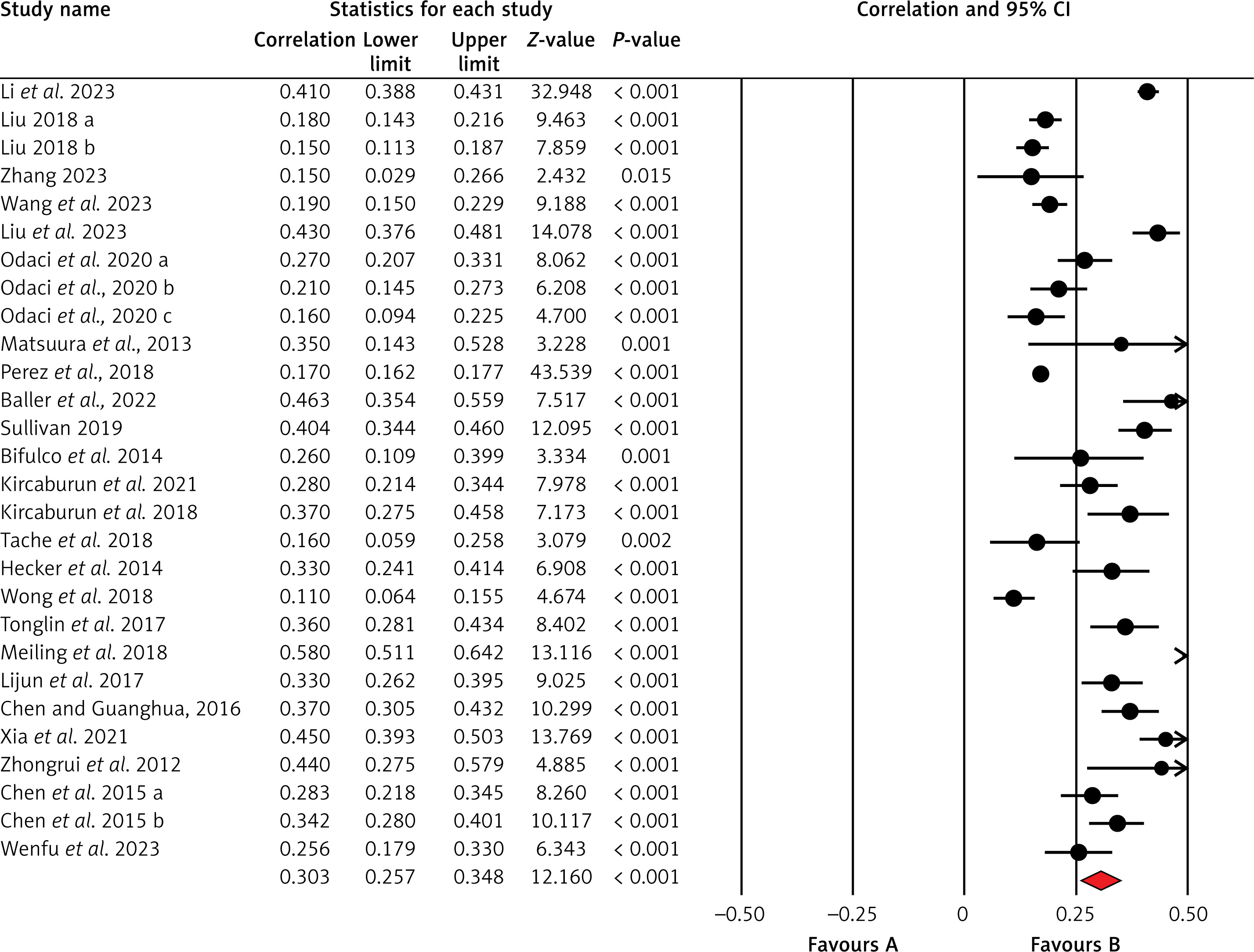
The random-effects model was used to explore the overall correlation between ACEs and aggressive behavior comprehensively. The results are shown in Supplementary Table SIII. The overall correlation coefficient between the two is 0.3, with a 95% confidence interval of [0.26, 0.35].
Figure 1 presents the forest plot summarizing the distribution of effect sizes. A “leave-one-out analysis” was conducted to assess the sensitivity of the effect size. The results showed that the correlation coefficient r fluctuated between 0.29 and 0.30 after excluding any single sample, indicating that the effect size in this study has good stability.
Analysis of regulatory effects
The results of the moderation effect analysis (Table I) indicate that gender does not have a significant moderating effect on the relationship between ACEs and aggressive behavior. The meta-analysis results show that the female ratio did not significantly predict the relationship between the two variables (b = 0.11, Z = 0.75, p > 0.05). Similarly, the subject group does not significantly moderate the relationship between ACEs and aggressive behavior. The subgroup analysis reveals that the correlation coefficients measured using ACEQ and CPANS (Childhood Psychosocial Adversity and Neglect Scale) are higher, whereas those measured using other scales are lower. Furthermore, cultural background, whether domestic or foreign, significantly moderates the relationship between ACEs and aggressive behavior. Given the sample distribution (majority from China), the present estimates are most directly generalizable to East-Asian/Chinese contexts. The subgroup analysis shows that the QB_BB value is 7.29, p < 0.05. A comparison of effect sizes reveals that the relationship between ACEs and aggressive behavior is stronger within the Chinese cultural context, with a higher degree of correlation than in other cultural contexts.
Table I
Test of the moderating effect of relevant factors on the relationship between ACEs and aggressive behavior
Discussion
The relationship between ACEs and aggressive behavior
The analysis confirmed a significant positive correlation between ACEs and aggressive behavior, indicating that childhood adversities – such as abuse, neglect, and household dysfunction – have enduring psychological and emotional impacts that heighten aggression [13]. These results align with the General Aggression Model, which explains how repeated trauma alters emotional regulation and cognitive schemas, increasing aggressive tendencies [14]. Stronger correlations in certain cultures suggest that social norms and appraisals shape responses to adversity. Importantly, ACEs influence both short- and long-term behavioral patterns, making aggression a common coping mechanism in stressful interactions [15]. Interventions such as supportive family environments, emotional regulation training, and early identification of high-risk children can help mitigate these effects, reducing aggression and alleviating burdens on mental health and social services.
Moderator variables of the relationship between ACEs and aggressive behavior
The meta-analysis found that gender did not significantly moderate the ACEs–aggression relationship. This suggests that although males and females may differ in socialized behavior, the pervasive effects of ACEs appear to outweigh potential gender differences [16]. Methodological issues – such as small sample sizes or inadequate measurement tools – may also explain the absence of significant effects. Prevention strategies should therefore target all children exposed to ACEs, while future research should refine designs and expand samples to better capture possible gender influences [17].
Similarly, age was not a significant moderator, indicating that the link between ACEs and aggression is consistent across children, adolescents, and adults [18]. This consistency underscores the need for broad, inclusive prevention and intervention strategies. The null findings may again reflect methodological weaknesses, highlighting the importance of larger, more diverse samples and improved tools [9]. Additionally, this research emphasizes the significance of taking an inclusive approach when devising mental health and behavioral intervention strategies to address behavioral issues caused by negative childhood experiences, thus helping more broadly across populations. In contrast, measurement instruments had a decisive moderating effect. Tools focusing on physical abuse versus those including neglect or psychological abuse yielded different outcomes, showing how questionnaire design, content, and response scales can shape findings [19]. Reliable, comprehensive instruments are therefore critical to accurately capturing the breadth of ACEs and their behavioral consequences [20].
Research gaps and prospects
This study identified two noteworthy influences of culture on the moderating process, highlighting its significance in explaining ACEs-induced aggressive behaviors. However, the underlying cultural mechanisms remain unclear, necessitating further exploration of factors such as family structures and support systems that may shape coping strategies. Furthermore, this study relies on preexisting literature, which could be biased when published. Future studies may opt for registered reports to ensure more transparency and consistency in research. All these flaws serve as guidelines for future investigations to increase our knowledge of how ACEs contribute to aggression and develop more effective interventions.
In conclusion, this meta-analysis confirms a significant positive link between ACEs and aggressive behavior, showing that childhood abuse, neglect, and household dysfunction have enduring impacts. While cultural background moderates the ACEs–aggression association, current evidence is most applicable to Chinese/East-Asian samples; targeted research in additional populations is required to fill the remaining gap. In contrast, gender and age were not significant moderators, suggesting that the ACEs–aggression link is consistent across demographics and that prevention strategies should be broadly inclusive. Measurement tools also shaped outcomes, highlighting the need for standardized, validated instruments. Overall, this meta-analysis advances both scholarly and practical understanding by clarifying how cultural, methodological, and familial factors shape the ACEs–aggression relationship. Future research should investigate cultural mechanisms in more depth, adopt larger and more diverse samples, refine measurement tools, and address publication bias.