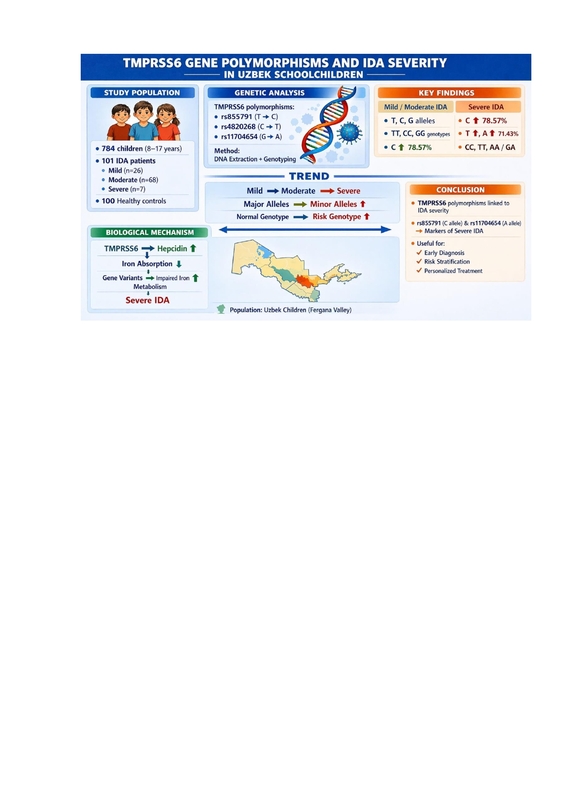
Iron deficiency anemia (IDA) is one of the most common nutritional disorders worldwide and is particularly prevalent among children, where/in whom it may impair cognitive development, physical performance, and immune function [1, 2]. Although nutritional deficiency remains the primary cause, genetic factors also contribute to variability in iron metabolism and disease severity. The TMPRSS6 gene plays a key role in regulating hepcidin expression, and its polymorphisms have been associated with altered iron status [3]. Previous studies have demonstrated interethnic differences in TMPRSS6 variants and their association with iron-related biomarkers [4].
However, data on TMPRSS6 gene polymorphisms in Central Asian pediatric populations remain limited. In particular, there is insufficient information regarding the distribution of these variants and their association with the severity of IDA among Uzbek schoolchildren. This study provides novel evidence on the relationship between TMPRSS6 polymorphisms (rs855791, rs4820268, and rs11704654) and the clinical severity of iron deficiency anemia. By analyzing allele and genotype distributions across different severity groups, the study highlights a potential role of these variants in disease progression. These findings help address an important regional data gap and may support the development of population-specific approaches for early risk assessment and prevention of IDA.
Methods
Study design and participants
This case-control study was conducted in the Fergana Valley region (Fergana, Andijan, and Namangan). A total of 784 schoolchildren were initially screened for iron deficiency, from which 101 children diagnosed with IDA were selectively enrolled for molecular-genetic analysis. Additionally, 100 age-matched healthy children with no clinical or laboratory evidence of anemia were included as a control group. The final cohort of 201 participants was stratified by IDA severity using standard WHO-aligned criteria: mild (Hb 90–110 g/l), moderate (Hb 70–89 g/l), and severe (Hb < 70 g/l).
Clinical and laboratory assessment
Peripheral blood samples were collected under standardized conditions. Hemoglobin concentration and erythrocyte indices were measured using routine laboratory methods.
DNA extraction and genotyping
Genomic DNA was extracted from peripheral blood leukocytes using standard procedures. Three TMPRSS6 gene polymorphisms (rs855791, rs4820268, and rs11704654) were genotyped using established molecular techniques.
Statistical analysis
Allele and genotype frequencies were calculated as percentages. Differences between groups were assessed using the chi-square (χ2) test for categorical variables. Fisher’s exact test was applied when expected cell counts were small. Comparisons of genotype distributions across anemia severity groups were also performed using the χ2 test.
The association between TMPRSS6 polymorphisms and anemia severity was evaluated using odds ratios (ORs) with 95% confidence intervals (95% CI). Statistical analyses were performed using SPSS software (version 22.0, IBM Corp., USA). All tests were two-sided, and a p-value < 0.05 was considered statistically significant.
Results
A total of 201 children were included, comprising 101 patients with IDA and 100 healthy controls. Among IDA cases, 25.7% were mild, 67.3% moderate, and 6.9% severe.
The rs855791 polymorphism showed a significant association with anemia severity (Table I). The T allele predominated in mild and moderate anemia, whereas the frequency of the C allele increased markedly in severe cases (78.57%) (p < 0.01). The CC genotype was observed predominantly in severe anemia, while the TT genotype was more common in mild and moderate groups.
Table I
Allele and genotype frequencies of the TMPRSS6 c.2207T>C (rs855791) polymorphism in children with different severity of iron deficiency anemia
Overall, these findings indicate a shift in allele and genotype distribution with increasing severity of iron deficiency anemia.
Analysis of the TMPRSS6 rs855791 (c.2207T>C) polymorphism showed that the T allele predominated in mild and moderate iron deficiency anemia, whereas the frequency of the C allele increased markedly in severe cases (p < 0.01). No significant differences were observed between mild and moderate groups (p > 0.05).
Genotype analysis indicated that the TT genotype was more common in mild and moderate anemia, whereas the CC genotype predominated in severe cases, suggesting a potential association with increased disease severity.
Analysis of the TMPRSS6 rs4820268 (c.1536C>T) polymorphism demonstrated that the C allele predominated in the total IDA group (83.16%) and in children with mild (88.46%) and moderate anemia (87.50%). In contrast, the frequency of the T allele increased markedly in severe anemia, reaching 78.57%.
Genotype analysis showed that the CC genotype was the most common in the total IDA group (71.28%) and predominated in children with mild (76.92%) and moderate anemia (76.47%), whereas it was absent in severe cases. The heterozygous CT genotype was observed with similar frequency in children with mild and moderate anemia but increased in severe cases (42.86%). Notably, the TT genotype was rare in children with mild (0%) and moderate anemia (1.47%) but was predominantly detected in children with severe anemia (57.14%).
These findings indicate a shift in allele and genotype distribution with increasing severity of iron deficiency anemia, suggesting a potential association of the T allele and TT genotype with severe disease.
Analysis of the TMPRSS6 rs11704654 (c.72G>A) polymorphism showed that the G allele predominated in the total IDA group (91.58%) and in children with mild (96.15%) and moderate anemia (96.32%). In contrast, the frequency of the A allele increased markedly in children with severe anemia, reaching 71.43%.
Genotype analysis demonstrated that the GG genotype was most common in the total IDA group (86.14%) and predominated in children with mild (92.31%) and moderate anemia (92.65%), whereas it was absent in severe cases. The heterozygous GA genotype was observed with low frequency in children with mild (7.69%) and moderate anemia (7.35%) but increased substantially in children with severe anemia (57.14%). Similarly, the AA genotype was not detected in children with mild and moderate anemia but was present in 42.86% of severe cases.
These findings indicate a pronounced shift in allele and genotype distribution with increasing severity of iron deficiency anemia, suggesting that the A allele and AA genotype may be associated with severe disease.
The distribution of allele and genotype frequencies of TMPRSS6 polymorphisms across different severity levels of iron deficiency anemia is presented in Figure 1.
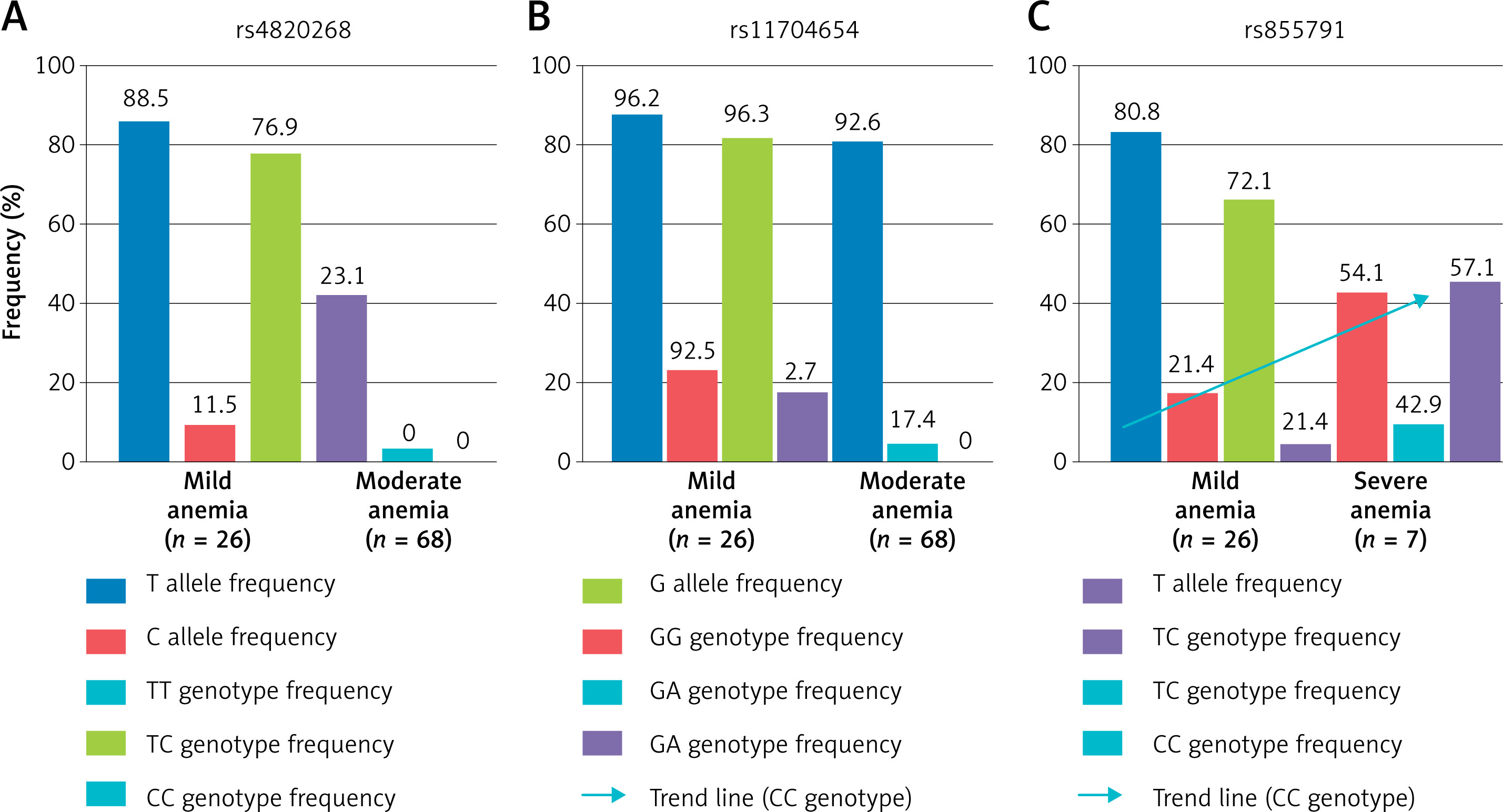
As shown in Figure 1, clear differences in allele and genotype distributions of TMPRSS6 polymorphisms were observed across anemia severity groups. Major alleles predominated in children with mild and moderate anemia, whereas severe cases were characterized by an increased frequency of minor alleles. A corresponding shift from homozygous major genotypes to heterozygous and homozygous minor genotypes was observed with increasing disease severity.
Discussion
The present study demonstrates a clear association between TMPRSS6 gene polymorphisms and the severity of iron deficiency anemia (IDA) in Uzbek schoolchildren. A progressive shift in allele and genotype distributions was observed across all analyzed variants, indicating a potential genetic contribution to disease severity.
For the rs855791 polymorphism, the C allele frequency increased markedly in severe anemia, whereas the TT genotype predominated in mild and moderate cases. This finding is consistent with previous studies reporting the involvement of TMPRSS6 variants in altered iron metabolism and iron deficiency anemia across different populations [5–7].
Similar patterns were observed for rs4820268 and rs11704654 polymorphisms, where minor alleles and homozygous mutant genotypes were predominantly detected in severe anemia. These results are in agreement with earlier molecular and clinical studies demonstrating that TMPRSS6 variants may contribute to iron-refractory phenotypes and influence disease expression [8–10].
From a biological perspective, TMPRSS6 plays a key role in regulating hepcidin expression, thereby controlling iron absorption and systemic iron distribution. Functional and clinical studies suggest that genetic variations in this gene may lead to dysregulation of iron metabolism, which could explain the increased prevalence of risk alleles in severe IDA cases [8, 9].
The findings of this study expand existing evidence by providing data from a Central Asian pediatric population, where genetic determinants of iron deficiency remain insufficiently explored. The consistent allele shifts observed across multiple polymorphisms support the role of TMPRSS6 in determining clinical severity of IDA.
Several limitations should be acknowledged. The sample size of the severe anemia subgroup was relatively small, which may limit statistical power. In addition, environmental, nutritional, and socioeconomic factors influencing iron status were not fully assessed.
In conclusion, TMPRSS6 polymorphisms are associated with increasing severity of iron deficiency anemia, and the presence of risk genotypes may contribute to disease progression. These findings suggest potential implications for genetic risk stratification and targeted management strategies in pediatric populations [11, 12].
The present study demonstrates a significant association between TMPRSS6 gene polymorphisms and the severity of iron deficiency anemia in Uzbek schoolchildren. A progressive increase in minor allele frequencies and homozygous risk genotypes was observed with increasing disease severity, suggesting a potential role of these variants in impaired iron metabolism.
These findings highlight the potential value of TMPRSS6 polymorphisms as genetic markers for early risk stratification and targeted management of iron deficiency anemia in pediatric populations. Further large-scale studies are required to confirm these results.