Low-density lipoprotein cholesterol (LDL-C) is a predominant risk factor for atherosclerotic cardiovascular disease (ASCVD) [1]. The lower the LDL-C remains for a longer period of time, the better the ASCVD outcomes. Contrary to exaggerated claims, statins, the cornerstone of lipid-lowering therapy (LLT), cause symptomatic adverse events in roughly 1–2% of patients treated for 5 years [2]. Beyond muscle outcomes and diabetes, only 4 of 66 undesirable effects listed in product labels are attributable to statins [3]. Nonetheless, almost 1 in 10 patients is intolerant to statins [4], primarily due to statin-associated muscle symptoms (SAMS), which lead to severe pain in 43% of affected individuals [5]. Given that 76% of statin-intolerant patients do not achieve the recommended LDL-C targets, well-tolerated non-statin LLTs are necessary to reduce LDL-C levels and ASCVD risk in this challenging population [6]. Bempedoic acid was introduced as an add-on to ezetimibe and proprotein convertase subtilisin kexin type 9 (PCSK9) inhibitors in patients at high ASCVD risk who are unable or unwilling to take statins [7].
Here, we describe a practical approach to the utilization of bempedoic acid in the treatment of a high-risk primary-prevention patient unable to take statins.
A 52-year-old female was referred to the outpatient lipid clinic due to suspected familial hypercholesterolemia and statin intolerance. The initial, fasting, off-treatment lipid profile showed total cholesterol of 370 mg/dl (≈9.6 mmol/l), non-high-density lipoprotein cholesterol of 293 mg/dl (≈7.6 mmol/l), calculated LDL-C of 268 mg/dl (≈6.9 mmol/l), high-density lipoprotein cholesterol of 77 mg/dl (≈2.0 mmol/l), and triglycerides (TG) of 126 mg/dl (≈1.4 mmol/l). The patient had a history of hypothyroidism, which was excluded as a cause of secondary hypercholesterolemia, given that the euthyroid state was restored with levothyroxine 25 µg. The patient was optimally treated for arterial hypertension with a single-pill combination of perindopril 2.5 mg and amlodipine 2.5 mg. Other modifiable ASCVD risk factors were not found, as the patient had normal glycated hemoglobin, normal kidney function, and no history of tobacco consumption. Carotid ultrasound revealed bilateral non-stenotic atherosclerotic plaques. Coronary computed tomography angiography demonstrated the coronary artery calcium score of zero. The patient presented no symptoms or signs of ASCVD, had no further medical history, was physically active, followed a healthy dietary pattern, displayed a body mass index of 22 kg/m2, high-sensitivity C-reactive protein (hs-CRP) of < 1 mg/l, and lipoprotein (a) [Lp(a)] of 9 mg/dl (≈19.4 nmol/l). Upon consideration of psychosocial and female-specific conditions, a history of premature ASCVD in both parents was identified as the only risk-enhancing factor, as per the 2025 Focused Update of the 2019 European Society of Cardiology and European Atherosclerosis Society (ESC/EAS) guidelines for the management of dyslipidemias [8].
Given the history of premature ASCVD in first-degree relatives and the LDL-C of 268 mg/dl (≈6.9 mmol/l), the patient received 7 points in the Dutch Lipid Clinic Network Score. As no pathogenic variants in LDLR, APOB, and PCSK9 genes were detected using next-generation sequencing, and no large rearrangements in the LDLR gene were found using multiplex ligation-dependent probe amplification, the probable diagnosis of familial hypercholesterolemia could not be confirmed. Considering markedly elevated LDL-C > 190 mg/dl (> 4.9 mmol/l) in the absence of ASCVD history, significant plaques (> 50% stenosis), or other major risk factors, the patient was classified into the high ASCVD risk category, as per the updated ESC/EAS guidelines [8]. The LDL-C goal was set at < 70 mg/dl (< 1.8 mmol/l), including ≥ 50% LDL-C reduction from baseline, and posing the need for drug intervention alongside lifestyle modifications. The patient was encouraged to maintain her current body weight and to continue her regular exercise with 30–60 min of moderate-intensity physical activity per day. The patient was advised to focus on whole-grain products, vegetables, and fish, to increase dietary fiber intake, and to avoid trans and saturated fats. Reduction in alcohol and carbohydrate intake was recommended to reach the optimal TG levels of < 100 mg/dl (< 1.2 mmol/l).
The patient had been previously placed on atorvastatin 10 mg, followed by rosuvastatin 5 mg. Anamnestically, shortly after initiating both treatment regimens, the patient experienced mild creatine kinase elevations, accompanied by bilateral pain in the calves and the proximal muscles of the upper limbs, which improved within days after statin discontinuation. As the patient received 10 points in the Statin-Associated Muscle Symptom Clinical Index (SAMS-CI), myalgia was probably induced by statins. Nonetheless, these findings were not properly documented by the referring physician, thus were interpreted with caution, precluding a definite diagnosis of complete statin intolerance. Repeated screening revealed no modifiable risk factors for SAMS. The patient was informed about the rationale for statin therapy, given her markedly elevated LDL-C and family history of premature ASCVD. In shared decision-making, the patient rejected a suggested rechallenge with a low-dose statin, e.g., pitavastatin 1 mg, in non-daily dosing. While considering non-statin LLTs, the patient reported a history of diarrhea, flatulence, and abdominal pain during the second-line treatment with ezetimibe 10 mg. In Poland, PCSK9 inhibitors are accessible in the B101 drug reimbursement program, dedicated to patients with familial hypercholesterolemia and those at very high or extreme ASCVD risk. As the patient did not meet the inclusion criteria, PCSK9 inhibitors remained unavailable for financial reasons. Thereby, a monotherapy with bempedoic acid 180 mg daily was initiated.
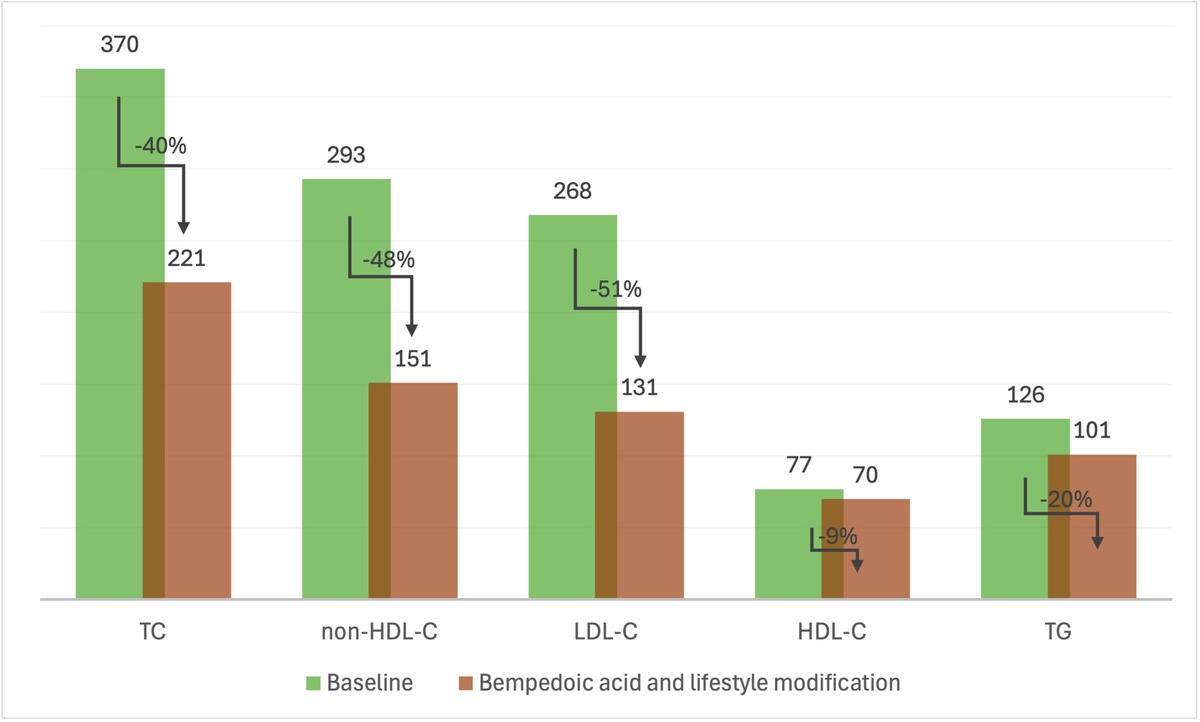
At 12-week follow-up, the patient implemented the suggested moderate dietary modifications, filled the prescription, claimed to adhere to the treatment regimen, and reported no adverse reactions related to bempedoic acid. No abnormalities in hemoglobin, creatinine, glomerular filtration rate, uric acid, or hepatic enzymes occurred. When measured at the same laboratory using the same method and fasting samples, calculated LDL-C decreased by 51% to 131 mg/dl (3.4 mmol/l) and TG decreased by 20% to 101 mg/dl (1.1 mmol/l). Lipid profile changes are summarized in Figure 1. As the patient did not achieve the LDL-C goal of < 70 mg/dl (< 1.8 mmol/l), the importance of ASCVD risk reduction and the need for LLT intensification were thoroughly discussed. The patient did not consent to statin or ezetimibe rechallenge, thus was advised to pursue a healthy lifestyle and bempedoic acid monotherapy. Follow-up appointments were scheduled every 6 months to monitor the lipid profile, atherosclerosis progression, and treatment adherence, as well as to reassess reimbursement options for PCSK9 inhibitors and possible indications for lipoprotein apheresis. The management algorithm is summarized in Table I.
Figure 1
Lipid profile changes. Lipid levels [mg/dl] at baseline and at week 12 of bempedoic acid monotherapy and lifestyle modifications
HDL-C – high-density lipoprotein cholesterol, LDL-C – lowdensity lipoprotein cholesterol, non-HDL-C – non-highdensity lipoprotein cholesterol, TC – total cholesterol, TG – triglycerides.
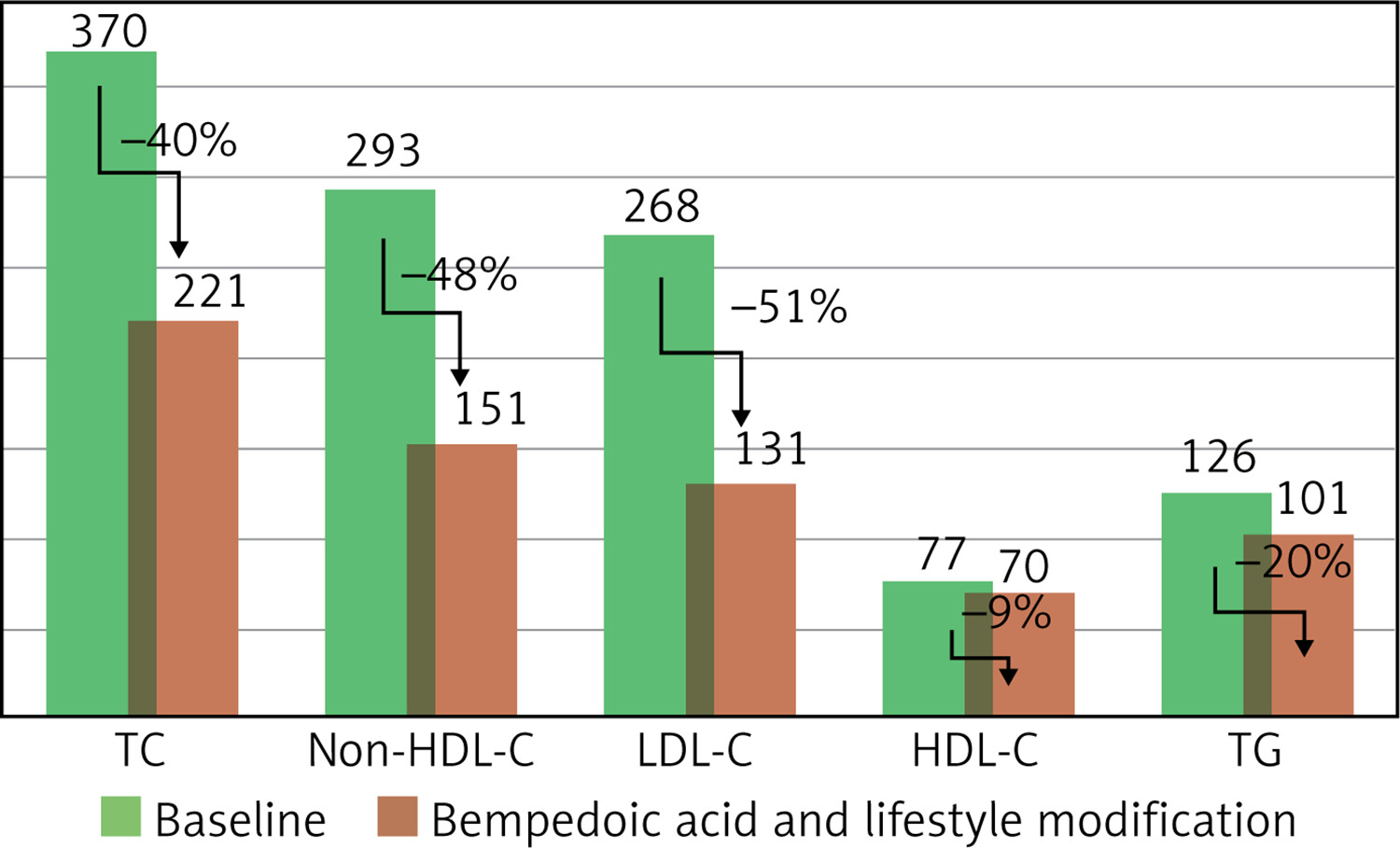
Table I
Management algorithm
[i] ALT – alanine aminotransferase, ASCVD – atherosclerotic cardiovascular disease, CK – creatine kinase, hs-CRP – high-sensitivity C-reactive protein, LDL-C – low-density lipoprotein cholesterol, Lp(a) – lipoprotein(a), PCSK9 mAb – proprotein convertase subtilisin kexin type 9 monoclonal antibody, SAMS – statin-associated muscle symptoms, SAMS-CI – Statin-Associated Muscle Symptom Clinical Index.
Patients exposed to widespread misinformation are likely to expect or misinterpret adverse events emerging during statin therapy [9]. Between 38% and 78% of SAMS may be explained by the drucebo effect [10]. Following careful, well-documented examination, the SAMS-CI can be applied to assess the causality of statin therapy. Non-pharmacological causes of adverse events must be discriminated from true statin intolerance. Proposed definitions of statin intolerance are summarized in Supplementary Table SI [11–15]. As advised by the International Lipid Expert Panel (ILEP), statin interruptions due to intolerable SAMS or elevations in creatine kinase or alanine aminotransferase should be limited to 2-6 weeks and followed by rechallenge [16]. Reversible risk factors for SAMS should be identified and addressed before statin initiation. Extensive education is advised to emphasize the benefits of statins, whereas intensified lifestyle measures might additionally reduce LDL-C. According to the ILEP and the National Lipid Association, to overcome SAMS, statins may be switched, used in a lower dose, or administered in alternate-day dosing [15, 16]. Although low-intensity statins decrease LDL-C, they may be insufficient to meet the recommended target values, particularly in high- and very-high-risk individuals. Concomitant use of non-statin LLTs improves the rates of LDL-C goal attainment without impairing the quality of life of statin-intolerant patients [17].
The updated ESC/EAS guidelines supported the concept of add-on non-statin LLTs with positive results of cardiovascular endpoint trials, i.e., ezetimibe, bempedoic acid, and/or PCSK9 monoclonal antibodies, to reduce LDL-C levels in patients unable to take statins, or unable to achieve the LDL-C goal on a maximally tolerated statin [8]. Selection of non-statin LLTs should be determined by required LDL-C reduction, patient preference, as well as treatment accessibility and expense. The updated ESC/EAS guidelines specifically recommended bempedoic acid to achieve the LDL-C goal in patients unable to take statins. The 2023 ILEP position paper additionally emphasized the possibility of using bempedoic acid in fixed-dose combination with ezetimibe or in combination with other non-statin LLTs [18]. Notably, the 2025 guidelines of the American Association of Clinical Endocrinology recommended bempedoic acid in addition to the usual care only in high- and very-high-risk adults with dyslipidemia and statin intolerance [19].
Bempedoic acid is an oral prodrug activated in hepatocytes by very-long-chain acyl-CoA synthetase-1 [7]. Its inactivity in skeletal muscles seems to minimize the risk of myotoxicity. While statins target 3-hydroxy-3-methylglutaryl-CoA reductase, the active metabolite of bempedoic acid inhibits adenosine triphosphate citrate lyase, and hence disrupts cholesterol biosynthesis at an earlier stage. In the CLEAR trial program, bempedoic acid decreased the mean LDL-C in statin-intolerant patients by 26.5% [20]. In a German real-world analysis, the mean LDL-C reduction attributable to bempedoic acid monotherapy reached 29.9%, yet the LDL-C-lowering effect was highly heterogeneous, ranging from 0% to over 80% [21]. Hyper-responsiveness, defined as > 50% LDL-C reduction, was described in even 25% of patients treated with bempedoic acid [22]. Female sex and lacking concomitant statin therapy were identified as predictors of ≥ 30% LDL-C reduction [23], which partially explains the strong response to bempedoic acid in the reported case. In addition to LDL-C, bempedoic acid reduces hs-CRP, a marker of systemic inflammation, but has no significant impact on TG and Lp(a) [7].
In the CLEAR Outcomes trial performed in statin-intolerant patients at high ASCVD risk or with pre-existing ASCVD, bempedoic acid reduced the rates of the primary endpoint, composed of cardiovascular death, nonfatal myocardial infarction, nonfatal stroke, or coronary revascularization by 13.3% compared to the placebo during the median follow-up of 40.6 months [24]. Larger benefit was observed in the subgroup of high-risk primary-prevention patients, as the relative risk reduction reached 30% [25]. Bempedoic acid was generally safe, although hepatic enzyme elevations (1.6% vs. 1.0%) and cholelithiasis (2.2.% vs. 1.2%) were more common in participants who received bempedoic acid compared to the placebo [26]. In patients treated for 6 months, the mean hemoglobin decreased by 0.36 ±0.85 mg/dl, yet the rates of anemia in both groups did not differ substantially (4.7% vs. 3.9%). Renal impairment (11.5% vs. 8.6%) was mostly pronounced as declines in glomerular filtration rate (3.6% vs. 2.9%). The mean creatinine increased minimally by 0.05 ±0.2 mg/dl and 0.07 ±0.2 mg/dl at months 6 and 36, respectively. Higher rates of hyperuricemia (10.9% vs. 5.6%) and gout (3.2% vs. 2.2%) were recorded mainly in patients with a history of gout or abnormal uric acid at baseline [26, 27]. In real-world settings, symptoms of gout and hepatic enzyme elevations > 3 times the upper limit of normal pose the need for bempedoic acid discontinuation [28].
In conclusion, patients unable to take statins require an individualized approach to guideline-recommended ASCVD prevention. The reported case illustrates the feasibility and tolerability of bempedoic acid when used alone to lower LDL-C in a high-risk patient unable to take statins.