The issue of parental anxiety that accompanies caregivers during the diagnostic process of a child is extremely important in the daily practice of a physician. Awareness of caregivers’ expectations, clear communication of medical information, and the communication skills of the paediatrician can contribute to reducing the level of this natural emotional reaction, whereas a misperception of the health problem by caregivers can intensify and reinforce their negative emotions, adversely affecting the child’s development and, secondarily, hindering contact with the physician [1, 2]. In spite of the prevalence of this problem, it is not discussed often enough in the literature, and there is a lack of studies on the emotional response of parents to referring their child for planned specialist diagnostics.
Detection of a heart murmur by a paediatrician and a diagnosis of mild intracardiac shunts in the form of a thermodynamically insignificant muscular ventricular septal defect (VSD) and patent foramen ovale (PFO) is one of the most common reasons for referring a child for a cardiological consultation and follow-up in the first year of life. The natural history of these benign shunts indicates a high rate of spontaneous closure during this period and an asymptomatic course [1, 3, 4].
The objective of the study was to assess the level of parental anxiety and the behaviour of mothers of infants observed during their first 10 months of life due to mild intracardiac shunts.
Methods
The study was approved by the Bioethics Committee of the Medical University of Silesia in Katowice (Approval No. PCN/CBN/0052/KB/117/22 of 21 June 2022).
306 mothers of asymptomatic infants who had been referred to a cardiologist by a paediatrician due to a heart murmur in the first 4 months of life were invited to participate in the study using an anonymous interview questionnaire. The infants were diagnosed using echocardiography during their first appointment with a hemodynamically insignificant intracardiac shunt at the level of PFO or muscular VSD, and were included in a cardiological follow-up programme during their first 10 months of life to observe the tendency for spontaneous closure of the above communications.
All mothers expressed their informed consent to their child undergoing an elective cardiological consultation and to their participation in an anonymous survey.
The study was conducted using a proprietary, verified interview questionnaire containing questions about socio-demographic data, emotions and behaviours at three points in time: after receiving a referral to a cardiologist, after the first and after the last cardiological consultation at 10 months of age. The research instrument was a structured Polish-language questionnaire. Content validity was ensured by a panel of three independent paediatric cardiology experts, whose feedback was incorporated to refine the wording for clarity and clinical relevance. Furthermore, the internal consistency of the questionnaire was evaluated using the first 60 completed surveys. The calculated Cronbach’s α coefficient was 0.87, indicating good reliability and high internal consistency of the tool. Responses to questions about emotional reactions were assigned a score from 1 to 3. An increase in the score value corresponded to an increase in the level of declared anxiety, need for action, overprotective attitude, and a decrease in the level of understanding of the information provided by the physician regarding the child’s health problem.
Categorical data were presented, taking into account the numerical strength and percentages relative to the entire study group. The analysis accounted for the distinction between nominal and ordinal variables. Quantitative data were presented, taking into account basic statistics. The Shapiro-Wilk test showed that the quantitative data deviated from the normal distribution (p < 0.001). The Friedman’s rank test was used in the analysis of multiple comparisons between several groups. The level of statistical significance was determined at p < 0.05.
To ensure the robustness of the results, the potential bias of socioeconomic status was evaluated using descriptive statistics and the Kruskal-Wallis H test. The study group showed high homogeneity (76.27% average status), and mean anxiety scores were similar across categories (below average: 1.44; average: 1.66; above average: 1.55). No statistically significant differences were found between these subgroups (p > 0.05), indicating that in this specific sample, material differentiation did not act as a significant confounding factor.
Results
Ultimately, 236 (100%) complete interview questionnaires were included in the study. According to the data provided, the mothers’ ages ranged from 21 to 39 years of age, and 221 of them (93.64%) reported good health, 15 (6.36%) reported average health, and none of the respondents described their own health as poor. The largest number of mothers declared secondary education (166; 70.34%), followed by higher education (47; 19.92%) and vocational education (23; 9.75%). The most common place of residence was the rural area (87; 36.86%), followed by towns with 30–100 thousand inhabitants (76; 32.20%), towns with less than 30 thousand inhabitants (44; 8.64%) and towns with more than 100 thousand inhabitants (29; 12.29%). Nineteen mothers (8.05%) declared that they ran their households on their own, 77 (32.63%) with a larger, extended family, and 140 (59.32%) with a domestic partner. The largest group of mothers had two dependent children (91; 38.56%), one (83; 35.17%), three (39; 16.53%), and more than three (23; 9.75%). Economic status was rated as average by 180 mothers (76.27%), above average by 40 (16.95%), and below average by 16 (6.78%).
In Table I, the results of the emotional reactions and behaviours declared by mothers at the three checkpoints/time points studied are presented.
Table I
Changes in the attitudes of mothers of the study group of children at specific time points
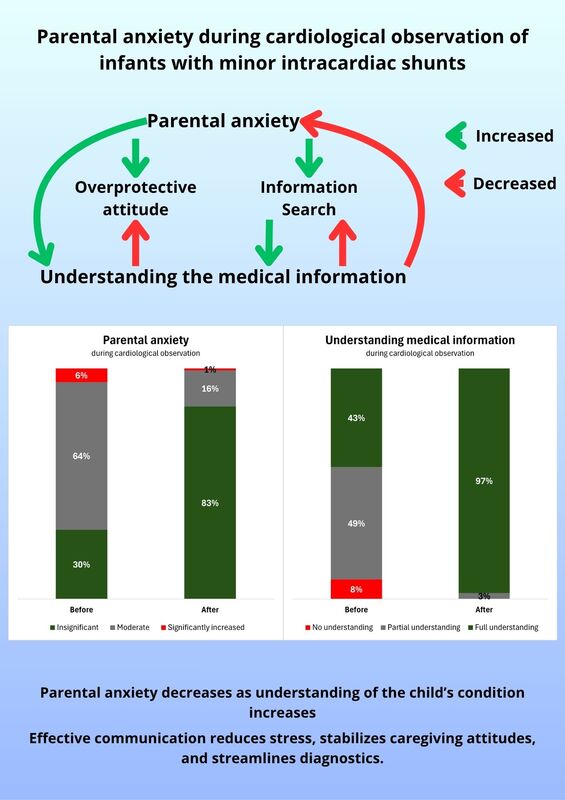
Almost 70% (165; 69.91%) of the mothers surveyed reported a moderate or high level of anxiety before their first cardiological consultation, whereas after their last visit, only 2 mothers (0.85%) still reported a high level of anxiety. Over 45% (107; 45.34%) of respondents reported an urgent need for action before their cardiological consultation, and after their last appointment with a cardiologist, almost 100% of them (235; 99.58%) adopted a wait-and-see approach. Almost 81% of mothers (191; 80.9%) indicated a reduction in overprotective attitude during cardiological follow-up. Over 97% (230; 97.46%) of the mothers surveyed declared a full understanding of the information provided after their last appointment with a cardiologist.
Table II presents the characteristics of the group of mothers studied, taking into account the results of the analysis of differences in the intensity of selected emotions and behaviours at specific points in time.
Table II
Intensity of selected emotions and behaviours of mothers during the cardiological follow-up at specific time points
The Freedman’s rank test revealed significant differences between the numerical values compared at individual points in time in terms of the intensity of selected emotions and behaviours and understanding of the information presented related to the child’s health condition. A decrease in average scores was observed in the area of perceived anxiety, overprotective attitude, and need for action, and an increase in the area of understanding the information provided.
Discussion
Intensified parental anxiety is a common reaction among caregivers when their child is referred for cardiological diagnosis, and the cause may be not only uncertainty about the child’s health and future development, but also about their own parenting skills in this new situation. In the case of cardiological diagnostics, the perception of the role of the heart as an important organ in the human body is an additional factor causing anxiety [1, 5].
In the presented work, already in the first point of the analysis, a significant intensification of parental anxiety is noted, accompanied by an increased need for action and the development of an overprotective attitude in some mothers. These observations are consistent with Frijda’s functional approach to emotions, which assumes that negative emotions triggered by a situation perceived as a threat can induce people to take actions with heightened intensity [1, 6]. In this context, the intensified search for information and the urgent need for action represent a drive to restore parental self-efficacy. By transitioning from passive recipients of a diagnosis to active information seekers, mothers attempt to mitigate subjective helplessness and regain a sense of control over the diagnostic process. The increased need for action declared by nearly all mothers translated into an active search for additional sources of information, and the most common ones reported were holding conversations with loved ones, searching for information online, and consulting other physicians [7, 8].
During cardiological follow-up of children with mild intracardiac shunts, a gradual decrease in initially declared maternal anxiety and overprotectiveness was observed, and a wait-and-see approach replaced the need for active intervention. This shift suggests that the follow-up process effectively reduces intolerance of uncertainty among mothers. Through clinical education, a situation initially perceived as an unpredictable threat is redefined as a safe and manageable monitoring process. Furthermore, the significant reduction in overprotective attitudes (observed in over 80% of respondents) is crucial for preventing vulnerable child syndrome, as it prevents the long-term consolidation of the ‘sick child’ image in the parent’s mind.
Many researchers have proved that the raised level of anxiety has a limiting effect on cognitive processes, causing disorientation and problems with understanding and remembering information [1, 3, 5, 9, 10]. The presented original research confirms this dependence through a distinctly marked increase in the level of understanding of the information provided by the physician, accompanied by a decrease in the level of anxiety between the first and last points of analysis.
A beneficial effect on the process of understanding a health problem can also be achieved by observing the child’s development and acquiring knowledge about the natural history.
A reduction in the level of anxiety also contributes to a reduction in the sense of threat, which limits the need for further independent searching for information on the Internet. Reports in the literature indicate that although patients frequently attempt to satisfy their information needs with readily available data from the Internet, they still prefer direct contact with their physician as a source of reliable information and also rely on family and friends in this regard [7, 8]. The results of our analysis confirmed that the support of the family is of importance to mothers throughout the entire period of the child’s follow-up.
Diagnosing even a minor anomaly of the cardiovascular system is a highly stressful situation for caregivers, and in the process of cardiological diagnosis, we observe the mutual interaction of emotional factors in the mother’s attitude, parental anxiety, the need to act, and the understanding of the health problem.
The physician’s communication skills, awareness of caregivers’ expectations and emotions determine the comprehensibility of medical information and ensure professional counselling, thereby enabling a significant reduction in parental anxiety at every stage of the diagnostic process, thus supporting the child’s proper development. Ultimately, the physician’s communication acts as a tool for restructuring the parent’s illness perception. It ensures that the symbolic significance of the ‘heart’ does not lead to a disproportionate assessment of health severity in cases of minor, benign anomalies [1, 3, 5, 7, 10–14].
The surveys conducted with the use of the interview questionnaire has certain limitations. The data subjected to analysis is a subjective assessment by the mother when responding to questions, which may be influenced not only by the stressful circumstances of the follow-ups carried out, but also by the psychophysical traits and life experiences of the respondents [1, 10, 11, 13]. Despite these limitations, the study provides valuable information on mothers’ attitudes during the course of their children’s diagnostics and highlights the important role of the physician’s communication skills and the manner in which medical information is conveyed. The attitude of caregivers and their quality of life have a significant impact on child development, which is why it is so important to conduct further research in this area, improve research tools, and educate caregivers on counselling strategies in diagnostic processes. Future research should incorporate additional parameters, such as the long-term assessment of parental coping mechanisms and the specific impact of the child’s age at diagnosis. Furthermore, investigating the role of structured communication training for physicians in specialised infant cardiology units could further clarify how to minimize parental anxiety in the most vulnerable clinical settings, where the physician’s communication skills are of paramount importance [1, 2, 4, 5, 11–13, 15].
In conclusion, high parental anxiety accompanies the cardiac diagnostic process, even in mild cases, and diminishes as understanding of the child’s condition increases. Effective communication with the physician reduces parental stress by increasing the understanding of the child’s health condition, which promotes the stabilization of caregiving attitudes and streamlines the diagnostic process.