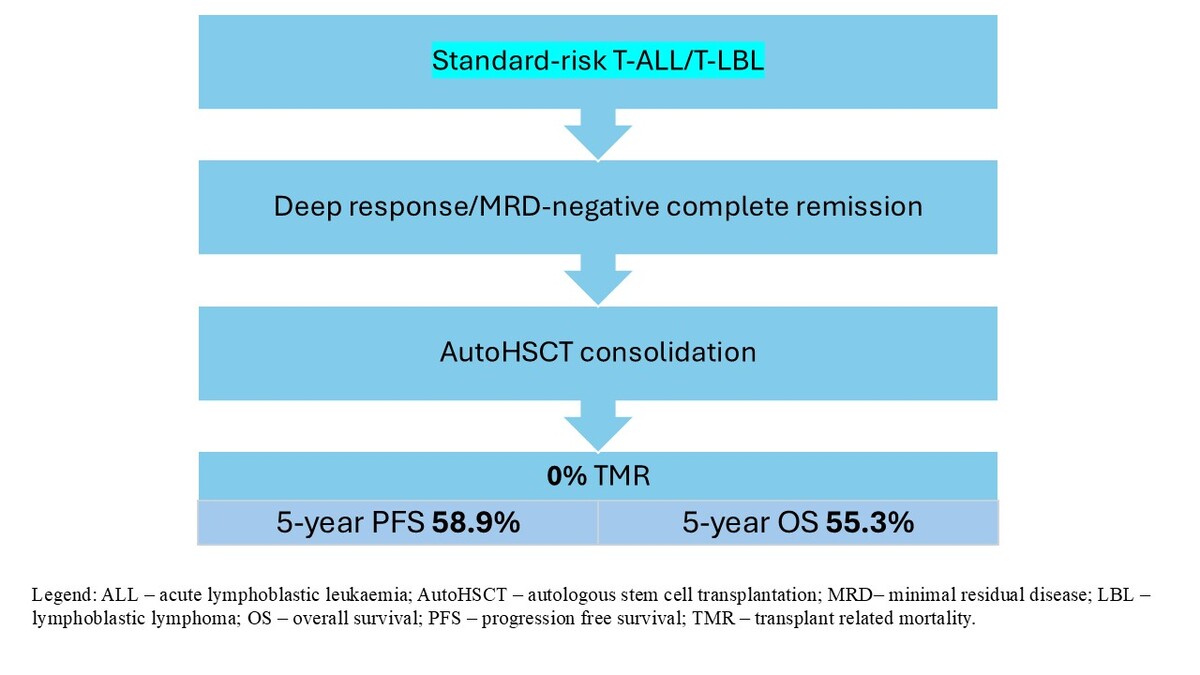
T-cell acute lymphoblastic leukaemia and lymphoblastic lymphoma (T-ALL/T-LBL) are rare and aggressive haematological malignancies in adults, associated with a high risk of relapse despite intensive multiagent chemotherapy [1]. Allogeneic haematopoietic stem cell transplantation (alloHSCT) is commonly recommended for patients with high-risk features or persistent disease; however, it is associated with substantial treatment-related morbidity and mortality [2]. The role of autologous stem cell transplantation (autoHSCT) in standard-risk patients achieving complete remission (CR) remains controversial, particularly in the era of sensitive measurable residual disease (MRD) assessment [3, 4]. We report a single-centre retrospective analysis evaluating the feasibility and outcomes of autoHSCT as consolidation therapy in adults with standard-risk T-ALL/T-LBL who achieved deep remission, defined as MRD negativity in T-ALL or complete metabolic response in T-LBL.
Methods
Between 2014 and 2023, adult patients with newly diagnosed T-ALL or T-LBL treated at our institution were retrospectively analysed. Diagnosis and disease classification were performed according to World Health Organisation (WHO) criteria applicable at the time of diagnosis. Risk stratification and treatment decisions were guided by contemporary adult T-ALL/T-LBL protocols and European LeukemiaNet recommendations [5]. Patients were considered standard risk if they achieved complete remission after induction therapy, demonstrated deep remission prior to autoHSCT (MRD negativity in T-ALL or complete metabolic response in T-LBL), and had no early T-cell precursor immunophenotype according to WHO criteria.
In patients with T-ALL, MRD was assessed after induction and after the second cycle using multiparameter flow cytometry, with sensitivity thresholds of < 0.1% and < 0.01%, respectively [3, 5]. Molecular T-cell receptor–based MRD assessment was not routinely available at our institution during the study period and therefore was not performed. In patients with T-LBL, remission status after the first cycle of chemotherapy was evaluated by positron emission tomography/computed tomography (PET/CT), with complete metabolic response defined as a Deauville score of 1–3 [3, 6]. Eligibility for autoHSCT required MRD-negative complete remission (T-ALL) or complete metabolic response (T-LBL) and a low Haematopoietic Cell Transplantation–Comorbidity Index (HCT-CI ≤ 2) [2, 4]. AutoHSCT was the intended consolidation strategy in this standard-risk population; therefore, routine donor search for allogeneic transplantation was not performed at the time of qualification. AlloHSCT was reserved for patients with MRD reappearance or overt relapse, including relapse after autoHSCT.
Peripheral blood stem cells were mobilised using intermediate-dose cytarabine (Ara-C 400 mg/m2 administered every 12 h for 1–2 days), followed by granulocyte colony-stimulating factor. Systematic MRD assessment of leukapheresis products confirmed MRD negativity in all cases (< 0.01%) [7]. Conditioning regimens consisted predominantly of total body irradiation (TBI; 12 Gy) combined with cyclophosphamide; 1 patient with Nijmegen breakage syndrome received a non-TBI–based conditioning regimen [8, 9]. No additional central nervous system (CNS) irradiation was administered beyond TBI used in the conditioning regimen. All patients received standard CNS prophylaxis, including at least one intrathecal chemotherapy administration per cycle, with routine cerebrospinal fluid evaluation. Overall survival (OS) and progression-free survival (PFS) were estimated using the Kaplan–Meier method. This retrospective study was conducted in accordance with the Declaration of Helsinki, using anonymised patient data.
Results
Thirteen patients with standard-risk disease were included. The median age at transplantation was 28 years (range: 19–65). Five patients (38%) had T-ALL and eight (62%) had T-LBL. All patients achieved complete remission prior to autoHSCT (Table I). Stem cell mobilisation was successful in all patients, with a median CD34+ cell yield of 3.9 × 10⁶/kg. Neutrophil and platelet engraftment occurred in all cases. Early post-transplant complications were manageable; 3 patients developed septic shock and recovered fully. No transplant-related mortality was observed (100-day TRM: 0%).
Table I
Patients’ characteristics (n = 13)
[i] ALL – acute lymphoblastic leukaemia, HCT-CI – Haematopoietic Cell Transplantation Comorbidity Index, HyperCVAD – cyclophosph-amide, vincristine, doxorubicin, dexamethasone, LBL – lympho-blastic lymphoma, PALG ind. – Polish Adult Leukaemia Group induction regimen, PLTs – platelets, WBCs – white blood cells.
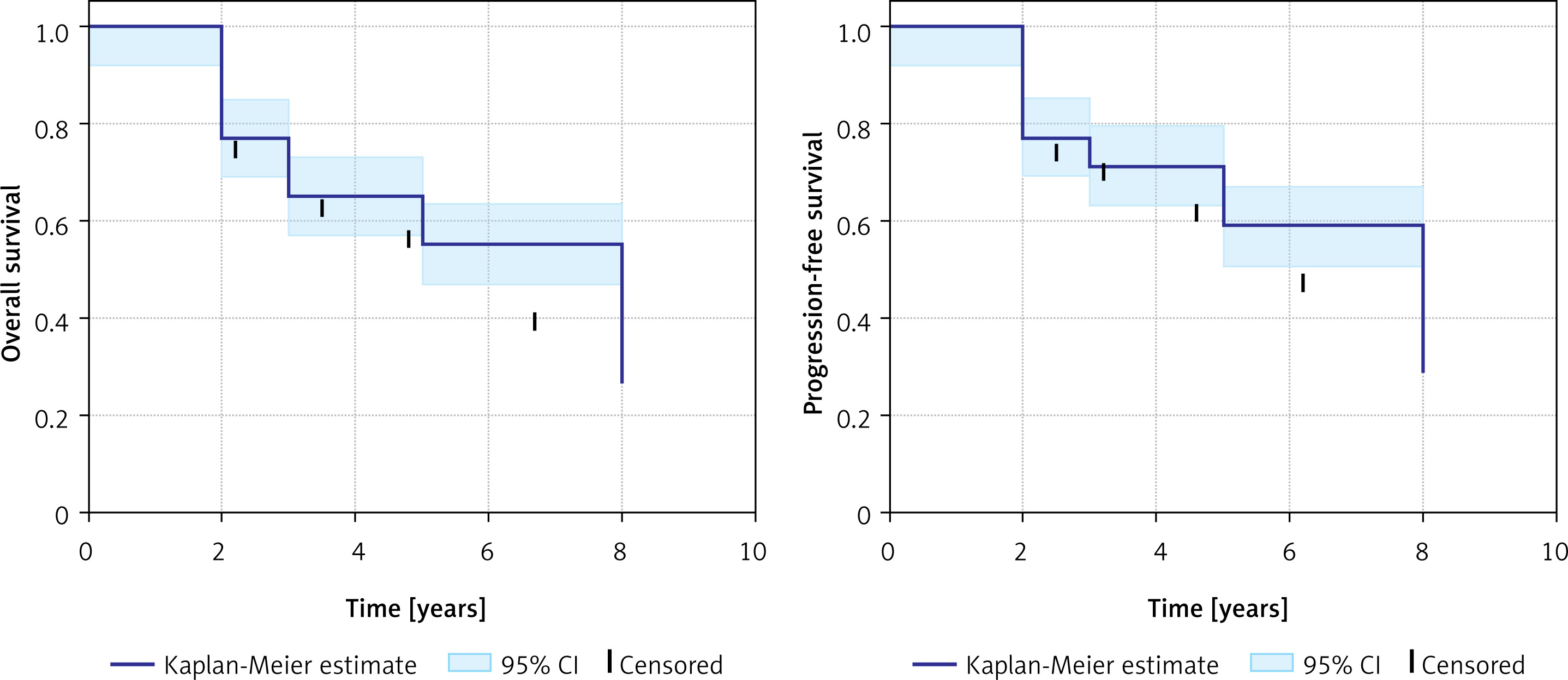
After a median follow-up of 60.5 months, 8 (62%) patients remained in continuous complete remission. Five patients died: three due to disease relapse and two due to infectious complications occurring in remission. Median OS from autoHSCT was 39 months (3.3 years). The estimated 5-year OS was 55.3%; confidence intervals were limited due to the small sample size and number of patients at risk. The estimated 5-year PFS was 58.9% (95% CI: 25.9–81.2) (Figure 1). All relapses occurred within the first year following transplantation, suggesting that relapse risk is concentrated in the early post-transplant period. Although limited by the small sample size, no relapses were observed among patients who completed planned maintenance therapy, whereas both patients who discontinued treatment prematurely due to toxicity subsequently relapsed.
Figure 1
Kaplan-Meier estimates of overall survival (OS) and progression-free survival (PFS) in patients with T-ALL/T-LBL after autologous hematopoietic stem cell transplantation (autoHSCT). With a median follow-up of 60.5 months, the estimated 5-year OS and PFS were 55.3% and 58.9%, respectively. Events included relapse or death from any cause; patients alive and relapse-free at the last follow-up were censored
Discussion
Due to the small sample size, formal comparative statistical testing was not performed. The role of transplantation in adult T-ALL/T-LBL remains a matter of ongoing debate. As highlighted in expert reviews, including the “How I treat T-cell acute lymphoblastic leukemia in adults” article, treatment strategies are increasingly risk-adapted, and the optimal integration of transplantation remains context-dependent [10]. Several retrospective analyses, including studies from Chinese cohorts, have demonstrated improved survival in patients undergoing transplantation compared with chemotherapy alone, with chemotherapy-treated patients included within the same cohorts as internal comparators. However, these studies are non-randomised and include clinically heterogeneous populations, particularly with respect to age, often incorporating adolescents or paediatric patients, as well as varying transplant approaches [11]. In contrast, prospective data from the RALL-2009 study reported by Parovichnikova et al. demonstrated that patients who did not undergo transplantation had the least favourable outcomes, supporting a potential role for transplantation-based consolidation in adult T-cell disease. Importantly, contemporary data directly comparing chemotherapy-only approaches with autoHSCT in a homogeneous population of adult standard-risk T-ALL/T-LBL patients remain scarce, further complicating the interpretation of the available evidence [12]. Recent analyses from the European Society for Blood and Marrow Transplantation (EBMT) registry reported 5-year PFS rates of approximately 40–50% in MRD-negative adult patients with Philadelphia-negative ALL in first CR [2]. In this context, the 5-year PFS of 58.9% observed in our carefully selected standard-risk T-ALL/T-LBL population supports the feasibility of autoHSCT as a consolidation therapy in carefully selected patients achieving deep remission. In T-cell ALL, chemotherapy-based approaches achieved 5-year survival rates of around 50%, while in adult T-LBL treated with ALL-type regimens without routine transplantation, 5-year overall survival has been reported at approximately 40–45% [13, 14]. Notably, these cohorts were not uniformly stratified by MRD status [14, 15]. In contrast, our strictly selected MRD-negative standard-risk population achieved a 5-year PFS of 58.9%, supporting the potential role of MRD-guided consolidation with autoHSCT.
Several limitations of this study should be acknowledged. First, the retrospective single-centre design and relatively small cohort size limit the generalisability of the findings. The limited number of patients should also be interpreted in the context of disease epidemiology and patient selection. Both ALL and LBL are uncommon malignancies in adults, while T-cell lineage disease represents a substantially less frequent subtype compared with B-cell ALL. Furthermore, the present analysis was restricted to standard-risk patients who achieved deep remission following induction therapy and subsequently underwent autoHSCT [2]. These stringent eligibility criteria inherently reduced the number of evaluable patients and contributed to the small cohort size.
Patient selection was additionally influenced by transplant eligibility, disease risk, and treatment response, because therapeutic allocation followed institutional transplant-oriented decision pathways. Consequently, a chemotherapy-only control group was not available for comparison, because eligible patients with favourable response and standard-risk features were routinely consolidated with autoHSCT, whereas alloHSCT was reserved for patients with persistent MRD, high-risk disease characteristics, or relapse [9].
The cohort included both T-ALL and T-LBL, which share biological overlap but differ in disease presentation and response assessment. Accordingly, response monitoring reflected standard clinical practice for each entity. MRD in T-ALL was evaluated using multiparameter flow cytometry, whereas response assessment in T-LBL was based on PET/CT imaging [3, 4, 6]. Molecular MRD techniques were not routinely available during the study period; therefore, response evaluation relied on the most sensitive methods available in routine clinical practice at that time.
Although standard-risk classification was based on established clinical criteria, comprehensive molecular characterisation was not uniformly available across the study population, limiting additional biological stratification beyond conventional clinicopathologic features and early T-cell precursor phenotype assessment.
Despite these limitations, the uniform treatment strategy, consistent transplant qualification criteria, systematic confirmation of remission status prior to transplantation, and long-term follow-up provide clinically relevant insight into outcomes following autoHSCT in carefully selected adults with standard-risk T-ALL/T-LBL. The absence of early transplant-related mortality further supports the feasibility of this consolidation approach. These findings support further investigation of MRD-guided consolidation strategies, including post-transplant maintenance therapy, in larger prospective studies.