Breast cancer (BC) is a leading cause of cancer-related death among women worldwide [1]. Although several dietary patterns have been linked to BC in observational studies, such designs are vulnerable to confounding, measurement error, and reverse causation [2]. Food preferences are relatively stable behavioural phenotypes that integrate sensory, cultural, and psychological components of diet. Because they can be proxied by genetic variants, they provide an opportunity to explore potential causal relationships between long-term dietary tendencies and BC risk using Mendelian randomisation (MR).
Methods
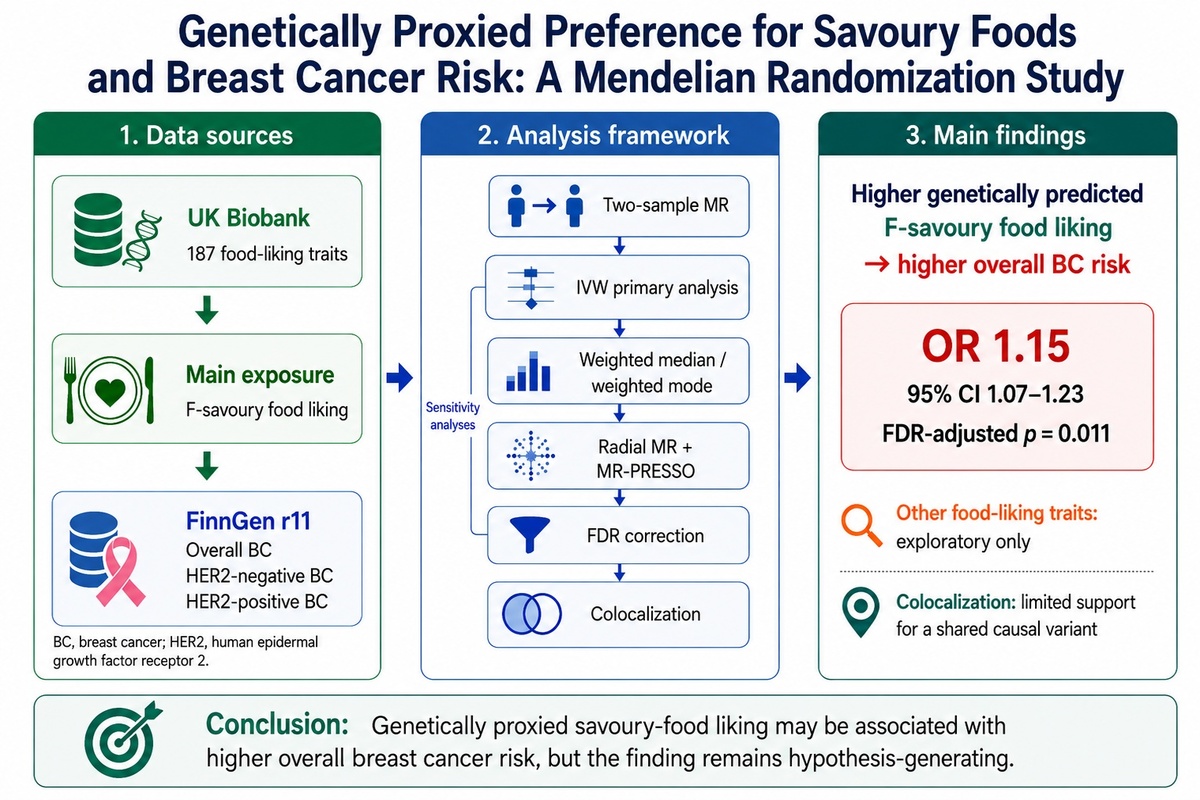
We conducted a two-sample MR analysis of 187 food-liking traits from UK Biobank, including individual items (e.g. black olives, jam, plain yoghurt) and derived food-liking factors (e.g. savoury foods, salad vegetables) (Supplementary Table SI). Genetic association estimates for food-liking were obtained from a large UK Biobank genome-wide association study in individuals of European ancestry [3]. The main exposure, “F-savoury food liking (derived food-liking factor)”, was not newly defined in the present study. In the original food-liking hierarchy, this derived factor contributed to both the highly palatable and acquired food-liking dimensions, and it should therefore be interpreted as a genetically proxied food-liking phenotype rather than a direct measure of savoury-food or salty-food intake. Instruments were constructed using independent single nucleotide polymorphisms (SNPs) associated with each trait at p < 1 × 10⁻⁷ and F-statistics > 10 [4]. During instrument selection, SNPs associated with breast cancer or with prespecified confounding traits, including physical activity, smoking status, number of cigarettes smoked per day, waist circumference, alcohol use, and body mass index, were excluded. The retained harmonised instruments used in the main analysis are listed in Supplementary Table SIII. Summary statistics were obtained from FinnGen r11 for overall breast cancer and HER2-status-defined breast cancer endpoints in individuals of European ancestry. The analysed outcomes were overall breast cancer (20,586 cases and 201,494 controls), HER2-negative breast cancer (8469 cases and 201,226 controls), and HER2-positive breast cancer (12,081 cases and 201,226 controls) (Supplementary Table SII). All analyses used publicly available, de-identified summary statistics; no new individual-level data were collected.
Two-sample MR analyses were performed using the inverse-variance-weighted (IVW) method as the primary estimator. For traits with ≥ 3 instruments, we additionally applied weighted median and weighted mode methods. Heterogeneity was evaluated using Cochran’s Q under the IVW model, whereas directional pleiotropy was assessed using the MR-Egger intercept. Outlying instruments were identified using radial IVW with modified second-order weights, and results were re-estimated after outlier removal. As an additional sensitivity analysis, MR-PRESSO was performed to detect outlying variants and assess whether the association persisted after outlier correction. Directionality was assessed using the Steiger test, and leave-one-out analyses were used to evaluate whether any single instrument unduly influenced the results. Multiple testing was controlled using the Benjamini–Hochberg false discovery rate procedure, applied separately for each endpoint across all 187 tested food-liking traits, yielding 561 exposure–outcome tests in total across the study. To further interrogate the top signal, we performed GWAS–GWAS colocalisation within ±500 kb windows around the locus, estimating the posterior probability that exposure and outcome share a single causal variant (PP4).
Results
Across the 187 traits examined, genetically proxied F-savoury food liking showed the most notable association with overall BC. The retained harmonised SNPs used in the main analysis are listed in Supplementary Table SIII. Before outlier correction, the IVW estimate was not statistically significant, although the weighted median and weighted mode analyses showed directionally consistent positive associations. Significant heterogeneity was observed before correction, whereas the MR-Egger intercept did not indicate significant directional pleiotropy. Side-by-side results before and after outlier correction are provided in Supplementary Table SIV. After outlier correction, the association remained directionally consistent, and the radial MR-corrected IVW estimate indicated that higher genetically predicted savoury-food liking was associated with increased overall BC risk (OR = 1.15, 95% CI: 1.07–1.23; p = 6.77 × 10⁻⁵; FDR-adjusted p = 0.011; Figure 1). Leave-one-out analyses did not identify any single SNP driving the association, and Steiger testing provided no evidence supporting reverse directionality.
Figure 1
Association of genetically proxied preference for savoury foods with overall breast cancer risk

For HER2-status-defined endpoints, effect estimates for savoury-food liking were directionally positive but imprecisely estimated, and none survived false discovery rate adjustment. Likewise, we observed nominal associations between overall BC risk and genetically proxied black olive liking, jam liking, F-salad-vegetables liking, and F-salty-food liking, as well as inverse associations for cheesecake liking, plain-yoghurt liking, soft-cheese liking, and lamb liking with specific endpoints. However, all these additional signals attenuated after multiple testing correction. Given their limited statistical support and potential for chance findings, we regard them as exploratory and do not emphasise them further in this letter. Full MR results and sensitivity analyses are provided in Supplementary Tables SV and SVI.
Colocalisation analysis for the savoury-food locus and overall BC yielded limited support for a shared causal variant (PP4 = 0.0058). This pattern does not provide strong support for a single shared causal variant at that locus; however, it does not exclude more complex local genetic architectures, linkage disequilibrium between distinct causal variants, or residual pleiotropy acting through pathways correlated with dietary preference.
Discussion
The biological interpretation of this finding should be cautious because F-savoury-food liking reflects a genetically proxied preference phenotype rather than measured dietary intake. Therefore, the present MR signal should not be interpreted as evidence that savoury-food consumption itself directly causes breast cancer. Instead, a higher genetic propensity toward savoury-food liking may mark a broader behavioural and metabolic profile, including preference for highly palatable or more processed foods, reward-related eating behaviour, and lifestyle or socioeconomic correlates. This interpretation is broadly consistent with observational evidence linking less favourable dietary patterns with higher breast cancer risk, and more specifically with studies showing that higher ultra-processed food exposure and more insulinaemic dietary profiles are associated with increased breast cancer risk [5–7]. These correlated pathways may influence breast cancer risk indirectly through adiposity, insulin resistance, metabolic dysfunction, alcohol use, smoking, and chronic inflammation rather than through savoury-food intake itself [7–9].
Within this broader framework, potential links between savoury-food liking and breast cancer may include greater exposure to dietary advanced glycation end products, nitrite-containing additives, and salt, which have been associated with oxidative stress, chronic inflammation, immune remodeling, and tumour-promoting metabolic changes [10–12]. Experimental work has also suggested that high-salt conditions may accelerate breast tumour progression through immune-related pathways [13]. However, in the context of the present MR analysis, these mechanisms should be regarded as indirect and hypothesis-generating rather than as evidence of a direct causal effect at the level of specific foods or nutrients.
These considerations also help explain why the subtype-specific findings should be interpreted cautiously. Because the subtype analyses were limited to HER2-status-defined endpoints and none of the subtype-specific associations survived false discovery rate correction, the present data do not support stronger subtype-specific mechanistic inference. Rather, the main implication of this letter is that genetically influenced savoury-food liking may index an unfavourable behavioural or metabolic liability relevant to overall breast cancer susceptibility.
We did not perform multivariable MR adjusting for body mass index, alcohol use, or smoking. Therefore, the present analysis cannot distinguish a direct effect of savoury-food liking from indirect pathways mediated by adiposity, metabolic dysfunction, or correlated lifestyle factors.
This study leverages large-scale genetic data to strengthen causal inference relative to conventional observational designs, but key limitations remain. Food-liking captures preference rather than actual consumption, and translation from liking to intake may vary across individuals and over the life course. Both UK Biobank and FinnGen are predominantly European-ancestry resources, and generalisability to other populations requires confirmation. Finally, although extensive sensitivity analyses were performed, residual pleiotropy cannot be fully excluded.
In conclusion, our two-sample MR analysis suggests that genetically proxied savoury-food liking may be associated with higher overall breast cancer risk, whereas other food-liking traits showed only exploratory associations. These findings should be interpreted cautiously and viewed as hypothesis-generating rather than as evidence that savoury-food intake itself is directly causal. Replication in independent cohorts, integration with detailed dietary intake and lifestyle data, and further mechanistic studies will be important to clarify the biological and behavioural pathways underlying this association.