Current issue
Archive
Manuscripts accepted
About the Journal
Editorial office
Editorial board
Section Editors
Abstracting and indexing
Subscription
Contact
Ethical standards and procedures
Most read articles
Instructions for authors
Article Processing Charge (APC)
Regulations of paying article processing charge (APC)


ORTHOPEDICS AND TRAUMATOLOGY / RESEARCH PAPER
Effect of resistance rotational correction manipulation for the knee joint on joint force line and joint temperature in patients with knee osteoarthritis: A randomized controlled trial.
1
Affiliated Hospital of Shandong University of Traditional Chinese Medicine, China
2
Shandong University of Traditional Chinese Medicine, China
3
Center for Prevention and Treatment of Affiliated Hospital of Shandong University of Traditional Chinese Medicine, China
4
Shandong First Medical University Affiliated Provincial Hospital, China
5
Shuguang Hospital Affiliated to Shanghai University of Traditional Chinese Medicine, China
Submission date: 2025-11-05
Final revision date: 2026-01-28
Acceptance date: 2026-03-06
Online publication date: 2026-06-04
Corresponding author
KEYWORDS
FasciaKnee osteoarthritisTuinaResistance rotational correction manipulation for the knee jointJoint force lineHelical force lineKnee temperature
TOPICS
ABSTRACT
Introduction:
Knee osteoarthritis (KOA) is a common chronic degenerative disease in middle-aged and elderly people, characterized by joint pain, functional impairment, and abnormal joint alignment.
Material and methods:
A single-blind, randomized controlled trial was conducted, selecting 40 patients with knee osteoarthritis (KOA) who visited the outpatient department of the Affiliated Hospital of Shandong University of Traditional Chinese Medicine from October 2020 to July 2021.
Results:
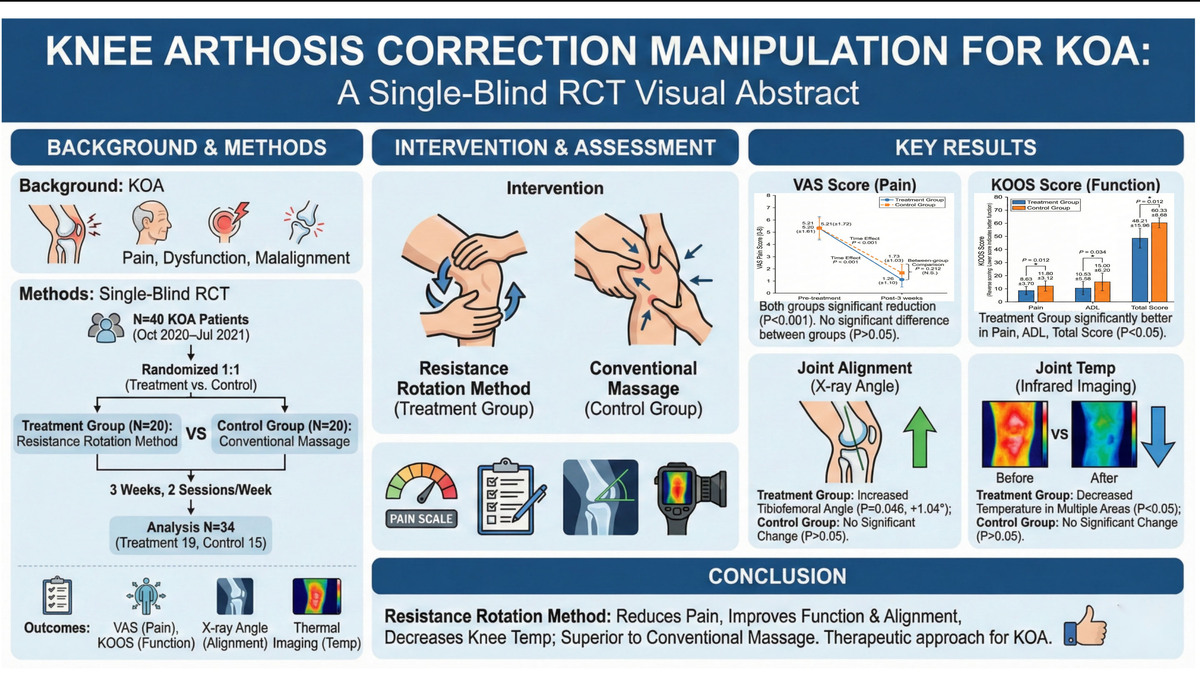
Ultimately, 34 patients (19 in the treatment group and 15 in the control group) completed the study (6 dropped out, dropout rate 15%). After treatment, VAS scores in both groups were significantly lower than before treatment (treatment group: 5.21±1.72 vs 1.26±1.10, P<0.001; control group: 5.20±1.61 vs 1.73±1.03, P<0.001), but the difference between the groups was not statistically significant (MD = -0.47, 95% CI: -1.22 to 0.28, P=0.212). Both groups showed significant improvements in KOOS scores across dimensions such as pain, symptoms, and activities of daily living compared to pre-treatment levels (P<0.05). Furthermore, the treatment group demonstrated superior scores compared to the control group in pain (8.63±3.70 vs 11.80±3.12, MD = -3.17, 95% CI: -5.60 to -0.74, P=0.012), activities of daily living (10.53±5.58 vs 18.00±8.20, MD = -7.47, 95% CI: -13.00 to -1.95, P=0.010).
Conclusions:
Knee joint resistance rotation therapy can effectively reduce pain, improve joint function, improve joint alignment, and lower knee joint temperature in patients with knee arthritis (KOA). Its efficacy is superior to conventional massage therapy, providing new ideas and methods for the clinical treatment of KOA.
Knee osteoarthritis (KOA) is a common chronic degenerative disease in middle-aged and elderly people, characterized by joint pain, functional impairment, and abnormal joint alignment.
Material and methods:
A single-blind, randomized controlled trial was conducted, selecting 40 patients with knee osteoarthritis (KOA) who visited the outpatient department of the Affiliated Hospital of Shandong University of Traditional Chinese Medicine from October 2020 to July 2021.
Results:
Ultimately, 34 patients (19 in the treatment group and 15 in the control group) completed the study (6 dropped out, dropout rate 15%). After treatment, VAS scores in both groups were significantly lower than before treatment (treatment group: 5.21±1.72 vs 1.26±1.10, P<0.001; control group: 5.20±1.61 vs 1.73±1.03, P<0.001), but the difference between the groups was not statistically significant (MD = -0.47, 95% CI: -1.22 to 0.28, P=0.212). Both groups showed significant improvements in KOOS scores across dimensions such as pain, symptoms, and activities of daily living compared to pre-treatment levels (P<0.05). Furthermore, the treatment group demonstrated superior scores compared to the control group in pain (8.63±3.70 vs 11.80±3.12, MD = -3.17, 95% CI: -5.60 to -0.74, P=0.012), activities of daily living (10.53±5.58 vs 18.00±8.20, MD = -7.47, 95% CI: -13.00 to -1.95, P=0.010).
Conclusions:
Knee joint resistance rotation therapy can effectively reduce pain, improve joint function, improve joint alignment, and lower knee joint temperature in patients with knee arthritis (KOA). Its efficacy is superior to conventional massage therapy, providing new ideas and methods for the clinical treatment of KOA.
| eISSN: | 1896-9151 |
| ISSN: | 1734-1922 |

We process personal data collected when visiting the website. The function of obtaining information about users and their behavior is carried out by voluntarily entered information in forms and saving cookies in end devices. Data, including cookies, are used to provide services, improve the user experience and to analyze the traffic in accordance with the Privacy policy. Data are also collected and processed by Google Analytics tool (more).
You can change cookies settings in your browser. Restricted use of cookies in the browser configuration may affect some functionalities of the website.
You can change cookies settings in your browser. Restricted use of cookies in the browser configuration may affect some functionalities of the website.