Current issue
Archive
Manuscripts accepted
About the Journal
Editorial office
Editorial board
Section Editors
Abstracting and indexing
Subscription
Contact
Ethical standards and procedures
Most read articles
Instructions for authors
Article Processing Charge (APC)
Regulations of paying article processing charge (APC)


NEUROLOGY / RESEARCH PAPER
Effects of nocturnal-diurnal sleep patterns and social participation factors on memory-related disorders in middle-aged and older adults
1
Zhaoqing University, China
2
Department of Sports, Exercise and Health Sciences, University of Trás-os-Montes and Alto Douro, Vila Real, Portugal
3
College of Sports Science, Dankook University, Korea (South)
4
Department of Sport and Exercise Sciences, Kunsan National University, Korea (South)
5
Faculty of Education, City University of Macau, China
6
Department of Rehabilitation Medicine, Shenzhen Hospital, Southern Medical University, China
Submission date: 2025-12-08
Final revision date: 2026-02-10
Acceptance date: 2026-03-03
Online publication date: 2026-06-04
Corresponding author
Hai Li
Department of Rehabilitation Medicine, Shenzhen Hospital, Southern Medical University, Shenzhen, China
Department of Rehabilitation Medicine, Shenzhen Hospital, Southern Medical University, Shenzhen, China
KEYWORDS
TOPICS
ABSTRACT
Introduction:
To investigate whether there is an association between nocturnal-daytime sleep patterns as well as social participation and memory-related categories of diseases in the middle-aged and elderly population in China.
Material and methods:
This study was based on data from the Peking University China Health and Aging Tracking Survey (CHARLS), and a total of 19,023 study participants were analyzed in the year 2018 according to the inclusion and exclusion criteria. Logistic regression models were used to explore the relationship between different night-time-daytime sleep patterns, social participation, and memory-related categories of disorders step by step with adjustments for different covariates, and the odds ratios (ORs) and 95% confidence intervals (95% Cl) were obtained.
Results:
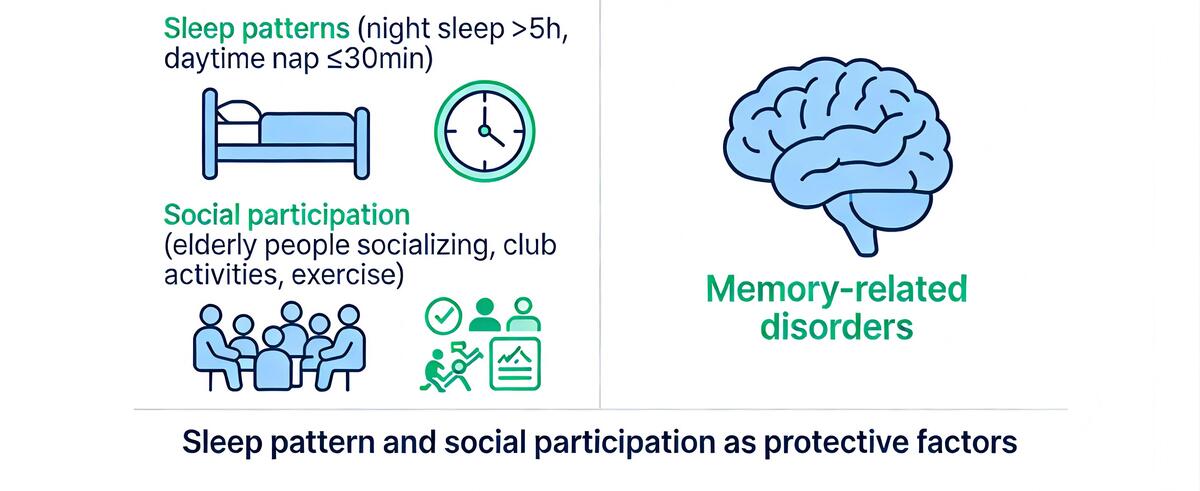
Logistic regression models gradually adjusted for confounding with nighttime sleep duration >5 h and daytime sleep duration ≤30 min group, Going to a sport, social, or other club activity and social participation as the protective factors of memory-related class of diseases. Stratified analyses found that among males, people living in rural areas, and married people, the group with >5 h of nighttime sleep and ≤30 min of daytime sleep was a protective factor for memory-related classes of diseases. Among women, people living in urban areas, and married people, social participation was a protective factor for memory-related diseases.
Conclusions:
Nighttime sleep time >5 h, daytime sleep time ≤30 min group, and social participation are independent protective factors for memory-related class disorders in older adults. Keywords: sleep patterns, social participation, memory-related disorders, CHARLS, middle‐aged and older adults
To investigate whether there is an association between nocturnal-daytime sleep patterns as well as social participation and memory-related categories of diseases in the middle-aged and elderly population in China.
Material and methods:
This study was based on data from the Peking University China Health and Aging Tracking Survey (CHARLS), and a total of 19,023 study participants were analyzed in the year 2018 according to the inclusion and exclusion criteria. Logistic regression models were used to explore the relationship between different night-time-daytime sleep patterns, social participation, and memory-related categories of disorders step by step with adjustments for different covariates, and the odds ratios (ORs) and 95% confidence intervals (95% Cl) were obtained.
Results:
Logistic regression models gradually adjusted for confounding with nighttime sleep duration >5 h and daytime sleep duration ≤30 min group, Going to a sport, social, or other club activity and social participation as the protective factors of memory-related class of diseases. Stratified analyses found that among males, people living in rural areas, and married people, the group with >5 h of nighttime sleep and ≤30 min of daytime sleep was a protective factor for memory-related classes of diseases. Among women, people living in urban areas, and married people, social participation was a protective factor for memory-related diseases.
Conclusions:
Nighttime sleep time >5 h, daytime sleep time ≤30 min group, and social participation are independent protective factors for memory-related class disorders in older adults. Keywords: sleep patterns, social participation, memory-related disorders, CHARLS, middle‐aged and older adults
| eISSN: | 1896-9151 |
| ISSN: | 1734-1922 |

We process personal data collected when visiting the website. The function of obtaining information about users and their behavior is carried out by voluntarily entered information in forms and saving cookies in end devices. Data, including cookies, are used to provide services, improve the user experience and to analyze the traffic in accordance with the Privacy policy. Data are also collected and processed by Google Analytics tool (more).
You can change cookies settings in your browser. Restricted use of cookies in the browser configuration may affect some functionalities of the website.
You can change cookies settings in your browser. Restricted use of cookies in the browser configuration may affect some functionalities of the website.