Current issue
Archive
Manuscripts accepted
About the Journal
Editorial office
Editorial board
Section Editors
Abstracting and indexing
Subscription
Contact
Ethical standards and procedures
Most read articles
Instructions for authors
Article Processing Charge (APC)
Regulations of paying article processing charge (APC)


INTERNAL MEDICINE AND GERIATRICS / RESEARCH PAPER
Long-Term Weight Patterns and Risk of Sarcopenia in Community-Dwelling Older Adults: A Three-Year Cohort Study
1
National Defense Medical University, Taiwan
2
Division of Geriatric Medicine, Department of Family and Community Medicine, Tri-Service General Hospital, Taiwan
Submission date: 2025-12-29
Final revision date: 2026-02-18
Acceptance date: 2026-03-11
Online publication date: 2026-06-04
KEYWORDS
TOPICS
ABSTRACT
Introduction:
Static body mass index (BMI) measurements fail to capture the clinical implications of body weight fluctuations. Therefore, this study investigated the association between multi-dimensional obesity dynamics and incident sarcopenia in community-dwelling older adults.
Material and methods:
The analytic cohort included 1,091 participants. Of these, 478 completed all assessments at the 3-year follow-up and were analyzed. Despite this attrition, baseline characteristics remained comparable between completers and those lost to follow-up. Obesity dynamics were assessed using BMI trajectories, variability, 3-year change, and cumulative overweight-years. Sarcopenia was defined according to the 2019 Asian Working Group for Sarcopenia (AWGS) criteria. We applied logistic regression models, adjusting for demographics, comorbidities, lifestyle factors, and physical activity.
Results:
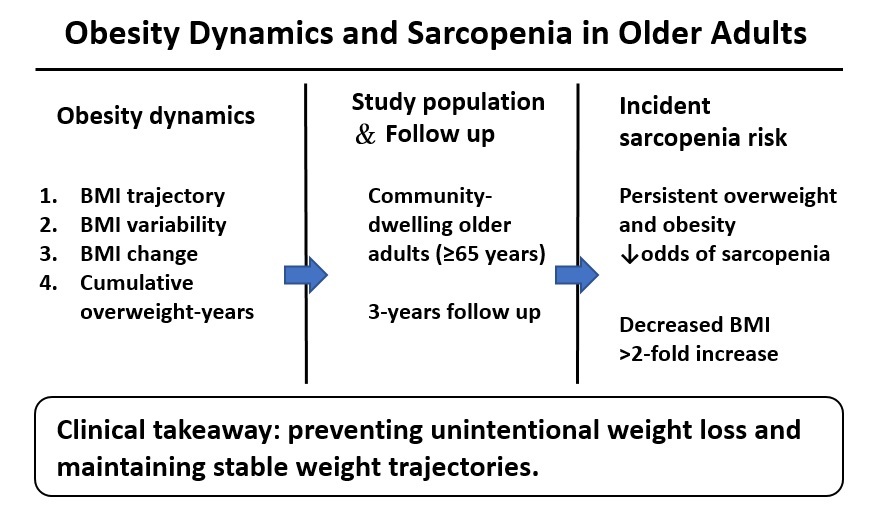
Persistent overweight (odds ratio (OR) = 0.31, 95% confidence interval (CI): 0.14-0.67, p = 0.003) and persistent obesity (OR = 0.21, 95% CI: 0.06-0.74, p = 0.016) were associated with significantly lower odds of developing sarcopenia compared with a stable normal BMI, whereas decreased BMI was linked to more than a twofold higher risk (OR = 2.70, 95% CI: 1.17-6.23, p = 0.020). Our analysis of sarcopenia components demonstrated that maintaining an overweight or obese status, along with higher cumulative overweight-years, correlated with a reduced risk of developing low muscle mass (all p < 0.001).
Conclusions:
These findings emphasize the importance of monitoring weight trajectories to prevent unintentional weight loss rather than promoting obesity in later life. Clinicians should prioritize maintaining weight stability to mitigate sarcopenia risk.
Static body mass index (BMI) measurements fail to capture the clinical implications of body weight fluctuations. Therefore, this study investigated the association between multi-dimensional obesity dynamics and incident sarcopenia in community-dwelling older adults.
Material and methods:
The analytic cohort included 1,091 participants. Of these, 478 completed all assessments at the 3-year follow-up and were analyzed. Despite this attrition, baseline characteristics remained comparable between completers and those lost to follow-up. Obesity dynamics were assessed using BMI trajectories, variability, 3-year change, and cumulative overweight-years. Sarcopenia was defined according to the 2019 Asian Working Group for Sarcopenia (AWGS) criteria. We applied logistic regression models, adjusting for demographics, comorbidities, lifestyle factors, and physical activity.
Results:
Persistent overweight (odds ratio (OR) = 0.31, 95% confidence interval (CI): 0.14-0.67, p = 0.003) and persistent obesity (OR = 0.21, 95% CI: 0.06-0.74, p = 0.016) were associated with significantly lower odds of developing sarcopenia compared with a stable normal BMI, whereas decreased BMI was linked to more than a twofold higher risk (OR = 2.70, 95% CI: 1.17-6.23, p = 0.020). Our analysis of sarcopenia components demonstrated that maintaining an overweight or obese status, along with higher cumulative overweight-years, correlated with a reduced risk of developing low muscle mass (all p < 0.001).
Conclusions:
These findings emphasize the importance of monitoring weight trajectories to prevent unintentional weight loss rather than promoting obesity in later life. Clinicians should prioritize maintaining weight stability to mitigate sarcopenia risk.
| eISSN: | 1896-9151 |
| ISSN: | 1734-1922 |

We process personal data collected when visiting the website. The function of obtaining information about users and their behavior is carried out by voluntarily entered information in forms and saving cookies in end devices. Data, including cookies, are used to provide services, improve the user experience and to analyze the traffic in accordance with the Privacy policy. Data are also collected and processed by Google Analytics tool (more).
You can change cookies settings in your browser. Restricted use of cookies in the browser configuration may affect some functionalities of the website.
You can change cookies settings in your browser. Restricted use of cookies in the browser configuration may affect some functionalities of the website.