Current issue
Archive
Manuscripts accepted
About the Journal
Editorial office
Editorial board
Section Editors
Abstracting and indexing
Subscription
Contact
Ethical standards and procedures
Most read articles
Instructions for authors
Article Processing Charge (APC)
Regulations of paying article processing charge (APC)


ORTHOPEDICS AND TRAUMATOLOGY / CLINICAL RESEARCH
Effects of dry needling of the gluteus medius muscle in individuals with chronic ankle instability: a randomized, single-blinded controlled clinical trial
1
Department of Physiotherapy, University of Seville, Seville, Spain
2
Faculty of Medicine, Health and Sport, Universidad Europea de Madrid, Villaviciosa de Odón, Madrid, Spain
3
Facultad de Enfermería, Fisioterapia y Podología, Universidad Complutense de Madrid, Spain
4
Frailty Research Organized Group (FROG), Department of Nursing, Faculty of Nursing and Podiatry, University of Valencia, Spain
5
Department of Physical Therapy, University of Alcalá, Alcalá de Henares, Spain
Submission date: 2021-09-11
Final revision date: 2021-10-19
Acceptance date: 2021-11-28
Online publication date: 2021-12-14
Corresponding author
Carlos Romero-Morales
Faculty of Medicine, Health and Sport Universidad Europea de Madrid Villaviciosa de Odón Madrid, Spain
Faculty of Medicine, Health and Sport Universidad Europea de Madrid Villaviciosa de Odón Madrid, Spain
KEYWORDS
TOPICS
ABSTRACT
Introduction:
Lateral ankle sprain (LAS) is one of the most common musculoskeletal injuries in sports and the general population. The goal of the present study was to evaluate the effectiveness of dry needling (DN) of the gluteus medius muscle in patients with chronic ankle instability (CAI).
Material and methods:
A two-arm (1 : 1), single-blinded (participants), randomized clinical trial was performed in 40 subjects with CAI who were divided into two groups: an intervention group that received one session of DN in the most hyperalgesic gluteus medius myofascial trigger point (MTrP), (n = 20) and a control group (n = 20). Dynamic balance, pain intensity, pain pressure threshold (PPT) in the anterior talofibular ligament (ATL) and ankle dorsiflexion range of motion (ROM) were assessed at baseline, post-intervention, and a 1-week follow up.
Results:
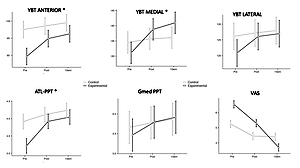
The intervention group showed significantly greater improvements than the control group in anterior and medial dynamic balance (p = 0.001), PPT at the ATL (p = 0.002) and ankle dorsiflexion ROM (p = 0.001).
Conclusions:
The findings of the present study suggest that DN at the most hyperalgesic MTrP of the gluteus medius may increase the anterior and medial dynamic balance, ankle ROM and PPT at the ATL in individuals with CAI in the short term. Pain intensity improved in both groups. Future studies should investigate DN as a potential adjunct to a physical therapy program for individuals with CAI.
REFERENCES (54)
1.
Feger MA, Glaviano NR, Donovan L, et al. Current trends in the management of lateral ankle sprain in the United States. Clin J Sport Med 2017; 27: 145-52.
2.
Gribble PA, Bleakley CM, Caulfield BM, et al. 2016 consensus statement of the International Ankle Consortium: prevalence, impact and long-term consequences of lateral ankle sprains. Br J Sports Med 2016; 50: 1493-5.
3.
Kim H, Son SJ, Seeley MK, Hopkins JT. Altered movement biomechanics in chronic ankle instability, coper, and control groups: energy absorption and distribution implications. J Athl Train 2019; 54: 708-17.
4.
Nabb MTM, Kimber L, Haines A, McCourt C. Does regular massage from late pregnancy to birth decrease maternal pain perception during labour and birth?--A feasibility study to investigate a programme of massage, controlled breathing and visualization, from 36 weeks of pregnancy until birth. Complement Ther Clin Pract 2006; 12: 222-31.
5.
Son SJ, Kim H, Seeley MK, Hopkins JT. Altered walking neuromechanics in patients with chronic ankle instability. J Athl Train 2019; 54: 684-97.
6.
Dingenen B, Deschamps K, Delchambre F, Van Peer E, Staes FF, Matricali GA. Effect of taping on multi-segmental foot kinematic patterns during walking in persons with chronic ankle instability. J Sci Med Sport 2017; 20: 835-40.
7.
Chinn L, Dicharry J, Hertel J. Ankle kinematics of individuals with chronic ankle instability while walking and jogging on a treadmill in shoes. Phys Ther Sport 2013; 14: 232-9.
8.
Hopkins JT, Coglianese M, Glasgow P, Reese S, Seeley MK. Alterations in evertor/invertor muscle activation and center of pressure trajectory in participants with functional ankle instability. J Electromyogr Kinesiol 2012; 22: 280-5.
9.
Koldenhoven RM, Feger MA, Fraser JJ, Saliba S, Hertel J. Surface electromyography and plantar pressure during walking in young adults with chronic ankle instability. Knee Surg Sports Traumatol Arthrosc 2016; 24: 1060-70.
10.
Delahunt E, Monaghan K, Caulfield B. Altered neuromuscular control and ankle joint kinematics during walking in subjects with functional instability of the ankle joint. Am J Sports Med 2006; 34: 1970-6.
11.
Delahunt E, Monaghan K, Caulfield B. Changes in lower limb kinematics, kinetics, and muscle activity in subjects with functional instability of the ankle joint during a single leg drop jump. J Orthop Res 2006; 24: 1991-2000.
12.
Hale SA, Fergus A, Axmacher R, Kiser K. Bilateral improvements in lower extremity function after unilateral balance training in individuals with chronic ankle instability. J Athl Train 2014; 49: 181-91.
13.
Van Deun S, Staes FF, Stappaerts KH, Janssens L, Levin O, Peers KKH. Relationship of chronic ankle instability to muscle activation patterns during the transition from double-leg to single-leg stance. Am J Sports Med 2007; 35: 274-81.
14.
Webster KA, Gribble PA. A comparison of electromyography of gluteus medius and maximus in subjects with and without chronic ankle instability during two functional exercises. Phys Ther Sport 2013; 14: 17-22.
15.
Gribble PA, Hertel J, Plisky P. Using the Star Excursion Balance Test to assess dynamic postural-control deficits and outcomes in lower extremity injury: a literature and systematic review. J Athl Train 2012; 47: 339-57.
16.
Plisky PJ, Gorman PP, Butler RJ, Kiesel KB, Underwood FB, Elkins B. The reliability of an instrumented device for measuring components of the star excursion balance test. N Am J Sports Phys Ther 2009; 4: 92-9.
17.
Bulow A, Anderson JE, Leiter JR, MacDonald PB, Peeler J. The modified star excursion balance and Y-balance test results differ when assessing physically active healthy adolescent females. Int J Sports Phys Ther 2019; 14: 192-203.
18.
Ayotte NW, Stetts DM, Keenan G, Greenway EH. Electromyographical analysis of selected lower extremity muscles during 5 unilateral weight-bearing exercises. J Orthop Sports Phys Ther 2007; 37: 48-55.
19.
Jaber H, Lohman E, Daher N, et al. Neuromuscular control of ankle and hip during performance of the star excursion balance test in subjects with and without chronic ankle instability. PLoS One 2018; 13: e0201479.
20.
Huguenin L, Brukner PD, McCrory P, Smith P, Wajswelner H, Bennell K. Effect of dry needling of gluteal muscles on straight leg raise: a randomised, placebo controlled, double blind trial. Br J Sports Med 2005; 39: 84-90.
21.
Shah JP, Thaker N, Heimur J, Aredo J V, Sikdar S, Gerber L. Myofascial trigger points then and now: a historical and scientific perspective. PM R 2015; 7: 746-61.
22.
Dunning J, Butts R, Mourad F, Young I, Flannagan S, Perreault T. Dry needling: a literature review with implications for clinical practice guidelines. Phys Ther Rev 2014; 19: 252-65.
23.
Salom-Moreno J, Ayuso-Casado B, Tamaral-Costa B, Sánchez-Milá Z, Fernández-de-Las-Peñas C, Alburquerque-Sendín F. Trigger point dry needling and proprioceptive exercises for the management of chronic ankle instability: a randomized clinical trial. Evid Based Complement Alternat Med 2015; 2015: 790209.
24.
Hu HT, Gao H, Ma R, Zhao XF, Tian HF, Li L. Is dry needling effective for low back pain?: A systematic review and PRISMA-compliant meta-analysis. Medicine 2018; 97: e11225.
25.
Gattie E, Cleland JA, Snodgrass S. The effectiveness of trigger point dry needling for musculoskeletal conditions by physical therapists: a systematic review and meta-analysis. J Orthop Sports Phys Ther 2017; 47: 133-49.
26.
Martin-Rodriguez A, Saez-Olmo E, Pecos-Martin D, Calvo-Lobo C. Effects of dry needling in the sternocleidomastoid muscle on cervical motor control in patients with neck pain: a randomised clinical trial. Acupunct Med 2019; 37: 151-63.
27.
Sánchez-Mila Z, Salom-Moreno J, Fernández-de-Las-Peñas C. Effects of dry needling on post-stroke spasticity, motor function and stability limits: a randomised clinical trial. Acupunct Med 2018; 36: 358-66.
28.
Welch V, Jull J, Petkovic J, et al. Protocol for the development of a CONSORT-equity guideline to improve reporting of health equity in randomized trials. Implement Sci 2015; 10: 146.
29.
Gribble PA, Delahunt E, Bleakley C, et al. Selection criteria for patients with chronic ankle instability in controlled research: a position statement of the International Ankle Consortium. J Orthop Sports Phys Ther 2013; 43: 585-91.
30.
Calvo-Lobo C, Pacheco-da-Costa S, Martínez-Martínez J, Rodríguez-Sanz D, Cuesta-Álvaro P, López-López D. Dry needling on the infraspinatus latent and active myofascial trigger points in older adults with nonspecific shoulder pain: a randomized clinical trial. J Geriatr Phys Ther 2018; 41: 1-13.
31.
Chou LW, Hsieh YL, Kuan TS, Hong CZ. Needling therapy for myofascial pain: recommended technique with multiple rapid needle insertion. BioMedicine 2014; 4: 13.
32.
Pecos-Martin D, Montanez-Aguilera FJ, Gallego-Izquierdo T, et al. Effectiveness of dry needling on the lower trapezius in patients with mechanical neck pain: a randomized controlled trial. Arch Phys Med Rehabil 2015; 96: 775-81.
33.
Tejera-Falcón E, Toledo-Martel NDC, Sosa-Medina FM, et al. Dry needling in a manual physiotherapy and therapeutic exercise protocol for patients with chronic mechanical shoulder pain of unspecific origin: a protocol for a randomized control trial. BMC Musculoskelet Disord 2017; 18: 400.
34.
Neziri AY, Scaramozzino P, Andersen OK, Dickenson AH, Arendt-Nielsen L, Curatolo M. Reference values of mechanical and thermal pain tests in a pain-free population. Eur J Pain 2011; 15: 376-83.
35.
Cheatham SW, Kolber MJ, Mokha GM, Hanney WJ. Concurrent validation of a pressure pain threshold scale for individuals with myofascial pain syndrome and fibromyalgia. J Man Manip Ther 2018; 26: 25-35.
36.
Fischer AA. Algometry in diagnosis of musculoskeletal pain and evaluation of treatment outcome: an update. J Musculoskelet Pain 1998; 6: 5-32.
37.
Gribble PA, Hertel J. Considerations for normalizing measures of the star excursion balance test. Meas Phys Educ Exerc Sci 2003; 7: 89-100.
38.
Konor MM, Morton S, Eckerson JM, Grindstaff TL. Reliability of three measures of ankle dorsiflexion range of motion. Int J Sports Phys Ther 2012; 7: 279-87.
39.
Fernandez-Carnero J, La Touche R, Ortega-Santiago R, et al. Short-term effects of dry needling of active myofascial trigger points in the masseter muscle in patients with temporomandibular disorders. J Orofac Pain 2010; 24: 106-12.
40.
Itoh K, Saito S, Sahara S, Naitoh Y, Imai K, Kitakoji H. Randomized trial of trigger point acupuncture treatment for chronic shoulder pain: a preliminary study. J Acupunct Meridian Stud 2014; 7: 59-64.
41.
Zheng Y, Shi D, Wu X, et al. Ultrasound-guided miniscalpel-needle release versus dry needling for chronic neck pain: a randomized controlled trial. Evid Based Complement Alternat Med 2014; 2014: 235817.
42.
Mayoral O, Salvat I, Martin MT, et al. Efficacy of myofascial trigger point dry needling in the prevention of pain after total knee arthroplasty: a randomized, double-blinded, placebo-controlled trial. Evid Based Complement Alternat Med 2013; 2013: 694941.
43.
Cotchett MP, Munteanu SE, Landorf KB. Effectiveness of trigger point dry needling for plantar heel pain: a randomized controlled trial. Phys Ther 2014; 94: 1083-94.
44.
Liu L, Huang QM, Liu QG, et al. Effectiveness of dry needling for myofascial trigger points associated with neck and shoulder pain: a systematic review and meta-analysis. Arch Phys Med Rehabil 2015; 96: 944-55.
45.
Llamas-Ramos R, Pecos-Martin D, Gallego-Izquierdo T, et al. Comparison of the short-term outcomes between trigger point dry needling and trigger point manual therapy for the management of chronic mechanical neck pain: a randomized clinical trial. J Orthop Sports Phys Ther 2014; 44: 852-61.
46.
Kamali F, Sinaei E, Morovati M. Comparison of upper trapezius and infraspinatus myofascial trigger point therapy by dry needling in overhead athletes with unilateral shoulder impingement syndrome. J Sport Rehabil 2019; 28: 243-9.
47.
Abbaszadeh-Amirdehi M, Ansari NN, Naghdi S, Olyaei G, Nourbakhsh MR. Neurophysiological and clinical effects of dry needling in patients with upper trapezius myofascial trigger points. J Bodyw Mov Ther 2017; 21: 48-52.
48.
Onat SS, Polat CS, Bicer S, Sahin Z, Tasoglu O. Effect of dry needling injection and kinesiotaping on pain and quality of life in patients with mechanical neck pain. Pain Physician 2019; 22: 583-9.
49.
Mendigutia-Gomez A, Martin-Hernandez C, Salom-Moreno J, Fernandez-de-Las-Penas C. Effect of dry needling on spasticity, shoulder range of motion, and pressure pain sensitivity in patients with stroke: a crossover study. J Manipulative Physiol Ther 2016; 39: 348-58.
50.
Benito-de-Pedro M, Becerro-de-Bengoa-Vallejo R, Losa-Iglesias ME, et al. Effectiveness between dry needling and ischemic compression in the triceps surae latent myofascial trigger points of triathletes on pressure pain threshold and thermography: a single blinded randomized clinical trial. J Clin Med 2019; 8: 1632.
51.
Lake AD, Myers H, Aefsky B, Butler R. Immediate and short term effect of dry needling on triceps suare range of motion and functional movement: a randomized trial. Int J Sports Phys Ther 2018; 13: 185-95.
52.
MacKinnon CD, Winter DA. Control of whole body balance in the frontal plane during human walking. J Biomech 1993; 26: 633-44.
53.
Hall ML, Mackie AC, Ribeiro DC. Effects of dry needling trigger point therapy in the shoulder region on patients with upper extremity pain and dysfunction: a systematic review with meta-analysis. Physiotherapy 2018; 104: 167-77.
54.
Dunning J, Butts R, Henry N, et al. Electrical dry needling as an adjunct to exercise, manual therapy and ultrasound for plantar fasciitis: a multi-center randomized clinical trial. PLoS One 2018; 13: e0205405.
Share
RELATED ARTICLE
| eISSN: | 1896-9151 |
| ISSN: | 1734-1922 |

We process personal data collected when visiting the website. The function of obtaining information about users and their behavior is carried out by voluntarily entered information in forms and saving cookies in end devices. Data, including cookies, are used to provide services, improve the user experience and to analyze the traffic in accordance with the Privacy policy. Data are also collected and processed by Google Analytics tool (more).
You can change cookies settings in your browser. Restricted use of cookies in the browser configuration may affect some functionalities of the website.
You can change cookies settings in your browser. Restricted use of cookies in the browser configuration may affect some functionalities of the website.