Current issue
Archive
Manuscripts accepted
About the Journal
Editorial office
Editorial board
Section Editors
Abstracting and indexing
Subscription
Contact
Ethical standards and procedures
Most read articles
Instructions for authors
Article Processing Charge (APC)
Regulations of paying article processing charge (APC)


UROLOGY / RESEARCH PAPER
Effects of overactive bladder on treatment-related behaviour and quality of life in an Eastern European country: findings from the LUTS POLAND Study
1
Department of Urology, Jagiellonian University Medical College, Krakow, Poland
Submission date: 2020-11-15
Final revision date: 2021-01-28
Acceptance date: 2021-02-07
Online publication date: 2021-03-18
Publication date: 2026-11-24
Corresponding author
Mikolaj Przydacz
Department of Urology Jagiellonian University Medical College 2 Jakubowskiego St 30-688 Krakow Poland Phone: +48 12 424 79 50
Arch Med Sci 2026;22(5):2821-2831
KEYWORDS
TOPICS
ABSTRACT
Introduction:
The aim of this study was to investigate treatment-related behaviour and quality of life of a Polish population that reported symptoms of overactive bladder (OAB) syndrome. The analysis also evaluated the impact of individual lower urinary tract symptoms and their specific bother on treatment seeking, treatment receiving, treatment satisfaction, and treatment continuation, in the same population.
Material and methods:
The participants were aged ≥ 40 years with possible diagnosis of OAB based on a score of ≥ 8 on the OAB-V8 questionnaire. Respondents used Likert-like scales to rate the frequency and symptom-specific bother of individual lower urinary tract symptoms. Regression models were constructed to analyse all associations.
Results:
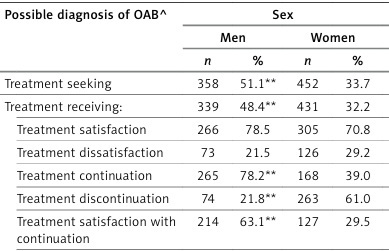
Of 6005 participants, 33.9% (n = 2041) had a possible diagnosis of OAB. Almost 40% (n = 810) were seeking treatment, and most participants received treatment (37.7%, n = 770). There was no difference between individuals in urban and rural areas. Prescribed drugs were the most common treatment for OAB symptoms. We did not observe differences in treatment satisfaction or dissatisfaction between men and women, but statistically more men than women continued their treatment. Symptoms of all categories, not only storage, but also voiding, and post-micturition, were associated with a negative effect on an individual’s treatment-related outcome. Finally, OAB had a negative effect on quality of life because 43% (n = 878) of persons with possible OAB had concerns about their quality of life related to their urinary condition.
Conclusions:
This study is the first Eastern European population-representative analysis of treatment-related behaviours for OAB. Our study highlights the importance of patient education about the condition and treatment options.
REFERENCES (39)
1.
Abrams P, Cardozo L, Fall M, et al. The standardisation of terminology of lower urinary tract function: report from the Standardisation Sub-committee of the International Continence Society. Neurourol Urodyn 2002; 21: 167-78.
2.
Coyne KS, Sexton CC, Kopp ZS, et al. The impact of overactive bladder on mental health, work productivity and health-related quality of life in the UK and Sweden: results from EpiLUTS. BJU Int 2011; 108: 1459-71.
3.
Errando-Smet C, Müller-Arteaga C, Hernández M, Lenero E, Roset M. Healthcare resource utilization and cost among males with lower urinary tract symptoms with a predominant storage component in Spain: the epidemiological, cross-sectional MERCURY study. Neurourol Urodyn 2018; 37: 307-15.
4.
Tikkinen KA, Tammela TL, Rissanen AM, et al. Is the prevalence of overactive bladder overestimated? A population-based study in Finland. PLoS One 2007; 2: e195.
5.
Vaughan CP, Johnson TM 2nd, Ala-Lipasti MA, et al. The prevalence of clinically meaningful overactive bladder: bother and quality of life results from the population-based FINNO study. Eur Urol 2011; 59: 629-36.
6.
Irwin DE, Milsom I, Chancellor MB, Kopp Z, Guan Z. Dynamic progression of overactive bladder and urinary incontinence symptoms: a systematic review. Eur Urol 2010; 58: 532-43.
7.
Welch LC, Botelho EM, Tennstedt SL. Race and ethnic differences in health beliefs about lower urinary tract symptoms. Nursing Res 2011; 60: 165-72.
8.
Wikipedia (Wiki), The Free Encyclopedia [Internet]; Publicated: 2004 [Updated: 2019, Cited: 2020 May]. Available from: https://en.wikipedia.org/wiki/....
9.
Przydacz M, Golabek T, Dudek P, Lipinski M, Chlosta P. Prevalence and bother of lower urinary tract symptoms and overactive bladder in Poland, an Eastern European Study. Sci Rep 2020; 10: 19819.
10.
Polska Agencja Rozwoju Przedsiebiorczosci (PARP), Raport metodologiczny z badan BKL [Internet]; Publicated: 2011 [Updated: 2020, Cited: 2020 May]. Available from: https://www.parp.gov.pl/compon....
11.
Na Strazy Sondazy, Uniwersytet Warszawski [Internet]; Publicated: 2013 [Cited: 2020 May]. Available from: http://nastrazysondazy.uw.edu.....].
12.
Glowny Urzad Statystyczny (GUS), Narodowe Spisy Powszechne [Internet]; Publicated: 2012 [Cited: 2020 May]. Available from: https://stat.gov.pl/spisy-pows....
13.
Soler R, Gomes CM, Averbeck MA, Koyama M. The prevalence of lower urinary tract symptoms (LUTS) in Brazil: results from the epidemiology of LUTS (Brazil LUTS) study. Neurourol Urodyn 2018; 37: 1356-64.
14.
Irwin DE, Milsom I, Kopp Z, et al. Prevalence, severity, and symptom bother of lower urinary tract symptoms among men in the EPIC study: impact of overactive bladder. Eur Urol 2009; 56: 14-20.
15.
Moreira ED Jr, Neves RC, Neto AF, et al. A population-based survey of lower urinary tract symptoms (LUTS) and symptom-specific bother: results from the Brazilian LUTS epidemiology study (BLUES). World J Urol 2013; 31: 1451-8.
16.
Allen IE, Seaman CA. Likert scales and data analyses. Quality Progress 2007; 40: 64-5.
17.
Program Kontroli Jakosci Pracy Ankieterow (PKJPA), Organizacja Firm Badania Opinii i Rynku (OBFOR) [Internet]; Publicated: 2000 [Updated: 2019; Cited: 2020 May]. Available from: https://www.pkjpa.pl.
18.
Coyne KS, Sexton CC, Kopp ZS, et al. Rationale for the study methods and design of the epidemiology of lower urinary tract symptoms (EpiLUTS) study. BJU Int 2009; 104: 348-51.
19.
Llorente C. New concepts in epidemiology of lower urinary tract symptoms in men. Eur Urol Suppl 2010; 9: 477-81.
20.
Irwin DE, Milsom I, Kopp Z, Abrams P. Symptom bother and health care-seeking behavior among individuals with overactive bladder. Eur Urol 2008; 53: 1029-37.
21.
Gomes CM, Averbeck MA, Koyama M, Soler R. Impact of OAB symptoms on work, quality of life and treatment-seeking behavior in Brazil. Curr Med Res Opinion 2020; 36: 1403-15.
22.
Chapple C, Castro-Diaz D, Chuang YC, et al. Prevalence of lower urinary tract symptoms in China, Taiwan, and South Korea: results from a cross-sectional, population-based study. Adv Ther 2017; 34: 1953-65.
23.
Wennberg AL, Molander U, Fall M, et al. Lower urinary tract symptoms: lack of change in prevalence and help-seeking behaviour in two population-based surveys of women in 1991 and 2007. BJU Int 2009; 104: 954-9.
24.
Coyne KS, Sexton CC, Kopp Z, et al. Assessing patients’ descriptions of lower urinary tract symptoms (LUTS) and perspectives on treatment outcomes: results of qualitative research. Int J Clin Pract 2010; 64: 1260-78.
25.
Chapple CR, Drake MJ, Van Kerrebroeck P, et al. Total urgency and frequency score as a measure of urgency and frequency in overactive bladder and storage lower urinary tract symptoms. BJU Int 2014; 113: 696-703.
26.
Corcos J, Przydacz M, Campeau L, et al. CUA guideline on adult overactive bladder. Canad Urol Assoc J 2017; 11: E142-73.
27.
Borello-France D, Burgio KL, Goode PS, et al. Adherence to behavioral interventions for urge incontinence when combined with drug therapy: adherence rates, barriers, and predictors. Phys Ther 2010; 90: 1493-505.
28.
Przydacz M, Chłosta P. The pharmacotherapy time-to-effect of overactive bladder medications and treatment duration. Acta Pol Pharm Drug Res 2020; 77: 411-6.
29.
Krhut J, Gartner M, Petzel M, et al. Persistence with first line anticholinergic medication in treatment-naive overactive bladder patients. Scand J Urol 2014; 48: 79-83.
30.
Tanaka Y, Tanuma Y, Masumori N. Long-term prospective study of the persistence of solifenacin succinate in previously untreated Japanese female patients with overactive bladder. Int J Urol 2016; 23: 866-72.
31.
Norby B, Nordling J, Mortensen S. Lower urinary tract symptoms in the danish population: a population-based study of symptom prevalence, health-care seeking behavior and prevalence of treatment in elderly males and females. Eur Urol 2005; 47: 817-23.
32.
European Association of Urology (EAU), Non-Oncology Guidelines [Internet]; Management of Non-neurogenic Male LUTS, Publicated: 2020 [Accessed: 2020 May]. Available from: https://uroweb.org/guideline/t....
33.
European Association of Urology (EAU), Non-Oncology Guidelines [Internet]; Urinary Incontinence, Publicated: 2020 [Accessed: 2020 May]. Available from: https://uroweb.org/guideline/u....
34.
Wagg AS, Foley S, Peters J, et al. Persistence and adherence with mirabegron vs antimuscarinics in overactive bladder: retrospective analysis of a UK General Practice prescription database. Int J Clin Pract 2017; 71: doi: 10.1111/ijcp.12996.
35.
Persu C, Braschi E, Lavelle J. A review of prospective Clinical Trials for neurogenic bladder: pharmaceuticals. Centr European J Urol 2014; 67: 264-9.
36.
Persu C, Braschi E, Lavelle J. A review of prospective Clinical Trials for neurogenic bladder: the place of surgery, experimental techniques and devices. Centr European J Urol 2014; 67: 270-6.
37.
Branowitzer Z. Number of patients seeking medical advice and morbidity in Poland (July 1967-June 1968). VII. Morbidity in urban and rural population in Poland based on a representative study. Przegl Epidemiol 1974; 28: 195-204.
38.
Europejski Fundusz Rozwoju Wsi Polskiej (EFRWP), Programs [Internet]; Publicated: 2004 [Cited: 2020 May]. Available from: https://www.efrwp.pl.
39.
Herschorn S, Gajewski J, Schulz J, Corcos J. A population-based study of urinary symptoms and incontinence: the Canadian Urinary Bladder Survey. BJU Int 2008; 101: 52-8.
| eISSN: | 1896-9151 |
| ISSN: | 1734-1922 |

We process personal data collected when visiting the website. The function of obtaining information about users and their behavior is carried out by voluntarily entered information in forms and saving cookies in end devices. Data, including cookies, are used to provide services, improve the user experience and to analyze the traffic in accordance with the Privacy policy. Data are also collected and processed by Google Analytics tool (more).
You can change cookies settings in your browser. Restricted use of cookies in the browser configuration may affect some functionalities of the website.