Introduction
Non-Hodgkin lymphoma (NHL) is a clinically and biologically diverse category of malignancies characterized by the clonal proliferation of lymphocytes, including B-cells, T-cells, and natural killer (NK) cells, within the lymphatic system [1]. As the predominant subtype of lymphoma, NHL accounts for approximately 90% of all lymphoma cases worldwide [2]. It represents a significant global health burden, ranking as the 11th most frequently diagnosed cancer and the 12th leading cause of cancer-related mortality in 2022 [3]. The World Health Organization (WHO) identifies over 60 distinct subtypes based on cellular origin, histological characteristics, and genetic profiles [4]. Among the diverse subtypes of NHL, diffuse large B-cell lymphoma (DLBCL), which accounts for approximately 30% of adult NHL cases across many regions, is characterized by its aggressive clinical behavior and rapid progression [5]. In contrast, follicular lymphoma (FL), the most common indolent subtype, represents approximately 20–25% of NHL cases and is typically associated with a more indolent disease course [6, 7]. T-cell lymphomas, although less frequent, constitute 10–15% of all NHL cases, with peripheral T-cell lymphoma (PTCL) and cutaneous T-cell lymphoma (CTCL) comprising approximately 6% and 4% of cases, respectively [8]. This extensive heterogeneity in NHL subtypes not only reflects the complex biological and clinical diversity of the disease but also underscores the critical importance of elucidating its epidemiological patterns. Dissecting these patterns provides a foundation for refining diagnostic precision and tailoring therapeutic approaches, directly confronting the subtype-specific biological and clinical complexities.
The etiology of NHL emerges from a complex interplay of multifaceted risk factors and underlying mechanisms that collectively contribute to its pathogenesis. Genetic factors exert a pivotal influence, as inherited predispositions converge with somatic mutations in key genes, including MYC, BCL-2, and BCL-6, to drive uncontrolled lymphocyte proliferation [9, 10]. Immunosuppressive states, particularly those induced by acquired immunodeficiency syndrome (AIDS), markedly heighten susceptibility by compromising immune surveillance, which permits malignant transformation to proceed unchecked [11]. Infectious agents also play a critical role, with Epstein-Barr virus (EBV) implicated in Burkitt lymphoma and specific T-cell lymphomas, whereas hepatitis C virus (HCV) elevate the risk of aggressive B-cell lymphomas through mechanisms that remain incompletely elucidated [12, 13]. Furthermore, environmental exposures, encompassing prolonged contact with chemical agents such as pesticides, solvents, and benzene as well as ionizing radiation from medical or occupational sources, are increasingly recognized as contributors to NHL development, potentially acting synergistically or independently to induce chronic inflammation, DNA damage, or epigenetic alterations that disrupt lymphoid cell homeostasis [14–16].
The geographical distribution of NHL incidence varies markedly across regions, reflecting disparities in environmental exposures, healthcare access and population demographics [17]. Previous analyses from the Global Burden of Disease (GBD) 2019 and GLOBOCAN 2020 studies consistently demonstrate elevated incidence rates in high-income regions such as North America, Western Europe and Australia/New Zealand contrasted with substantially lower rates in parts of Africa and South Asia [18, 19]. Nevertheless, these estimates constrained by the absence of contemporary data fail to fully elucidate current trends and evolving patterns. This limitation highlights the pressing need to strategically deploy healthcare resources to address the escalating incidence of NHL and ameliorate the resultant disparities in clinical outcomes. This study meticulously delineates the contemporary global burden of NHL by integrating the most recent GLOBOCAN 2022 estimates of incident cases, mortality, and corresponding age-standardized rates (ASRs). Building upon this foundation, it evaluates temporal trends in incidence and mortality from 1990 to 2017/2020, thereby elucidating the disease’s evolving trajectory. Further advancing this analysis, the investigation probes the association between ASIR and ASMR and the Human Development Index (HDI), revealing how socioeconomic disparities shape NHL’s epidemiological landscape. Culminating in a forward-looking perspective, the study projects the NHL burden to 2045, offering stratified insights by geographical region, human development level, and age group. These findings aim to refine global, regional, and national cancer control strategies while shedding light on progress toward alleviating the epidemiological and public health burden of NHL.
Material and methods
Data sources
All data used in this study were sourced from the Global Cancer Observatory (GCO) maintained by the International Agency for Research on Cancer (IARC) [20]. To quantify the current global burden of NHL, we employed incidence and mortality data provided by GLOBOCAN, covering 185 countries/regions at global, regional, and national levels, stratified by Human Development Index (HDI) categories (low, medium, high, and very high HDI), and aligned with the International Classification of Diseases, 10th Revision (ICD-10, codes C82-C86, C96). These estimates were derived from the best available national cancer registry and vital statistics data specific to each country or region.
To assess temporal trends, we compiled annual incidence data from the CI5plus and NORDCAN databases, alongside annual mortality data from the World Health Organization (WHO) Mortality Database [21, 22]. Incidence data spanned 1990 to 2017 for all countries, with the Nordic countries (Denmark, Finland, Iceland, Norway, and Sweden) including the most recent data up to 2020. Mortality trends were analyzed from 1990 to 2020. The CI5plus database encompasses data from 108 population-based cancer registries meeting stringent quality criteria, predominantly from high-income countries. Incidence data were aggregated for 50 countries or territories, while mortality data included 60 countries or territories. To explore trends associated with human development, we integrated the latest 2022 HDI data from the United Nations Development Program [23], which were correlated with ASIR and ASMR using Pearson correlation analysis.
Statistical analysis
This study rigorously assessed the contemporary global and regional burden of NHL, stratified by sex and 18 age groups (e.g., 0–4, 5–9, …, 80–84, and ≥ 85 years), by synthesizing key epidemiological indices – incident cases, cancer-attributable mortality, and ASIR and ASMR per 100,000 person-years – adjusted to the Segi world standard population. Temporal trends in ASIR and ASMR were elucidated through locally weighted scatterplot smoothing (LOESS) regression, employing a bandwidth of 0.4. Projections of NHL burden to 2045 were modeled using seven demographic scenarios – annual population growth rates of 1%, 2%, or 3%, stability, or declines of 1%, 2%, or 3% – applied to United Nations World Population Prospects estimates from a 2020 baseline, generating global and regional estimates of incident cases and mortality with 95% uncertainty intervals (UIs) for both case-to-mortality ratios and population trajectories. All statistical analyses were conducted in R version 4.4.1.
Data availability
All data used in this study were derived from publicly accessible repositories. Estimates of the NHL burden were sourced from GLOBOCAN 2022, available through the Global Cancer Observatory (https://gco.iarc.fr/). Data on incidence, mortality, prevalence, and survival for Nordic countries were obtained from NORDCAN Probabilistic population projections, based on the United Nations World Population Prospects 2024, were retrieved from (https://population.un.org/wpp/downloads?folder=Probabilistic%20Projections&group=Population).
Results
Geographical and age group variations in NHL incidence and mortality by world region in 2022
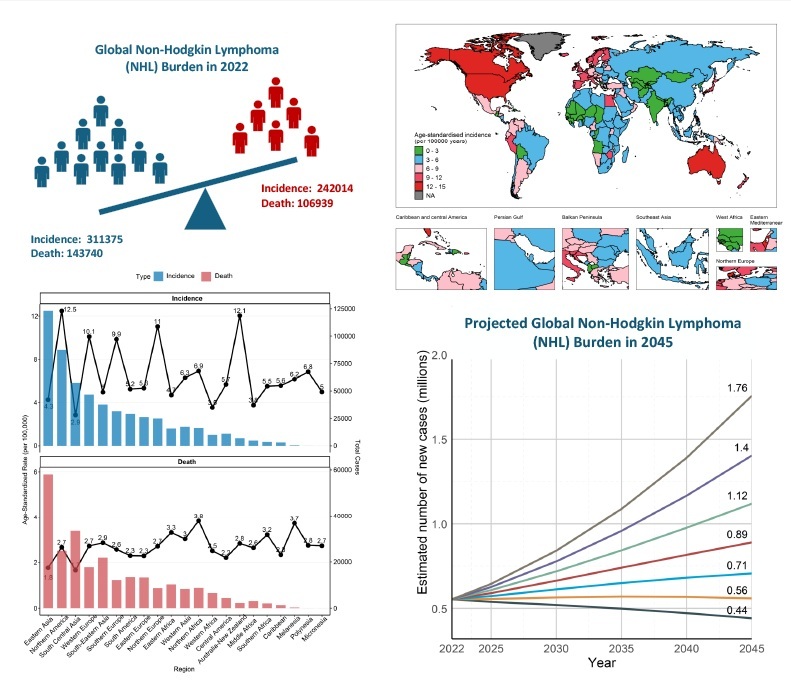
The global burden of NHL in 2022 was estimated at 553,389 incident cases and 250,679 deaths, with ASIR and ASMR of 5.6 and 2.4 per 100,000 person-years, respectively. Among these estimates, countries designated as very high and high HDI regions accounted for 81.34% of incident cases and 75.24% of deaths, whereas the very high HDI category, distinguished by the most elevated ASIR and ASMR of 17.72 and 6.63 per 100,000 person-years respectively, emerged as the predominant contributor within this stratification (Table I). At the regional level, Eastern Asia, Northern America, and South-Central Asia emerged as the leading contributors to the global burden of NHL, with incident cases numbering 123,078, 87,466, and 57,461 respectively, paralleled by mortality figures of 58,109, 24,714, and 33,317. With respect to ASIR, Northern America recorded the highest value at 12.49 per 100,000 person-years, closely followed by Australia/New Zealand (12.05), Northern Europe (11.04), Western Europe (10.11), and Southern Europe (9.86), whereas South-Central Asia (2.79) and African regions manifested the lowest rates, thereby highlighting substantial geographical disparities. In contrast, ASMR reached their peak in Northern Africa at 3.83 per 100,000 person-years, succeeded by Melanesia (3.72) and Eastern Africa (3.31), which collectively underscore a pronounced divergence between incidence and mortality patterns across diverse developmental contexts (Table I).
Table I
Number and age-standardized rates of non-Hodgkin lymphoma (NHL) incidence and mortality by sex and world region in 2022
Across global and regional scales, ASIR and ASMR for NHL remained consistently higher in males than in females, except in Western Africa, where this gender disparity inverted (Table I). At the global level, ASIR and ASMR exhibited a progressive increase with advancing age, peaking at 55.8 and 42.2 per 100,000 person-years respectively in individuals aged 85 years and older, a trend mirrored across all regions, in alignment with the global pattern, except in Micronesia and Polynesia, where limited sample sizes likely obscured this consistency (Supplementary Figure S1, Table I). Globally, the preponderance of incident NHL cases was concentrated within the 50–79 age group, which encompassed 64.26% of the total burden (approximately 355,486 cases), with the 65–69 age cohort representing the largest single subset at 71,000 cases. The most pronounced mortality burden emerged among individuals aged 70–74 years, registering 32,261 deaths, although a substantial proportion of fatalities also accrued in those aged 85 years and older. Across most regions, both incidence and mortality predominantly clustered among individuals aged 50 years and above, whereas East, Central, and West Africa exhibited a contrasting epidemiological pattern, wherein a notable proportion of incident cases and deaths spanned age cohorts below 50 years (Supplementary Figure S1). Specifically, very high HDI regions such as Western Europe exhibit approximately 80% of incidence and 93.3% of mortality in individuals over 60, while in East, Middle, and West Africa, these figures fall below 40% (Supplementary Figure S2).
National disparities in NHL incidence and mortality in 2022
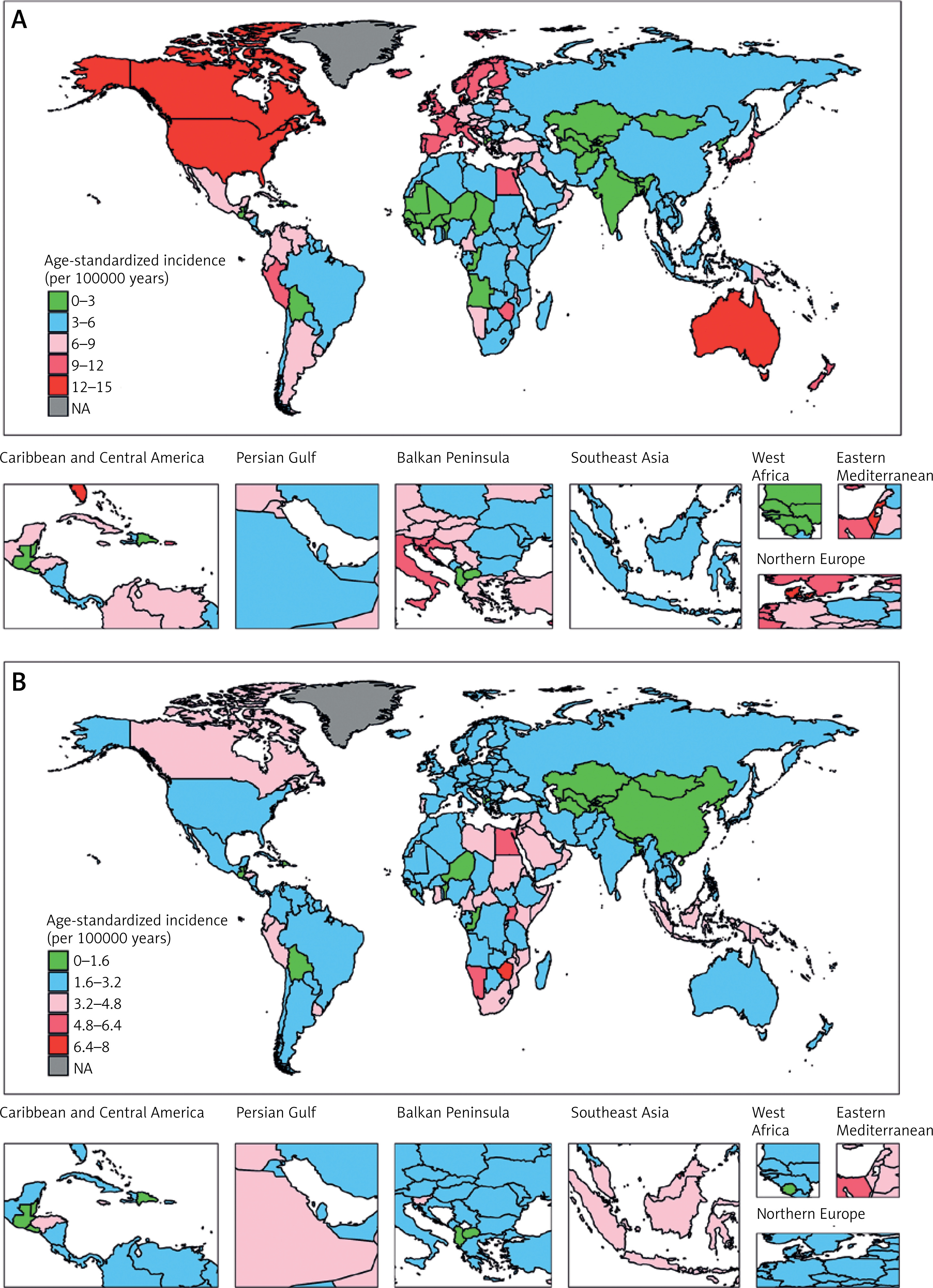
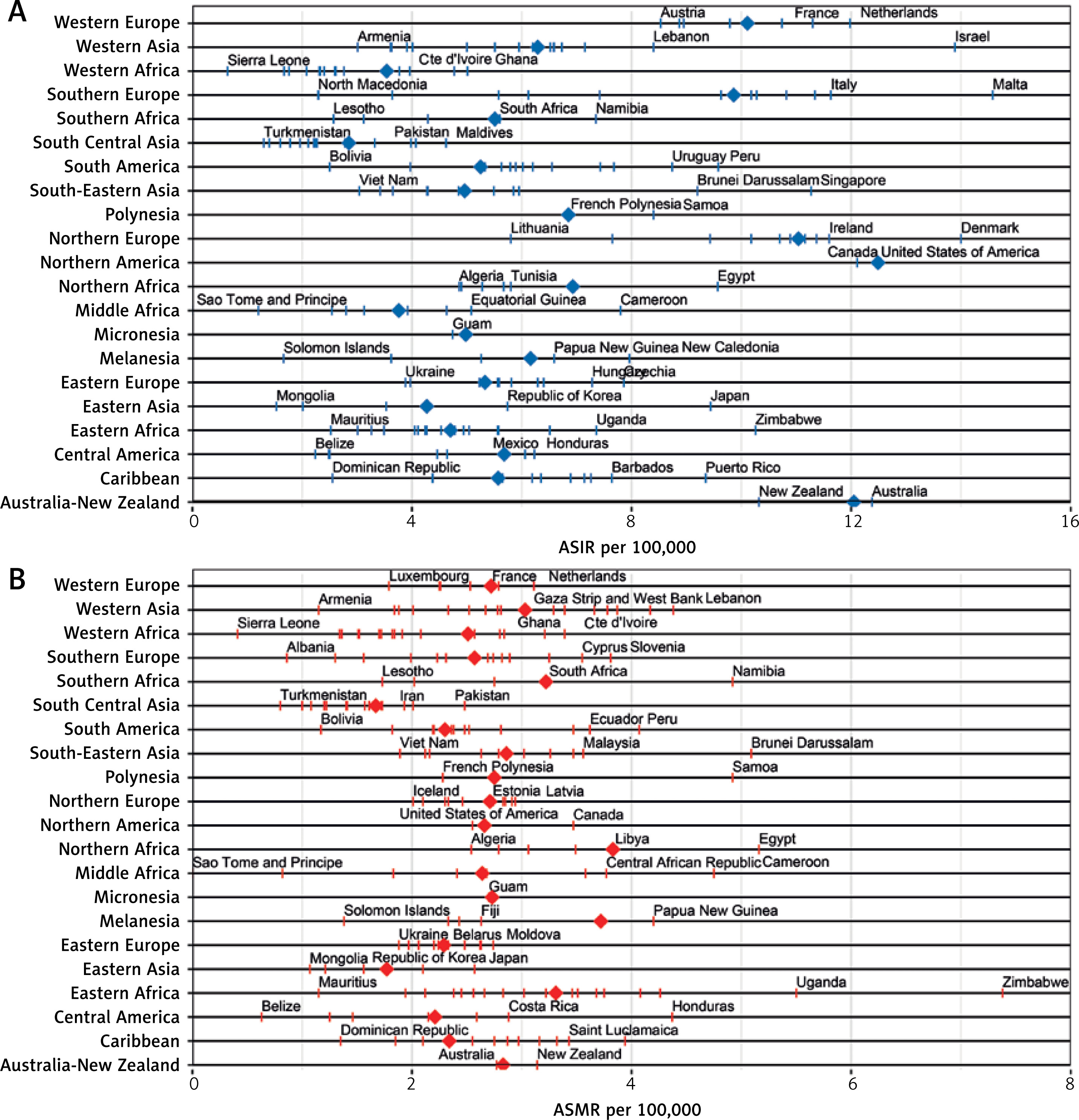
Striking disparities in NHL incidence and mortality across countries in 2022, as depicted in Figures 1 A, B and 2 A, B, underscore the influence of heterogeneous epidemiological and demographic factors. Globally, the highest ASIR emerged in Malta, Denmark, Israel, the United States, and Australia, registering 14.58, 14.00, 13.89, 12.54, and 12.38 per 100,000 person-years, respectively, whereas within Western Europe, the Netherlands recorded an ASIR of 11.98, and in Eastern Asia, Japan’s rate of 9.44 contrasted sharply with Mongolia’s global minimum of 1.53 per 100,000 person-years (Figure 2 A). In terms of mortality, the highest ASMR were observed in Zimbabwe, Uganda, Egypt, Brunei Darussalam, and Samoa, peaking at 7.38, 5.50, 5.16, 5.09, and 4.92 per 100,000 person-years respectively, revealing divergent patterns between incidence and mortality across global contexts (Figure 2 B, Supplementary Table SI).
Figure 1
Age-standardized rates (ASRs) for non-Hodgkin lymphoma (NHL) per 100,000 people in 2022, by country: A – age-standardized incidence rate (ASIR), B – age-standardized mortality rate (ASMR). Note: The world map was created using the R packages sf, ggplot2, and rnaturalearth, based on data from Natural Earth (public domain, no copyright restrictions; https://www.naturalearthdata.com). ASR data were obtained from GLOBOCAN 2022 (International Agency for Research on Cancer; https://gco.iarc.fr)
Temporal trends of NHL
Between 1990 and 2017/2020, ASIR for NHL exhibited pronounced temporal trends across countries, with most nations in Asia, Central-Eastern Europe, and Northern Europe demonstrating a sustained increase, a pattern that persisted beyond 2008, as substantiated by elevated estimated annual percentage changes (EAPC) (Figure 3 A, Supplementary Figure S3 A). Among males, Cyprus recorded the steepest rise, with an EAPC of 4.4895 (95% CI: 2.0542–6.9829) from 2008 to 2017, whereas in Asia, Japan, China, and South Korea registered substantial EAPCs of 4.1291 (95% CI: 3.0512–5.2184), 2.8797 (95% CI: 1.0506–4.7419), and 2.7203 (95% CI: 2.3383–3.1038), respectively, underscoring robust regional growth. For females, Iceland manifested the most rapid escalation, with an EAPC of 4.2895 (95% CI: 0.308–8.429) between 2011 and 2020, followed by Japan, Estonia, and Croatia, which collectively reinforced the upward trajectory. In contrast, Uganda, Kuwait, and the United States exhibited notable declines in EAPC for both sexes, highlighting a divergent epidemiological shift that deviates from the predominant global trend (Supplementary Figure S3 A).
Figure 3
Trends in age-standardized incidence rates (ASIRs) and age-standardized mortality rates (ASMRs) by regions, 1990–2017/2020: Asia, Central and Eastern Europe, Latin America, Northern America and Oceania, Northern Europe, Western and Southern Europe. Note: The trend above the line represents the change in ASIR, while the trend below the line represents the change in ASMR. Trend lines are smoothed using the LOESS regression algorithm (bandwidth: 0.4)
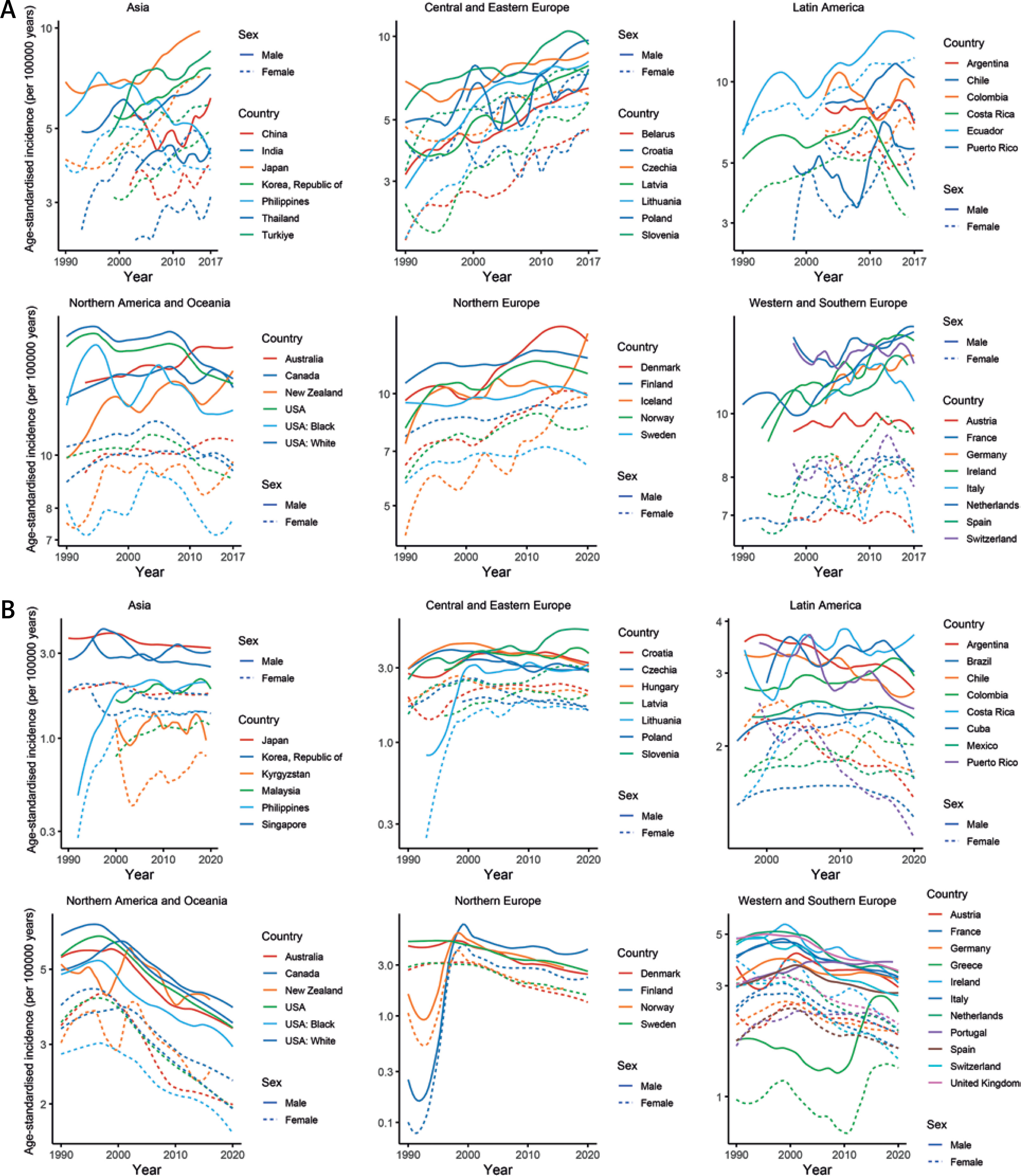
From 1990 to 2020, ASMR for NHL exhibited a prevailing decline across most countries, notably in North America, Oceania, Southwestern Europe, and selected nations in Asia and Northern Europe, a trend that persisted beyond 2011 with sustained reductions substantiated by EAPC (Figure 3 B, Supplementary Figure S3 B). Among females, Ireland manifested the most pronounced decrease, registering an EAPC of –6.1041 (95% CI: –8.4635 to –3.6838), closely followed by Israel at –4.6746 (95% CI: –6.3697 to –2.9488), whereas in Denmark, both sexes demonstrated substantial declines, with males at an EAPC of –3.9225 (95% CI: –4.8032 to –3.0336) and females at –3.9208 (95% CI: –5.6747 to –2.1344). Conversely, a striking divergence emerged in a minority of countries where ASMR rose markedly, with Greece recording the steepest increase – females at an EAPC of 8.1449 (95% CI: 3.2329 to 13.2906) and males at 6.6458 (95% CI: 1.9369 to 11.5722) – while significant upward trends also characterized males in South Africa and the Philippines, as well as females in Guatemala, Uruguay, and Slovakia, all exhibiting statistically robust positive EAPC values (Supplementary Figure S3 B).
Correlation of NHL with HDI
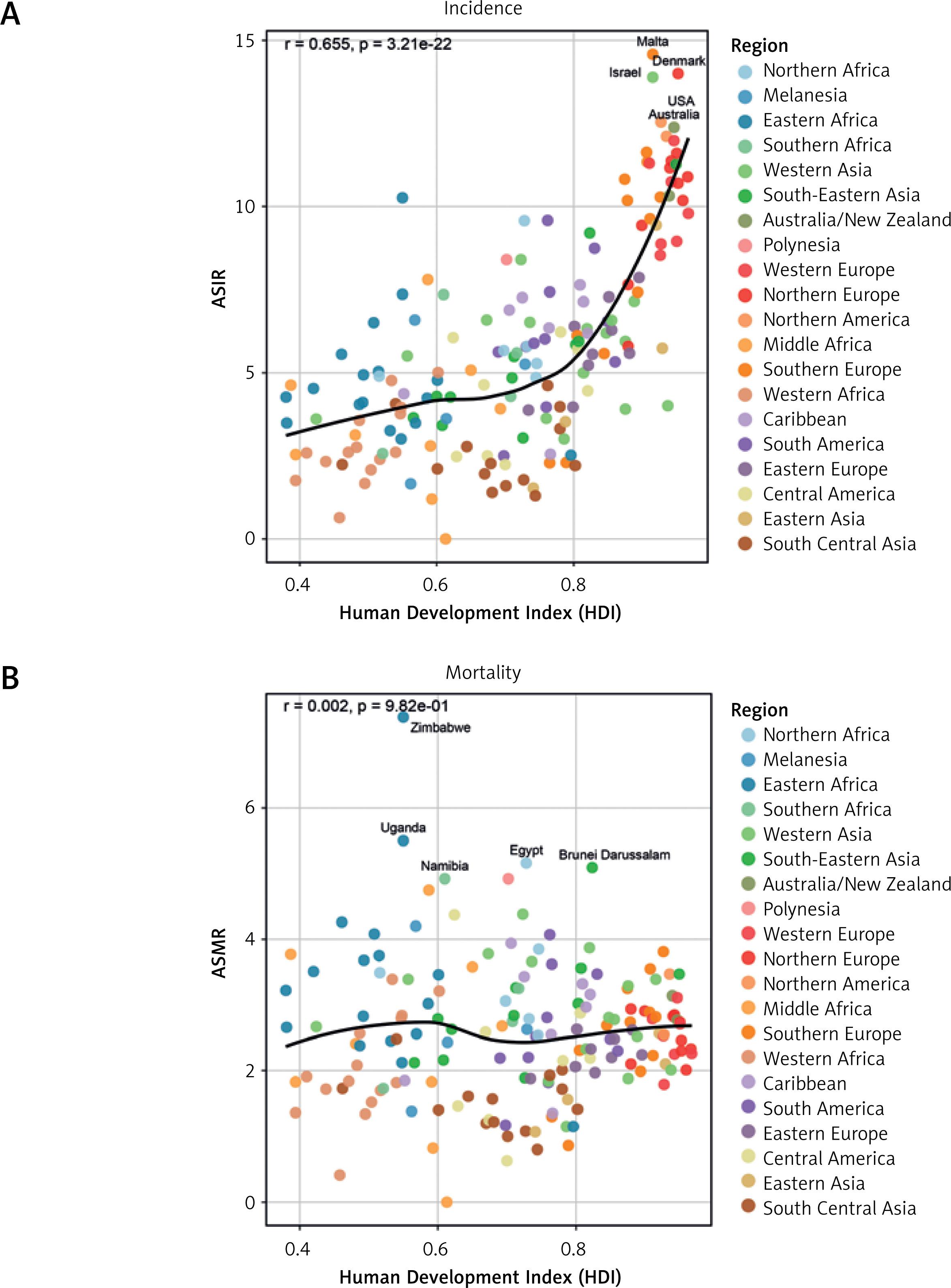
A complex association was identified between NHL metrics and the HDI, characterized by a significant correlation with incidence but a negligible correlation with mortality. For ASIR, a strong positive correlation with HDI was observed (r = 0.655, p = 3.21E-22, Figure 4 A). In contrast, ASMR exhibited no significant correlation with HDI (r = 0.002, p = 0.982, Figure 4 B).
Future NHL incidence and mortality burden in 2045
Regional projections indicate a sustained increase in NHL incidence and mortality across all regions by 2045, driven by demographic changes. In terms of incidence, East Asia is projected to experience a notable rise of 51.27%, reaching 186,174 new cases from a 2022 baseline of 123,078, followed by South-Central Asia with a 71.47% increase to 98,528 cases (from 57,461) and Northern America with a 40.08% increase to 122,519 cases (from 87,466). However, the largest proportional increases are anticipated in African regions, with Middle Africa, Eastern Africa, and Western Africa exhibiting growth rates of 109.10%, 97.96%, and 93.37%, respectively, reflecting significant demographic impacts. For mortality, the greatest absolute increases are projected in East Asia, with 43,023 additional deaths (reaching 101,132 from 58,109), South-Central Asia, with 25,303 (reaching 58,620 from 33,317), and Northern America, with 17,606 (reaching 42,320 from 24,714). The highest percentage increases in mortality are expected in Middle Africa, with 112.88%, Western Asia, with 111.53%, and Eastern Africa, with 105.36%, highlighting a substantial regional burden escalation. These projections underscore the varying influence of population dynamics on NHL epidemiology by 2045 (Figures 5 A, B). With respect to HDI classifications, regions with lower HDI exhibit a higher rate of increase, whereas regions with higher HDI demonstrate a greater absolute increase in magnitude (Supplementary Figure S4).
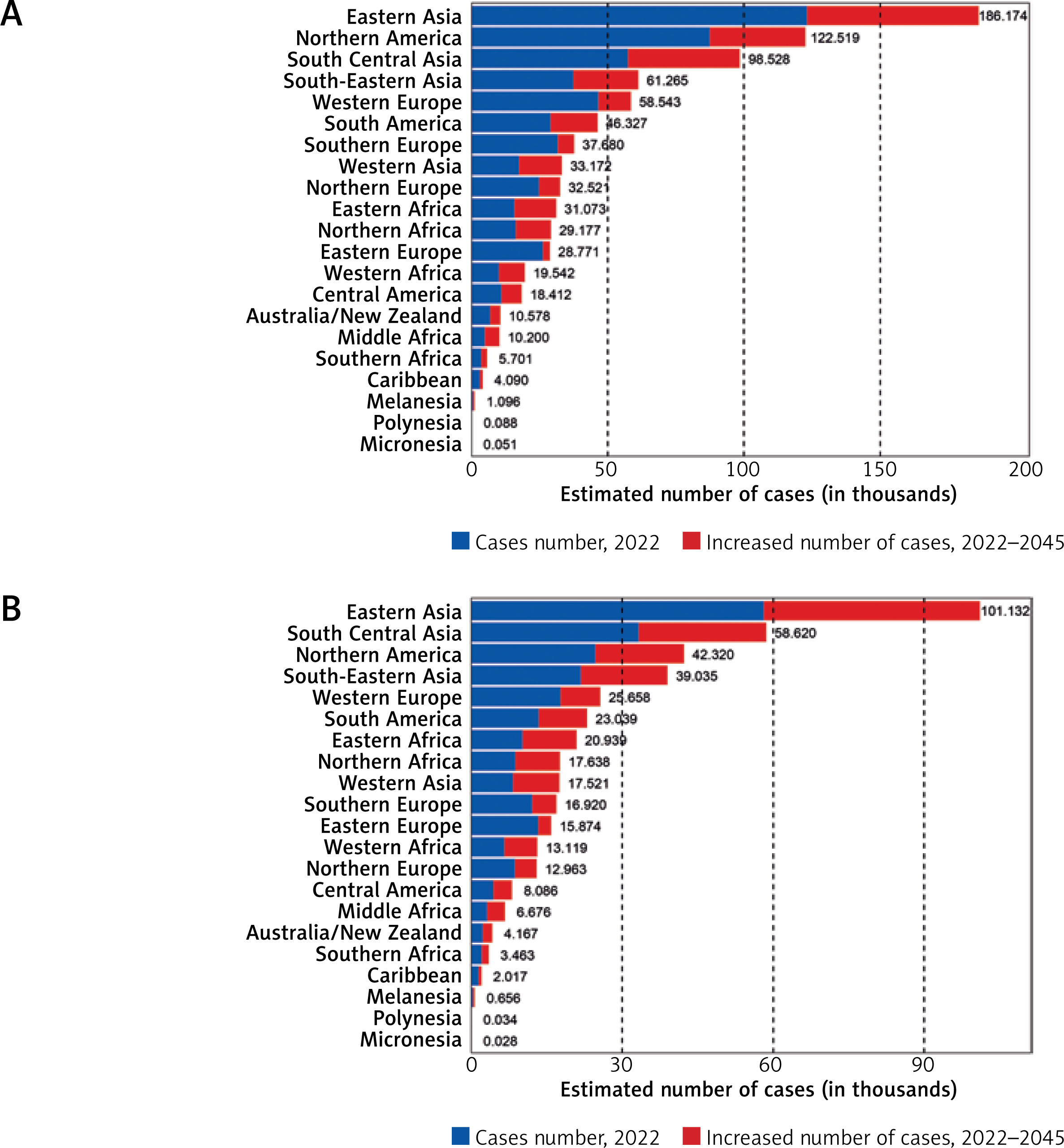
Global projections for NHL indicate a significant increase from the 2022 baseline of 553,156 cases and 250,556 deaths to approximately 889,841 million cases and 433,254 deaths by 2045 under the baseline scenario. When accounting for population changes within a ±3% range, six additional scenarios are projected, with case estimates ranging from 0.44 to 1.76 million and mortality estimates ranging from 0.22 to 0.86 million, corresponding to annual growth rates of –3% to +3% (Supplementary Figure S5).
Discussion
This study provides a comprehensive analysis of the epidemiological profile of NHL across 185 countries and regions in 2022, coupled with projections extending to 2045. The NHL burden was observed to exhibit significant heterogeneity across gender, age, HDI, geographic regions, and individual countries. Pronounced regional disparities were observed, with higher proportions of cases aged 60 and above in North America, Europe, and Australia/New Zealand (e.g., approximately 80% of incidence and 93.3% of mortality in Western Europe), compared to less than 40% in East, Middle, and West Africa for both incidence and mortality. Correspondingly, ASIR and ASMR displayed significant regional variation, with elevated ASIR in North America, Europe, and Australia/New Zealand, contrasting with lower ASIR in South-Central Asia and African subregions, particularly East, Middle, and West Africa, consistent with prior findings. Remarkably, 81.34% of incident cases and 75.24% of deaths were concentrated in very high and high HDI countries, substantiating a robust ASIR-HDI correlation. Conversely, no significant association was detected between ASMR and HDI, primarily attributable to the disproportionately high mortality in low HDI countries, driven by constrained medical resources, delayed diagnostic capabilities, and limited access to effective treatments, as opposed to diagnostic advancements in high HDI settings masking survival disparities. Projections for 2045 suggest that low HDI countries will experience a 98.45% surge in incident cases and a 94.33% rise in deaths, compared to increases of 35.32% and 54.87% in very high HDI countries, respectively, highlighting an escalating global disparity in NHL burden. This divergence suggests that NHL is becoming a two-tier disease: a preventable and manageable chronic condition in high-resource settings, versus a frequently fatal diagnosis in low-resource settings. This dichotomy underscores the urgent need for targeted health interventions that go beyond mere resource allocation, necessitating a shift towards building basic diagnostic infrastructure in low-HDI regions, rather than solely focusing on advanced therapeutic innovations suited for high-HDI countries.
In very high and high HDI regions such as North America, Europe, and Australia/New Zealand, the exceptionally high ASIR, alongside the rising ASIR in transitional countries, may partly stem from population aging, underpinned by genomic instability, epigenetic alterations, chronic inflammation, microbial dysbiosis, and immune surveillance failure [24–26]. In contrast, in African regions – particularly East, Middle, and West Africa – a striking predominance of NHL cases in the 0–60 age group diverges from the global and high-HDI pattern, where 60+ age groups prevail, likely due to lower life expectancy (e.g., approximately 54.48 years in the Central African Republic and 58.06 years in Namibia, compared to over 80 years in very high-HDI regions), and a predominantly younger population structure [27]. This finding has profound socio-economic implications, as the burden of NHL in Africa disproportionately affects the working-age population, potentially exacerbating poverty cycles compared to high-HDI regions, where the burden falls mainly on the retired demographic. This shifts the focus of intervention from geriatric oncology to bolstering pediatric and adult workforce health.
Lifestyle and environmental risk factors including high consumption of processed meats and obesity also contribute and are linked to increased NHL risk, particularly follicular lymphoma in Western populations [28, 29]. Furthermore, population-based screening programs and enhanced diagnostic tools such as PET/CT and biopsy likely inflate ASIR through early detection, with evidence of higher detection rates in high-HDI settings [30]. Given the aging-driven burden in high-HDI regions, strengthening research on the link between aging and NHL is critical to inform prevention and treatment strategies for older adults. Additionally, we found that the ASIR in males is higher than in females, especially in very high HDI regions, where the male ASIR is 52.7% higher than that of females, consistent with previous reports [31]. Studies have confirmed that the use of oral contraceptives can reduce the risk of all NHL subtypes, including diffuse large B-cell lymphoma (DLBCL) and follicular lymphoma (OR = 0.68, 95% CI: 0.49–0.94), though subsequent studies have not reached the same conclusion [32]. The molecular mechanisms by which sex hormones influence NHL development remain incompletely understood and require further exploration. From a translational perspective, this persistent male predominance suggests that future risk stratification models should consider sex as a critical variable, and clinical trials for immunotherapies or targeted agents might need to pre-specify sex-specific analyses to ensure equitable therapeutic outcomes.
Lower ASMR in very high and high HDI regions reflects improved survival, driven by rituximab-based therapies and stem cell transplantation, supported by improved treatment outcomes, while low-HDI regions such as East Africa face delayed diagnosis and limited access to rituximab, compounded by high HIV infection rates reaching 72.1% among NHL cases compared to 22.8% in Botswana’s general adult population, contributing to an exceptionally high ASMR/ASIR ratio [33–36]. Subtype variation further explains these disparities, with DLBCL predominating in high-HDI regions and T-cell lymphoma in Africa. For example, a histopathological review of 626 NHL cases from Central Africa found that Burkitt lymphoma (BL) accounted for 82% of all NHL cases among children under 18 years of age [37, 38]. Furthermore, in sub-Saharan Africa and parts of Latin America and the Caribbean, public healthcare expenditure accounts for less than 1% of GDP, with nearly 90% of the population still lacking access to essential public health services. This severely limits healthcare accessibility and health security in these regions [39]. The above explanations elucidate the intrinsic mechanisms behind the significant correlation between HDI and ASIR but not ASMR, underscoring the persistent health resource disparities, which should be addressed by enhancing diagnostic and treatment capacities in Africa through improved access to advanced tools, training of healthcare professionals, increased availability of molecular targeted drugs, strengthening HIV/AIDS control, and the establishment of regional cancer care networks. Critically, the strong interplay between HIV and NHL in these regions implies that integrated care models, where oncology services are co-delivered with infectious disease clinics, could yield synergistic benefits, transforming the current episodic care into a continuum of chronic disease management.
With the development and application of therapies targeting specific NHL subtypes, the ASMR has declined in most countries globally. However, a few nations, such as Greece, exhibit a persistent rise in ASMR between 2011 and 2020, potentially attributable to enhanced diagnostic efficacy, as suggested by studies on NHL subtype distribution within Greece [40]. Our projections indicate that, over the next 25 years, many countries will likely experience a rising ASIR primarily driven by population growth, aging, and other high-risk factors, accompanied by increased diagnosis rates, as observed in Greece. To address this evolving burden, future efforts should prioritize the continued development of targeted therapies, increased investment in radiotherapy infrastructure, and accelerated multidisciplinary collaboration to optimize diagnosis and treatment across diverse populations.
Compared to the Global Burden of Disease (GBD) 2019 estimates, which reported a global ASIR of NHL at approximately 5.7 per 100,000 and an ASMR of 3.2 per 100,000, with the highest proportion of cases in the 70–74 age group [41], our study reveals similar ASIR values but a notably lower ASMR of less than 3.2 per 100,000, alongside a shift in peak incidence to the 65–69 age group. In China specifically, our findings indicate an ASIR of 3.5 and an ASMR of 1.6 per 100,000, substantially below GBD 2019 estimates of 4.99 and 2.32, respectively [42], and far lower than Australia’s reported ASIR of 19.06 compared to our 12.4 [43]. Globally, our 553,389 cases exceed the 457,076 reported by GBD 2019 but fall below the 604,554 estimated by GBD 2021, though GBD 2021 later revised the 2019 estimate to 586,601 [44]. In contrast, GLOBOCAN 2022 provides more stable iterative estimates that align closely with our findings, building on the consistency seen in earlier GLOBOCAN 2020 data [45], possibly reflecting differences in data sources and challenges in data collection and modeling related to COVID-19 disruptions [46, 47]. Furthermore, compared with the U.S. age-adjusted incidence rate of 18.7 per 100,000 reported by the SEER program for 2018–2022, the 12.54 per 100,000 incidence in our study is substantially lower [48]. This discrepancy likely arises from differences in data sources and standardization methods between GLOBOCAN and SEER. Specifically, GLOBOCAN employs the world standard population proposed by Segi (1960) and modified by Doll et al. (1966) for age adjustment, enabling global comparability across regions with diverse demographic structures [49]. In contrast, SEER uses the U.S. 2000 standard population, which differs in its demographic composition and standardization framework [48]. Additionally, GLOBOCAN integrates national and subnational registry data through modeling procedures to estimate country-level incidence, whereas SEER derives its data directly from continuous, population-based cancer registries within the United States [46]. These methodological and demographic differences together explain the observed variation in reported rates. This discrepancy serves as a critical reminder for policymakers and researchers to exercise caution when comparing global estimates with national cancer statistics. It highlights the need for adopting standardized global age-adjustment frameworks in international comparisons, while relying on national registries such as SEER for domestic healthcare planning, thereby preventing misinterpretation of data that could lead to either unwarranted alarm or complacency in resource allocation.
This study has several important limitations that warrant consideration. First, the lack of detailed regional data on NHL subtype distribution limits our ability to fully assess subtype-specific contributions to observed disparities. For instance, PTCL, an aggressive subtype, constitutes approximately 24% of NHL cases in Asia but only 4% in North America [50], which may contribute to higher ASMR in regions with greater prevalence of such subtypes, independently of overall NHL ASIR. Second, data quality in low-income regions remains a concern, as underreporting and diagnostic inaccuracies may result in underestimation of ASIR and ASMR [45]. Third, our 23-year projections of new cases and deaths are based on current data trends and demographic forecasts. While our projection methodology follows established approaches in global cancer epidemiology, using population estimates from the United Nations World Population Prospects (WPP) 2019 Revision [51, 52], these projections are illustrative of potential trends rather than precise predictions and should be interpreted with caution. They do not account for future shifts in risk factors, demographic dynamics, or therapeutic advancements, which may influence the long-term burden of NHL. Taken together, these limitations emphasize the need for more detailed regional subtype data, improved registry coverage in low-HDI settings, and the application of dynamic and flexible modeling strategies to enhance the accuracy and utility of global NHL burden estimates.
In conclusion, a key strength of this study lies in its use of up-to-date and high-quality data from population-based cancer registries, enabling a comprehensive analysis of the current and projected global burden of NHL and its associated trends. By integrating these data, we provide updated insights into cross-country ASIR and ASMR disparities, our finding underscores critical global inequities in NHL burden, emphasizing the urgent need for enhanced diagnostic and therapeutic access in low-HDI regions, alongside continued efforts to address aging-related incidence in high-HDI areas, to mitigate the projected 2045 burden increase. Furthermore, enhancing public health awareness is critical to achieving sustainable reductions in NHL burden, complementing these efforts by addressing preventable risk factors across diverse populations.