Current issue
Archive
Manuscripts accepted
About the Journal
Editorial office
Editorial board
Section Editors
Abstracting and indexing
Subscription
Contact
Ethical standards and procedures
Most read articles
Instructions for authors
Article Processing Charge (APC)
Regulations of paying article processing charge (APC)


CLINICAL RESEARCH
Evaluating the Life’s Crucial 9 score as a predictor of all-cause and cardiovascular mortality in a diabetic and prediabetic population: insights from NHANES 2005–2018
1
Tianjin University of Traditional Chinese Medicine, China
2
Acupuncture Center for Brain Diseases, The Second Affiliated Hospital of Tianjin University of Traditional Chinese Medicine, China
These authors had equal contribution to this work
Submission date: 2026-03-24
Final revision date: 2026-06-15
Acceptance date: 2026-07-09
Online publication date: 2026-11-26
Corresponding author
Jiachun Xu
Acupuncture Center for Brain Diseases The Second Affiliated Hospital of Tianjin University of Traditional Chinese Medicine China
Zhen Zhou
Acupuncture Center for Brain Diseases The Second Affiliated Hospital of Tianjin University of Traditional Chinese Medicine China
KEYWORDS
TOPICS
ABSTRACT
Introduction:
The aim of the study was to investigate the association between the Life’s Crucial 9 (LC9) score and all-cause and cardiovascular mortality in individuals with diabetes or prediabetes.
Material and methods:
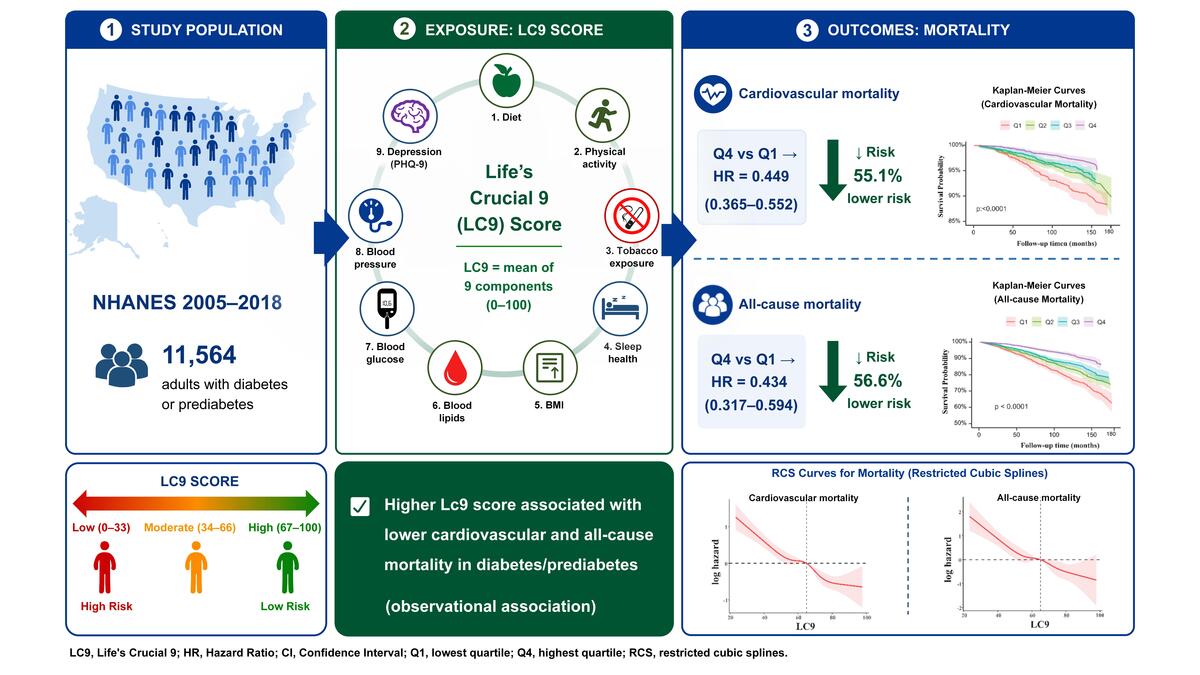
This prospective cohort study included 11,564 adults with diabetes/prediabetes from NHANES 2005–2018. The LC9 score (0–100) comprised four health behaviors, four health factors, and a depression component (PHQ-9). Weighted Cox proportional hazards models, Kaplan–Meier curves, and restricted cubic splines were used. Incremental predictive performance was assessed by C-index, time-dependent AUC, net reclassification improvement (NRI), and integrated discrimination improvement (IDI). Multiple imputation was performed for sensitivity analysis.
Results:
Higher LC9 scores were associated with lower all-cause and cardiovascular mortality. In fully adjusted models, compared with the lowest quartile (Q1), the highest quartile (Q4) yielded HRs of 0.434 (95% CI: 0.317–0.594) for all-cause mortality and 0.449 (95% CI: 0.365–0.552) for cardiovascular mortality (both p for trend < 0.0001), with no significant evidence of nonlinearity. Adding LC9 significantly improved the C-index (all-cause: from 0.806 to 0.815; cardiovascular: from 0.833 to 0.847), with NRIs of 34.7% and 42.3%, and IDIs of 0.70% and 0.61%, respectively. Time-dependent AUCs were consistently improved across follow-up. Stronger associations were observed in younger participants and those without a family history of cardiovascular disease.
Conclusions:
Higher LC9 scores are associated with lower risks of all-cause and cardiovascular mortality in U.S. adults with diabetes/prediabetes. Adding LC9 to the baseline model provided additional prognostic information, with discrimination and reclassification analyses suggesting potential improvement in risk stratification.
REFERENCES (35)
2.
International Diabetes Federation. IDF diabetes atlas. 8th ed. Brussels: International Diabetes Federation 2017.
3.
Singh GM, Danaei G, Farzadfar F, et al. The age-specific quantitative effects of metabolic risk factors on cardiovascular diseases and diabetes: a pooled analysis. PLoS One 2013; 8: e65174.
4.
Danaei G, Lawes CM, Vander Hoorn S, Murray CJ, Ezzati M. Global and regional mortality from ischaemic heart disease and stroke attributable to higher-than-optimum blood glucose concentration: comparative risk assessment. Lancet 2006; 368: 1651-9.
5.
D’Agostino RB Sr, Pencina MJ, Massaro JM, Coady S. Cardiovascular disease risk assessment: insights from Framingham. Glob Heart 2013; 8: 11-23.
6.
GBD 2016 Causes of Death Collaborators. Global, regional, and national age-sex specific mortality for 264 causes of death, 1980-2016: a systematic analysis for the Global Burden of Disease Study 2016. Lancet 2017; 390: 1151-210.
7.
GBD 2017 Causes of Death Collaborators. Global, regional, and national age-sex-specific mortality for 282 causes of death in 195 countries and territories, 1980-2017: a systematic analysis for the Global Burden of Disease Study 2017. Lancet 2018; 392: 1736-88.
8.
Einarson TR, Acs A, Ludwig C, Panton UH. Prevalence of cardiovascular disease in type 2 diabetes: a systematic literature review of scientific evidence from across the world in 2007-2017. Cardiovasc Diabetol 2018; 17: 83-102.
9.
Fox CS, Golden SH, Anderson C, et al. Update on prevention of cardiovascular disease in adults with type 2 diabetes mellitus in light of recent evidence: a scientific statement from the American Heart Association and the American Diabetes Association. Circulation 2015; 132: 691-718.
10.
World Health Organization. Depression. Geneva: WHO; 2020. Available from: https://www.who.int/en/news-ro....
11.
Charlson FJ, Stapelberg NJ, Baxter AJ, Whiteford HA. Should global burden of disease estimates include depression as a risk factor for coronary heart disease? BMC Med 2011; 9: 47-53.
12.
Egede LE, Nietert PJ, Zheng D. Depression and all-cause and coronary heart disease mortality among adults with and without diabetes. Diabetes Care 2005; 28: 1339-45.
13.
Atlantis E, Shi Z, Penninx BJ, Wittert GA, Taylor A, Almeida OP. Chronic medical conditions mediate the association between depression and cardiovascular disease mortality. Soc Psychiatry Psychiatr Epidemiol 2012; 47: 615-25.
14.
Bruin MC, Comijs HC, Kok RM, Van der Mast RC, Van den Berg JF. Lifestyle factors and the course of depression in older adults: a NESDO study. Int J Geriatr Psychiatry 2018; 33: 1000-8.
15.
Sacco RL. The new American Heart Association 2020 goal: achieving ideal cardiovascular health. J Cardiovasc Med 2011; 12: 255-7.
16.
Lloyd-Jones DM, Allen NB, Anderson CAM, et al. Life’s Essential 8: updating and enhancing the American Heart Association’s construct of cardiovascular health: a presidential advisory from the American Heart Association. Circulation 2022; 146: e18-43.
17.
Gaffey AE, Rollman BL, Burg MM. Strengthening the pillars of cardiovascular health: psychological health is a crucial component. Circulation 2024; 149: 641-3.
18.
Krebs-Smith SM, Pannucci TE, Subar AF, et al. Update of the Healthy Eating Index: HEI-2015. J Acad Nutr Diet 2018; 118: 1591-602.
19.
Yi J, Wang L, Guo X, Ren X. Association of Life’s Essential 8 with all-cause and cardiovascular mortality among US adults: a prospective cohort study from the NHANES 2005-2014. Nutr Metab Cardiovasc Dis 2023; 33: 1134-43.
20.
National Cancer Institute. Healthy Eating Index SAS code. 2022. Available from: https://epi.grants.cancer.gov/....
21.
Kroenke K, Spitzer RL, Williams JB. The PHQ-9: validity of a brief depression severity measure. J Gen Intern Med 2001; 16: 606-13.
22.
American Diabetes Association. Standards of medical care in diabetes - 2013. Diabetes Care 2013; 36 (Suppl 1): S11-66.
23.
World Health Organization. Definition and diagnosis of diabetes mellitus and intermediate hyperglycemia: report of a WHO/IDF consultation. Geneva: World Health Organization 2006.
24.
Liu C, Liang D, Xiao K, Xie L. Association between the triglyceride-glucose index and all-cause and CVD mortality in the young population with diabetes. Cardiovasc Diabetol 2024; 23: 171-82.
25.
Sun J, Li Y, Zhao M, et al. Association of the American Heart Association’s new “Life’s Essential 8” with all-cause and cardiovascular disease-specific mortality: prospective cohort study. BMC Med 2023; 21: 116-29.
26.
Li Y, Chu Y, Abudukeranmu A, et al. Life’s essential 8 and mortality in US adults with diabetes: greater risk reduction compared to those without diabetes. Can J Diabetes 2026; 50: 381-93.
27.
Huang ZG, Gao JW, Zhang HF, et al. Cardiovascular health metrics defined by Life’s Essential 8 scores and subsequent macrovascular and microvascular complications in individuals with type 2 diabetes: a prospective cohort study. Diabetes Obes Metab 2024; 26: 2673-83.
28.
Tian X, Chen S, Xu Q, et al. Longitudinal cardiovascular health measured by life’s essential 8 metrics with incident diabetes: a 13-year prospective cohort study. Diabetes Metab Res Rev 2024; 40: e3757.
29.
Ge J, Peng W, Lu J. Predictive value of Life’s Crucial 9 forp Cardiovascular and All-Cause Mortality: a prospective cohort study from the NHANES 2007 to 2018. J Am Heart Assoc 2024; 13: e036669.
30.
Gong H, Gao M, Zeng Z. The association between life’s crucial 9 and all-cause, cancer-specific and cardiovascular mortality in US cancer survivors: a cohort study of NHANES. BMC Cancer 2025; 25: 805-18.
31.
Pu B, Wang W, Lei L, et al. Association of depressive symptoms and cardiovascular health with mortality among U.S. adults. J Psychosom Res 2025; 189: 112032.
32.
Drake I, Dias JA, Teleka S, Stocks T, Orho-Melander M. Lifestyle and cancer incidence and mortality risk depending on family history of cancer in two prospective cohorts. Int J Cancer 2020; 146: 1198-207.
33.
Kokubo Y, Padmanabhan S, Iwashima Y, Yamagishi K, Goto A. Gene and environmental interactions according to the components of lifestyle modifications in hypertension guidelines. Environ Health Prev Med 2019; 24: 19-30.
34.
Dong X, Zhong X, Lin Y, et al. Associations of life’s essential 8 with mortality among individuals with diabetes and/or hypertension: statistical mediation by inflammation and biological aging. Mediators Inflamm 2026; 1: e3674573.
35.
Watts EL, Matthews CE, Freeman JR, et al. Association of leisure time physical activity types and risks of all-cause, cardiovascular, and cancer mortality among older adults. JAMA Netw Open 2022; 5: e2228510.
Share
RELATED ARTICLE
| eISSN: | 1896-9151 |
| ISSN: | 1734-1922 |

We process personal data collected when visiting the website. The function of obtaining information about users and their behavior is carried out by voluntarily entered information in forms and saving cookies in end devices. Data, including cookies, are used to provide services, improve the user experience and to analyze the traffic in accordance with the Privacy policy. Data are also collected and processed by Google Analytics tool (more).
You can change cookies settings in your browser. Restricted use of cookies in the browser configuration may affect some functionalities of the website.