Current issue
Archive
Manuscripts accepted
About the Journal
Editorial office
Editorial board
Section Editors
Abstracting and indexing
Subscription
Contact
Ethical standards and procedures
Most read articles
Instructions for authors
Article Processing Charge (APC)
Regulations of paying article processing charge (APC)


DIABETOLOGY / RESEARCH PAPER
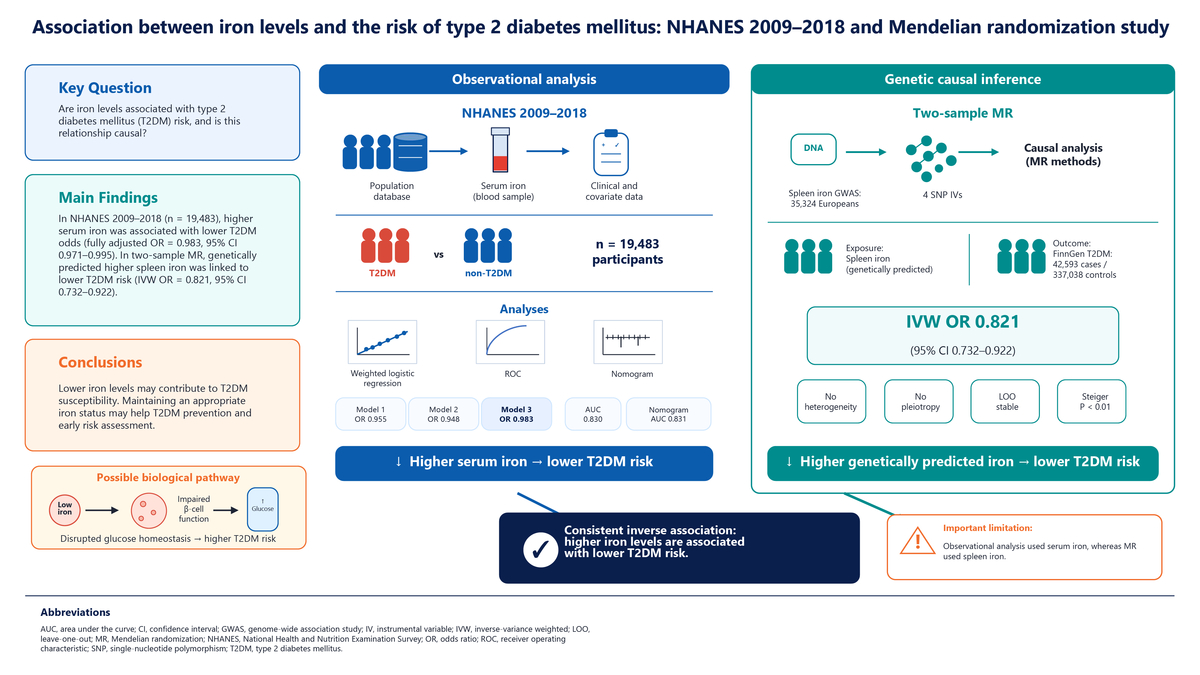
Association between iron levels and the risk of type 2 diabetes mellitus: NHANES 2009−2018 and Mendelian randomization study
1
Department of Endocrinology, The Fifth Affiliated Hospital of Guangxi Medical University, Nanning, Guangxi, China, China
2
Department of Endocrinology, The First People’s Hospital of Nanning, Guangxi, China, China
Submission date: 2025-12-22
Final revision date: 2026-05-25
Acceptance date: 2026-06-18
Online publication date: 2026-09-05
Corresponding author
Xuemi Huang
Department of Endocrinology, The First People’s Hospital of Nanning, Guangxi, China, China
Department of Endocrinology, The First People’s Hospital of Nanning, Guangxi, China, China
KEYWORDS
TOPICS
ABSTRACT
Introduction:
The association between serum iron levels and type 2 diabetes mellitus (T2DM) remains unclear.
Material and methods:
In total, 19,483 participants from the National Health and Nutrition Examination Survey (NHANES) 2009–2018 were included in this study. The weighted t-test and chi-squared test were used to compare differences in iron levels and covariates between individuals with and without T2DM. Subsequently, weighted multivariate logistic regression models were constructed to assess the association between iron levels and T2DM risk. Furthermore, Mendelian randomization (MR) analysis was conducted to evaluate the causal effect of iron levels on T2DM. Sensitivity analysis and Steiger’s test were employed to validate the dependability and effectiveness of the MR findings.
Results:
Weighted multivariate logistic regression analyses revealed a statistically significant inverse association between iron levels and T2DM risk, with odds ratios of 0.955, 0.948, and 0.983 in models 1, 2, and 3, respectively. Receiver operating characteristic curve analysis implied that iron levels accurately identified patients with T2DM. MR analysis demonstrated a marked causal impact of iron levels on T2DM risk, and iron levels represented a protective factor to some extent. Sensitivity analysis confirmed the robustness of the MR findings, and Steiger’s test confirmed the plausibility and validity of the causal effect direction of iron levels on T2DM.
Conclusions:
This study supported a negative correlation between iron levels and T2DM risk, which holds potential clinical significance for T2DM prevention and early risk assessment.
The association between serum iron levels and type 2 diabetes mellitus (T2DM) remains unclear.
Material and methods:
In total, 19,483 participants from the National Health and Nutrition Examination Survey (NHANES) 2009–2018 were included in this study. The weighted t-test and chi-squared test were used to compare differences in iron levels and covariates between individuals with and without T2DM. Subsequently, weighted multivariate logistic regression models were constructed to assess the association between iron levels and T2DM risk. Furthermore, Mendelian randomization (MR) analysis was conducted to evaluate the causal effect of iron levels on T2DM. Sensitivity analysis and Steiger’s test were employed to validate the dependability and effectiveness of the MR findings.
Results:
Weighted multivariate logistic regression analyses revealed a statistically significant inverse association between iron levels and T2DM risk, with odds ratios of 0.955, 0.948, and 0.983 in models 1, 2, and 3, respectively. Receiver operating characteristic curve analysis implied that iron levels accurately identified patients with T2DM. MR analysis demonstrated a marked causal impact of iron levels on T2DM risk, and iron levels represented a protective factor to some extent. Sensitivity analysis confirmed the robustness of the MR findings, and Steiger’s test confirmed the plausibility and validity of the causal effect direction of iron levels on T2DM.
Conclusions:
This study supported a negative correlation between iron levels and T2DM risk, which holds potential clinical significance for T2DM prevention and early risk assessment.
REFERENCES (39)
1.
Yan Y, Wu T, Zhang M, Li C, Liu Q, Li F. Prevalence, awareness and control of type 2 diabetes mellitus and risk factors in Chinese elderly population. BMC Public Health 2022;22:1382.
2.
Kautzky-Willer A, Harreiter J, Pacini G. Sex and Gender Differences in Risk, Pathophysiology and Complications of Type 2 Diabetes Mellitus. Endocr Rev 2016;37:278-316.
3.
Wei C, Zhao P, Zhai W, Zhao M, Sun L. Prediction of Post-Stroke Cognitive Impairment Based on Iron Metabolism Parameters: Results From a Prospective Study. Mol Neurobiol 2025;62:13352-13362.
4.
Fang X, Ardehali H, Min J, Wang F. The molecular and metabolic landscape of iron and ferroptosis in cardiovascular disease. Nat Rev Cardiol 2023;20:7-23.
5.
Sarkaya NC, Uğur Kurtoğlu A, Uğur S, Göçer M. The relationship between ghrelin and iron metabolism in beta thalassaemia major patients. Arch Med Sci 2024;21:1354-1360.
6.
Harrison AV, Lorenzo FR, McClain DA. Iron and the Pathophysiology of Diabetes. Annu Rev Physiol 2023;85:339-362.
7.
Zhao P, Lv X, Zhou Z, Yang X, Huang Y, Liu J. Indexes of ferroptosis and iron metabolism were associated with the severity of diabetic nephropathy in patients with type 2 diabetes mellitus: a cross-sectional study. Front Endocrinol (Lausanne) 2023;14:1297166.
8.
Feng J, Shan X, Wang L, Lu J, Cao Y, Yang L. Association of Body Iron Metabolism with Type 2 Diabetes Mellitus in Chinese Women of Childbearing Age: Results from the China Adult Chronic Disease and Nutrition Surveillance (2015). Nutrients 2023;15(8):1935.
9.
Ning Y, Pan D, Guo J, et al. Association of prognostic nutritional index with the risk of all-cause mortality and cardiovascular mortality in patients with type 2 diabetes: NHANES 1999-2018. BMJ Open Diabetes Res Care 2023;11:e003564.
10.
Yuan Y, Isasi C R, Al-Rousan T, et al. Associations of Concurrent Hypertension and Type 2 Diabetes With Mortality Outcomes: A Prospective Study of U.S. Adults. Diabetes Care 2025;48:1241-1250.
11.
Birney E. Mendelian Randomization. Cold Spring Harb Perspect Med 2022;12:a041302.
12.
Liu J, Cao Q, Lu D, Zheng B, Wen J. Mendelian randomization studies of diagnostic value of standard biochemistry serum enzymes portfolio in cardiovascular diseases. Arch Med Sci 2025;21:695-700.
13.
Zhao J, Zhang T, Zhu Y, et al. High-density lipoprotein cholesterol and nuclear factor I A in type 2 diabetes and mild cognitive impairment: biomarkers and mechanistic insights. Arch Med Sci 2025;21:2304-2318.
14.
Panos A, Mavridis D. TableOne: an online web application and R package for summarising and visualising data. Evid Based Ment Health 2020;23: 127-130.
15.
Robin X, Turck N, Hainard A, et al. pROC: an open-source package for R and S+ to analyze and compare ROC curves. BMC Bioinformatics 2011;12:77.
16.
Hemani G, Zheng J, Elsworth B, et al. The MR-Base platform supports systematic causal inference across the human phenome. Elife 2018;7:e34408.
17.
Bowden J, Davey Smith G, Burgess S. Mendelian randomization with invalid instruments: effect estimation and bias detection through Egger regression. Int J Epidemiol 2015;44:512-525.
18.
Burgess S, Scott RA, Timpson NJ, Davey Smith G, Thompson SG; EPIC- InterAct Consortium. Using published data in Mendelian randomization: a blueprint for efficient identification of causal risk factors. Eur J Epidemiol 2015;30:543-552.
19.
Bowden J, Davey Smith G, Haycock PC, Burgess S. Consistent Estimation in Mendelian Randomization with Some Invalid Instruments Using a Weighted Median Estimator. Genet Epidemiol 2016;40:304-314.
20.
Hartwig FP, Davey Smith G, Bowden J. Robust inference in summary data Mendelian randomization via the zero modal pleiotropy assumption. Int J Epidemiol 2017;46:1985-1998.
21.
Qin Q, Zhao L, Ren A, et al. Systemic lupus erythematosus is causally associated with hypothyroidism, but not hyperthyroidism: A Mendelian randomization study. Front Immunol 2023;14:1125415.
22.
Davey Smith G, Hemani G. Mendelian randomization: genetic anchors for causal inference in epidemiological studies. Hum Mol Genet 2014;23:R89-R98.
23.
Cui Z, Feng H, He B, He J, Tian Y. Relationship Between Serum Amino Acid Levels and Bone Mineral Density: A Mendelian Randomization Study. Front Endocrinol (Lausanne) 2021;12:763538.
24.
Xiao G, He Q, Liu L, et al. Causality of genetically determined metabolites on anxiety disorders: a two-sample Mendelian randomization study. J Transl Med 2022;20:475.
25.
Hu PW, Yang BR, Zhang XL, et al. The association between dietary inflammatory index with endometriosis: NHANES 2001-2006. PLoS One 2023;18:e0283216.
26.
Kim C, Bullard KM, Herman WH, Beckles GL. Association between iron deficiency and A1C Levels among adults without diabetes in the National Health and Nutrition Examination Survey, 1999-2006. Diabetes Care 2010;33:780-785.
27.
Mukasa RJ, Mubiru N, Sekitoleko I, et al. Comparative assessment of the impact of iron deficiency on HbA1c accuracy in non-anaemic individuals with type 2 diabetes: A secondary data analysis. PLoS One 2026;21:e0323034.
28.
Cheng WW, Zhu Q, Zhang HY. Mineral Nutrition and the Risk of Chronic Diseases: A Mendelian Randomization Study. Nutrients 2019;11:378.
29.
Hu X, Lin Y, Appleton AA, et al. Remnant cholesterol, iron status and diabetes mellitus: a dose-response relationship and mediation analysis. Diabetol Metab Syndr 2024;16:65.
30.
Marku A, Galli A, Marciani P, Dule N, Perego C, Castagna M. Iron Metabolism in Pancreatic Beta-Cell Function and Dysfunction. Cells 2021;10:2841.
31.
Katsiki N, Mikhailidis DP. Iron absorption, bone marrow fat and hematopoiesis in heart failure: Additional mechanisms of action for sodium-glucose co-transporter 2 inhibitors (SGLT2i)? J Diabetes Complications 2019;33:107408.
32.
Hansen JB, Moen IW, Mandrup-Poulsen T. Iron: the hard player in diabetes pathophysiology. Acta Physiol (Oxf) 2014;210:717-732.
33.
Sahebkar A, Foroutan Z, Katsiki N, Jamialahmadi T, Mantzoros CS. Ferroptosis, a new pathogenetic mechanism in cardiometabolic diseases and cancer: Is there a role for statin therapy? Metabolism 2023;146:155659.
34.
Urrechaga E. Influence of iron deficiency on HbA1c levels in type 2 diabetic patients. Diabetes Metab Syndr 2018;12:1051-1055.
35.
Katwal PC, Jirjees S, Htun ZM, Aldawudi I, Khan S. The Effect of Anemia and the Goal of Optimal HbA1c Control in Diabetes and Non-Diabetes. Cureus 2020;12:e8431.
36.
Hilton C, Sabaratnam R, Drakesmith H, Karpe F. Iron, glucose and fat metabolism and obesity: an intertwined relationship. Int J Obes (Lond) 2023;47:554-563.
37.
Bjørklund G, Peana M, Pivina L, et al. Iron Deficiency in Obesity and after Bariatric Surgery. Biomolecules 2021;11:613.
38.
Kalra S, Coetzee A, Kalra PA, Saldaña JR, Kilov G. Rubrometabolic Syndrome. Minerva Endocrinol (Torino) 2023;48:59-75.
39.
Wu Y, Xiao M, Chen J, et al. Association of dietary iron intake with diabetic kidney disease among individuals with diabetes. Endocrine 2024;85:1154-1161.
Share
RELATED ARTICLE
| eISSN: | 1896-9151 |
| ISSN: | 1734-1922 |

We process personal data collected when visiting the website. The function of obtaining information about users and their behavior is carried out by voluntarily entered information in forms and saving cookies in end devices. Data, including cookies, are used to provide services, improve the user experience and to analyze the traffic in accordance with the Privacy policy. Data are also collected and processed by Google Analytics tool (more).
You can change cookies settings in your browser. Restricted use of cookies in the browser configuration may affect some functionalities of the website.
You can change cookies settings in your browser. Restricted use of cookies in the browser configuration may affect some functionalities of the website.