Current issue
Archive
Manuscripts accepted
About the Journal
Editorial office
Editorial board
Section Editors
Abstracting and indexing
Subscription
Contact
Ethical standards and procedures
Most read articles
Instructions for authors
Article Processing Charge (APC)
Regulations of paying article processing charge (APC)


CLINICAL RESEARCH
Macroeconomic burden of colorectal cancer in low- and middle-income countries: estimates and projections to 2050
1
Institute of Clinical Medicine, Ruijin Hospital Luwan Branch, Shanghai Jiao Tong University School of Medicine, Shanghai, China
2
National Institute of Parasitic Diseases, Chinese Center for Disease Control and Prevention (Chinese Center for Tropical Diseases Research), Shanghai, China
3
Department of nephrology, Southwest Hospital Jiangbei Area (The 958th Hospital of Chinese People’s Liberation Army), Chongqing, China
4
Departments of Pediatric, Ruijin Hospital, Shanghai Jiao Tong University School of Medicine, Shanghai, China
5
Clinical Research and Development Center of Shanghai Municipal Hospitals, Shanghai Hospital Development Center, Shanghai, China
These authors had equal contribution to this work
Submission date: 2026-06-08
Final revision date: 2026-08-04
Acceptance date: 2026-10-16
Online publication date: 2026-11-26
KEYWORDS
colorectal cancerlow- and middle-income countriesvalue of lost welfareeconomic burdenhealth economics
TOPICS
ABSTRACT
Introduction:
Colorectal cancer (CRC) is an increasing health challenge in low- and middle-income countries (LMICs), where demographic transition, population ageing, and limited access to screening and treatment amplify both health and economic consequences. However, the macroeconomic burden of CRC across LMICs remains insufficiently characterised.
Material and methods:
We conducted a cross-country macroeconomic valuation study across 122 LMICs using data from the Global Burden of Disease 2023 study. CRC-attributable disability-adjusted life years (DALYs) were monetised using a value of a statistical life year (VSLY) approach to estimate the value of lost welfare (VLW). Country-specific DALY series from 1990 to 2023 were projected to 2050 using exponential smoothing state space models and incorporated into the VLW framework. Results were reported in absolute terms and relative to gross domestic product (GDP). Sensitivity analyses tested alternative income-elasticity assumptions.
Results:
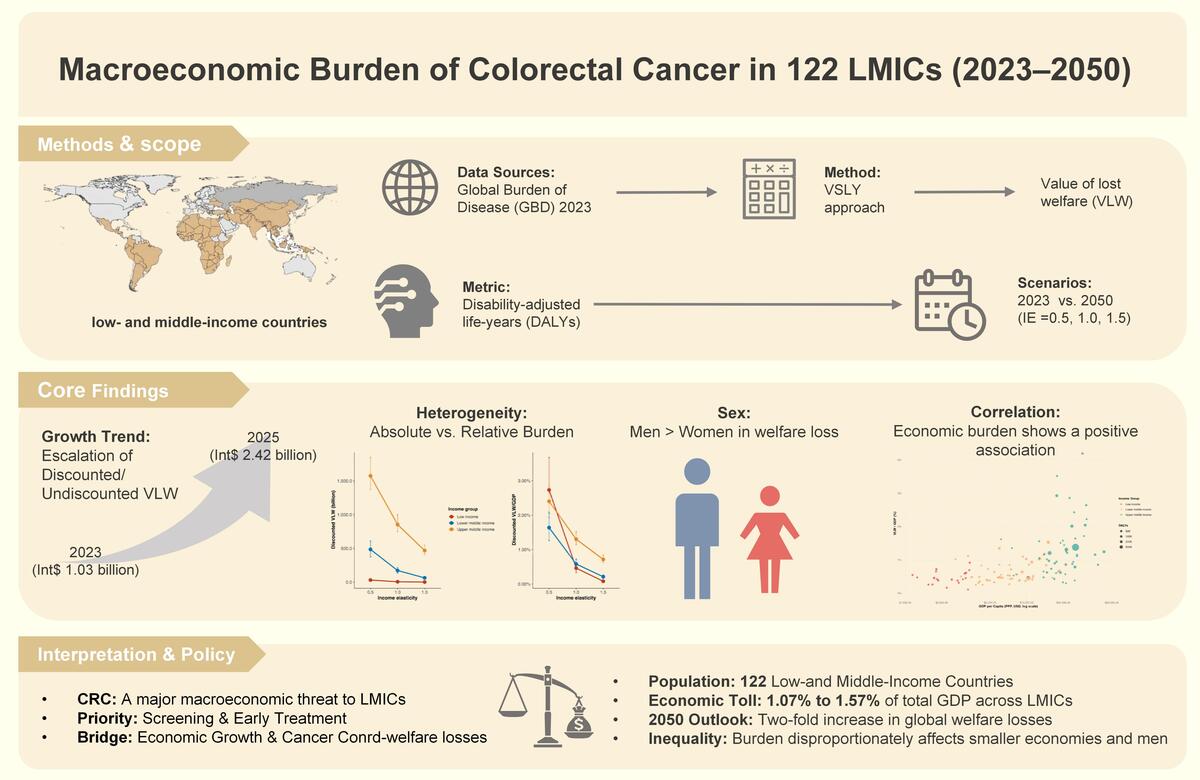
In 2023, total discounted VLW attributable to CRC across LMICs was Int$1.03 trillion (1.07% of GDP), increasing to Int$1.51 trillion (1.57% of GDP) when undiscounted. By 2050, DALYs are projected to reach 46.73 million, with discounted and undiscounted VLW rising to Int$2.42 trillion and Int$3.51 trillion, respectively. Absolute economic losses were concentrated in upper-middle-income countries, whereas relative burdens were higher in some lower-income and smaller economies. GDP per capita was positively associated with relative economic burden in 2023, with no significant association observed in the 2050 projections. Aggregate welfare losses across LMICs were higher among men than among women.
Conclusions:
CRC imposes a substantial and uneven macroeconomic burden across LMICs, with divergence between absolute and relative impacts. Macroeconomic valuation may improve priority setting and support context-specific cancer control.
REFERENCES (42)
1.
Bray F, Laversanne M, Sung H, et al. Global cancer statistics 2022: GLOBOCAN estimates of incidence and mortality worldwide for 36 cancers in 185 countries. CA Cancer J Clin 2024; 74: 229-63.
2.
Lopez BAA, Pinto-Colmenarez R, Caliwag FMC, et al. Colorectal cancer screening and management in low- and middle-income countries and high-income countries: a narrative review. Cureus 2024; 16: e70933.
3.
Afolaranmi O, Diehl TM, Virani SS, et al. Survival following colorectal cancer surgery in low- and middle-income countries: a systematic review and meta-analysis. J Surg Oncol 2026; 133: 872-80.
4.
Hämmerl L, Mezger NCS, Seraphin TP, et al. Treatment and survival among patients with colorectal cancer in Sub-Saharan Africa: a multicentric population-based follow-up study. J Natl Compr Canc Netw 2023; 21: 924-33.e7.
5.
Tao M, Zhang P, Yang W, et al. Global, regional, and national burden of disease attributable to a diet low in milk, 1990–2021: an updated analysis of the Global Burden of Disease study 2021. J Dairy Sci 2025; 108: 4558-72.
6.
Lv W, Wang S, Duan L, et al. Estimating the global macroeconomic impact of colorectal cancer: evidence from Global Burden of Disease 2021 and Value of a Statistical Life Year framework. Int J Surg 2026; 112: 9577-86.
7.
Gerstl JVE, Blitz S, Qu QR, et al. Global, regional, and national economic consequences of stroke. Stroke 2023; 54: 2380-9.
8.
Matyja M, Pasternak A, Szura M, et al. How to improve the adenoma detection rate in colorectal cancer screening? Clinical factors and technological advancements. Arch Med Sci 2019; 15: 424-33.
9.
Horton S, Gauvreau CL. Cancer in Low- and Middle-Income Countries: An Economic Overview, in Cancer: Disease Control Priorities, Third Edition, H. Gelband, et al., Editors. 2015, The International Bank for Reconstruction and Development/The World Bank: Washington, DC.
10.
Chen S, Cao Z, Nandi A, et al. The global macroeconomic burden of Alzheimer’s disease and other dementias: estimates and projections for 152 countries or territories. Lancet Glob Health 2024; 12: e1534-43.
11.
Ranganathan K, Singh P, Raghavendran K, et al. The global macroeconomic burden of breast cancer: implications for oncologic surgery. Ann Surg 2021; 274: 1067-72.
12.
Zheng J, Yao L, Lei K, et al. Economic burden attributable to high BMI-caused cancers: a global level analysis between 2002 and 2021. BMC Med 2025; 23: 297.
13.
GBD 2021 Diseases and Injuries Collaborators. Global incidence, prevalence, years lived with disability (YLDs), disability-adjusted life-years (DALYs), and healthy life expectancy (HALE) for 371 diseases and injuries in 204 countries and territories and 811 subnational locations, 1990-2021: a systematic analysis for the Global Burden of Disease Study 2021. Lancet 2024; 403: 2133-61.
14.
GBD 2023 Cancer Collaborators. The global, regional, and national burden of cancer, 1990-2023, with forecasts to 2050: a systematic analysis for the Global Burden of Disease Study 2023. Lancet 2025; 406: 1565-86.
15.
The World, B. World Bank Country and Lending Groups. 2024/10/11; Available from: https://datahelpdesk.worldbank....
16.
Zhong H, Yu S, Huang Y, Xuan F. Temporal trends in mortality of female cancers among women and the impact of COVID-19 in low- and middle-income countries, 1990-2023: an age-period-cohort analysis from the Global Burden of Disease Study 2023. Int J Womens Health 2026; 18: 581359.
17.
Wang C, Sun Y, Jiang D, Wang C, Liu S. Risk-attributable burden of ischemic heart disease in 137 low- and middle-income countries from 2000 to 2019. J Am Heart Assoc 2021; 10: e021024.
18.
Erbas B, Hyndman RJ, Gertig DM. Forecasting age-specific breast cancer mortality using functional data models. Stat Med 2007; 26: 458-70.
19.
Hyndman RJ, Khandakar Y. Automatic time series forecasting: the forecast Package for R. J Stat Software 2008; 27: 1-22.
20.
Hurvich CM, Tsai CL. Regression and time series model selection in small samples. Biometrika 1989; 76: 297-307.
21.
Husereau D, Drummond M, Augustovski F, et al. Consolidated Health Economic Evaluation Reporting Standards 2022 (CHEERS 2022) statement: updated reporting guidance for health economic evaluations. Value Health 2022; 25: 3-9.
22.
GBD 2019 Diseases and Injuries Collaborators. Global burden of 369 diseases and injuries in 204 countries and territories, 1990-2019: a systematic analysis for the Global Burden of Disease Study 2019. Lancet 2020; 396: 1204-22.
23.
He Y, Wang X, Zhou M, et al. Global, regional and national burden of colon and rectum cancer: a systematic analysis of prevalence, incidence, deaths and DALYs from 1990 to 2021 using data from the Global Burden of Disease Study 2021 with projections to 2036. BMJ Open 2025; 15: e100042.
24.
Arnold M, Sierra MS, Laversanne M, et al. Global patterns and trends in colorectal cancer incidence and mortality. Gut 2017; 66: 683-91.
25.
Islami F, Marlow EC, Thomson B, et al. Proportion and number of cancer cases and deaths attributable to potentially modifiable risk factors in the United States, 2019. CA Cancer J Clin 2024; 74: 405-32.
26.
Jamison DT, Summers LH, Alleyne G, et al. Global health 2035: a world converging within a generation. Lancet 2013; 382: 1898-955.
27.
Kazi DS, Elind MSV, Deutsch A, et al. Forecasting the economic burden of cardiovascular disease and stroke in the United States through 2050: a presidential advisory from the American Heart Association. Circulation 2024; 150: e89-101.
28.
Dekker E, Tanis PJ, Vleugels JLA, Kasi PM, Wallace MB. Colorectal cancer. Lancet 2019; 394: 1467-80.
29.
Murphy CC, Harlan LC, Lund JL, et al. Patterns of colorectal cancer care in the United States: 1990-2010. J Natl Cancer Inst 2015; 107: djv198.
30.
Wong MC, Ding H, Wang J, Chan PSF, Huang J. Prevalence and risk factors of colorectal cancer in Asia. Intest Res 2019; 17: 317-29.
31.
Favoriti P, Carbone G, Greco M, Pirozzi F, Pirozzi REM, Corcione F. Worldwide burden of colorectal cancer: a review. Updates Surg 2016; 68: 7-11.
32.
Yu KX, Yuan WJ, Huang CH, et al. Socioeconomic deprivation and survival outcomes in patients with colorectal cancer. Am J Cancer Res 2022; 12: 829-38.
33.
Carethers JM. Racial and ethnic disparities in colorectal cancer incidence and mortality. Adv Cancer Res 2021; 151: 197-229.
34.
Poulson MR, Geary A, Annesi C, Dechert T, Kenzik K, Hall J. The impact of income and social mobility on colorectal cancer outcomes and treatment: a cross-sectional study. Ann Surg 2022; 275: 546-50.
35.
Tsokkou S, Konstantinidis I, Papakonstantinou M, et al. Sex differences in colorectal cancer: epidemiology, risk factors, and clinical outcomes. J Clin Med 2025; 14: 5539.
36.
González-Flores E, Garcia-Carbonero R, Élez E, et al. Gender and sex differences in colorectal cancer screening, diagnosis and treatment. Clin Transl Oncol 2025; 27: 2825-37.
37.
van Erning FN, Greidanus NEM, Verhoeven RHA, et al. Gender differences in tumor characteristics, treatment and survival of colorectal cancer: a population-based study. Cancer Epidemiol 2023; 86: 102441.
38.
Kuipers EJ, Grady WM, Lieberman D, et al. Colorectal cancer. Nat Rev Dis Primers 2015; 1: 15065.
39.
Rolfo C, Russo A. The next frontier for colorectal cancer screening: blood-based tests. Cancer Res 2024; 84: 3128-9.
40.
Waldmann E, Jiricka L, Zessner-Spitzenberg J, et al. Differences between men and women with respect to colorectal cancer mortality despite screening colonoscopy. Gastrointest Endosc 2024; 99: 998-1005.e2.
41.
Shao M, Yu J, Dai S, Zhang W. Transcobalamin I: a potential diagnostic biomarker and therapeutic target for deep venous thrombus in colorectal cancer. Arch Med Sci 2025; 21: 2868-71.
42.
Robinson LA, Hammitt JK, O’Keeffe L. Valuing mortality risk reductions in global benefit-cost analysis. J Benefit Cost Anal 2019; 10 (Suppl 1): 15-50.
| eISSN: | 1896-9151 |
| ISSN: | 1734-1922 |

We process personal data collected when visiting the website. The function of obtaining information about users and their behavior is carried out by voluntarily entered information in forms and saving cookies in end devices. Data, including cookies, are used to provide services, improve the user experience and to analyze the traffic in accordance with the Privacy policy. Data are also collected and processed by Google Analytics tool (more).
You can change cookies settings in your browser. Restricted use of cookies in the browser configuration may affect some functionalities of the website.