Current issue
Archive
Manuscripts accepted
About the Journal
Editorial office
Editorial board
Section Editors
Abstracting and indexing
Subscription
Contact
Ethical standards and procedures
Most read articles
Instructions for authors
Article Processing Charge (APC)
Regulations of paying article processing charge (APC)


OSTEOPOROSIS / RESEARCH PAPER
Genetic Associations Between Common Medication Use and Osteoporosis-Related Outcomes: A Mendelian Randomization Study
1
Department of Orthopaedics, Deyang people's Hospital, China
These authors had equal contribution to this work
Submission date: 2025-11-03
Final revision date: 2026-02-09
Acceptance date: 2026-02-25
Online publication date: 2026-06-04
Corresponding author
KEYWORDS
OsteoporosisDrug-Related Side Effects and Adverse ReactionsMendelian Randomization AnalysisThyroid HormonesAnilidesAntidiabetic Agents
TOPICS
ABSTRACT
Introduction:
Osteoporosis pathogenesis involves a complex interplay of genetic predisposition and medication exposure. Although long-term medication use contributes to bone fragility, which is distinct from osteomalacia, genetic evidence linking common medication-use traits to osteoporosis remains limited.
Material and methods:
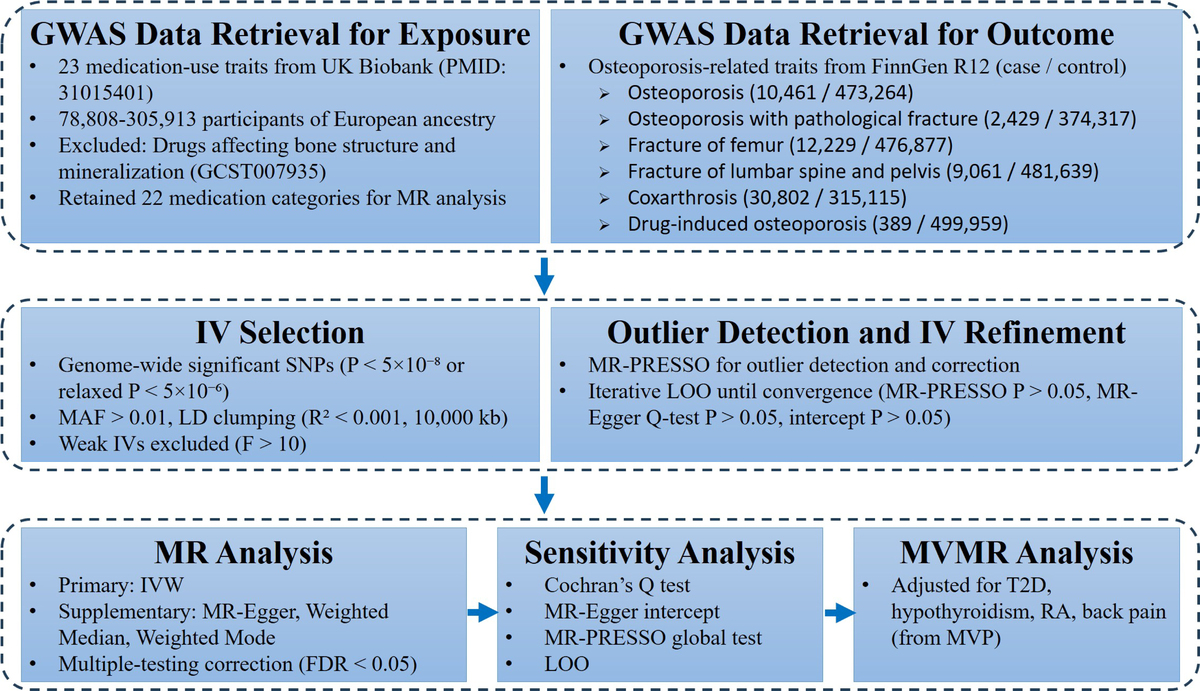
Two-sample Mendelian randomization (MR) analyses utilized GWAS data for 22 medication-use traits (UK Biobank) and osteoporosis outcomes (FinnGen R12). Multivariable MR (MVMR) was employed to adjust for confounding by underlying disease indications. Primary estimates were derived using the inverse variance–weighted (IVW) method, supported by comprehensive sensitivity analyses including MR-Egger, weighted median, and MR-PRESSO to evaluate heterogeneity and pleiotropy.
Results:
Univariable MR identified seven significant associations: anilide use with increased osteoporosis risk (OR=1.25, FDR=0.0201); immunosuppressant use with higher risks of osteoporosis with pathological fracture (OR=1.16, FDR=0.0074) and drug-induced osteoporosis (OR=1.36, FDR=0.0168); thyroid preparations with increased osteoporosis (OR=1.08, FDR=0.0016), drug-induced osteoporosis, and osteoporosis with pathological fracture; and an inverse association between antidiabetic drug use and osteoporosis (OR=0.88, FDR=0.0002). In MVMR, associations for anilide and thyroid preparation use remained significant after adjusting for back pain and hypothyroidism, respectively. However, the antidiabetic signal reversed after type 2 diabetes adjustment, indicating the observed benefit was likely confounded by the underlying metabolic condition rather than a direct pharmacological effect.
Conclusions:
Genetic evidence supports that anilide and thyroid hormone use may independently increase osteoporosis risk, while the protection from antidiabetic therapy is confounded by diabetes status. Medication-related osteoporosis should be considered in long-term pharmacologic management.
Osteoporosis pathogenesis involves a complex interplay of genetic predisposition and medication exposure. Although long-term medication use contributes to bone fragility, which is distinct from osteomalacia, genetic evidence linking common medication-use traits to osteoporosis remains limited.
Material and methods:
Two-sample Mendelian randomization (MR) analyses utilized GWAS data for 22 medication-use traits (UK Biobank) and osteoporosis outcomes (FinnGen R12). Multivariable MR (MVMR) was employed to adjust for confounding by underlying disease indications. Primary estimates were derived using the inverse variance–weighted (IVW) method, supported by comprehensive sensitivity analyses including MR-Egger, weighted median, and MR-PRESSO to evaluate heterogeneity and pleiotropy.
Results:
Univariable MR identified seven significant associations: anilide use with increased osteoporosis risk (OR=1.25, FDR=0.0201); immunosuppressant use with higher risks of osteoporosis with pathological fracture (OR=1.16, FDR=0.0074) and drug-induced osteoporosis (OR=1.36, FDR=0.0168); thyroid preparations with increased osteoporosis (OR=1.08, FDR=0.0016), drug-induced osteoporosis, and osteoporosis with pathological fracture; and an inverse association between antidiabetic drug use and osteoporosis (OR=0.88, FDR=0.0002). In MVMR, associations for anilide and thyroid preparation use remained significant after adjusting for back pain and hypothyroidism, respectively. However, the antidiabetic signal reversed after type 2 diabetes adjustment, indicating the observed benefit was likely confounded by the underlying metabolic condition rather than a direct pharmacological effect.
Conclusions:
Genetic evidence supports that anilide and thyroid hormone use may independently increase osteoporosis risk, while the protection from antidiabetic therapy is confounded by diabetes status. Medication-related osteoporosis should be considered in long-term pharmacologic management.
| eISSN: | 1896-9151 |
| ISSN: | 1734-1922 |

We process personal data collected when visiting the website. The function of obtaining information about users and their behavior is carried out by voluntarily entered information in forms and saving cookies in end devices. Data, including cookies, are used to provide services, improve the user experience and to analyze the traffic in accordance with the Privacy policy. Data are also collected and processed by Google Analytics tool (more).
You can change cookies settings in your browser. Restricted use of cookies in the browser configuration may affect some functionalities of the website.
You can change cookies settings in your browser. Restricted use of cookies in the browser configuration may affect some functionalities of the website.