Current issue
Archive
Manuscripts accepted
About the Journal
Editorial office
Editorial board
Section Editors
Abstracting and indexing
Subscription
Contact
Ethical standards and procedures
Most read articles
Instructions for authors
Article Processing Charge (APC)
Regulations of paying article processing charge (APC)


ONCOLOGY / STATE OF THE ART PAPER
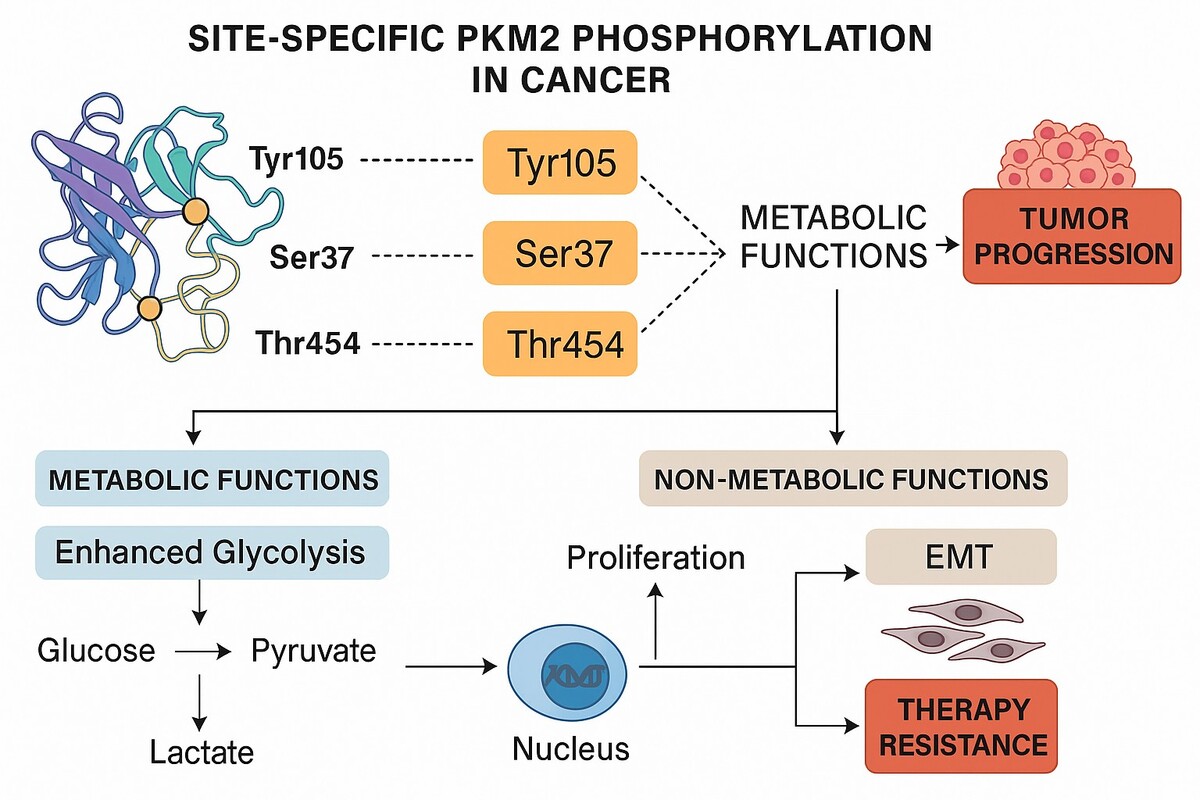
Site-specific PKM2 phosphorylation in Cancer: A systematic review of its role in metabolic plasticity and precision therapy

1
Department of Clinical Laboratory Sciences, Faculty of Applied Medical Sciences, Najran University, 1988, Najran 61441, Saudi Arabia, Saudi Arabia
Submission date: 2025-10-29
Final revision date: 2026-03-23
Acceptance date: 2026-03-24
Online publication date: 2026-06-04
Corresponding author
Mohammed Merae Alshahrani
Department of Clinical Laboratory Sciences, Faculty of Applied Medical Sciences, Najran University, 1988, Najran 61441, Saudi Arabia, Saudi Arabia
Department of Clinical Laboratory Sciences, Faculty of Applied Medical Sciences, Najran University, 1988, Najran 61441, Saudi Arabia, Saudi Arabia
KEYWORDS
Precision oncologyPyruvate kinase M2 (PKM2)Site-specific phosphorylationCancer metabolismTumor growth and therapy resistanceMetabolic plasticity
TOPICS
ABSTRACT
Pyruvate Kinase M2 (PKM2), a central glycolytic enzyme, plays a key role in tumour metabolism and growth. Its activity is regulated via site-specific phosphorylation at Tyr105, Ser37, and Thr454, affecting metabolic plasticity, tumour progression, and therapy resistance. This systematic review consolidates evidence on PKM2 phosphorylation in cancer, its metabolic and signalling roles, and potential as a biomarker and therapeutic target in precision oncology. A systematic search of PubMed, Scopus, and EMBASE was conducted per PRISMA 2020 guidelines. Studies examining site-specific PKM2 phosphorylation and its functional or clinical relevance in cancer were included. Data extraction focused on phosphorylation sites, signalling pathways, metabolic and tumour effects, and therapeutic applications. Fifty-eight studies met inclusion. Tyr105, Ser37, and Thr454 influenced PKM2 activity, localization, and oncogenic interactions, enhancing glycolysis, tumour plasticity, growth, and therapy resistance. Site-specific PKM2 phosphorylation regulates metabolism and tumour behaviour, highlighting its value as a biomarker and therapeutic target.
| eISSN: | 1896-9151 |
| ISSN: | 1734-1922 |

We process personal data collected when visiting the website. The function of obtaining information about users and their behavior is carried out by voluntarily entered information in forms and saving cookies in end devices. Data, including cookies, are used to provide services, improve the user experience and to analyze the traffic in accordance with the Privacy policy. Data are also collected and processed by Google Analytics tool (more).
You can change cookies settings in your browser. Restricted use of cookies in the browser configuration may affect some functionalities of the website.
You can change cookies settings in your browser. Restricted use of cookies in the browser configuration may affect some functionalities of the website.