Introduction
Atherosclerotic renal artery stenosis (ARAS) is a frequent finding, especially in older patients and those with cardiovascular comorbidities [1, 2]. While even non-obstructive renal artery lesions are associated with higher incidence of cardiovascular death (CVD), all-cause mortality and cardiovascular ischaemic events, therapy with statin, angiotensin-II-receptor antagonists (sartans) and angiotensin-converting enzyme inhibitors (ACEI) may decrease this risk [3–5]. On the other hand, ACEI may also offer renal function (RF) preservation in medically treated patients with primary hypertension, but in those with ARAS, use of ACEI and sartans suppresses renal function [5, 6].
Although medical treatment is a first line management strategy in patients with renovascular hypertension [4], recent population-based data show that antihypertensive therapy is insufficient in about 30% of hypertensive patients, leading to masked uncontrolled blood pressure elevations [7]. This inadequate blood pressure control is most frequent in patients with cardiovascular comorbidities and those who require multiple antihypertensive medications [7, 8].
Lack of sufficient blood pressure control and progression of renal failure in the presence of ARAS promotes patients’ referral to endovascular intervention with stent-assisted angioplasty (PTA) [9–11]. Although systolic (SBP) and diastolic blood pressure (DBP) lowering following PTA for ARAS is associated with better outcomes, the effect of PTA on blood pressure response is difficult to predict [9, 10]. For example, randomized trials demonstrate mild or no advantage of PTA plus best medical therapy (BMT) over BMT alone in regard to blood pressure or renal function improvement in unselected patients with ARAS [6–8, 12]. On the other hand, observational studies reported potential benefits of PTA for ARAS, including reductions in cardiovascular death (CVD) and all-cause mortality, blood pressure lowering, and even hypertension remission [13–15].
In summary, the profile of an individual patient with ARAS who may benefit from PTA for ARAS remains unclear. The ongoing clinical challenge is to identify patients who are likely to respond to PTA in terms of BP improvement, ideally with an associated reduction in cardiovascular risk [9, 16].
Renal color-coded Doppler ultrasonography (DUS) is used to identify patients with ARAS, and it is recommended in class I according to guidelines [17]. However, whether DUS can enhance patient selection for PTA in ARAS and whether it has any predictive value in assessing the probability of a favourable post-PTA response in terms of SBP and DBP lowering remain undetermined.
Data regarding the role of preoperative renal ultrasonography and assessment of clinical variables as potential predictors of PTA response are scarce [18, 19]. Whilst kidney size, renal resistive index and stenosis-related parameters may indicate the degree of renovascular system damage, kidneys and renal vasculature may also provide information on the reversibility of the process. ARAS-induced neurohormonal activation of the sympathetic nervous system and the renin-angiotensin-aldosterone system is a key factor associated with accelerated hypertension, progressive renal impairment and cardiovascular instability [20].
Therefore, the aim of the present study was to investigate which ultrasonographic and clinical features distinguish responders from non-responders to PTA in terms of SBP and DBP reduction.
Material and methods
Study population
Between January 2003 and December 2018, 202 patients with anatomically and/or functionally significant ARAS (50% to 99% lumen diameter stenosis on quantitative angiography), concomitant accelerated or refractory hypertension on at least 3 antihypertensive medications, and/or RF impairment underwent PTA for ARAS. Exclusion criteria included: non-atherosclerotic renal artery stenosis (9 patients with fibromuscular dysplasia) and non-diagnostic renal ultrasonography (1 patient).
The institutional review board approved the protocol, and all patients gave written informed consent.
Assessment of renal flow parameters and kidneys on renal color-coded Doppler ultrasonography (DUS)
The DUS was performed with the patient in a supine and/or left or right lateral position, depending on which renal artery was assessed. Assessments were performed by two operators, using a high-resolution ultrasonograph (TOSHIBA APLIO with a 3.5–5MHz probe). The DUS assessment included the following parameters: systolic velocity in aorta, peak-systolic (PSV) and end-diastolic velocity (EDV) in the index renal artery, renal-aortic ratio (RAR), resistive index in the renal artery (RI) and intra-renal resistive index (IRI). The pole-to-pole length of the index and contralateral kidneys was measured.
Renal artery stenting
The detailed PTA procedure was described previously [16]. In brief, PTA was performed either for angiographically significant ARAS exceeding at least 70% diameter stenosis on quantitative angiography, or in cases with 50–69% diameter stenosis (9 patients) after haemodynamic confirmation of stenosis severity by means of a fractional flow reserve (< 0.8) performed with papaverine.
All patients received dual antiplatelet therapy before the procedure, which was continued for 3 months after PTA, then single antiplatelet therapy was continued indefinitely. The choice of stent type and route of vascular access was left to the individual operator’s discretion. A distal embolic protection device was used in one procedure.
Preoperative and follow-up blood pressure assessment
SBP and DBP data were collected on the patient’s admission to the department, prior to any intervention, immediately after the signed informed consent was obtained from the patient.
Blood pressure values were measured according to guidelines published by the Joint National Committee on Prevention, Detection, Evaluation, and Treatment of High Blood Pressure VII [21]. Hypertension was defined as SBP ≥ 140 mm Hg and/or DBP ≥ 90 mm Hg.
The follow-up evaluation of SBP and DBP was conducted before discharge and at 6 and 12 months following PTA. BP evaluation was based on at least 2 BP measurements in a patient in a sitting position with a 5-minute interval during outpatient office visits.
Subjects were categorised as responders or non-responders. SBP responders were defined as patients demonstrating a decrease of SBP of at least 20 mm Hg and DBP of at least 5 mm Hg at 12 months follow-up. The above cut-offs were adopted from a previously published study, as associated with reduced risk of cardiovascular events after PTA for ARAS [16].
Statistical analysis
Predictors of SBP and DBP improvement after PTA
In the initial univariate regression analyses, we specified potential independent prognostic markers of blood pressure response, including clinical, DUS, and angiographic variables. Variables with a p-level < 0.01 from univariate analysis were included in the logistic multivariate regression model to calculate adjusted odds ratios (ORs) for improvement in each of two categories (SBP or DBP responder).
We next specified the predictive models for SBP and DBP response using a step-wise elimination procedure. Decision characteristics, such as sensitivity, specificity, positive predictive value (PPV) and negative predictive value (NPV), were evaluated on the basis of classification performance of the learning set. The relative contribution of each independent variable to each model was calculated.
A receiver-operating characteristic (ROC) analysis was performed to determine the optimal cut-off values of continuous variables of DUS, preoperative SBP, DBP, as well as angiographic parameters (lumen diameter stenosis, reference diameter) in predicting SBP and DBP response (as a dichotomous variable responder vs non-responder) after PTA. Angiographic and procedural parameters of index renal artery (PTA of single-functional, unilateral or bilateral PTA) were also analysed.
Statistical analyses were performed with Statistica 13.0 software. Statistical significance was set at p < 0.05.
Results
The detailed characteristics of the patients are shown in Table I. Study participants were characterised by a high prevalence of atherosclerotic risk factors and comorbidities. A substantial number of patients had concomitant atherosclerotic lesions in the other major arterial beds.
Table I
Baseline characteristics of 202 study participants with atherosclerotic renal artery stenosis according to clinical, renal Doppler ultrasonography and angiographic status
Blood pressure response
Following PTA, the median decreases in SBP and DBP were –14 mm Hg (IQR: -26; 2.3) and –5 mm Hg (IQR: –12; 2.0), respectively. The overall mean values of SBP and DBP after PTA in comparison to baseline values were 134.3 ±17.8 vs. 150 ±25 mm Hg (p < 0.001) and 75.5 ±10.8 vs. 83 ±13 mm Hg (p < 0.001), respectively. Out of 202 patients, a decrease in SBP of at least 20 mm Hg and a decrease in DBP of at least 5 mm Hg or higher were observed in 104 (51.5%), and 135 (66.8%) patients, respectively, resulting in resolution of hypertension (withdrawal of antihypertensive therapy) in 4 (2.0%) patients and a reduction in the antihypertensive medication regimen in 31 (15.3%) patients. The overall number of blood lowering medications was 3.61 ±1.3 before PTA vs. 3.33 ±1.3 after the procedure (p = 0.025).
Univariate logistic regression analysis indicated several parameters that may have had an impact on response likelihood (Table II).
Table II
Univariate logistic regression analysis for responders vs non-responders in systolic and diastolic blood pressure at 12 months following stent-assisted angioplasty for atherosclerotic renal artery stenosis
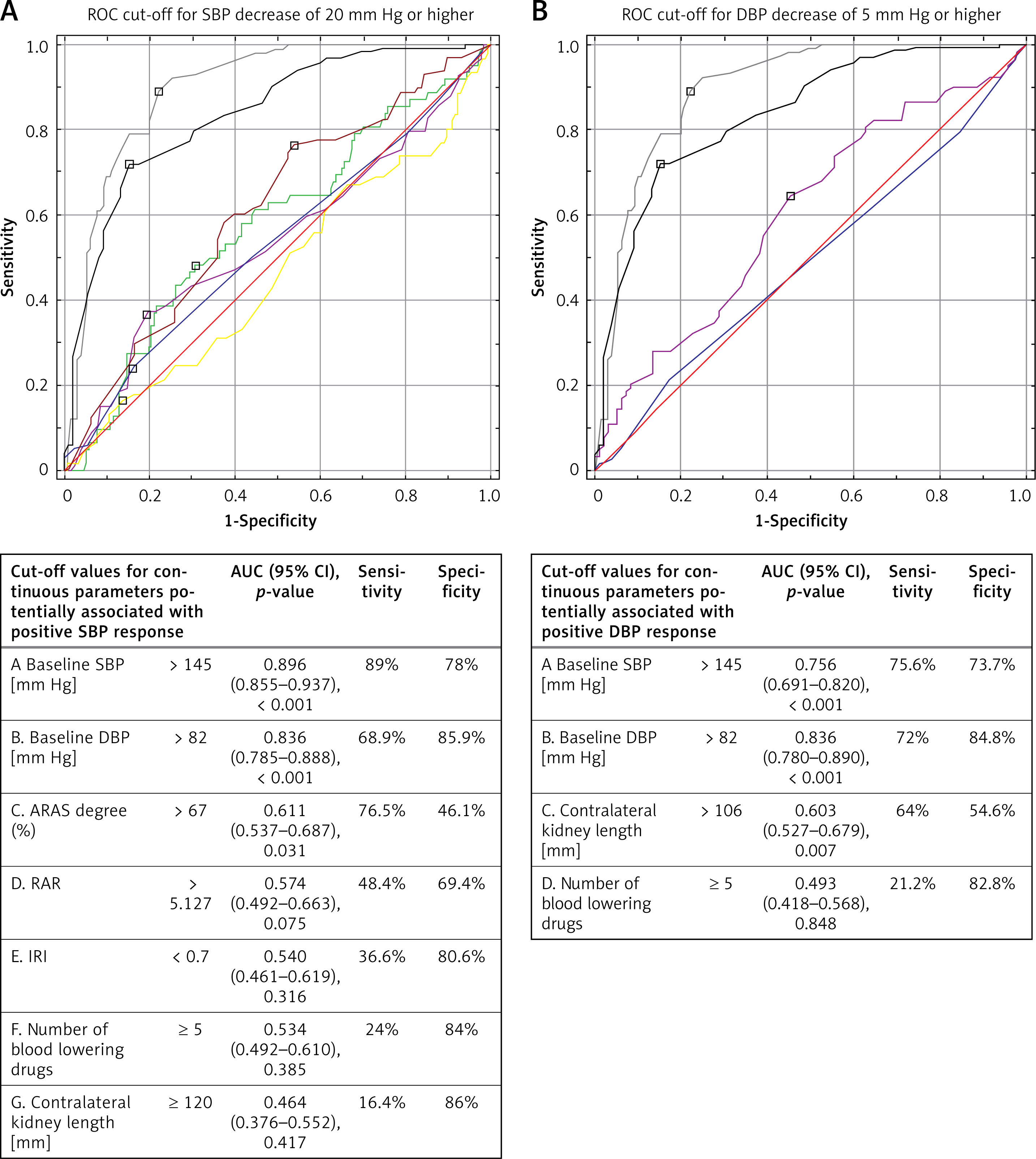
For a decrease in SBP of at least 20 mm Hg at 12 months, the following cut-offs from ROC analyses were established: baseline SBP > 145 mm Hg (sensitivity: 89%, specificity: 78%) and DBP > 82 mm Hg (sensitivity: 68.9%, specificity: 85.9%), ARAS diameter stenosis > 67% (sensitivity: 76.5%, specificity: 46.1%), use of five or more antihypertensive medications before PTA (sensitivity: 24%, specificity: 84%), as well as the following DUS parameters: IRI < 0.7 (sensitivity: 36.6%, specificity: 80.6%), RAR > 5.12 (sensitivity: 48.4%, specificity: 69.4%), and contralateral kidney length ≥ 120 mm (sensitivity: 16.4%, specificity: 86%) (Figure 1 A).
Figure 1
Receiver-operating characteristic (ROC) analysis to determine the optimal cut-off values of continuous parameters for: A – systolic blood pressure (SBP) decrease ≥ 20 mm Hg, B – diastolic blood pressure (DBP) decrease ≥ 5 mm Hg following PTA
ARAS – atherosclerotic renal artery stenosis, AUC – area under the curve, DBP – diastolic blood pressure, IRI – intra-renal resistive index, RAR – renal-aortic ratio, SBP – systolic blood pressure.
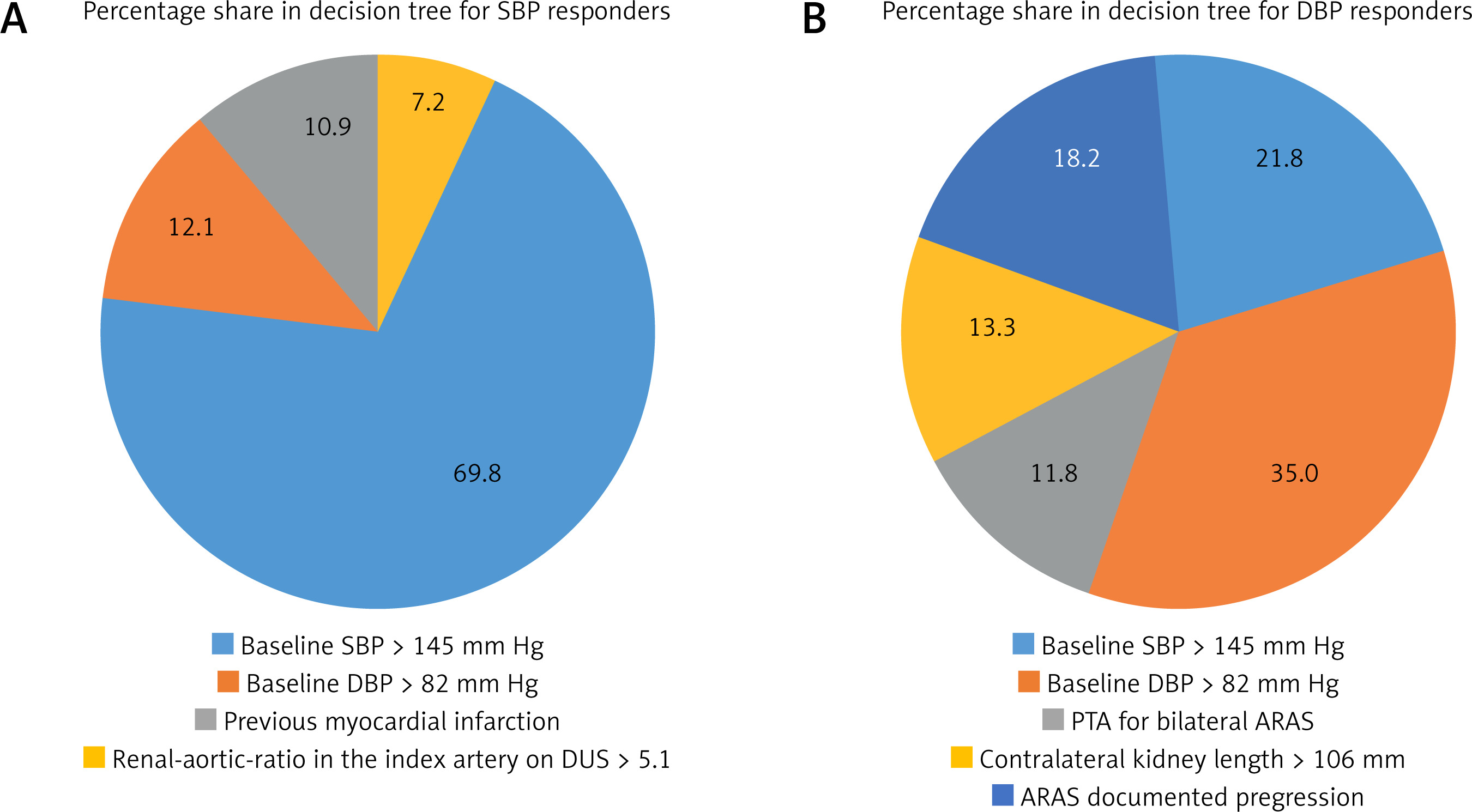
As a result of univariate logistic regression analysis, multivariate analysis identified four independent predictors of SBP response: (1) baseline SBP > 145 mm Hg (OR = 20.0 [95% CI: 8.67–46.2], p < 0.001), (2) baseline DBP > 82 mm Hg (OR = 3.46 [95% CI: 1.61–7.42], p = 0.001), (3) prior myocardial infarction (OR = 3.14 [95% CI: 1.09–9.0], p = 0.033), and (4) renal-aortic ratio (OR = 2.67 [95% CI: 1.20–6.0], p = 0.016), with model sensitivity, specificity, PPV and NPV of 82%, 86.3%, 82% and 86.3%, respectively. The relative contributions of these variables to SBP response probability were 69.8%, 12.1%, 10.9% and 7.2%, respectively (Figure 2 A).
Figure 2
Relative contribution of the independent variables to the probability of SBP and DBP response, based on the variables included in the multivariate logistic regression: A – SBP response, B – DBP response
For a decrease in DBP of at least 5 mm Hg, ROC cut-offs were as follows: baseline SBP > 145 mm Hg (sensitivity: 75.6%, specificity: 73.7%) and DBP > 82 mm Hg (sensitivity: 72%, specificity: 84.8%), preoperative use of five or more antihypertensive medications (sensitivity: 21.2%, specificity: 82.8%), and contralateral kidney length > 106 mm (sensitivity: 64%, specificity: 54.6%) (Figure 1 B).
The final prediction model for a DBP decrease ≥ 5 mm Hg included: (1) baseline SBP > 145 mm Hg (OR = 3.79 [95% CI: 1.87–7.70], p < 0.001), (2) baseline DBP > 82 mm Hg (OR = 6.09 [95% CI: 2.88–12.9], p < 0.001), (3) ARAS progression (OR = 0.32 [95% CI: 0.09–1.07], p = 0.062), (4) contralateral kidney length > 106 mm (OR = 0.43 [95% CI: 0.22–0.86], p = 0.017), and (5) bilateral PTA (OR = 2.39 [95% CI: 1.08–5.27], p = 0.03), with respective relative contributions of 21.8%, 35.0%, 18.2%, 13.3% and 11.8% (Figure 2 B). The sensitivity, specificity, PPV and NPV of the predictive model were 76%, 77.8%, 80.7% and 72.6%, respectively.
Discussion
Arterial stiffness, endothelial dysfunction, atherosclerosis, and oxidative stress all contribute to the development of systemic hypertension [22]. ARAS can also result in various cardiopulmonary complications, primarily through activation of neurohormonal pathways that result in fluid overload and systemic hypertension [20]. Unfortunately, correction of ARAS with PTA does not necessarily result in a reduction of SBP and DBP [6, 9–11, 23]. In fact, PTA for ARAS does not lead to a subsequent reduction in SBP and/or DBP in about 30% to 60% of subjects [5, 9–11, 16].
In the present study, antihypertensive treatment was discontinued in 2.0% of patients, while a reduction in antihypertensive treatment was possible in 15% of patients who achieved the predefined BP reduction thresholds. In the remaining patients, a decrease in SBP of at least 20 mm Hg and a decrease in DBP of at least 5 mm Hg or higher were observed in 34% and 49.5% of patients, respectively (which did not result in a reduction of the number or doses of antihypertensive treatment), whereas no SBP in DBP reduction (or an increase) was observed in 48.5% and 33.2% of subjects, respectively. In line with our results, a higher proportion of responders has also been observed for DBP than for SBP in patients with primary systolic hypertension [24].
We analysed factors associated with SBP and DBP reduction separately, as the clinical significance of SBP and DBP in relation to cardiovascular risk differs. Moreover, elevations in SBP frequently occur without corresponding elevations in DBP [22, 25]. The meta-analysis performed by Lewington et al. revealed that a 20 mmHg reduction in usual SBP was associated with a significantly lower risk of death from stroke (hazard ratios, 0.36–0.67) and ischaemic heart disease (HR = 0.49–0.67) [25].
SBP also seems superior to DBP as a predictor of adverse renal outcomes in patients with diabetic nephropathy. Pohl et al. found that patients with an SBP reduction of 20 mm Hg had decreased relative risks of doubling of serum creatinine (HR = 0.79) and progression to end-stage renal disease (HR = 0.52) [26]. This SBP-lowering effect was maintained continuously down to a level of 120 mm Hg, whereas SBP lower than 120 mm Hg was associated with a substantial increase in the all-cause mortality [26].
As regards DBP-lowering therapy, the target DBP values recommended for treatment should range between 70 and 80 mm Hg [27]. These target DBP values are associated with the lowest risk of major vascular events and stroke [27]. In the context of ARAS, our previous study found that reductions in SBP of at least 20 mm Hg and DBP of at least 5 mm Hg following renal artery stenting were associated with improved cardiovascular outcomes [16].
However, it is difficult to predict the probability of an SBP or DBP response following PTA for ARAS in patients with renovascular disease [9–11, 18]. As a consequence of limitations of randomized trials, including intention-to-treat analyses, uncertainty regarding physician selection of patients, exclusion of patients potentially most likely to benefit from revascularization, potential overestimation of ARAS severity, and selection bias against patients with severe ARAS, guidelines have largely restricted patient selection for PTA [12–14]. PTA is currently recommended for patients who present with resistant hypertension despite treatment with three maximally tolerated antihypertensive medications, one of which is a diuretic [23], episodes of sudden-onset pulmonary flash oedema [17, 23], and/or accelerating decline in renal function [23].
Some authors have identified patients who may have a favourable blood pressure response following PTA despite current recommendations [28].
In the present study, we calculated the percentage contribution (individual impact) of the identified independent parameters to the likelihood of blood pressure reduction, such as preoperative SBP and DBP values, bilateral PTA, DUS criteria indicative of ARAS severity, and kidney viability.
Our main finding, in accordance with the guidelines, is that we cannot expect improvement in patients with well-controlled SBP and DBP unless SBP and DBP values exceed 145 and 82 mm Hg, respectively, despite best medical treatment. Baseline SBP > 145 mm Hg and DBP > 82 mm Hg accounted for approximately 70% of the relative contribution to SBP reduction after PTA, whereas baseline DBP > 82 mm Hg accounted for 35% of the relative contribution to DBP reduction. The RAR > 5.12 accounted for 7% of the relative contribution to SBP reduction, whereas bilateral PTA and a contralateral kidney length >106 mm accounted for 12% and 13%, respectively, of the relative contribution to DBP reduction.
The role of preoperative SBP and DBP in the likelihood of post-interventional blood pressure reduction has also been reported by other authors [11, 20, 23, 28–30]. Modrall et al. identified preoperative DBP > 90 mm Hg (OR = 13.9; p < 0.001) as an independent predictor of a positive blood pressure response [29]. In the study by Kim et al., 77.8% of patients with preoperative mean SBP of 152 mm Hg experienced a reduction in SBP (mean post-intervention SBP 134 mm Hg), while there was no difference between preoperative (77 mm Hg) and postoperative mean DBP values [30].
Many authors have investigated the severity of ARAS as a potential determinant of blood pressure response [11, 28, 30–32].
In our present study, a decrease in SBP of at least 20 mm Hg was associated with ARAS diameter stenosis > 67% according to ROC analysis (sensitivity of 76.5%, specificity of 46.1%). Nonetheless, ARAS severity was not found to be an independent indicator of SBP improvement following PTA. This is in line with findings that ARAS greater than 70–80% is necessary to activate the intra-renal neurohormonal system; thus, renovascular hypertension is less probable in patients with a lower degree of ARAS [33].
However, visual estimation of ARAS severity may be inaccurate [31, 34, 35], and this limitation can be overcome through assessment of renal fractional flow reserve, translesional pressure gradient, or renal frame count [31–33]. Clinical studies have shown an improved blood pressure response when treating lesions with resting or hyperaemic pressure gradients > 20 mm Hg [31, 32]. In the present study, papaverine-induced hyperaemic pressure gradients > 20 mm Hg were identified as potentially important predictors of SBP response in univariate analysis but did not remain independently associated with SBP response in the multivariate logistic regression analysis.
Finally, ARAS severity can be estimated from DUS parameters, such as aortic and renal artery velocities. In the present study, a preoperative RAR > 5.12 was identified as a marker of SBP reduction and is indicative of severe ARAS. Some authors have highlighted the potential role of preoperative renal and intrarenal RIs and kidney size as markers of arterial stiffness and the potential reversibility of renal function decline [18]. An RI > 0.8 has been associated with a lower probability of improvement in BP or renal function after renal intervention [18]. In the present study, resistive indices and kidney size were also associated with SBP and/or DBP response in univariate logistic regression analysis.
In conclusion, patients with renovascular hypertension that is controlled are unlikely to experience a clinically meaningful additional reduction in blood pressure following renal artery stenting. Patients with baseline SBP of 145 mm Hg or higher and DBP of 83 mm Hg or higher, despite medical treatment with at least 3 antihypertensive medications, may be more likely to benefit from renal artery stenting. Although the addition of renal ultrasonography parameters provided limited incremental information, RAR and contralateral kidney size may improve identification of patients more likely to achieve a favourable SBP or DBP response, respectively, following renal artery stenting for ARAS.