Current issue
Archive
Manuscripts accepted
About the Journal
Editorial office
Editorial board
Section Editors
Abstracting and indexing
Subscription
Contact
Ethical standards and procedures
Most read articles
Instructions for authors
Article Processing Charge (APC)
Regulations of paying article processing charge (APC)


CLINICAL RESEARCH
Shared genetic architecture and mendelian randomisation between simvastatin-related medication use and cholelithiasis: a multi-method GWAS-based analysis
1
GCP Office, The First People’s Hospital of Shuangliu District (West China Airport Hospital of Sichuan University), Chengdu, China
2
Department of Gastroenterology, The First People’s Hospital of Shuangliu District (West China Airport Hospital of Sichuan University), Chengdu, China
Submission date: 2026-04-14
Final revision date: 2026-08-07
Acceptance date: 2026-09-24
Online publication date: 2026-10-21
Corresponding author
Xin Zhang
Department of Gastroenterology The First People’s Hospital of Shuangliu District (West China Airport Hospital of Sichuan University) 120, Chengbei Shangjie St Dongsheng Town Shuangliu District Chengdu 610200, China
Department of Gastroenterology The First People’s Hospital of Shuangliu District (West China Airport Hospital of Sichuan University) 120, Chengbei Shangjie St Dongsheng Town Shuangliu District Chengdu 610200, China
KEYWORDS
cholelithiasissimvastatincholesterol-reducing agentsmedication-use phenotypedrug-target Mendelian randomisationgenetic correlationgenomic SEMMAGMAbile acid metabolismFXR signalling
TOPICS
ABSTRACT
Introduction:
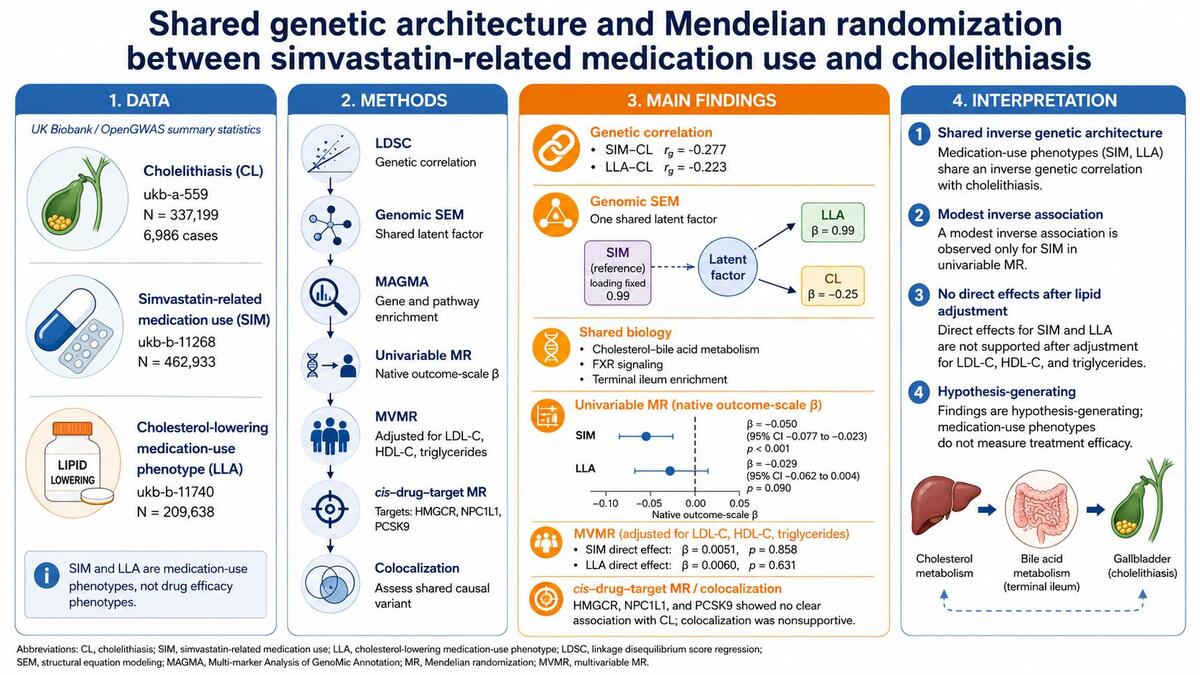
Statins are widely prescribed, but their relationship with cholelithiasis (CL) remains uncertain. We evaluated shared genetic architecture and MR associations between CL and UK Biobank medication-use phenotypes for simvastatin (SIM) and cholesterol-lowering medication (LLA).
Material and methods:
GWAS summary statistics were analysed using LDSC, Genomic SEM, MAGMA, univariable MR, lipid-adjusted multivariable MR (MVMR), and cis-drug-target MR for HMGCR, NPC1L1, and PCSK9. MVMR adjusted SIM and LLA separately for LDL-C, HDL-C, and triglycerides.
Results:
CL showed inverse genetic correlations with SIM (rg = –0.277, p = 1.54 × 10⁻⁴) and LLA (rg = –0.223, p = 2.47 × 10⁻³). Gene and pathway analyses implicated cholesterol–bile acid metabolism and enterohepatic signalling. On the native linear-model outcome scale, univariable MR supported an inverse SIM association ( = –0.050, 95% CI: –0.077 to –0.023, p < 0.001), whereas LLA was not significant (β = –0.029, 95% CI: –0.062 to 0.004, p = 0.090). MVMR direct effects were near null for SIM (β = 0.0051, p = 0.858) and LLA (β = 0.0060, p = 0.631), with conditional F-statistics < 10 and marked heterogeneity. Cis-drug-target MR showed no clear association for HMGCR, NPC1L1, or PCSK9.
Conclusions:
Genetic liability to simvastatin medication use was modestly inversely associated with CL in univariable MR but not after lipid adjustment. Together, these findings support a potential protective genetic relationship between simvastatin-related medication use and CL and highlight lipid-related and target-specific mechanisms for further mechanistic and clinical validation.
REFERENCES (41)
1.
Wang X, Yu W, Jiang G, et al. Global epidemiology of gallstones in the 21st century: a systematic review and meta-analysis. Clin Gastroenterol Hepatol 2024; 22: 1586-95.
2.
Tazuma S. Gallstone disease: epidemiology, pathogenesis, and classification of biliary stones (common bile duct and intrahepatic). Best Pract Res Clin Gastroenterol 2006; 20: 1075-83.
3.
Pak M, Lindseth G. Risk factors for cholelithiasis. Gastroenterol Nurs 2016; 39: 297-309.
4.
Di Ciaula A, Wang DQ, Portincasa P. An update on the pathogenesis of cholesterol gallstone disease. Curr Opin Gastroenterol 2018; 34: 71-80.
5.
Istvan ES, Deisenhofer J. Structural mechanism for statin inhibition of HMG-CoA reductase. Science 2001; 292: 1160-4.
6.
Han T, Lv Y, Wang S, Hu T, Hong H, Fu Z. Pioglitazone prevents cholesterol gallstone formation through the regulation of cholesterol homeostasis in guinea pigs with a lithogenic diet. Lipids Health Dis 2019; 18: 218.
7.
Smith JL, Roach PD, Wittenberg LN, et al. Effects of simvastatin on hepatic cholesterol metabolism, bile lithogenicity and bile acid hydrophobicity in patients with gallstones. J Gastroenterol Hepatol 2000; 15: 871-9.
8.
Ginting Z. The effect of statin in managing cholelithiasis: a systematic review. Int J Res Rev 2024; 11: 607-12.
9.
Martin D, Schmidt R, Mortensen EM, Mansi I. Association of statin therapy and risks of cholelithiasis, biliary tract diseases, and gallbladder procedures: retrospective cohort analysis of a US population. Ann Pharmacother 2016; 50: 161-71.
10.
Kan HP, Guo WB, Tan YF, Zhou J, Liu CD, Huang YQ. Statin use and risk of gallstone disease: a meta-analysis. Hepatol Res 2015; 45: 942-8.
11.
Yang G, Mason AM, Gill D, Schooling CM, Burgess S. Multi-biobank Mendelian randomization analyses identify opposing pathways in plasma low-density lipoprotein-cholesterol lowering and gallstone disease. Eur J Epidemiol 2024; 39: 857-67.
12.
Post SM, Duez H, Gervois PP, Staels B, Kuipers F, Princen HM. Fibrates suppress bile acid synthesis via peroxisome proliferator-activated receptor-alpha-mediated downregulation of cholesterol 7alpha-hydroxylase and sterol 27-hydroxylase expression. Arterioscler Thromb Vasc Biol 2001; 21: 1840-5.
13.
Reihnér E, Rudling M, Ståhlberg D, et al. Influence of pravastatin, a specific inhibitor of HMG-CoA reductase, on hepatic metabolism of cholesterol. N Engl J Med 1990; 323: 224-8.
14.
Tomlinson B, Chan P, Lan W. How well tolerated are lipid-lowering drugs? Drugs Aging 2001; 18: 665-83.
15.
Chen X, Liu X. Weekend warrior physical activity patterns can reduce the risk of gallstone formation: NHANES 2017-2020 and Mendelian randomization analyses. Arch Med Sci 2026; 22: 45-55.
16.
Bulik-Sullivan B, Finucane HK, Anttila V, et al. An atlas of genetic correlations across human diseases and traits. Nat Genet 2015; 47: 1236-41.
17.
Zhang Y, Cheng Y, Jiang W, Ye Y, Lu Q, Zhao H. Comparison of methods for estimating genetic correlation between complex traits using GWAS summary statistics. Brief Bioinform 2021; 22: bbaa442.
18.
Grotzinger AD, Rhemtulla M, de Vlaming R, et al. Genomic structural equation modelling provides insights into the multivariate genetic architecture of complex traits. Nat Hum Behav 2019; 3: 513-25.
19.
de Leeuw CA, Mooij JM, Heskes T, Posthuma D. MAGMA: generalized gene-set analysis of GWAS data. PLoS Comput Biol 2015; 11: e1004219.
20.
Gerring ZF, Mina-Vargas A, Gamazon ER, Derks EM. E-MAGMA: an eQTL-informed method to identify risk genes using genome-wide association study summary statistics. Bioinformatics 2021; 37: 2245-9.
21.
Burgess S, Butterworth A, Thompson SG. Mendelian randomization analysis with multiple genetic variants using summarized data. Genet Epidemiol 2013; 37: 658-65.
22.
Bowden J, Davey Smith G, Haycock PC, Burgess S. Consistent estimation in mendelian randomization with some invalid instruments using a weighted median estimator. Genet Epidemiol 2016; 40: 304-14.
23.
Bowden J, Davey Smith G, Burgess S. Mendelian randomization with invalid instruments: effect estimation and bias detection through Egger regression. Int J Epidemiol 2015; 44: 512-25.
24.
Richardson TG, Sanderson E, Palmer TM, et al. Evaluating the relationship between circulating lipoprotein lipids and apolipoproteins with risk of coronary heart disease: a multivariable Mendelian randomisation analysis. PLoS Med 2020; 17: e1003062.
25.
Võsa U, Claringbould A, Westra HJ, et al. Large-scale cis- and trans-eQTL analyses identify thousands of genetic loci and polygenic scores that regulate blood gene expression. Nat Genet 2021; 53: 1300-10.
26.
GTEx Consortium. The GTEx Consortium atlas of genetic regulatory effects across human tissues. Science 2020; 369: 1318-30.
27.
Sun BB, Maranville JC, Peters JE, et al. Genomic atlas of the human plasma proteome. Nature 2018; 558: 73-9.
28.
Giambartolomei C, Vukcevic D, Schadt EE, et al. Bayesian test for colocalisation between pairs of genetic association studies using summary statistics. PLoS Genet 2014; 10: e1004383.
29.
Sanderson E, Davey Smith G, Windmeijer F, Bowden J. An examination of multivariable Mendelian randomization in the single-sample and two-sample summary data settings. Int J Epidemiol 2019; 48: 713-27.
30.
Sanderson E, Spiller W, Bowden J. Testing and correcting for weak and pleiotropic instruments in two-sample multivariable Mendelian randomization. Stat Med 2021; 40: 5434-52.
31.
Costa CJ, Nguyen MTT, Vaziri H, Wu GY. Genetics of gallstone disease and their clinical significance: a narrative review. J Clin Transl Hepatol 2024; 12: 316-26.
32.
Cooper-DeHoff RM, Niemi M, Ramsey LB, et al. The clinical pharmacogenetics implementation consortium guideline for SLCO1B1, ABCG2, and CYP2C9 genotypes and statin-associated musculoskeletal symptoms. Clin Pharmacol Ther 2022; 111: 1007-21.
33.
Khaleqsefat E, Rasul KH, Kheder RK, Baban S, Baban J. Frameshift variation in the HMG-CoA reductase gene and unresponsiveness to cholesterol-lowering drugs in type 2 diabetes mellitus patients. Sci Rep 2025; 15: 288.
34.
Sané AT, Sinnett D, Delvin E, et al. Localization and role of NPC1L1 in cholesterol absorption in human intestine. J Lipid Res 2006; 47: 2112-20.
35.
Li T, Matozel M, Boehme S, et al. Overexpression of cholesterol 7α-hydroxylase promotes hepatic bile acid synthesis and secretion and maintains cholesterol homeostasis. Hepatology 2011; 53: 996-1006.
36.
Li X, Xiao H, Jian X, et al. Epigenetic regulation of key enzymes CYP7a1 and HMGCR affect hepatic cholesterol metabolism in different breeds of piglets. Front Vet Sci 2020; 7: 231.
37.
Dagli-Hernandez C, Zhou Y, Lauschke VM, et al. Pharmacogenomics of statins: lipid response and other outcomes in Brazilian cohorts. Pharmacol Rep 2022; 74: 47-66.
38.
Chiang JYL, Ferrell JM. Discovery of farnesoid X receptor and its role in bile acid metabolism. Mol Cell Endocrinol 2022; 548: 111618.
39.
Jiang L, Zhang H, Xiao D, Wei H, Chen Y. Farnesoid X receptor (FXR): Structures and ligands. Comput Struct Biotechnol J 2021; 19: 2148-59.
40.
Ticho AL, Malhotra P, Dudeja PK, Gill RK, Alrefai WA. Intestinal absorption of bile acids in health and disease. Compr Physiol 2019; 10: 21-56.
41.
Dawson PA, Haywood J, Craddock AL, et al. Targeted deletion of the ileal bile acid transporter eliminates enterohepatic cycling of bile acids in mice. J Biol Chem 2003; 278: 33920-7.
Share
RELATED ARTICLE
| eISSN: | 1896-9151 |
| ISSN: | 1734-1922 |

We process personal data collected when visiting the website. The function of obtaining information about users and their behavior is carried out by voluntarily entered information in forms and saving cookies in end devices. Data, including cookies, are used to provide services, improve the user experience and to analyze the traffic in accordance with the Privacy policy. Data are also collected and processed by Google Analytics tool (more).
You can change cookies settings in your browser. Restricted use of cookies in the browser configuration may affect some functionalities of the website.
You can change cookies settings in your browser. Restricted use of cookies in the browser configuration may affect some functionalities of the website.