Current issue
Archive
Manuscripts accepted
About the Journal
Editorial office
Editorial board
Section Editors
Abstracting and indexing
Subscription
Contact
Ethical standards and procedures
Most read articles
Instructions for authors
Article Processing Charge (APC)
Regulations of paying article processing charge (APC)


NEUROLOGY / SYSTEMATIC REVIEW/META-ANALYSIS
Associations between enlarged perivascular spaces and clinical manifestations: a meta-analysis
1
Department of Neurology, Hebei General Hospital, Shijiazhuang, Hebei Province, China
Submission date: 2022-05-12
Final revision date: 2022-07-23
Acceptance date: 2022-08-24
Online publication date: 2022-09-09
Publication date: 2026-08-28
Corresponding author
Arch Med Sci 2026;22(4):2025-2037
KEYWORDS
TOPICS
ABSTRACT
Introduction:
Enlarged perivascular spaces (EPVS) are ubiquitous in the elderly and have an insidious onset. Their correlation with clinical symptoms is easily overlooked and controversial. We conducted a meta-analysis to investigate the clinical outcomes associated with EPVS.
Material and methods:
Relevant studies published up to April 2022 were extracted from PubMed, Embase, Cochrane, OVID, and Web of Science. Odds ratios (ORs) and 95% confidence intervals (CIs) were used to estimate the strength of the associations.
Results:
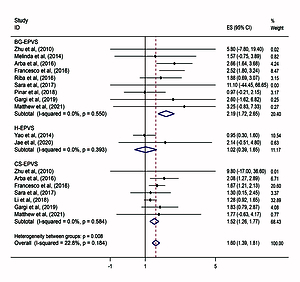
Of the 6622 articles identified, 32 studies were eligible, including a total of 19,987 people. EPVS were associated with an increased risk of cognitive impairment (OR = 1.60, 95% CI: 1.39–1.81), motor impairment (OR = 2.24, 95% CI: 1.22–3.25), sleep disturbance (OR = 1.81, 95% CI: 1.34–2.28), and depressive symptoms (OR = 1.54, 95% CI: 1.14–1.95), but was not significantly associated with the occurrence of stroke (OR = 0.97, 95% CI: 0.74–1.21). Results of subgroup analysis showed that basal ganglia (BG) EPVS were more strongly associated with cognitive impairment (OR = 2.19, 95% CI: 1.72–2.65) and sleep disturbance (OR = 1.74, 95% CI: 1.20–2.29).
Conclusions:
Our findings suggest that EPVS are associated with cognitive impairment, motor impairment, sleep disturbance, and depressive symptoms. These findings may provide a basis for further investigation of the clinical significance of EPVS.
Enlarged perivascular spaces (EPVS) are ubiquitous in the elderly and have an insidious onset. Their correlation with clinical symptoms is easily overlooked and controversial. We conducted a meta-analysis to investigate the clinical outcomes associated with EPVS.
Material and methods:
Relevant studies published up to April 2022 were extracted from PubMed, Embase, Cochrane, OVID, and Web of Science. Odds ratios (ORs) and 95% confidence intervals (CIs) were used to estimate the strength of the associations.
Results:
Of the 6622 articles identified, 32 studies were eligible, including a total of 19,987 people. EPVS were associated with an increased risk of cognitive impairment (OR = 1.60, 95% CI: 1.39–1.81), motor impairment (OR = 2.24, 95% CI: 1.22–3.25), sleep disturbance (OR = 1.81, 95% CI: 1.34–2.28), and depressive symptoms (OR = 1.54, 95% CI: 1.14–1.95), but was not significantly associated with the occurrence of stroke (OR = 0.97, 95% CI: 0.74–1.21). Results of subgroup analysis showed that basal ganglia (BG) EPVS were more strongly associated with cognitive impairment (OR = 2.19, 95% CI: 1.72–2.65) and sleep disturbance (OR = 1.74, 95% CI: 1.20–2.29).
Conclusions:
Our findings suggest that EPVS are associated with cognitive impairment, motor impairment, sleep disturbance, and depressive symptoms. These findings may provide a basis for further investigation of the clinical significance of EPVS.
REFERENCES (59)
1.
Brown R, Benveniste H, Black SE, et al. Understanding the role of the perivascular space in cerebral small vessel disease. Cardiovasc Res 2018; 114: 1462-73.
2.
Wang X, Chappell FM, Valdes Hernandez M, et al. Endothelial function, inflammation, thrombosis, and basal ganglia perivascular spaces in patients with stroke. J Stroke Cerebrovasc Dis 2016; 25: 2925-931.
3.
Debette S, Schilling S, Duperron MG, et al. Clinical significance of magnetic resonance imaging markers of vascular brain injury: a systematic review and meta-analysis. JAMA Neurol 2019; 76: 81-94.
4.
Wardlaw JM, Smith EE, Biessels GJ, et al. Neuroimaging standards for research into small vessel disease and its contribution to ageing and neurodegeneration. Lancet Neurol 2013; 12: 822-38.
5.
Rudie JD, Rauschecker AM, Nabavizadeh SA, et al. Neuroimaging of dilated perivascular spaces: from benign and pathologic causes to mimics. J Neuroimaging 2018; 28: 139-49.
6.
Dubost F, Yilmaz P, Adams H, et al. Enlarged perivascular spaces in brain MRI: automated quantification in four regions. Neuroimage 2019; 185: 534-44.
7.
Potter GM, Chappell FM, Morris Z, et al. Cerebral perivascular spaces visible on magnetic resonance imaging: development of a qualitative rating scale and its observer reliability. Cerebrovasc Dis 2015; 39: 224-31.
8.
Jie W, Lin G, Liu Z, et al. The relationship between enlarged perivascular spaces and cognitive function: a meta-analysis of observational studies. Front Pharmacol 2020, 11: 715.
9.
Heiland EG, Welmer AK, Kalpouzos G, et al. Cerebral small vessel disease, cardiovascular risk factors, and future walking speed in old age: a population-based cohort study. BMC Neurol 2021; 21: 496.
10.
Liang Y, Chan YL, Deng M, et al. Enlarged perivascular spaces in the centrum semiovale are associated with poststroke depression: a 3-month prospective study. J Affect Disord 2018; 228: 166-72.
11.
Ramirez J, Holmes MF, Berezuk C, et al. MRI-visible perivascular space volumes, sleep duration and daytime dysfunction in adults with cerebrovascular disease. Sleep Med 2021; 83: 83-8.
12.
Burnett MS, Witte RJ, Ahlskog JE. Swiss cheese striatum: clinical implications. JAMA Neurol 2014; 71: 735-41.
13.
Charidimou A, Meegahage R, Fox Z, et al. Enlarged perivascular spaces as a marker of underlying arteriopathy in intracerebral haemorrhage: a multicentre MRI cohort study. J Neurol Neurosurg Psychiatry 2013; 84: 624-9.
15.
Postrzech-Adamczyk K, Nahorecki A, Jacków-Nowicka J, et al. Magnetic resonance white matter changes in patients with obstructive sleep apnoea. The subset of the PURE-MIND (Prospective Urban and Rural Epidemiological) cohort study. Arch Med Sci 2021; 22: 169-74.
16.
Wardlaw JM, Benveniste H, Nedergaard M, et al. Perivascular spaces in the brain: anatomy, physiology and pathology. Nat Rev Neurol 2020; 16: 137-53.
17.
Francis F, Ballerini L, Wardlaw JM. Perivascular spaces and their associations with risk factors, clinical disorders and neuroimaging features: a systematic review and meta-analysis. Int J Stroke 2019; 14: 359-71.
18.
Van Sloten TT, Sigurdsson S, Van Buchem MA, et al. Cerebral small vessel disease and association with higher incidence of depressive symptoms in a general elderly population: the AGES-Reykjavik Study. Am J Psychiatry 2015; 172: 570-8.
19.
Zhang X, Tang Y, Xie Y, et al. Total magnetic resonance imaging burden of cerebral small-vessel disease is associated with post-stroke depression in patients with acute lacunar stroke. Eur J Neurol 2017; 24: 374-80.
20.
Yang S, Yin J, Qin W, et al. Poor sleep quality associated with enlarged perivascular spaces in patients with lacunar stroke. Front Neurol 2021; 12: 809217.
21.
Arba F, Quinn TJ, Hankey GJ, et al. Enlarged perivascular spaces and cognitive impairment after stroke and transient ischemic attack. Int J Stroke 2018; 13: 47-56.
22.
Sim JE, Park MS, Shin HY, et al. Correlation between hippocampal enlarged perivascular spaces and cognition in non-dementic elderly population. Front Neurol 2020; 11: 542511.
23.
Bakker EN, Bacskai BJ, Arbel-Ornath M, et al. Lymphatic clearance of the brain: perivascular, paravascular and significance for neurodegenerative diseases. Cell Mol Neurobiol 2016; 36: 181-94.
24.
Stang A. Critical evaluation of the Newcastle-Ottawa scale for the assessment of the quality of nonrandomized studies in meta-analyses. Eur J Epidemiol 2010; 25: 603-5.
25.
Higgins JP, Thompson SG. Quantifying heterogeneity in a meta-analysis. Stat Med 2002; 21: 1539-58.
26.
Zhu YC, Dufouil C, Soumare A, et al. High degree of dilated Virchow-Robin spaces on MRI is associated with increased risk of dementia. J Alzheimers Dis 2010; 22: 663-72.
27.
Yao M, Zhu YC, Soumare A, et al. Hippocampal perivascular spaces are related to aging and blood pressure but not to cognition. Neurobiol Aging 2014; 35: 2118-25.
28.
Arba F, Quinn T, Hankey GJ, et al. Cerebral small vessel disease, medial temporal lobe atrophy and cognitive status in patients with ischaemic stroke and transient ischaemic attack. Eur J Neurol 2017; 24: 276-82.
29.
Riba-Llena I, Nafria C, Mundet X, et al. Assessment of enlarged perivascular spaces and their relation to target organ damage and mild cognitive impairment in patients with hypertension. Eur J Neurol 2016; 23: 1044-50.
30.
Shams S, Martola J, Charidimou A, et al. Topography and determinants of magnetic resonance imaging (MRI)-visible perivascular spaces in a large memory clinic cohort. J Am Heart Assoc 2017; 6: e006279.
31.
Yilmaz P, Ikram MK, Niessen WJ, et al. Practical small vessel disease score relates to stroke, dementia, and death. Stroke 2018; 49: 2857-65.
32.
Xiong L, Boulouis G, Charidimou A, et al. Dementia incidence and predictors in cerebral amyloid angiopathy patients without intracerebral hemorrhage. J Cereb Blood Flow Metab 2018; 38: 241-9.
33.
Banerjee G, Chan E, Ambler G, et al. Effect of small-vessel disease on cognitive trajectory after atrial fibrillation-related ischaemic stroke or TIA. J Neurol 2019; 266: 1250-9.
34.
Paradise M, Crawford JD, Lam BCP, et al. Association of dilated perivascular spaces with cognitive decline and incident dementia. Neurology 2021; 96: e1501-11.
35.
Lioutas VA, Wu B, Norton C, et al. Cerebral small vessel disease burden and functional and radiographic outcomes in intracerebral hemorrhage. J Neurol 2018; 265: 2803-14.
36.
Wan Y, Hu W, Gan J, et al. Exploring the association between cerebral small-vessel diseases and motor symptoms in Parkinson’s disease. Brain Behav 2019; 9: e01219.
37.
Del Brutto OH, Peinado CD, Mera RM, et al. Neuroimaging signatures of cerebral small vessel disease and risk of falls in stroke-free older adults living in rural Ecuador. The Atahualpa Project. J Neurol Sci 2019; 402: 133-5.
38.
Song TJ, Park JH, Choi KH, et al. Moderate-to-severe obstructive sleep apnea is associated with cerebral small vessel disease. Sleep Med 2017; 30: 36-42.
39.
Del Brutto OH, Mera RM, Del Brutto VJ, et al. Enlarged basal ganglia perivascular spaces and sleep parameters. A population-based study. Clin Neurol Neurosurg 2019; 182: 53-7.
40.
Del Brutto OH, Mera RM, Del Brutto VJ, et al. Lack of association between periodic limb movements during sleep and neuroimaging signatures of cerebral small vessel disease in stroke-free community-dwelling older adults. The Atahualpa Project. J Stroke Cerebrovasc Dis 2020; 29: 104497.
41.
Aribisala B S, Riha R L, Valdes Hernandez M, et al. Sleep and brain morphological changes in the eighth decade of life. Sleep Med 2020; 65: 152-8.
42.
Wang J, Chen X, Liao J, et al. Non breathing-related sleep fragmentation and imaging markers in patients with atherosclerotic cerebral small vessel disease (CSVD): a cross-sectional case-control study. BMC Neurol 2020; 20: 98.
43.
Gutierrez J, Elkind MSV, Dong C, et al. Brain perivascular spaces as biomarkers of vascular risk: results from the Northern Manhattan Study. AJNR Am J Neuroradiol 2017; 38: 862-7.
44.
Lau KK, Li L, Lovelock CE, et al. Clinical correlates, ethnic differences, and prognostic implications of perivascular spaces in transient ischemic attack and ischemic stroke. Stroke 2017; 48: 1470-7.
45.
Zhang J, Han F, Liang X, et al. Lacune and large perivascular space: two kinds of cavities are of different risk factors and stroke risk. Cerebrovasc Dis 2020; 49: 522-30.
46.
Xu M, Cheng Y, Zhang S, et al. Higher cerebral small vessel disease burden is associated with smaller hematoma volume in mixed-location intracerebral hemorrhage. Microcirculation 2021; 28: e12705.
47.
Song Q, Cheng Y, Wang Y, et al. Enlarged perivascular spaces and hemorrhagic transformation after acute ischemic stroke. Ann Transl Med 2021; 9: 1126.
48.
Lim J S, Kim N, Jang M U, et al. Cortical hubs and subcortical cholinergic pathways as neural substrates of poststroke dementia. Stroke 2014; 45: 1069-76.
49.
Rasmussen MK, Mestre H, Nedergaard M. The glymphatic pathway in neurological disorders. Lancet Neurol 2018; 17: 1016-24.
50.
Xie L, Kang H, Xu Q, et al. Sleep drives metabolite clearance from the adult brain. Science 2013; 342: 373-7.
51.
Kang MK, Koo DL, Shin JH, et al. Association between periodic limb movements during sleep and cerebral small vessel disease. Sleep Med 2018; 51: 47-52.
52.
Berezuk C, Ramirez J, Gao F, et al. Virchow-Robin spaces: correlations with polysomnography-derived sleep parameters. Sleep 2015; 38: 853-8.
53.
Iliff JJ, Lee H, Yu M, et al. Brain-wide pathway for waste clearance captured by contrast-enhanced MRI. J Clin Invest 2013; 123: 1299-309.
54.
Iliff JJ, Wang M, Liao Y, et al. A paravascular pathway facilitates CSF flow through the brain parenchyma and the clearance of interstitial solutes, including amyloid . Sci Transl Med 2012; 4: 147ra111.
55.
Pinter D, Ritchie S J, Doubal F, et al. Impact of small vessel disease in the brain on gait and balance. Sci Rep 2017; 7: 41637.
56.
Patankar T F, Baldwin R, Mitra D, et al. Virchow-Robin space dilatation may predict resistance to antidepressant monotherapy in elderly patients with depression. J Affect Disord 2007; 97: 265-70.
57.
Shi Y, Xiang Y, Yang Y, et al. Depression after minor stroke: prevalence and predictors. J Psychosom Res 2015; 79: 143-7.
58.
Zhang Y, Wang C, Sun C, et al. Neural complexity in patients with poststroke depression: a resting EEG study. J Affect Disord 2015; 188: 310-8.
59.
Boespflug EL, Schwartz DL, Lahna D, et al. MR Imaging-based multimodal autoidentification of perivascular spaces (mMAPS): automated morphologic segmentation of enlarged perivascular spaces at clinical field strength. Radiology 2018; 286: 632-42.
Share
RELATED ARTICLE
| eISSN: | 1896-9151 |
| ISSN: | 1734-1922 |

We process personal data collected when visiting the website. The function of obtaining information about users and their behavior is carried out by voluntarily entered information in forms and saving cookies in end devices. Data, including cookies, are used to provide services, improve the user experience and to analyze the traffic in accordance with the Privacy policy. Data are also collected and processed by Google Analytics tool (more).
You can change cookies settings in your browser. Restricted use of cookies in the browser configuration may affect some functionalities of the website.
You can change cookies settings in your browser. Restricted use of cookies in the browser configuration may affect some functionalities of the website.