
Type 2 diabetes mellitus (T2DM) and cardiovascular disease frequently coexist and substantially increase the risk of adverse clinical outcomes [1, 2]. Over the last decade, glucagon-like peptide-1 receptor agonists (GLP-1RAs) and sodium-glucose cotransporter-2 inhibitors (SGLT2i) have emerged as key therapies capable of reducing cardiovascular and renal events beyond their glucose-lowering effects [1–3]. Consequently, major scientific societies have progressively incorporated these agents into recommendations for the management of patients with T2DM and cardiovascular disease [1–5]. Despite the growing evidence base, limited data are available regarding how these therapies have been incorporated into routine cardiovascular practice during the early phases of their implementation. We therefore conducted the nationwide French GLUCOSE (GLP1RA Use by CardiOlogists SurvEy) survey to explore perceptions and prescribing habits regarding GLP-1RAs and SGLT2i among private-practice cardiologists.
The French GLUCOSE survey was conducted between October and November 2022 using an online questionnaire hosted on the website of the National College of French Cardiologists (CNCF). All CNCF members were invited by email to participate, with up to four reminders sent to non-respondents. The questionnaire explored respondents’ professional characteristics and prescribing habits regarding GLP-1RAs and SGLT2i in routine practice, including perceived barriers to their use. Only fully completed questionnaires were included in the analysis. In accordance with French regulations, the registry was declared to the Institute National des Données de Santé, and all participants provided informed consent before accessing the survey.
A total of 165 cardiologists completed the survey during the two-month study period. Overall, 60% of respondents reported regularly prescribing or recommending antidiabetic medications. Among these physicians, SGLT2i were the most frequently prescribed agents (73%), followed by metformin (65%) and GLP-1RAs (44%), whereas DPP-4 inhibitors, insulin, and sulfonylureas accounted for only a minority of prescriptions (15%, 7%, and 5%, respectively).
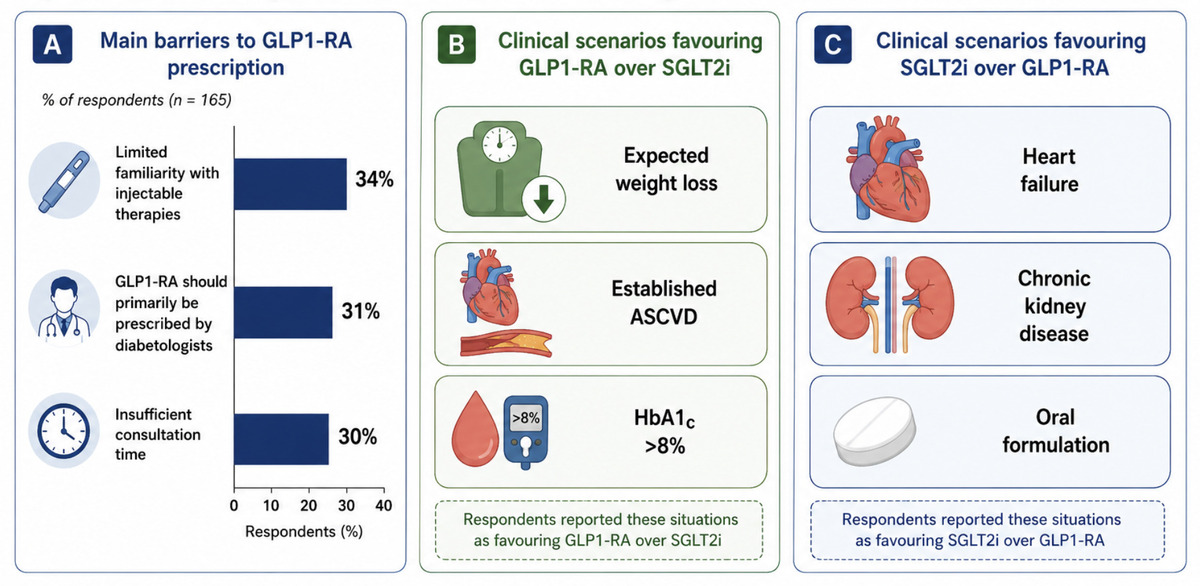
The main barriers to GLP-1RA prescription were limited familiarity with injectable therapies (34%), the perception that these drugs should primarily be prescribed by diabetologists (31%), and insufficient consultation time to initiate treatment (30%).
When asked to identify clinical scenarios favoring GLP-1RAs over SGLT2i, respondents most frequently cited expected weight loss, established atherosclerotic cardiovascular disease and glycated hemoglobin levels exceeding 8%. Conversely, heart failure, chronic kidney disease and the availability of an oral formulation were the leading reasons for preferring SGLT2i over GLP-1RAs (Figure 1).
Figure 1
Main findings of the French GLUCOSE survey. A – Principal barriers to GLP1 receptor agonist (GLP-1RA) prescription among French private-practice cardiologists. Percentages indicate the proportion of respondents reporting each barrier. B – Clinical scenarios most frequently identified as favoring GLP-1RAs over sodium-glucose cotransporter-2 inhibitors (SGLT2i), including expected weight loss, established atherosclerotic cardiovascular disease (ASCVD), and glycated hemoglobin (HbA1c) > 8%. C – Clinical scenarios most frequently identified as favoring SGLT2i over GLP-1RAs, including heart failure, chronic kidney disease (CKD), and the availability of an oral formulation
ASCVD – atherosclerotic cardiovascular disease, CKD – chronic kidney disease, GLP-1RA – glucagon-like peptide-1 receptor agonists, HbA1c – glycated hemoglobin, SGLT2i – sodium-glucose cotransporter-2 inhibitors.
These prescribing preferences appear broadly aligned with the evidence available at the time of the survey. Respondents associated SGLT2i with cardiorenal protection, whereas GLP-1RAs were primarily linked to atherosclerotic cardiovascular disease and weight management. Such findings suggest that cardiologists were already differentiating the clinical roles of these therapies according to their predominant benefits [6]. This observation is particularly relevant given the rapid expansion of evidence supporting the use of these agents across multiple cardiovascular and renal disease settings.
These findings provide insight into the early adoption of GLP-1RAs and SGLT2i among French private-practice cardiologists. Consistent with the growing evidence base available at the time of the survey, respondents appeared to recognize distinct clinical profiles favoring each therapeutic class. SGLT2i were predominantly preferred in the presence of heart failure and chronic kidney disease, whereas GLP-1RAs were mainly associated with weight reduction, atherosclerotic cardiovascular disease, and inadequate glycemic control.
The relatively low use of GLP-1RAs observed in our survey may be partially explained by practical barriers, including limited familiarity with injectable therapies and time constraints during routine consultations. Notably, almost one-third of respondents considered the prescription of these agents to be primarily the responsibility of diabetologists. While cardiologists are increasingly involved in the management of patients with cardiovascular disease and type 2 diabetes, optimal care remains multidisciplinary.
Identification of eligible patients and assessment of cardiovascular risk may be facilitated by cardiologists, whereas comprehensive metabolic management, diabetes education, lifestyle counseling, and long-term follow-up require close collaboration with diabetologists, primary care physicians, and other healthcare professionals.
The evolving role of these therapies extends beyond traditional glucose lowering and is consistent with the broader concept of cardiometabolic medicine [7, 8].
More recently, the American Heart Association introduced the Cardiovascular–Kidney–Metabolic (CKM) framework, highlighting the close interrelationship among obesity, type 2 diabetes, chronic kidney disease, and cardiovascular disease [9]. This integrated approach further supports the implementation of therapies capable of simultaneously targeting multiple disease pathways. Emerging evidence supports expanding this paradigm toward cardiovascular–kidney–liver–metabolic (CKLM) health, recognizing the contribution of metabolic dysfunction-associated steatotic liver disease to overall cardiometabolic risk [10, 11]. In this context, GLP-1RAs and SGLT2i are increasingly viewed as key therapies, with benefits extending across multiple organ systems [12]. Furthermore, recent updates to the ADA Standards of Care have recognized selected GLP-1RAs with demonstrated renal benefit as therapeutic options for patients with type 2 diabetes and chronic kidney disease, further reinforcing their role within the contemporary cardiorenal–metabolic therapeutic landscape [13].
This study has several limitations. First, the survey was restricted to cardiologists affiliated with the National College of French Cardiologists and working at least partially in private practice; therefore, the findings may not be representative of all French cardiologists. Second, the number of respondents was relatively small. Third, as with all surveys, responses may have been influenced by reporting bias despite the anonymous design. In addition, the survey assessed self-reported prescribing practices rather than actual prescription data, and therefore discrepancies between reported attitudes and real-world behavior cannot be excluded.
Finally, the survey was conducted in 2022 and therefore reflects perceptions and prescribing habits during an early phase of implementation of GLP-1RAs and SGLT2i in cardiovascular practice. Since then, several landmark clinical trials and guideline updates have further expanded the indications for these therapies. These include studies demonstrating cardiovascular benefit of GLP-1RAs in patients with overweight or obesity irrespective of diabetes status, which may have influenced prescribing attitudes since the survey was conducted. A repeat survey using the same questionnaire and sampling strategy could help determine how cardiologists’ perceptions and prescribing practices have evolved and which factors have contributed to change or stability over time. Accordingly, our findings should be interpreted as a snapshot of early adoption rather than as a representation of current prescribing patterns.
In conclusion, this national survey provides insight into the early implementation of GLP-1RAs and SGLT2i among French private-practice cardiologists. The results suggest early recognition of the distinct clinical profiles supporting each therapeutic class while highlighting barriers to GLP-1RA use at the time of the survey. These findings support ongoing educational initiatives and multidisciplinary collaboration to facilitate broader implementation of evidence-based cardiometabolic therapies in routine clinical practice.