Current issue
Archive
Manuscripts accepted
About the Journal
Editorial office
Editorial board
Section Editors
Abstracting and indexing
Subscription
Contact
Ethical standards and procedures
Most read articles
Instructions for authors
Article Processing Charge (APC)
Regulations of paying article processing charge (APC)


CLINICAL RESEARCH
Value of autoimmune screening and immunomodulatory treatment to improve subsequent pregnancy outcomes in patients undergoing preimplantation genetic testing
1
Department of Reproductive Medicine and Genetics Center, Tongji Hospital, Tongji Medical College, Huazhong University of Science and Technology, Wuhan, China
2
Hubei Clinical Research Center for Reproductive Medicine, Shiyan, China
3
Shiyan Key Laboratory of Reproduction and Genetics (Renmin Hospital, Hubei University of Medicine), Shiyan, China
4
Reproductive Medicine Center, Renmin Hospital, Hubei University of Medicine, Shiyan, China
5
Department of Rheumatology and Immunology, Tongji Hospital, Tongji Medical College, Huazhong University of Science and Technology, Wuhan, China
Submission date: 2026-01-11
Final revision date: 2026-03-22
Acceptance date: 2026-05-04
Online publication date: 2026-08-18
Corresponding author
Wei Tu
Department of Rheumatology and Immunology Tongji Hospital Tongji Medical College Huazhong University of Science and Technology Wuhan, China, 430030 Phone: +86-18238638530
Department of Rheumatology and Immunology Tongji Hospital Tongji Medical College Huazhong University of Science and Technology Wuhan, China, 430030 Phone: +86-18238638530
Shulin Yang
Department of Reproductive Medicine and Genetics Center Tongji Hospital Tongji Medical College Huazhong University of Science and Technology Wuhan, China, 430030 Phone: +86-15927001408
Department of Reproductive Medicine and Genetics Center Tongji Hospital Tongji Medical College Huazhong University of Science and Technology Wuhan, China, 430030 Phone: +86-15927001408
KEYWORDS
preimplantation genetic testingeuploid blastocystautoimmune screeningtargeted immunomodulationempirical therapy
TOPICS
ABSTRACT
Introduction:
We aimed to evaluate the clinical utility of autoimmune screening and the effectiveness of immunomodulatory treatment in preimplantation genetic testing (PGT) patients.
Material and methods:
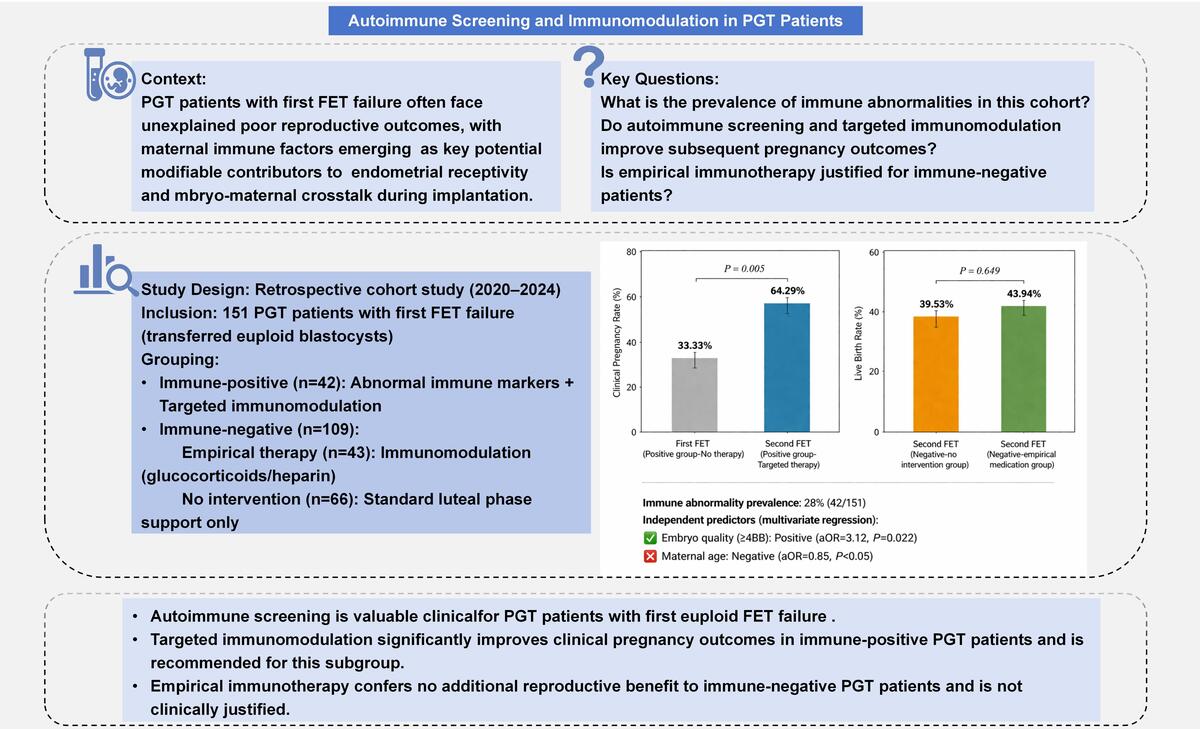
In this retrospective cohort study, 151 PGT patients who experienced a failed first frozen embryo transfer (FET) were divided into two groups. Patients underwent immune marker screening before their second FET. Among them, 42 were classified into the immune-positive group and received targeted interventions, while 109 were categorized into the immune-negative group, which was further divided into an empirical medication subgroup (n = 43) and a no-intervention subgroup (n = 66). Baseline characteristics and pregnancy outcomes were analyzed using statistical methods, including univariate and multivariate logistic regression analyses.
Results:
We found that among PGT patients with first transfer failure, 28% (42/151) showed abnormal immune markers. Targeted therapy in immune-positive patients was associated with significantly improved clinical pregnancy rates compared to their first unscreened cycle (64.29% vs. 33.33%, p = 0.005), while reducing the miscarriage rate. In contrast, empirical immunomodulation in immune-negative patients did not provide any additional benefit in terms of live birth rate (39.53% vs. 43.94%, p = 0.649). Multivariate analysis confirmed that embryo quality was an independent positive predictor of both hCG positivity (p = 0.034) and clinical pregnancy (p = 0.022), whereas maternal age showed an inverse association with the likelihood of success (p < 0.05).
Conclusions:
Immune abnormalities are relatively prevalent in the PGT population. Targeted immunomodulatory interventions in immune-positive patients were associated with improved pregnancy outcomes. We recommend that these patients should undergo immune screening and targeted interventions before embryo transfer. However, empirical therapy in immune-negative individuals is unjustified.
We aimed to evaluate the clinical utility of autoimmune screening and the effectiveness of immunomodulatory treatment in preimplantation genetic testing (PGT) patients.
Material and methods:
In this retrospective cohort study, 151 PGT patients who experienced a failed first frozen embryo transfer (FET) were divided into two groups. Patients underwent immune marker screening before their second FET. Among them, 42 were classified into the immune-positive group and received targeted interventions, while 109 were categorized into the immune-negative group, which was further divided into an empirical medication subgroup (n = 43) and a no-intervention subgroup (n = 66). Baseline characteristics and pregnancy outcomes were analyzed using statistical methods, including univariate and multivariate logistic regression analyses.
Results:
We found that among PGT patients with first transfer failure, 28% (42/151) showed abnormal immune markers. Targeted therapy in immune-positive patients was associated with significantly improved clinical pregnancy rates compared to their first unscreened cycle (64.29% vs. 33.33%, p = 0.005), while reducing the miscarriage rate. In contrast, empirical immunomodulation in immune-negative patients did not provide any additional benefit in terms of live birth rate (39.53% vs. 43.94%, p = 0.649). Multivariate analysis confirmed that embryo quality was an independent positive predictor of both hCG positivity (p = 0.034) and clinical pregnancy (p = 0.022), whereas maternal age showed an inverse association with the likelihood of success (p < 0.05).
Conclusions:
Immune abnormalities are relatively prevalent in the PGT population. Targeted immunomodulatory interventions in immune-positive patients were associated with improved pregnancy outcomes. We recommend that these patients should undergo immune screening and targeted interventions before embryo transfer. However, empirical therapy in immune-negative individuals is unjustified.
REFERENCES (40)
1.
Parikh FR, Athalye AS, Naik NJ, Naik DJ, Sanap RR, Madon PF. Preimplantation genetic testing: its evolution, where are we today? J Hum Reprod Sci 2018; 11: 306-14.
2.
Sacchi L, Albani E, Cesana A, et al. Preimplantation genetic testing for aneuploidy improves clinical, gestational, and neonatal outcomes in advanced maternal age patients without compromising cumulative live-birth rate. J Assist Reprod Genet 2019; 36: 2493-504.
3.
Gill P, Ata B, Arnanz A, et al. Does recurrent implantation failure exist? Prevalence and outcomes of five consecutive euploid blastocyst transfers in 123 987 patients. Hum Reprod 2024; 39: 974-80.
4.
Petch S, Crosby D. Updates in preimplantation genetic testing (PGT). Best Pract Res Clin Obstet Gynaecol 2024; 96: 102526.
5.
Scriven PN. A tale of two studies: now is no longer the best of times for preimplantation genetic testing for aneuploidy (PGT-A). J Assist Reprod Genet 2020; 37: 673-6.
6.
Awonuga AO, Camp OG, Abu-Soud HM, Rappolee DA, Puscheck EE, Diamond MP. Determinants of embryo implantation: roles of the endometrium and embryo in implantation success. Reprod Sci 2023; 30: 2339-48.
7.
Zhong J, Li J, Burton GJ, et al. The functional roles of protein glycosylation in human maternal-fetal crosstalk. Hum Reprod Update 2024; 30: 81-108.
8.
Abu-Raya B, Michalski C, Sadarangani M, Lavoie PM. Maternal immunological adaptation during normal pregnancy. Front Immunol 2020; 11: 575197.
9.
Geva E, Amit A, Lerner-Geva L, Lessing JB. Autoimmunity and reproduction. Fertil Steril 1997; 67: 599-611.
10.
Krivonos MI, Khizroeva JK, Zainulina MS, et al. The role of lymphocytic cells in infertility and reproductive failures in women with antiphospholipid antibodies. J Matern Fetal Neonatal Med 2022; 35: 871-7.
11.
Hu X, Zhang L. Uteroplacental circulation in normal pregnancy and preeclampsia: functional adaptation and maladaptation. Int J Mol Sci 2021; 22: 8622.
12.
Mao R, Wang X, Long R, Wang M, Jin L, Zhu L. A new insight into the impact of systemic lupus erythematosus on oocyte and embryo development as well as female fertility. Front Immunol 2023; 14: 1132045.
13.
Mao R, Zhu L, Long R, et al. A new insight on evaluation of the fertility and pregnancy outcome in patients with primary Sjögren syndrome: a propensity score matched study in multi-IVF centers. Reprod Biol Endocrinol 2024; 22: 57.
14.
Gao R, Zeng R, Qing P, et al. Antiphospholipid antibodies and pregnancy outcome of assisted reproductive treatment: a systematic review and meta-analysis. Am J Reprod Immunol 2021; 86: e13470.
15.
Ticconi C, Inversetti A, Logruosso E, et al. Antinuclear antibodies positivity in women in reproductive age: from infertility to adverse obstetrical outcomes – a meta-analysis. J Reprod Immunol 2023; 155: 103794.
16.
Liu M, Zhang H, Xu S, et al. The correlation between ANAs and pregnancy loss and their impact on IVF/ICSI-ET pregnancy outcomes in patients with recurrent pregnancy loss. Int J Gynaecol Obstet 2025; [Epub ahead of print].
17.
Chighizola CB, Pregnolato F, Raschi E, et al. Antiphospholipid antibodies and infertility: a gene expression study in decidual stromal cells. Isr Med Assoc J 2016; 18: 146-9.
18.
Tan X, Ding J, Pu D, Wu J. Anti-phospholipid antibody may reduce endometrial receptivity during the window of embryo implantation. J Gynecol Obstet Hum Reprod 2021; 50: 101912.
19.
Viall CA, Chamley LW. Histopathology in the placentae of women with antiphospholipid antibodies: a systematic review of the literature. Autoimmun Rev 2015; 14: 446-71.
20.
Deroux A, Dumestre-Perard C, Dunand-Faure C, Bouillet L, Hoffmann P. Female infertility and serum auto-antibodies: a systematic review. Clin Rev Allergy Immunol 2017; 53: 78-86.
21.
Zych M, Kniotek M, Roszczyk A, Dąbrowski F, Jędra R, Zagożdżon R. Surface immune checkpoints as potential biomarkers in physiological pregnancy and recurrent pregnancy loss. Int J Mol Sci 2024; 25: 9378.
22.
Piekarska K, Dratwa M, Radwan P, Radwan M, Bogunia-Kubik K, Nowak I. Pro- and anti-inflammatory cytokines and growth factors in patients undergoing in vitro fertilization procedure treated with prednisone. Front Immunol 2023; 14: 1250488.
23.
Garmendia JV, De Sanctis CV, Hajdúch M, De Sanctis JB. Exploring the immunological aspects and treatments of recurrent pregnancy loss and recurrent implantation failure. Int J Mol Sci 2025; 26: 1295.
24.
Quenby S, Kalumbi C, Bates M, Farquharson R, Vince G. Prednisolone reduces preconceptual endometrial natural killer cells in women with recurrent miscarriage. Fertil Steril 2005; 84: 980-4.
25.
Gomaa MF, Elkholy AG, El-Said MM, Abdel-Salam NE. Combined oral prednisolone and heparin versus heparin: the effect on peripheral NK cells and clinical outcome in patients with unexplained recurrent miscarriage. A double-blind placebo randomized controlled trial. Arch Gynecol Obstet 2014; 290: 757-62.
26.
Zhu Q, Wu L, Xu B, et al. A retrospective study on IVF/ICSI outcome in patients with anti-nuclear antibodies: the effects of prednisone plus low-dose aspirin adjuvant treatment. Reprod Biol Endocrinol 2013; 11: 98.
27.
Gao R, Deng W, Meng C, Cheng K, Zeng X, Qin L. Combined treatment of prednisone and hydroxychloroquine may improve outcomes of frozen embryo transfer in antinuclear antibody-positive patients undergoing IVF/ICSI treatment. Lupus 2021; 30: 2213-20.
28.
Sung N, Khan SA, Yiu ME, et al. Reproductive outcomes of women with recurrent pregnancy losses and repeated implantation failures are significantly improved with immunomodulatory treatment. J Reprod Immunol 2021; 148: 103369.
29.
Wang L, Xie J, Chu Y, Chen J, Jin L, Yue J. Effect of letrozole cotreatment in progestin-primed ovarian stimulation on IVF/ICSI outcomes in POSEIDON group 3 and 4 poor responders: a retrospective cohort study. Eur J Med Res 2025; 30: 314.
30.
Hiraoka T, Osuga Y, Hirota Y. Current perspectives on endometrial receptivity: a comprehensive overview of etiology and treatment. J Obstet Gynaecol Res 2023; 49: 2397-409.
31.
Mohamed Khosroshahi L, Parhizkar F, Kachalaki S, Aghebati-Maleki A, Aghebati-Maleki L. Immune checkpoints and reproductive immunology: pioneers in the future therapy of infertility related Disorders? Int Immunopharmacol 2021; 99: 107935.
32.
Sparaco M, Carbone L, Landi D, et al. Assisted reproductive technology and disease management in infertile women with multiple sclerosis. CNS Drugs 2023; 37: 849-66.
33.
Achilli C, Duran-Retamal M, Saab W, Serhal P, Seshadri S. The role of immunotherapy in in vitro fertilization and recurrent pregnancy loss: a systematic review and meta-analysis. Fertil Steril 2018; 110: 1089-100.
34.
Fawzy M, El-Refaeey AAA. Does combined prednisolone and low molecular weight heparin have a role in unexplained implantation failure? Arch Gynecol Obstet 2014; 289: 677-80.
35.
Peero EK, Banjar S, Khoudja R, et al. Intravenous immunoglobulin for patients with unexplained recurrent implantation failure: a 6-year single center retrospective review of clinical outcomes. Sci Rep 2024; 14: 3876.
36.
Sun Y, Cui L, Lu Y, et al. Prednisone vs Placebo and live birth in patients with recurrent implantation failure undergoing in vitro fertilization. JAMA 2023; 329: 1460-8.
37.
Hamdi K, Danaii S, Farzadi L, Abdollahi S, Chalabizadeh A, Abdollahi Sabet S. The role of heparin in embryo implantation in women with recurrent implantation failure in the cycles of assisted reproductive techniques (without history of thrombophilia). J Family Reprod Health 2015; 9: 59-64.
38.
Vitagliano A, Paffoni A, Viganò P. Does maternal age affect assisted reproduction technology success rates after euploid embryo transfer? A systematic review and meta-analysis. Fertil Steril 2023; 120: 251-65.
39.
Lou H, Li N, Guan Y, Zhang Y, Hao D, Cui S. Association between morphologic grading and implantation rate of euploid blastocyst. J Ovarian Res 2021; 14: 18.
40.
Li X, Wang Z, Wang H, Xu H, Sheng Y, Lian F. Role of N-acetylcysteine treatment in women with advanced age undergoing IVF/ICSI cycles: a prospective study. Front Med (Lausanne) 2022; 9: 917146.
| eISSN: | 1896-9151 |
| ISSN: | 1734-1922 |

We process personal data collected when visiting the website. The function of obtaining information about users and their behavior is carried out by voluntarily entered information in forms and saving cookies in end devices. Data, including cookies, are used to provide services, improve the user experience and to analyze the traffic in accordance with the Privacy policy. Data are also collected and processed by Google Analytics tool (more).
You can change cookies settings in your browser. Restricted use of cookies in the browser configuration may affect some functionalities of the website.
You can change cookies settings in your browser. Restricted use of cookies in the browser configuration may affect some functionalities of the website.