Current issue
Archive
Manuscripts accepted
About the Journal
Editorial office
Editorial board
Section Editors
Abstracting and indexing
Subscription
Contact
Ethical standards and procedures
Most read articles
Instructions for authors
Article Processing Charge (APC)
Regulations of paying article processing charge (APC)


BASIC RESEARCH
Ginsenoside Rg1 attenuates inflammatory injury and apoptosis in autoimmune thyroiditis by reshaping the Notch1/Hes1–CDH2 axis
1
The First Affiliated Hospital of Anhui Medical University, China
2
Anhui Public Health Clinical Center, China
These authors had equal contribution to this work
Submission date: 2025-12-13
Final revision date: 2026-04-07
Acceptance date: 2026-04-28
Online publication date: 2026-07-20
KEYWORDS
autoimmune thyroiditisHashimoto’s thyroiditisginsenoside Rg1Notch1/Hes1CDH2Mendelian randomizationsingle-cell RNA sequencingapoptosisinflammation
TOPICS
ABSTRACT
Introduction:
This study aimed to determine whether ginsenoside Rg1(Rg1) alleviates inflammation and apoptosis in autoimmune thyroiditis (AIT) by remodeling the Notch1/Hes1 signaling pathway, and to evaluate the potential of this pathway as a therapeutic target.
Material and methods:
Differentially expressed genes (DEGs) were identified from the GSE269497 bulk RNA-seq dataset and intersected with Notch1/Hes1 pathway gene sets to screen for candidate molecules. A protein–protein interaction network, CIBERSORT immune infiltration analysis, gene set enrichment analysis (GSEA), and gene set variation analysis (GSVA) were conducted to characterize CDH2-related immune and pathway features. Public GWAS/eQTL datasets were integrated using two-sample Mendelian randomization (MR) to evaluate the causal relationship between candidate genes and AIT risk. Single-cell RNA sequencing data from GSE163203 were used to analyze the cell-type-specific distribution of CDH2 in the thyroid microenvironment. In vitro validation was performed using CCK-8, RT-qPCR, and Western blot to assess cell viability, Notch1/Hes1 signaling, CDH2 levels, and apoptosis-related proteins.
Results:
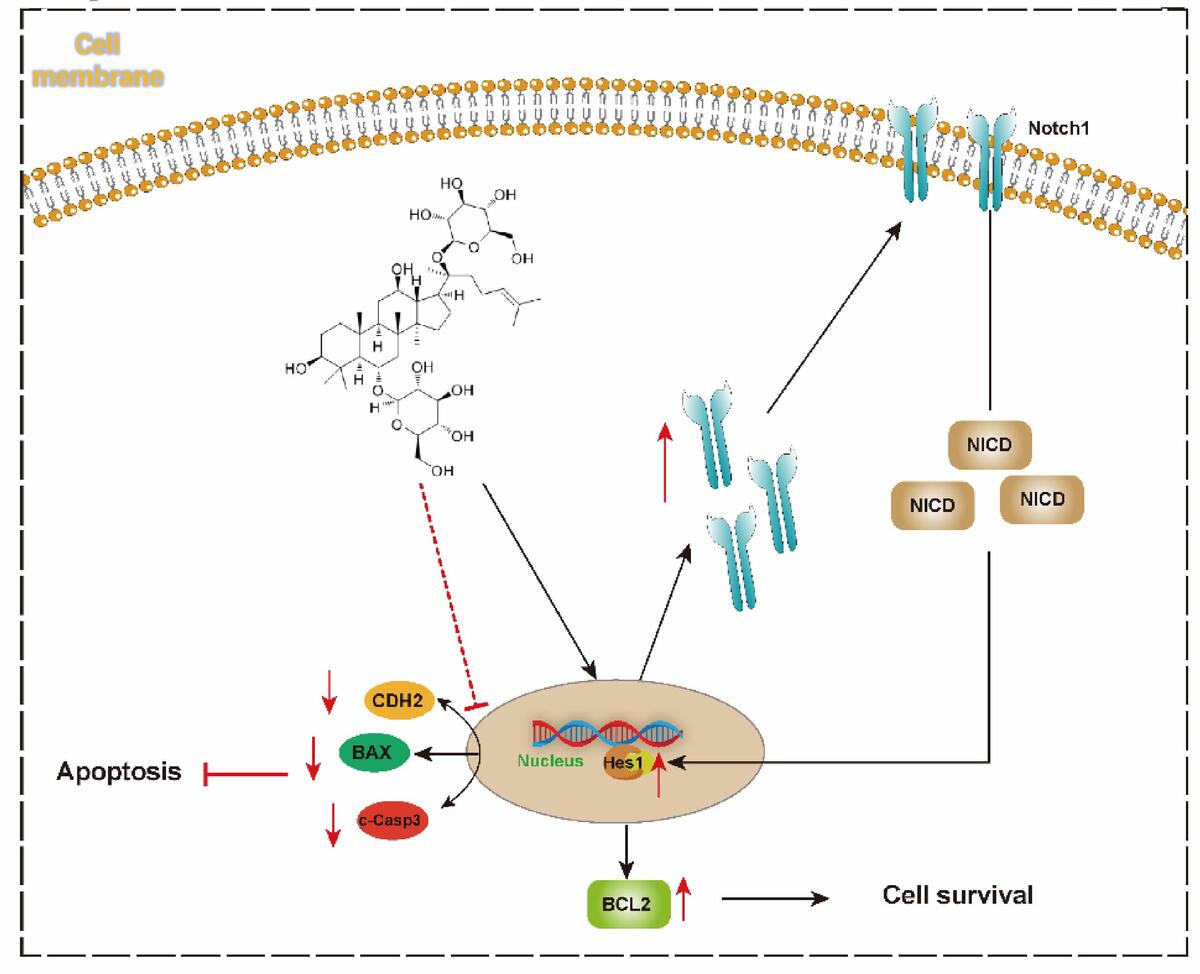
Transcriptomic analysis revealed disrupted Notch1/Hes1 signaling and significant upregulation of CDH2 in AIT. MR analysis indicated a positive causal relationship between genetically predicted CDH2 expression and AIT susceptibility. Elevated CDH2 expression correlated with reduced regulatory T-cell infiltration and enrichment of pro-inflammatory and stress-related pathways, including complement/coagulation, oxidative phosphorylation, and proteasome activation. In vitro, inflammatory stimulation inhibited Notch1/Hes1 signaling, shifted the Bcl-2/Bax–caspase axis toward apoptosis, and increased CDH2 expression. Rg1 treatment restored Notch1/Hes1 activation, increased Bcl-2 expression, reduced Bax and cleaved caspase-3 levels, suppressed CDH2 expression, and improved cell viability.
Conclusions:
Rg1 reduces inflammatory apoptosis and tissue damage in thyroid follicular cells during autoimmune thyroiditis (AIT) by reshaping the Notch1/Hes1–CDH2 axis, thereby enhancing pro-survival signals while inhibiting CDH2-mediated abnormal adhesion and pro-inflammatory activation. The Notch1/Hes1–CDH2 axis may serve as a potential target for mechanism-guided adjuvant therapy in AIT.
This study aimed to determine whether ginsenoside Rg1(Rg1) alleviates inflammation and apoptosis in autoimmune thyroiditis (AIT) by remodeling the Notch1/Hes1 signaling pathway, and to evaluate the potential of this pathway as a therapeutic target.
Material and methods:
Differentially expressed genes (DEGs) were identified from the GSE269497 bulk RNA-seq dataset and intersected with Notch1/Hes1 pathway gene sets to screen for candidate molecules. A protein–protein interaction network, CIBERSORT immune infiltration analysis, gene set enrichment analysis (GSEA), and gene set variation analysis (GSVA) were conducted to characterize CDH2-related immune and pathway features. Public GWAS/eQTL datasets were integrated using two-sample Mendelian randomization (MR) to evaluate the causal relationship between candidate genes and AIT risk. Single-cell RNA sequencing data from GSE163203 were used to analyze the cell-type-specific distribution of CDH2 in the thyroid microenvironment. In vitro validation was performed using CCK-8, RT-qPCR, and Western blot to assess cell viability, Notch1/Hes1 signaling, CDH2 levels, and apoptosis-related proteins.
Results:
Transcriptomic analysis revealed disrupted Notch1/Hes1 signaling and significant upregulation of CDH2 in AIT. MR analysis indicated a positive causal relationship between genetically predicted CDH2 expression and AIT susceptibility. Elevated CDH2 expression correlated with reduced regulatory T-cell infiltration and enrichment of pro-inflammatory and stress-related pathways, including complement/coagulation, oxidative phosphorylation, and proteasome activation. In vitro, inflammatory stimulation inhibited Notch1/Hes1 signaling, shifted the Bcl-2/Bax–caspase axis toward apoptosis, and increased CDH2 expression. Rg1 treatment restored Notch1/Hes1 activation, increased Bcl-2 expression, reduced Bax and cleaved caspase-3 levels, suppressed CDH2 expression, and improved cell viability.
Conclusions:
Rg1 reduces inflammatory apoptosis and tissue damage in thyroid follicular cells during autoimmune thyroiditis (AIT) by reshaping the Notch1/Hes1–CDH2 axis, thereby enhancing pro-survival signals while inhibiting CDH2-mediated abnormal adhesion and pro-inflammatory activation. The Notch1/Hes1–CDH2 axis may serve as a potential target for mechanism-guided adjuvant therapy in AIT.
REFERENCES (35)
1.
Piticchio T, Frasca F, Malandrino P, et al. Effect of gluten-free diet on autoimmune thyroiditis progression in patients with no symptoms or histology of celiac disease: a meta-analysis. Front Endocrinol 2023; 14: 1200372.
2.
Ragusa F, Fallahi P, Elia G, et al. Hashimotos’ thyroiditis: epidemiology, pathogenesis, clinic and therapy. Best Pract Res Clin Endocrinol Metab 2019; 33: 101367.
3.
Ralli M, Angeletti D, Fiore M, et al. Hashimoto’s thyroiditis: an update on pathogenic mechanisms, diagnostic protocols, therapeutic strategies, and potential malignant transformation. Autoimmun Rev 2020; 19: 102649.
4.
Weetman AP. An update on the pathogenesis of Hashimoto’s thyroiditis. J Endocrinol Invest 2021; 44: 883-90.
5.
Martinez Quintero B, Yazbeck C, Sweeney LB. Thyroiditis: evaluation and treatment. Am Fam Physician 2021; 104: 609-17.
6.
Caturegli P, De Remigis A, Rose NR. Hashimoto thyroiditis: clinical and diagnostic criteria. Autoimmun Rev 2014; 13: 391-7.
7.
Ding H, Qin J, Liu Z, et al. Mesenchymal stem cells alleviate autoimmune thyroiditis by modulating macrophage phenotypes and through influencing the STING pathway. Tissue Cell 2024; 91: 102596.
8.
Kimura H, Caturegli P. Chemokine orchestration of autoimmune thyroiditis. Thyroid 2007; 17: 1005-11.
9.
Mo K, Chu Y, Liu Y, et al. Targeting hnRNPC suppresses thyroid follicular epithelial cell apoptosis and necroptosis through m(6)A-modified ATF4 in autoimmune thyroid disease. Pharmacol Res 2023; 196: 106933.
10.
Zhao Z, Li J, Song N, et al. Buzhong Yiqi decoction improves inflammation and oxidative damage in autoimmune thyroiditis by inhibiting apoptosis via the SIRT1-Mediated Nrf2/NF-B axis. J Ethnopharmacol 2025; 351: 119967.
11.
Zhou B, Lin W, Long Y, et al. Notch signaling pathway: architecture, disease, and therapeutics. Signal Transduct Target Ther 2022; 7: 95.
12.
Lin YW, Li XX, Fu FH, et al. Notch1/Hes1 PTEN/AKT/IL 17A feedback loop regulates Th17 cell differentiation in mouse psoriasis like skin inflammation. Mol Med Rep 2022; 26: 223.
13.
Wang L, Lai S, Zou H, et al. Ischemic preconditioning/ischemic postconditioning alleviates anoxia/reoxygenation injury via the Notch1/Hes1/VDAC1 axis. J Biochem Mol Toxicol 2022; 36: e23199.
14.
Lu Y, Li SY, Lou H. Patchouli alcohol protects against myocardial ischaemia-reperfusion injury by regulating the Notch1/Hes1 pathway. Pharm Biol 2022; 60: 949-57.
15.
Yang SJ, Wang JJ, Cheng P, et al. Ginsenoside Rg1 in neurological diseases: from bench to bedside. Acta Pharmacol Sin 2023; 44: 913-30.
16.
Tang BL, Liu Y, Zhang JL, et al. Ginsenoside Rg1 ameliorates hypoxia-induced pulmonary arterial hypertension by inhibiting endothelial-to-mesenchymal transition and inflammation by regulating CCN1. Biomed Pharmacother 2023; 164: 114920.
17.
Tian G, Li J, Zhou L. Ginsenoside Rg1 regulates autophagy and endoplasmic reticulum stress via the AMPK/mTOR and PERK/ATF4/CHOP pathways to alleviate alcohol induced myocardial injury. Int J Mol Med 2023; 52: 56.
18.
Ning L, Zhou YL, Sun H, et al. Microbiome and metabolome features in inflammatory bowel disease via multi-omics integration analyses across cohorts. Nat Commun 2023; 14: 7135.
19.
He X, Liu X, Zuo F, et al. Artificial intelligence-based multi-omics analysis fuels cancer precision medicine. Semin Cancer Biol 2023; 88: 187-200.
20.
Chen Z, Wang Y, Xu Y. Genetic association between autoimmune thyroiditis and microscopic polyangiitis: a two-sample Mendelian randomization study. Medicine 2024; 103: e40827.
21.
Zhang Q, Lan X. Assessment of causal association between autoimmune thyroiditis and thyroid cancer: a Mendelian randomization study. Medicine 2025; 104: e41633.
22.
Vargas-Uricoechea H. Molecular mechanisms in autoimmune thyroid disease. Cells 2023; 12: 918.
23.
Mogahed EA, Soliman HM, Morgan DS, et al. Prevalence of autoimmune thyroiditis among children with autoimmune hepatitis. Ital J Pediatr 2024; 50: 72.
24.
Han D, Zhao Z, Mao T, et al. Ginsenoside Rg1: a neuroprotective natural dammarane-type triterpenoid saponin with anti-depressive properties. CNS Neurosci Ther 2024; 30: e70150.
25.
Zhu Y, Zou W, Sun B, et al. Ginsenoside Rg1 regulates the activation of astrocytes through lncRNA-Malat1/miR-124-3p/Lamc1 axis driving PI3K/AKT signaling pathway, promoting the repair of spinal cord injury. CNS Neurosci Ther 2024; 30: e70103.
26.
Yin S, Xia F, Zou W, et al. Ginsenoside Rg1 regulates astrocytes to promote angiogenesis in spinal cord injury via the JAK2/STAT3 signaling pathway. J Ethnopharmacol 2024; 334: 118531.
27.
Parker J, Hockney S, Blaschuk OW, et al. Targeting N-cadherin (CDH2) and the malignant bone marrow microenvironment in acute leukaemia. Expert Rev Mol Med 2023; 25: e16.
28.
László ZI, Lele Z. Flying under the radar: CDH2 (N-cadherin), an important hub molecule in neurodevelopmental and neurodegenerative diseases. Front Neurosci 2022; 16: 972059.
29.
Guvakova MA, Prabakaran I, Wu Z, et al. CDH2/N-cadherin and early diagnosis of invasion in patients with ductal carcinoma in situ. Breast Cancer Res Treat 2020; 183: 333-46.
30.
Situ Y, Deng L, Huang Z, et al. CDH2 and CDH13 as potential prognostic and therapeutic targets for adrenocortical carcinoma. Cancer Biol Ther 2024; 25: 2428469.
31.
Liu C, Pan Y, Li Q, et al. Bioinformatics analysis identified shared differentially expressed genes as potential biomarkers for Hashimoto’s thyroiditis-related papillary thyroid cancer. Int J Med Sci 2021; 18: 3478-87.
32.
Costa P, Rusconi S, Mavilio D, et al. Differential disappearance of inhibitory natural killer cell receptors during HAART and possible impairment of HIV-1-specific CD8 cytotoxic T lymphocytes. AIDS 2001; 15: 965-74.
33.
Filaci G, Rizzi M, Setti M, et al. Non-antigen-specific CD8(+) T suppressor lymphocytes in diseases characterized by chronic immune responses and inflammation. Ann N Y Acad Sci 2005; 1050: 115-23.
34.
Murdaca G, Spanò F, Contatore M, Guastalla A, Magnani O, Puppo F. Pharmacogenetics of etanercept: role of TNF- gene polymorphisms in improving its efficacy. Expert Opin Drug Metab Toxicol 2014; 10: 1703-10.
35.
Murdaca G, Gulli R, Spanò F, et al. TNF- gene polymorphisms: association with disease susceptibility and response to anti-TNF- treatment in psoriatic arthritis. J Invest Dermatol 2014; 134: 2503-9.
Share
RELATED ARTICLE
| eISSN: | 1896-9151 |
| ISSN: | 1734-1922 |

We process personal data collected when visiting the website. The function of obtaining information about users and their behavior is carried out by voluntarily entered information in forms and saving cookies in end devices. Data, including cookies, are used to provide services, improve the user experience and to analyze the traffic in accordance with the Privacy policy. Data are also collected and processed by Google Analytics tool (more).
You can change cookies settings in your browser. Restricted use of cookies in the browser configuration may affect some functionalities of the website.
You can change cookies settings in your browser. Restricted use of cookies in the browser configuration may affect some functionalities of the website.