Current issue
Archive
Manuscripts accepted
About the Journal
Editorial office
Editorial board
Section Editors
Abstracting and indexing
Subscription
Contact
Ethical standards and procedures
Most read articles
Instructions for authors
Article Processing Charge (APC)
Regulations of paying article processing charge (APC)


Editor's Choice
MICROBIOLOGY AND VIROLOGY / PUBLIC HEALTH
Assessment of microbial contamination of mobile phones among medical staff, students, and visitors in a pediatric hematology-oncology ward and its relationship with infections among pediatric patients
1
Student Scientific Society of the Department of Paediatric Haematology, Oncology and Transplantology, Medical University of Lublin, Poland
2
Department of Immunology, Faculty of Biology and Biotechnology, Maria Curie-Skłodowska University, Lublin, Poland
3
Department of Pediatric Hematology, Oncology, and Transplantation, Medical University of Lublin, Poland
Submission date: 2026-04-09
Final revision date: 2026-05-27
Acceptance date: 2026-06-26
Online publication date: 2026-07-25
Publication date: 2026-08-28
Corresponding author
Karolina Różycka
Student Scientific Club at the Department of Pediatric Hematology, Oncology, and Transplantation Medical University of Lublin ul. prof. Antoniego Gębali 6 20-093 Lublin, Poland
Student Scientific Club at the Department of Pediatric Hematology, Oncology, and Transplantation Medical University of Lublin ul. prof. Antoniego Gębali 6 20-093 Lublin, Poland
Arch Med Sci 2026;22(4):1970-1977
KEYWORDS
bacterial contaminationhealthcare-associated infectionscell phoneshealthcare workerscross infectionpediatric oncology
TOPICS
ABSTRACT
Introduction:
Healthcare-associated infections (HAIs) remain a significant threat to patient safety. The aim of this study was to evaluate the frequency and extent of microbial contamination of cell phones (CPs) used by medical staff, medical students, and visitors to pediatric patients with hematological and oncological diseases and immune disorders, as well as their potential contribution to microbial dissemination in the hospital environment.
Material and methods:
The study was conducted at the Department of Pediatric Hematology, Oncology, and Transplantation at the University Children’s Hospital in Lublin between May and July 2025. Samples were collected by swabbing the surfaces of cell phones. The samples were analyzed in an outsourced laboratory in accordance with standard procedures. Additionally, patients’ medical records were reviewed for signs of infection.
Results:
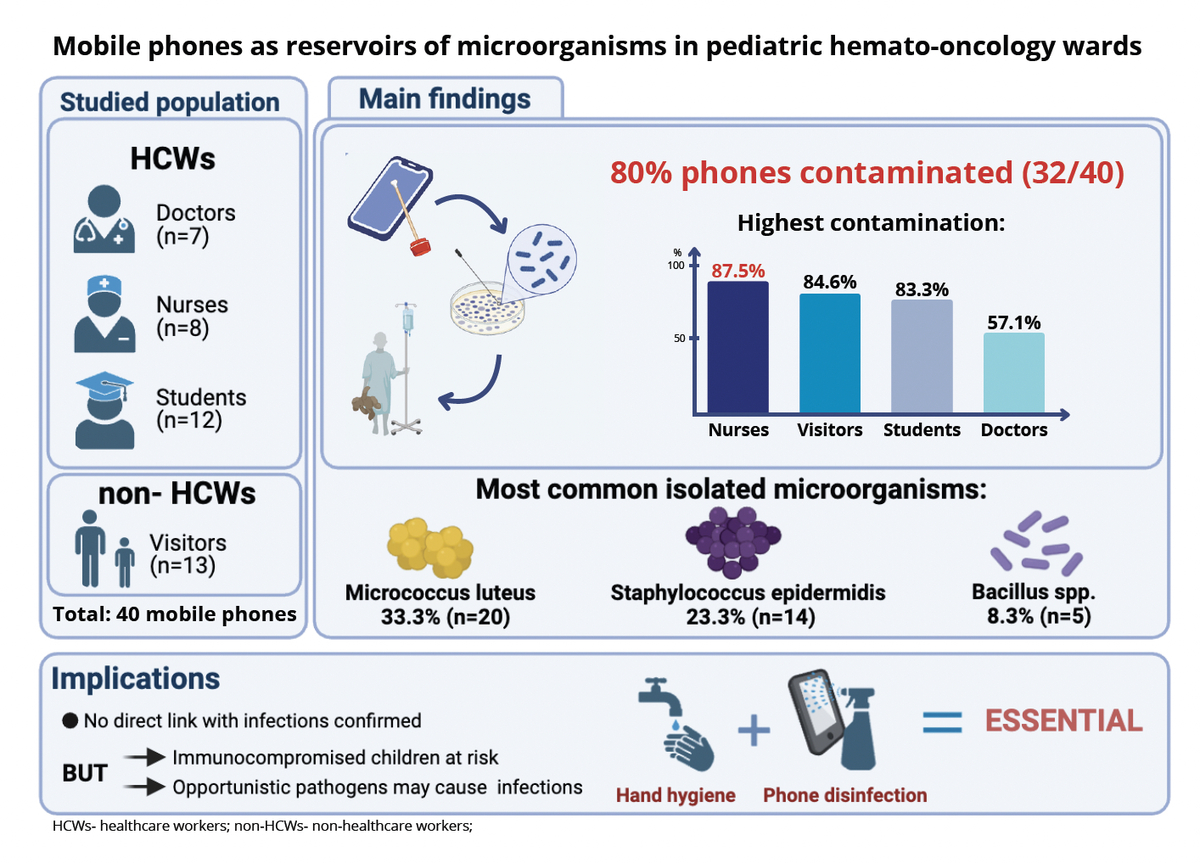
Forty active CP users were included in the study, including visitors (n = 13), students (n = 12), nurses (n = 8), and doctors (n = 7). Contamination was detected in 32/40 (80%) CP samples. A total of 61 strains were isolated: 60 bacterial strains and 1 mold isolate. The most prevalent species were Micrococcus luteus (33.3%; n = 20) and Staphylococcus epidermidis (23.3%; n = 14). The highest proportion of contaminated CPs was observed among nurses (87.5%). Symptoms of infection were observed in 7 patients; however, no correlation was found between the microorganisms isolated from CPs and the etiological agents identified in patients with infections.
Conclusions:
The results indicate that CPs used by medical staff are frequently contaminated with bacteria. This suggests that, in addition to their communicative function, they may serve as potential reservoirs of microorganisms and therefore warrant attention in infection prevention strategies.
Healthcare-associated infections (HAIs) remain a significant threat to patient safety. The aim of this study was to evaluate the frequency and extent of microbial contamination of cell phones (CPs) used by medical staff, medical students, and visitors to pediatric patients with hematological and oncological diseases and immune disorders, as well as their potential contribution to microbial dissemination in the hospital environment.
Material and methods:
The study was conducted at the Department of Pediatric Hematology, Oncology, and Transplantation at the University Children’s Hospital in Lublin between May and July 2025. Samples were collected by swabbing the surfaces of cell phones. The samples were analyzed in an outsourced laboratory in accordance with standard procedures. Additionally, patients’ medical records were reviewed for signs of infection.
Results:
Forty active CP users were included in the study, including visitors (n = 13), students (n = 12), nurses (n = 8), and doctors (n = 7). Contamination was detected in 32/40 (80%) CP samples. A total of 61 strains were isolated: 60 bacterial strains and 1 mold isolate. The most prevalent species were Micrococcus luteus (33.3%; n = 20) and Staphylococcus epidermidis (23.3%; n = 14). The highest proportion of contaminated CPs was observed among nurses (87.5%). Symptoms of infection were observed in 7 patients; however, no correlation was found between the microorganisms isolated from CPs and the etiological agents identified in patients with infections.
Conclusions:
The results indicate that CPs used by medical staff are frequently contaminated with bacteria. This suggests that, in addition to their communicative function, they may serve as potential reservoirs of microorganisms and therefore warrant attention in infection prevention strategies.
REFERENCES (38)
1.
Allegranzi B, Bagheri Nejad S, Combescure C, et al. Burden of endemic health-care-associated infection in developing countries: systematic review and meta-analysis. Lancet 2011; 377: 228-41.
2.
Lemiech-Mirowska E, Kiersnowska ZM, Michałkiewicz M, Depta A, Marczak M. Nosocomial infections as one of the most important problems of healthcare system. Ann Agric Environ Med 2021; 28: 361-6.
3.
Larypoor M, Frsad S. Evaluation of nosocomial infections in one of hospitals of Qom, 2008. Iran J Med Microbiol 2011; 5: 7-17.
4.
Olise CC, Simon-Oke IA. Fomites: possible vehicle of nosocomial infections. J Pub Health Catalog 2018; 1: 11-6.
5.
Khashei R, Ebrahim-Saraie HS, Hadadi M, Ghayem M, Shahraki HR. The occurrence of nosocomial pathogens on cell phones of healthcare workers in an Iranian Tertiary Care Hospital. Infect Disord Drug Targets 2019; 19: 327-33.
6.
Bodena D, Teklemariam Z, Balakrishnan S, Tesfa T. Bacterial contamination of mobile phones of health professionals in Eastern Ethiopia: antimicrobial susceptibility and associated factors. Trop Med Health 2019;47: 15.
7.
Mushabati NA, Samutela MT, Yamba K, et al. Bacterial contamination of mobile phones of healthcare workers at the University Teaching Hospital, Lusaka, Zambia. Infect Prev Pract 2021; 3: 100126.
8.
Pal S, Juyal D, Adekhandi S, et al. Mobile phones: reservoirs for the transmission of nosocomial pathogens. Adv Biomed Res 2015; 4: 144.
9.
Banawas S, Abdel-Hadi A, Alaidarous M, et al. Multidrug-resistant bacteria associated with cell phones of healthcare professionals in selected hospitals in Saudi Arabia. Can J Infect Dis Med Microbiol 2018; 2018: 6598918.
10.
Kramer A, Schwebke I, Kampf G. How long do nosocomial pathogens persist on inanimate surfaces? A systematic review. BMC Infect Dis 2006; 6: 130.
11.
Ulger F, Esen S, Dilek A, Yanik K, Gunaydin M, Leblebicioglu H. Are we aware how contaminated our mobile phones with nosocomial pathogens? Ann Clin Microbiol Antimicrob 2009; 8: 7.
12.
Amala S, Ejikema I. Bacteria associated with the mobile phones of medical personnel. Am J Biomed Sci 2015; 7: 36.
13.
Vinod Kumar B, Hobani YH, Abdulhaq A, et al. Prevalence of antibacterial resistant bacterial contaminants from mobile phones of hospital inpatients. Libyan J Med 2014; 9: 25451.
14.
Heyba M, Ismaiel M, Alotaibi A, et al. Microbiological contamination of mobile phones of clinicians in intensive care units and neonatal care units in public hospitals in Kuwait. BMC Infect Dis 2015; 15: 434.
15.
De Groote P, Blot K, Conoscenti E, Labeau S, Blot S. Mobile phones as a vector for healthcare-associated infection: a systematic review. Intensive Crit Care Nurs 2022; 72: 103266.
16.
Semmelweis IP. Die Aetilogie, der Begriff und die Prophylaxis des Kindbettfiebers. C.A. Hartleben’s Verlags-Expedition. Budapest 1861.
18.
Ulger F, Dilek A, Esen S, Sunbul M, Leblebicioglu H. Are healthcare workers’ mobile phones a potential source of nosocomial infections? Review of the literature. J Infect Dev Ctries 2015; 9: 1046-53.
19.
Rehman R, Ahmed K, Shaikh S. Stethoscope as a vector for nosocomial bacterial infections. J College Phys Surg Pakistan 2019; 29: 592.
20.
Girma MM, Ketema A, Gemeda A. Bacterial contamination of mobile phones of healthcare workers at Jimma University Specialized Hospital, Jimma, South West Ethiopia. Int J Infect Control 2014; 11: 1-8.
21.
Morubagal RR, Shivappa SG, Mahale RP, Neelambike SM. Study of bacterial flora associated with mobile phones of healthcare workers and non-healthcare workers. Iran J Microbiol 2017; 9: 143-51.
22.
Marwa AE, Nadia ME. Mobile phones are silent threat. Int J Curr Microbiol App Sci 2015; 4: 199-205.
23.
Jayalakshmi J, Appalaraju B, Usha S. Cellphones as reservoirs of nosocomial pathogens. J Assoc Physicians India 2008; 56: 388-9.
24.
Neha S, Aruna S, Parihar RS, Khatri PK, Arvind C, Archana B. Prevalence and antibiotic pattern of microbes isolated from mobile phones of health care workers and non- health care workers. Int Curr Microbiol App Sci 2014; 3: 43-60.
25.
Chawla K, Mukhopadhayay C, Gurung B, Bhate P, Bairy I. Bacterial ‘cell’ phones: do cell phones carry potential pathogens? Online J Health Allied Sci 2009; 8 (1): 8.
26.
Qureshi NQ, Mufarrih SH, Irfan S, et al. Mobile phones in the orthopedic operating room: microbial colonization and antimicrobial resistance. World J Orthop 2020; 11: 252-64.
27.
Nwankwo EO, Ekwunife N, Mofolorunsho KC. Nosocomial pathogens associated with the mobile phones of healthcare workers in a hospital in Anyigba, Kogi state, Nigeria. J Epidemiol Glob Health 2014; 4: 135-40.
28.
Albertson D, Natsios GA, Gleckman R. Septic shock with Micrococcus luteus. Arch Intern Med 1978; 138: 487-8.
29.
Polk HC. Zakażenia w chirurgii. Wydawnictwo Lekarskie PZWL Wyd. I, Warszawa 1987.
30.
Szczerba I. Mikrokoki jako etiologiczny czynnik zakażeń oportunistycznych. Przegl Epidemiol 2000; 54: 385-92.
31.
Galazzi A, Panigada M, Broggi E, et al. Microbiological colonization of healthcare workers’ mobile phones in a tertiary-level Italian intensive care unit. Intensive Crit Care Nurs 2019; 52: 17-21.
32.
Bhumbla U, Ahmad S, Mathur D, Bandey L, Mathur G. Study on microbial contamination of mobile phones and their role in nosocomial infections in a tertiary hospital of south India. Asian J Pharm Clin Res 2016; 9: 201-2.
33.
McCann MT, Gilmore BF, Gorman SP. Staphylococcus epidermidis device-related infections: pathogenesis and clinical management. J Pharm Pharmacol 2008; 60: 1551-71.
34.
Gomes F, Teixeira P, Oliveira R. Mini-review: Staphylococcus epidermidis as the most frequent cause of nosocomial infections: old and new fighting strategies. Biofouling 2014; 30: 131-41.
35.
Ziebuhr W, Hennig S, Eckart M, Kränzler H, Batzilla C, Kozitskaya S. Nosocomial infections by Staphylococcus epidermidis: how a commensal bacterium turns into a pathogen. Int J Antimicrob Agents 2006; 28 Suppl 1: S14-20.
36.
Eltwisy HO, Twisy HO, Hafez MH, Sayed IM, El-Mokhtar MA. Clinical infections, antibiotic resistance, and pathogenesis of Staphylococcus haemolyticus. Microorganisms 2022; 10: 1130.
38.
Samsung Support NZ. Galaxy note 8: how to clean dirty glass/screen? Available: https://www.samsung.com/nz/sup....
Share
RELATED ARTICLE
| eISSN: | 1896-9151 |
| ISSN: | 1734-1922 |

We process personal data collected when visiting the website. The function of obtaining information about users and their behavior is carried out by voluntarily entered information in forms and saving cookies in end devices. Data, including cookies, are used to provide services, improve the user experience and to analyze the traffic in accordance with the Privacy policy. Data are also collected and processed by Google Analytics tool (more).
You can change cookies settings in your browser. Restricted use of cookies in the browser configuration may affect some functionalities of the website.
You can change cookies settings in your browser. Restricted use of cookies in the browser configuration may affect some functionalities of the website.