Introduction
Interstitial lung disease (ILD) comprises a heterogeneous group of pulmonary disorders characterized by inflammation, fibrosis, progressive respiratory impairment, and increased mortality, particularly among older adults [1–3]. While age-adjusted mortality rates (AAMR) showed relative stability before the COVID-19 pandemic, sharp inequalities were evident across racial groups, sexes, and geographic regions. Mortality was highest among older populations, especially individuals aged 85 years and older [4]. On a global scale, data from the 2019 Global Burden of Disease (GBD) study indicate an age-standardized prevalence rate for ILD (encompassing pulmonary sarcoidosis) of roughly 57.62 cases per 100,000 people. The corresponding global mortality rate was 2.17 per 100,000, reflecting a slow but consistent increase over time [5].
Older adults are particularly vulnerable to ILD mortality because age-related declines in pulmonary function, multimorbidity, frailty, and reduced tolerance to diagnostic and therapeutic interventions can delay diagnosis and worsen outcomes [6, 7]. Despite this elevated risk, important public health gaps remain, including limited understanding of long-term mortality trends, future projections, and demographic, geographic, and socioeconomic disparities in ILD mortality among older adults.
Although prior CDC WONDER-based studies have described historical ILD mortality trends, they have rarely integrated forecasting with detailed geographic and socioeconomic disparity analyses. As a result, it remains difficult to identify underperforming regions with potentially preventable excess mortality or to anticipate future public health needs, limiting the ability to inform targeted policy and resource allocation [4].
Clarifying the demographic (e.g., age, sex, race) and geographic distribution patterns of ILD-associated fatalities enables the pinpointing of high-risk groups – such as older males, specific racial and ethnic populations, and regions with a lower Socio-demographic Index (SDI). This knowledge is critical for guiding resource distribution, implementing early detection programs, and developing targeted interventions aimed at reducing health inequities and improving patient outcomes [8, 9].
This study aims to fill these gaps by applying advanced statistical methods, including Joinpoint regression, ARIMA forecasting, and frontier analysis, to comprehensively assess ILD mortality trends, disparities, and projected future burden among US adults aged ≥ 65 years.
Material and methods
This ecological study used population-level mortality data to examine trends, disparities, and projections of ILD mortality among U.S. adults aged ≥ 65 years.
Data sources and case definition
Mortality data were obtained from the CDC WONDER underlying cause-of-death database for U.S. adults aged ≥ 65 years from 1999 to 2020. ILD deaths were identified using ICD-10 code J84 when it was listed as the underlying cause of death. Thus, this study captures deaths primarily attributed to ILD rather than deaths in which ILD was recorded only as a contributing condition. Age-adjusted mortality rates were calculated per 100,000 population using the 2000 U.S. standard population. Stratified analyses were conducted by sex, age group, race, Hispanic origin, census region, state, and urbanization level according to available CDC WONDER categories.
Handling of missing data
For Hispanic origin, deaths reported as “Not Stated” in CDC WONDER were included in the overall “All” totals and rates but were excluded from Hispanic origin-specific counts and rates because no corresponding population denominator is available for this category. For race, NCHS applies a bridging procedure to impute multiple-race reports to a single-race category based on combinations of race, Hispanic origin, sex, and age, thereby maintaining comparability across the study period. Records with completely unknown race were rare and were handled similarly to other “Not Stated” categories. Urbanization classification was based on the decedent’s county of residence using the NCHS Urban-Rural Classification Scheme, such as metro and nonmetro categories. Because each U.S. county is assigned to an urbanization category, this variable has near-complete coverage; records with missing urbanization information, if present, were retained in overall totals but not included in stratum-specific urbanization analyses.
Study design and population
This population-based study assessed ILD mortality among US adults aged ≥ 65 years from 1999 to 2020. Analyses were conducted using aggregate-level mortality data from all US states and the District of Columbia. Deaths and AAMRs were stratified by sex, age group, race/ethnicity, year, geographic region, and urbanization status. Age adjustment minimized the influence of changes in population age structure over time and allowed comparisons across demographic and geographic subgroups.
Statistical analysis
Temporal trends (Joinpoint regression)
Joinpoint regression was used to identify temporal changes in ILD mortality rates and to pinpoint time points (“joinpoints”) at which trends significantly changed direction, allowing for a more precise characterization of mortality dynamics over time. This method detects points where the linear slope of the trend undergoes statistically significant changes, calculates the annual percent change (APC), and identifies key turning points [10, 11]. This analysis enables us to determine periods of significant increase or decrease in ILD mortality rates, thereby providing deeper insights into the temporal patterns of mortality and potential factors influencing these trends.
ARIMA forecasting analysis
Autoregressive integrated moving average (ARIMA) modeling was used to forecast ILD mortality rates through 2030, providing a forward-looking estimate of future burden based on historical patterns. The model was based on annual data from 1999–2020, with parameters optimized via autocorrelation functions and the BIC [12, 13].
Time-series forecasting was performed using ARIMA models, which are well suited for modeling temporal trends and autocorrelation in relatively short annual mortality time series. Alternative approaches, including exponential smoothing (ETS) and Prophet models, were considered; however, given the limited length of the annual data and the absence of pronounced seasonal patterns, ARIMA was selected as a more parsimonious and interpretable approach. Model performance was evaluated by comparing observed and fitted values, which demonstrated good agreement (r = 0.789, p < 0.001). Residual diagnostics, including Q–Q plots, autocorrelation function (ACF), and partial autocorrelation function (PACF), indicated that residuals were approximately normally distributed and exhibited no significant autocorrelation. The Ljung–Box test further confirmed that residuals behaved as white noise (Q = 4.954, p = 0.292), supporting model adequacy.
SDI correlation analysis
To examine the relationship between socioeconomic development and ILD mortality, we conducted correlation analyses between mortality rates and the SDI, a composite measure reflecting income, education, and fertility. This analysis provides insight into how ILD mortality varies across levels of socioeconomic development.
Frontier analysis
The SDI was used to characterize state-level socioeconomic development. SDI is a composite indicator ranging from 0 to 1, derived from income per capita, average educational attainment, and fertility rate; higher SDI values indicate higher socioeconomic development, whereas lower values indicate lower development. We quantified the association between state-level SDI and AAMR to identify states with excess mortality relative to their development level.
Frontier analysis was applied to estimate the lowest potentially achievable AAMR at a given SDI level and to identify states deviating from this benchmark. The frontier model specified state-level AAMR as the dependent variable and SDI as the main explanatory variable, with a composed error term including random statistical noise and a one-sided non-negative inefficiency component representing excess mortality above the frontier. The model was fitted using Stata version 18.0 with the frontier command. States closer to the estimated frontier were interpreted as having lower-than-expected mortality for their SDI level, whereas states farther from the frontier were considered to have greater potentially reducible mortality burden.
Results
Demographic and geographic disparities in ILD mortality
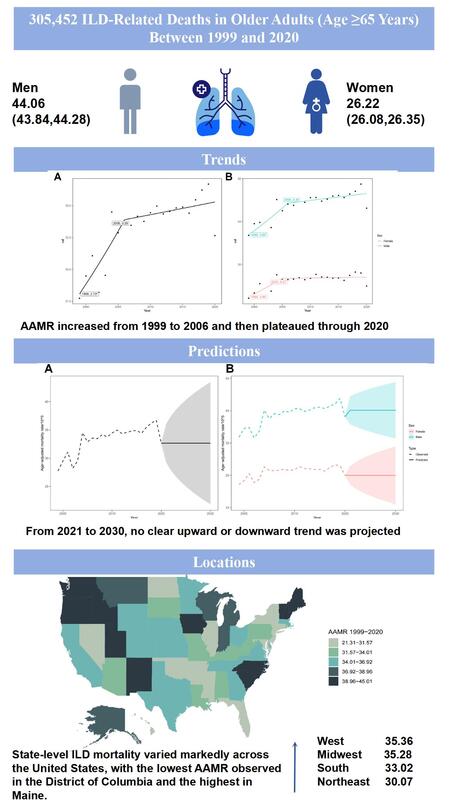
From 1999 to 2020, a total of 305,452 ILD deaths occurred among US adults aged ≥ 65 years, corresponding to an overall age-adjusted mortality rate of 33.45 per 100,000 population. Substantial disparities were observed across demographic and geographic groups. Mortality was markedly higher among males than females, approaching a twofold difference. Among racial groups, American Indian or Alaska Native individuals experienced the highest mortality burden, whereas Black or African American individuals had the lowest rates. Geographic variation was also evident, with higher mortality concentrated in the West and Midwest. Nonmetropolitan areas showed only a modestly higher mortality burden than metropolitan areas. Detailed subgroup-specific estimates are presented in Table I.
Table I
Demographic and geographic characteristics of deaths due to interstitial lung disease among adults aged ≥ 65 years in the United States, 1999–2020. Deaths/population indicates the number of ILD deaths and the corresponding population size. AAMR is expressed per 100,000 population and was age-adjusted using the 2000 U.S. standard population
State-level geographic variation
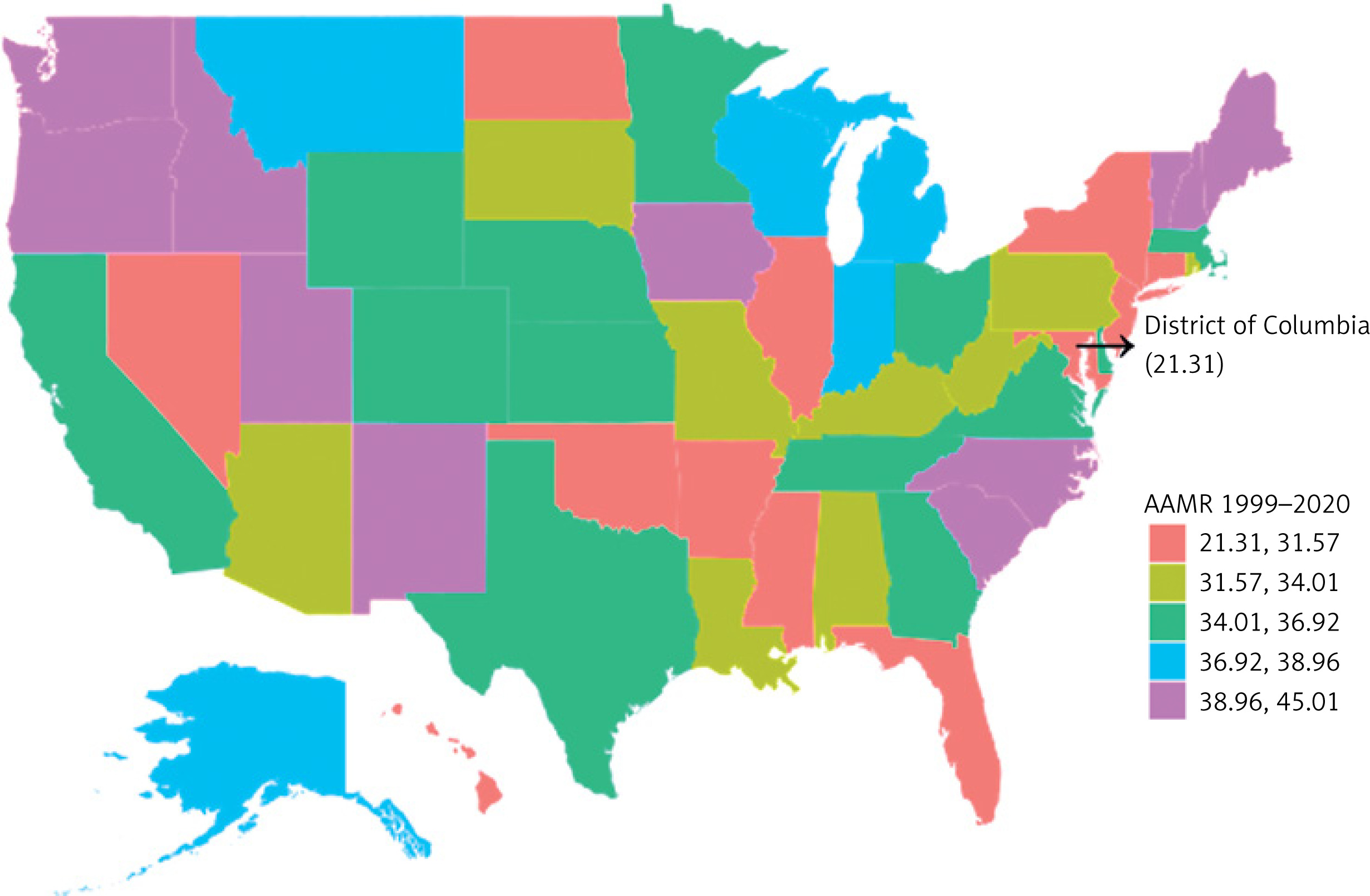
State-level AAMRs among older adults showed substantial geographic heterogeneity from 1999 to 2020. Higher mortality burdens were concentrated in several northern, western, and Appalachian states, whereas lower rates were observed in the District of Columbia and some coastal states. These findings indicate that the burden of ILD mortality was unevenly distributed across the country. Detailed state-specific estimates are provided in Supplementary Table SI and Figure 1.
Sex- and age-specific trends in mortality rates
Mortality rates increased markedly with advancing age in both 1999 and 2020, and males consistently exhibited higher rates than females across all age groups. The sex disparity was most pronounced in the oldest age group, indicating that advanced age and male sex were both associated with a greater mortality burden. Across the study period, mortality in the 65–74-year group remained relatively stable or declined slightly, whereas rates in the older age groups increased for much of the period before showing a modest decline near the end of follow-up. These age- and sex-specific patterns, together with their temporal changes, are summarized in Supplementary Figures S2 and S3 and Supplementary Table SII.
Long-term trends and age distribution of ILD burden
From 1999 to 2020, the burden of ILD mortality among older US adults increased substantially in absolute terms, with annual deaths nearly doubling over the study period and peaking in 2019 before a slight decline in 2020. The AAMR also rose overall and then leveled off toward the end of the study period. Throughout the follow-up, males consistently carried a higher mortality burden than females, and the distribution of deaths gradually shifted toward the oldest age group. Together, these findings suggest that population aging contributed importantly to the growing burden of ILD mortality, even as age-adjusted rates stabilized in later years. These patterns are shown in Supplementary Figures S4 and S5 and Supplementary Table SIII.
Trend analysis and inflection points
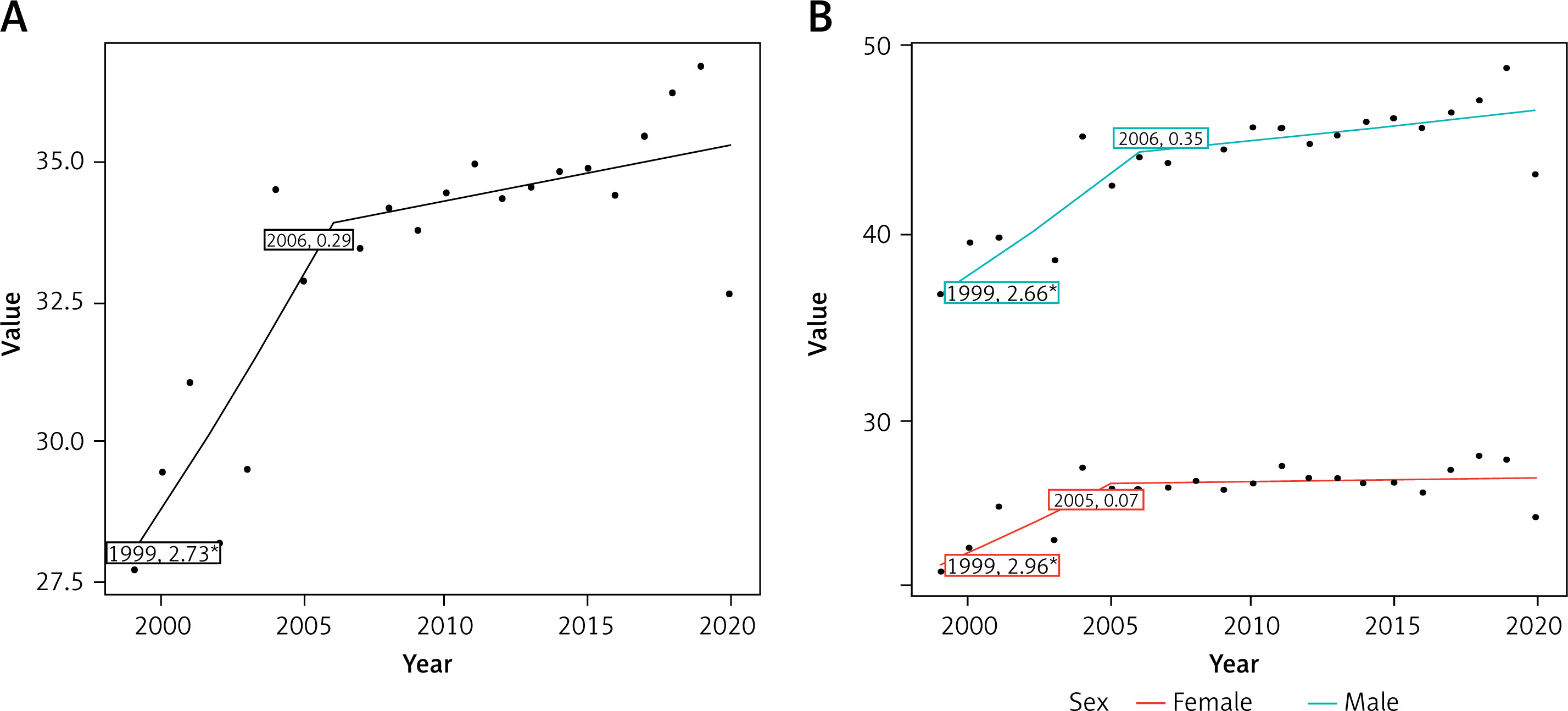
Joinpoint regression identified a significant increase in overall age-adjusted ILD mortality from 1999 to 2006 (APC 2.73%, p < 0.001), followed by a non-significant plateau through 2020. Sex-stratified analyses showed a similar pattern in both females and males, with an early increase followed by relative stabilization. These results indicate that the mortality burden rose in the early years of the study period but did not continue increasing thereafter. Detailed APC estimates are provided in Figure 2 and Supplementary Table SIV.
Projections of future ILD mortality trajectories
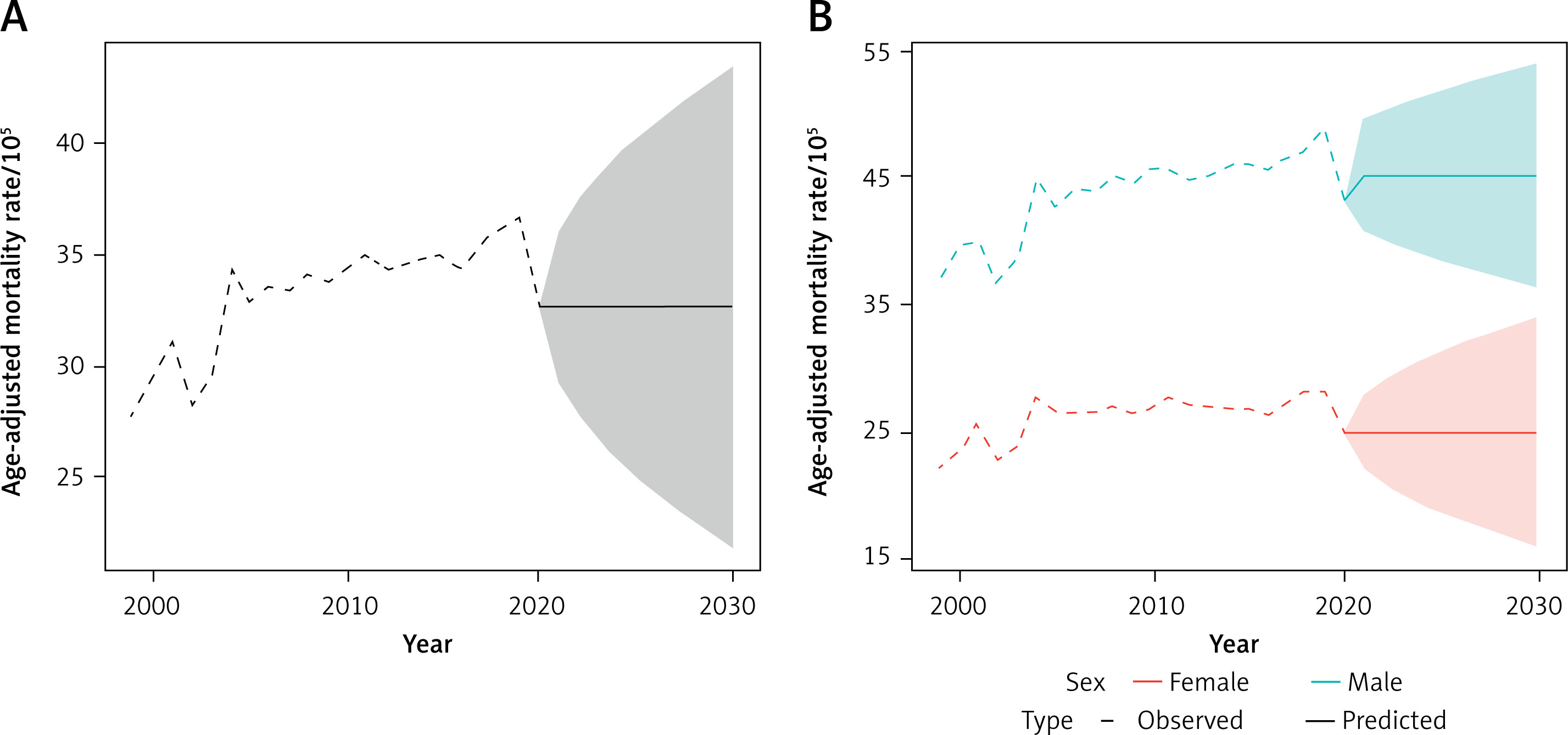
ARIMA modeling projected that age-adjusted ILD mortality rates will remain broadly stable from 2021 through 2030 overall and in both sexes. Male mortality is expected to remain consistently higher than female mortality throughout the projection period. Although prediction intervals widened over time, reflecting increasing uncertainty in longer-term forecasts, no clear upward or downward trend was anticipated. Detailed projected estimates are presented in Figure 3 and Supplementary Table SV.
Figure 3
Observed and autoregressive integrated moving average (ARIMA)-predicted age-adjusted mortality rates for interstitial lung disease among U.S. adults aged ≥ 65 years through 2030. Panel A shows the overall observed and projected age-adjusted mortality rates (AAMRs), and Panel B shows sex-specific observed and projected AAMRs. Shaded areas represent 95% prediction intervals
Socio-demographic influences and efficiency frontiers
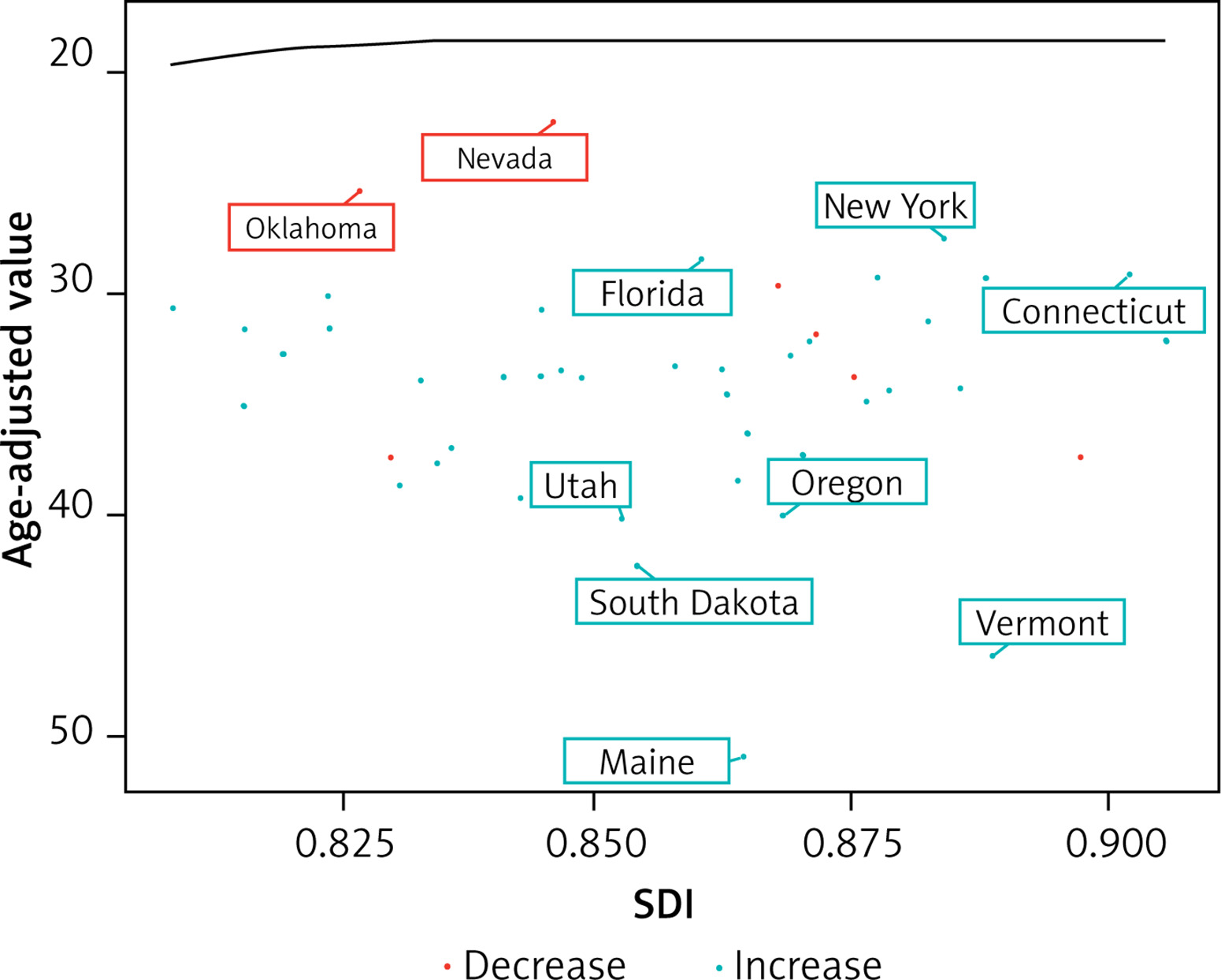
State-level analyses showed a non-linear association between socio-demographic development and ILD mortality, with mortality generally tending to decline as SDI increased. Frontier analysis further revealed substantial heterogeneity among states with similar SDI levels, suggesting that part of the observed burden may be potentially reducible. States located far from the frontier appeared to have greater room for improvement relative to their socioeconomic context. These findings are illustrated in Figures 4 and 5.
Figure 4
Distribution of interstitial lung disease mortality burden across state-level Socio-demographic Index (SDI) levels among U.S. adults aged ≥ 65 years. Each point represents a state-year estimate. Age-adjusted mortality rates (AAMRs) are expressed per 100,000 population
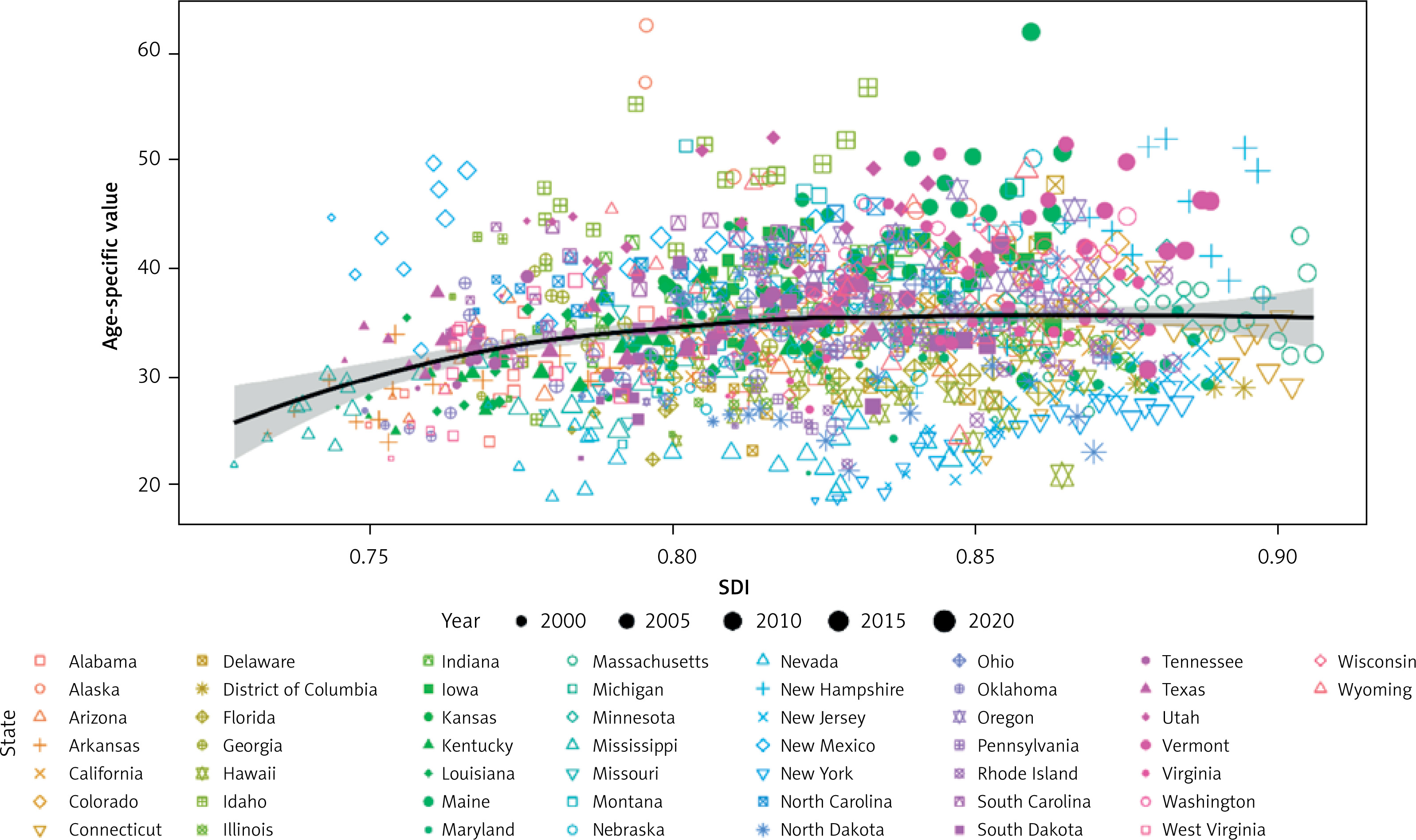
Figure 5
Frontier analysis of the relationship between state-level Socio-demographic Index (SDI) and age-adjusted mortality rates for interstitial lung disease among U.S. adults aged ≥ 65 years, 2020. The plot displays 2020 state-level age-adjusted mortality rates (AAMRs) and SDI values for each state across the study period. The frontier represents the lowest theoretically achievable AAMR at a given SDI level. States farther from the frontier indicate greater excess mortality relative to their socioeconomic development level
Discussion
Because this study was based on an ecological design using aggregate mortality data, the observed temporal, demographic, geographic, and socioeconomic patterns should be interpreted as population-level associations, and causal inferences at the individual level cannot be drawn.
The plateau: a story of progress and persistent challenges: In this national analysis of ILD mortality among U.S. adults aged 65 years and older from 1999 to 2020, we observed an early increase in age-adjusted mortality followed by a prolonged plateau after the mid-2000s. This pattern may reflect improvements in disease recognition, diagnostic coding, and access to high-resolution imaging during the earlier study period [14, 15]. However, because our analysis was based on aggregate mortality data, we cannot determine the relative contribution of these factors or establish causality. The subsequent stabilization may suggest progress in clinical management, including broader awareness of fibrotic ILD and the availability of antifibrotic therapies for selected ILD subtypes [16–18]. This interpretation should be considered hypothesis-generating, as the present dataset did not include information on imaging use, ILD subtype, treatment uptake, disease severity, or individual-level clinical characteristics. However, the absence of a sustained decline indicates that major challenges remain, including delayed diagnosis, variable access to specialist care, and limited treatment options for non-IPF fibrotic ILD. Our ARIMA projections further suggest that ILD mortality rates among older adults may remain stable through 2030, highlighting the need for continued efforts to improve prevention, early detection, and treatment delivery.
Sex, race, and place: unpacking persistent disparities: Marked disparities by sex, race/ethnicity, and geography were evident. Males consistently experienced higher mortality than females, particularly in the oldest age groups. This sex differential has been repeatedly documented in ILD cohorts and may stem from higher cumulative occupational and environmental exposures (e.g., asbestos, silica, organic dusts), historically greater smoking rates among male cohorts, hormonal influences on fibrogenesis, or sex-specific differences in immune response and disease progression [19–21]. Racial and ethnic variations further highlighted inequities: American Indian or Alaska Native individuals displayed the highest AAMR (41.67 per 100,000), followed by White (35.37) groups, whereas Black or African American (16.28) and Asian or Pacific Islander (23.75) populations had substantially lower rates [22]. The elevated burden among Native Americans likely reflects compounded risks from socioeconomic disadvantage, residential environmental exposures (e.g., biomass fuel, mining), and restricted access to specialized pulmonary care [23, 24]. The relatively high rates in Hispanic individuals contrast with lower mortality patterns observed in other chronic conditions (the “Hispanic paradox”) and may indicate differences in diagnostic practices, regional occupational hazards, or underascertainment in non-Hispanic groups. These findings should be interpreted cautiously, because death certificate data cannot fully account for differences in diagnosis, coding, healthcare access, environmental exposures, or comorbidity burden. Nonetheless, the observed disparities highlight the need for more detailed studies using individual-level clinical and socioeconomic data.
The frontier: identifying states with excess mortality: Geographically, AAMR showed substantial variation across census regions and states, with the highest rates observed in the West (35.36) and Midwest (35.28). Notable high outliers included Maine (45.01), Idaho (44.67), and Utah (42.91). Distribution and frontier analyses demonstrated a inverse relationship between state-level SDI and AAMR. States such as Nevada, Oklahoma, New York, Florida, and Connecticut closely approximated the mortality frontier, indicating optimized ILD outcomes relative to their socioeconomic context. In contrast, distant outliers, including Maine, Vermont, South Dakota, Utah, and Oregon, consistently demonstrated substantially higher mortality than expected given their SDI levels.
These underperforming states, many of which are predominantly rural, likely face multiple modifiable barriers including limited access to specialized pulmonary care, fewer ILD centers, longer travel distances to academic medical centers, and delayed specialist referrals. Additional contributing factors may include higher environmental and occupational exposures (e.g., mining, agriculture, or wood dust in northern New England and Pacific Northwest states), diagnostic delays due to lower clinician awareness or limited availability of high-resolution CT, and challenges in implementing antifibrotic therapies in resource-constrained settings. Nonmetro areas also exhibited marginally higher AAMR than metro areas (33.97 vs. 33.33), further underscoring the role of urbanization and healthcare resource distribution.
These findings highlight substantial preventable mortality burden and point to clear policy directions. Targeted interventions worth testing in lagging states include: expanding tele-pulmonology networks and mobile diagnostic services, establishing regional ILD referral hubs, incentivizing specialist retention in rural areas, enhancing environmental surveillance and exposure mitigation programs, and implementing clinician education campaigns on early ILD recognition. Such state-specific strategies could meaningfully reduce the efficiency gap identified by frontier analysis and advance health equity in ILD care.
The shifting age composition of ILD deaths – toward greater contribution from the ≥ 85-year stratum – mirrors broader demographic aging and underscores the vulnerability of the oldest old, in whom comorbidities, frailty, and therapeutic intolerance amplify mortality risk [25]. ARIMA forecasts of sustained stability, coupled with widening prediction intervals, highlight that the absolute number of ILD deaths may rise with population aging despite stable mortality rates, underscoring the need for continued advances in prevention, early detection, and treatment.
Implications for policy and practice: These findings have several implications. First, stable mortality rates should not be interpreted as evidence that the burden of ILD is diminishing, particularly as the U.S. older adult population continues to grow. Second, persistent disparities suggest the need for targeted strategies in high-burden populations and regions, including improved access to ILD specialty care, earlier recognition of fibrotic lung disease, and equitable implementation of evidence-based therapies. Third, state-level geographic differences support the value of regional surveillance and resource planning. Finally, the combination of mortality trend analysis, forecasting, and frontier benchmarking may help public health agencies identify areas where intervention could yield the greatest reduction in preventable ILD deaths.
Strengths and limitations: Several limitations should be acknowledged. First, this study was based on an ecological, state-level analysis using aggregated mortality data; therefore, the findings cannot be used to infer individual-level risk or establish causal relationships between socio-demographic factors, geographic characteristics, and ILD mortality. Second, ILD deaths were identified using ICD-10 code J84 from death certificate data, which may be subject to misclassification, underreporting, or coding bias. In older adults with multiple comorbidities, ILD may not always be recorded consistently as a contributing or underlying cause of death. Third, the ICD-10 J84 category includes a heterogeneous group of ILD, and the database does not allow reliable differentiation among ILD subtypes, such as idiopathic pulmonary fibrosis, connective tissue disease-associated ILD, hypersensitivity pneumonitis, or occupational/environmental ILD. As a result, subtype-specific mortality patterns and treatment-related effects could not be evaluated. Fourth, the study lacked individual-level information on smoking history, occupational and environmental exposures, comorbidities, medication use, healthcare access, and disease severity, which limits mechanistic interpretation of the observed disparities. Finally, although frontier and SDI analyses are useful for benchmarking state-level variation, they should be interpreted as hypothesis-generating tools rather than evidence of causal underperformance by specific states. The decline in ILD AAMR observed in 2020 was interpreted with caution. This decrease may not necessarily represent a true reduction in ILD mortality, as the COVID-19 pandemic may have influenced mortality patterns through competing causes of death, changes in healthcare utilization, delayed diagnosis or treatment, and potential shifts in death certificate coding. In particular, some deaths among older adults with ILD may have been attributed primarily to COVID-19 or other acute respiratory complications rather than ILD. Given the aggregate nature of CDC WONDER data, we were unable to distinguish these mechanisms or quantify the direct contribution of COVID-19 to the 2020 decline. Future studies incorporating post-2020 data and individual-level clinical information are warranted to clarify the pandemic’s long-term impact on ILD mortality trends.
In conclusion, although ILD age-adjusted mortality rates in older US adults have stabilized since the mid-2000s, profound disparities persist by sex, race/ethnicity, geography, and SDI. Males experience nearly twofold higher mortality, while American Indian/Alaska Native and Hispanic populations, along with several rural and low-SDI states, bear a disproportionately high burden. Frontier analysis highlights substantial preventable mortality even after accounting for socioeconomic context. With the continued aging of the US population, the absolute number of ILD deaths is expected to remain substantial through 2030. Targeted interventions in high-risk populations and underperforming states are essential to reduce inequities and alleviate the growing public health burden of ILD.