Current issue
Archive
Manuscripts accepted
About the Journal
Editorial office
Editorial board
Section Editors
Abstracting and indexing
Subscription
Contact
Ethical standards and procedures
Most read articles
Instructions for authors
Article Processing Charge (APC)
Regulations of paying article processing charge (APC)


CLINICAL RESEARCH
Association between ambient air pollution and skin health in middle-aged and older adults: the China Health and Retirement Longitudinal Study
1
Jiujiang Maternal and Child Health Care Hospital, Jiujiang, China
Submission date: 2026-03-17
Final revision date: 2026-05-19
Acceptance date: 2026-06-21
Online publication date: 2026-09-08
KEYWORDS
TOPICS
ABSTRACT
Introduction:
Long-term exposure to ambient air pollution is a significant public health concern, yet its specific association with skin diseases in the Chinese middle-aged and older population remains insufficiently characterized, with limited evidence on the role of individual pollutants.
Material and methods:
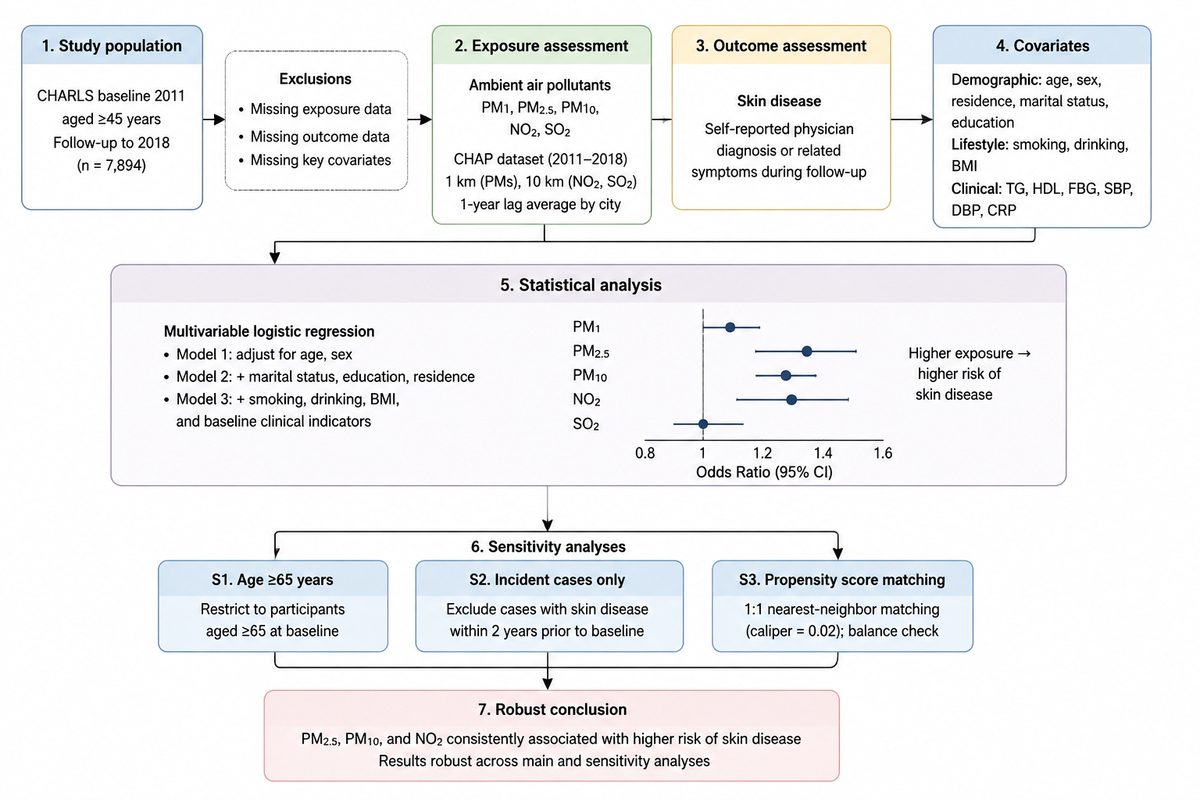
We analyzed prospective data from the China Health and Retirement Longitudinal Study (CHARLS), a nationally representative cohort. Participants aged ≥ 45 years from the 2011 baseline survey were followed through 2018. Annual average concentrations of PM2.5, PM10, NO2, SO2, and PM1 at participants’ community residences were assessed using satellite-based models with 1-km resolution. Skin disease was defined by a self-reported physician diagnosis or related symptoms. Multivariable logistic regression models were used to estimate odds ratios (ORs), adjusting for demographic, socioeconomic, lifestyle, and health-related covariates. Sensitivity analyses included age-restricted (≥65 years) and incident-case cohorts, and propensity score matching.
Results:
Among 7,894 participants, long-term exposure to higher levels of PM2.5 (fully adjusted OR = 1.25, 95% CI: 1.13–1.38), PM10 (OR = 1.18, 95% CI: 1.04–1.32), and NO2 (OR = 1.15, 95% CI: 1.02–1.29) was significantly associated with higher odds of skin disease. Associations for SO2 and PM1 were not statistically significant. Results remained consistent across all sensitivity analyses, supporting the robustness of the findings.
Conclusions:
This national cohort study provides evidence that long-term exposure to PM2.5, PM10, and NO2 is associated with higher odds of skin diseases among Chinese middle-aged and older adults. These findings suggest that air pollution control may represent a potential intervention target for reducing the burden of skin disease in aging populations.
Long-term exposure to ambient air pollution is a significant public health concern, yet its specific association with skin diseases in the Chinese middle-aged and older population remains insufficiently characterized, with limited evidence on the role of individual pollutants.
Material and methods:
We analyzed prospective data from the China Health and Retirement Longitudinal Study (CHARLS), a nationally representative cohort. Participants aged ≥ 45 years from the 2011 baseline survey were followed through 2018. Annual average concentrations of PM2.5, PM10, NO2, SO2, and PM1 at participants’ community residences were assessed using satellite-based models with 1-km resolution. Skin disease was defined by a self-reported physician diagnosis or related symptoms. Multivariable logistic regression models were used to estimate odds ratios (ORs), adjusting for demographic, socioeconomic, lifestyle, and health-related covariates. Sensitivity analyses included age-restricted (≥65 years) and incident-case cohorts, and propensity score matching.
Results:
Among 7,894 participants, long-term exposure to higher levels of PM2.5 (fully adjusted OR = 1.25, 95% CI: 1.13–1.38), PM10 (OR = 1.18, 95% CI: 1.04–1.32), and NO2 (OR = 1.15, 95% CI: 1.02–1.29) was significantly associated with higher odds of skin disease. Associations for SO2 and PM1 were not statistically significant. Results remained consistent across all sensitivity analyses, supporting the robustness of the findings.
Conclusions:
This national cohort study provides evidence that long-term exposure to PM2.5, PM10, and NO2 is associated with higher odds of skin diseases among Chinese middle-aged and older adults. These findings suggest that air pollution control may represent a potential intervention target for reducing the burden of skin disease in aging populations.
REFERENCES (42)
1.
Dijkhoff IM, Drasler B, Karakocak BB, et al. Impact of airborne particulate matter on skin: a systematic review from epidemiology to in vitro studies. Part Fibre Toxicol 2020; 17; 35.
2.
Klinngam W, Loruthai O, Vimolmangkang S. Cannabidiol mitigates pollution-induced inflammatory, oxidative, and barrier damage in ex vivo human skin. Biomolecules 2025; 16: 10.
3.
Maunjumpon P, Thamsermsang O, Panich U. Mitigating PM2.5-induced skin injury and aging: botanical strategies targeting redox and inflammatory pathways. Redox Rep 2026; 31: 2629079.
4.
Jiao Q, Zhi L, You B, Wang G, Wu N, Jia Y. Skin homeostasis: mechanism and influencing factors. J Cosmet Dermatol 2024; 23: 1518-26.
5.
Karimkhani C, Dellavalle RP, Coffeng LE, et al. Global skin disease morbidity and mortality: an update from the Global Burden of Disease Study 2013. JAMA Dermatol 2017; 153: 406-12.
6.
Jee MH, Mraz V, Geisler C, Bonefeld CM. T cells and inflammatory skin diseases. Immunol Rev 2020; 298: 61-73.
7.
Kottner J, Fastner A, Lintzeri DA, Blume-Peytavi U, Griffiths CEM. Skin health of community-living older people: a scoping review. Arch Dermatol Res 2024; 316: 319.
8.
Farage MA, Miller KW, Berardesca E, Maibach HI. Clinical implications of aging skin: cutaneous disorders in the elderly. Am J Clin Dermatol 2009; 10: 73-86.
10.
Takeshita J, Grewal S, Langan SM, et al. Psoriasis and comorbid diseases: epidemiology. J Am Acad Dermatol 2017; 76: 377-90.
11.
Wu JJ, Kavanaugh A, Lebwohl MG, Gniadecki R, Merola JF. Psoriasis and metabolic syndrome: implications for the management and treatment of psoriasis. J Eur Acad Dermatol Venereol 2022; 36: 797-806.
12.
Ju Y, Pei H, Kang N, et al. Prevalence and potential risk factors of chronic pruritus among community middle-aged and older population in Beijing, China. J Eur Acad Dermatol Venereol 2022; 36: 1074-79.
13.
Kim BE, Hui-Beckman JW, Nevid MZ, Goleva E, Leung DYM. Air pollutants contribute to epithelial barrier dysfunction and allergic diseases. Ann Allergy Asthma Immunol 2024; 132: 433-39.
14.
Peng D, Liu XY, Sheng YH, et al. Ambient air pollution and the risk of cancer: Evidence from global cohort studies and epigenetic-related causal inference. J Hazard Mater 2025; 489: 137619.
15.
Tian F, Wang Y, Huang Z, et al. Metabolomic profiling identifies signatures and biomarkers linking air pollution to dementia risk: a prospective cohort study. J Hazard Mater 2024; 480: 136498.
16.
Han HS, Seok J, Park KY. Air pollution and skin diseases. Ann Dermatol 2025; 37: 53-67.
17.
Abolhasani R, Araghi F, Tabary M, Aryannejad A, Mashinchi B, Robati RM. The impact of air pollution on skin and related disorders: a comprehensive review. Dermatol Ther 2021; 34: e14840.
18.
van den Bogaard EH, Elias PM, Goleva E, et al. Targeting skin barrier function in atopic dermatitis. J Allergy Clin Immunol Pract 2023; 11: 1335-46.
19.
Gu X, Jing D, Xiao Y, et al. Association of air pollution and genetic risks with incidence of elderly-onset atopic dermatitis: a prospective cohort study. Ecotoxicol Environ Saf 2023; 253: 114683.
20.
Xiong Y, Xia Y, Zhang X, et al. Joint exposure to multiple air pollutants, genetic risk and incident psoriasis: a large-scale prospective cohort study. Br J Dermatol 2025; 192:420-29.
21.
Chao L, Feng B, Liang H, Zhao X, Song J. Particulate matter and inflammatory skin diseases: From epidemiological and mechanistic studies. Sci Total Environ 2023; 905: 167111.
22.
Wei J, Li Z, Lyapustin A, et al. Reconstructing 1-km-resolution high-quality PM2.5 data records from 2000 to 2018 in China: spatiotemporal variations and policy implications. Remote Sens Environ 2020; 252: 112136.
23.
Wei J, Li Z, Cribb M, et al. Improved 1 km resolution PM2.5 estimates across China using enhanced space-time extremely randomized trees. Atmos Chem Phys 2020; 20: 3273-89.
24.
Jiang L, Tang M, Zheng Y, et al. Association between depressive symptoms and pain intensity in patients with arthritis. Brain Behav 2026; 16: e71493.
25.
Li W, Cao GH, Jiang LX, Liu L, Fan LL. Pain and kidney disease risk in older adults: CHARLS Longitudinal Study. Pain Manag Nurs 2026; S1524-9042(26)00144-X.
26.
Li Y, Qin L, Wang Y, Li S, Ling L, Jia N. Age at menopause and risk of sarcopenia in postmenopausal women: evidence from the China health and retirement longitudinal study. Reprod Health 2026; 23: 135.
27.
Wang H, Sun YZ, Li SY. The association between stomach disease and chronic obstructive pulmonary disease: a cross-sectional analysis of the 2018 China Health and Retirement Longitudinal Study (CHARLS). Int J Chron Obstruct Pulmon Dis 2026; 21: 599948.
28.
Zhang S, Ban Y, Su F. Association between extreme climate exposures and bodily pain: evidence from the Chinese Health and Retirement Longitudinal Study. J Epidemiol Glob Health 2026; 16: 86.
29.
Zhu H, Wei L, Chen Q, Liu X. Temporal patterns of depressive symptoms and risk of osteoarthritis: a multi-cohort longitudinal analysis. Exp Gerontol 2026; 220: 113170.
30.
Zu B, Wang T, Li G, et al. Exploring the relationship between cognitive function and frailty in middle-aged and older adults Chinese adults: evidence from the CHARLS database. Front Public Health 2026; 14: 1825820.
31.
Bahman F, Choudhry K, Al-Rashed F, Al-Mulla F, Sindhu S, Ahmad R. Aryl hydrocarbon receptor: current perspectives on key signaling partners and immunoregulatory role in inflammatory diseases. Front Immunol 2024; 15: 1421346.
32.
Sondermann NC, Faßbender S, Hartung F, et al. Functions of the aryl hydrocarbon receptor (AHR) beyond the canonical AHR/ARNT signaling pathway. Biochem Pharmacol 2023; 208: 115371.
33.
Gu X, Li Z, Su J. Air pollution and skin diseases: a comprehensive evaluation of the associated mechanism. Ecotoxicol Environ Saf 2024; 278: 116429.
34.
Vogel CFA, Van Winkle LS, Esser C, Haarmann-Stemmann T. The aryl hydrocarbon receptor as a target of environmental stressors – implications for pollution mediated stress and inflammatory responses. Redox Biol 2020; 34: 101530.
35.
Pinel-Marie ML, Sparfel L, Desmots S, Fardel O. Aryl hydrocarbon receptor-dependent induction of the NADPH oxidase subunit NCF1/p47 phox expression leading to priming of human macrophage oxidative burst. Free Radic Biol Med 2009; 47: 825-34.
36.
Amara N, Bachoual R, Desmard M, et al. Diesel exhaust particles induce matrix metalloprotease-1 in human lung epithelial cells via a NADP(H) oxidase/NOX4 redox-dependent mechanism. Am J Physiol Lung Cell Mol Physiol 2007; 293: L170-81.
37.
Ryu YS, Kang KA, Piao MJ, et al. Particulate matter induces inflammatory cytokine production via activation of NFκB by TLR5-NOX4-ROS signaling in human skin keratinocyte and mouse skin. Redox Biol 2019; 21: 101080.
38.
Wang J, Alli AS, Clark S, et al. Nitrogen oxides (NO and NO(2)) pollution in the Accra metropolis: Spatiotemporal patterns and the role of meteorology. Sci Total Environ 2022; 803: 149931.
39.
Koohgoli R, Hudson L, Naidoo K, Wilkinson S, Chavan B, Birch-Machin MA. Bad air gets under your skin. Exp Dermatol 2017; 26: 384-87.
40.
Liu T, Chan AWH, Abbatt JPD. Multiphase oxidation of sulfur dioxide in aerosol particles: implications for sulfate formation in polluted environments. Environ Sci Technol 2021; 55: 4227-42.
41.
Brüggemann M, Xu R, Tilgner A, et al. Organosulfates in ambient aerosol: state of knowledge and future research directions on formation, abundance, fate, and importance. Environ Sci Technol 2020; 54: 3767-82.
42.
Lowe ME, Akhtari FS, Potter TA, et al. The skin is no barrier to mixtures: air pollutant mixtures and reported psoriasis or eczema in the Personalized Environment and Genes Study (PEGS). J Expo Sci Environ Epidemiol 2023; 33: 474-81.
Share
RELATED ARTICLE
| eISSN: | 1896-9151 |
| ISSN: | 1734-1922 |

We process personal data collected when visiting the website. The function of obtaining information about users and their behavior is carried out by voluntarily entered information in forms and saving cookies in end devices. Data, including cookies, are used to provide services, improve the user experience and to analyze the traffic in accordance with the Privacy policy. Data are also collected and processed by Google Analytics tool (more).
You can change cookies settings in your browser. Restricted use of cookies in the browser configuration may affect some functionalities of the website.
You can change cookies settings in your browser. Restricted use of cookies in the browser configuration may affect some functionalities of the website.